The Scariest Sea Creatures — Fangs, Parasites, Giants and Real Danger
The scariest sea creatures are not always the most dangerous ones. The most nightmarish-looking animals, such as the viperfish, fangtooth, gulper eel and goblin shark, live hundreds of metres down and never meet people. The parasites are the creepiest: the tongue-eating louse destroys a fish’s tongue and takes its place. The real threats to swimmers are mostly small and venomous, such as the box jellyfish, blue-ringed octopus and geographer cone, or large predators such as the saltwater crocodile and great white shark. This list ranks them by fear factor, then explains the actual risk.
Each creature earns its place for a frightening appearance, a gruesome way of feeding or a real record of harming people; for each one we give the size, depth and level of risk from published sources.
Scary versus dangerous
Fear is a poor guide to danger. People are frightened by teeth, darkness, size, slime and the idea of being eaten, and the deep sea delivers all five. Yet most of the animals that look the most terrifying are small, live far below any diver, and have never harmed a human. Meanwhile some of the animals responsible for real injuries and deaths in the sea are almost invisible: a transparent jellyfish, a palm-sized octopus, a snail. This list is organised by what makes each creature frightening, and for each one we give the facts about how dangerous it actually is. For a ranking by real risk to people, see our list of the most dangerous animals in the ocean.
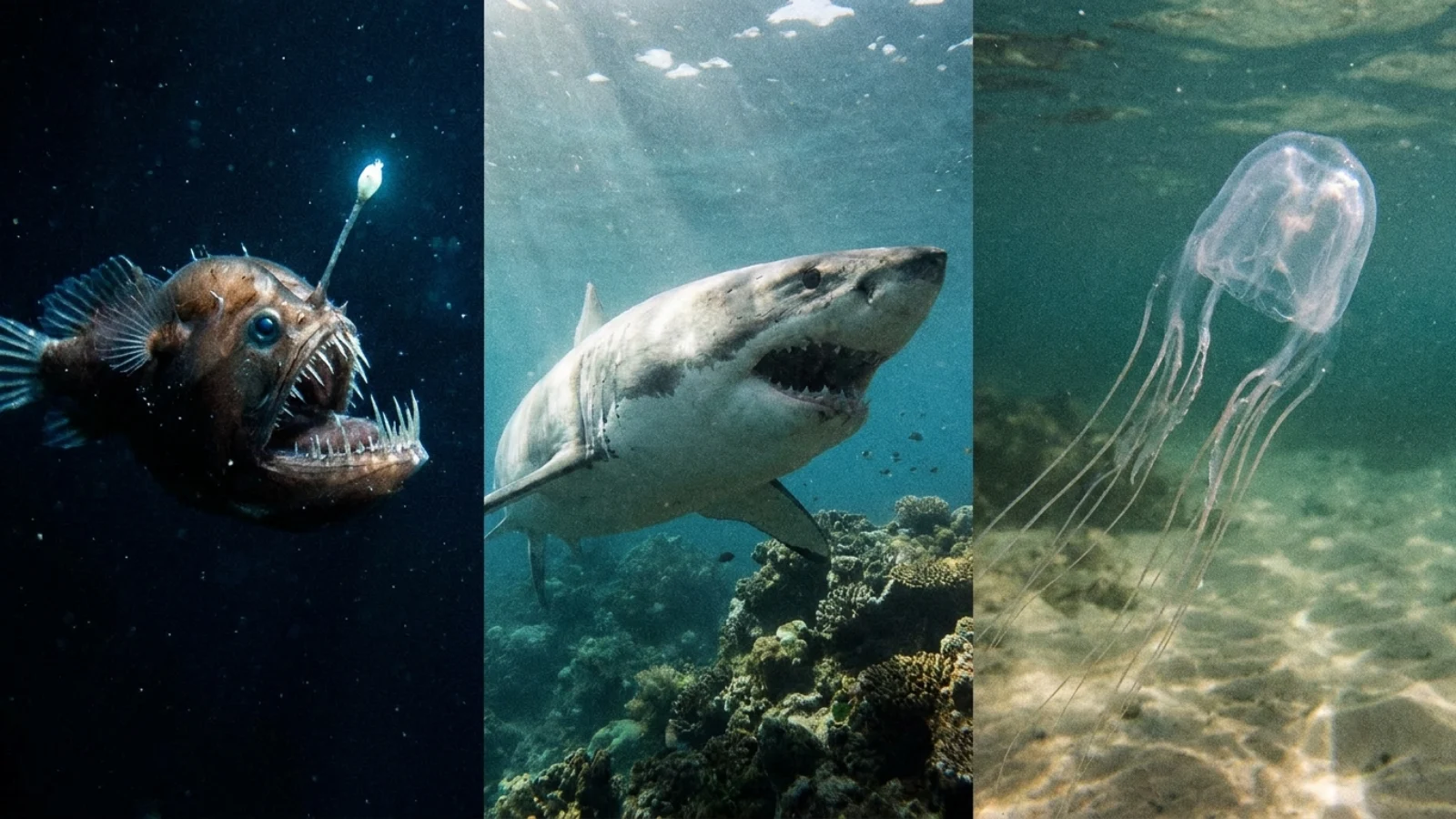
Nightmare faces from the deep
Viperfish. The Sloane’s viperfish, Chauliodus sloani, has teeth so long that they cannot fit inside its closed mouth. When the jaws shut, the fangs interlock outside the head to form a cage in which prey can be trapped. The fish is only up to about 35 cm long and lives between about 200 and 5,000 m, rising towards the surface at night and sinking by day. Rows of light-producing photophores along its body, and a luminous lure on a long dorsal-fin ray, help it hunt in the dark. Its hinged jaws open wide enough to take relatively large prey. Our viperfish profile has more. Danger to people: none.
Fangtooth and anglerfish. The common fangtooth looks like a gargoyle, with a huge bony head and fangs out of all proportion to an 18 cm body, and lives as deep as 5,000 m. Deep-sea anglerfish add a glowing lure to the same basic design, and their reproduction is the stuff of horror films: in several families the tiny males bite onto a female and, in some species, fuse permanently with her body. Both appear in our list of the ugliest fish in the world. Danger to people: none.
Gulper eel. The gulper eel, or pelican eel, Eurypharynx pelecanoides, is mostly mouth and tail. It usually reaches about 75 cm, mostly whip-like tail, and its loosely hinged jaws can open far beyond a right angle into a pouch large enough to engulf prey bigger than its own body. It lives at roughly 500 to 3,000 m and has a pinkish luminous tip on its tail. The huge mouth is less sinister than it looks; the jaw muscles are weak, and the eel probably feeds mostly on small crustaceans and fish. Danger to people: none.
Goblin shark and frilled shark. Two deep-water sharks round out the gallery. The pink goblin shark can fire its jaws forward out of its head to snatch prey, and the frilled shark looks like a sea serpent, with frilly gill slits and about 300 needle-like teeth. Both live on continental slopes, usually far below divers, and neither has any record of harming people. Their lives are covered in our goblin shark profile.
Monsters of size
Colossal squid. The colossal squid, Mesonychoteuthis hamiltoni, of the Southern Ocean is the heaviest invertebrate known. The largest specimen ever examined, caught by a New Zealand longline vessel in the Ross Sea in February 2007, weighed 495 kg and is now displayed at the Museum of New Zealand Te Papa Tongarewa. Beaks found in the stomachs of sperm whales suggest that some individuals may reach 600 to 700 kg. Its eyes, estimated at about 27 cm across, are the largest of any known animal. It is the only member of its family, the glass squids, with hooks on its arms and tentacles, some of them swivelling and some three-pointed. It lives at around 1,000 to 2,000 m in Antarctic waters and has never been encountered by divers. Read more in our article on colossal squid size. Danger to people: none recorded.
Giant squid. The giant squid, Architeuthis, is longer but lighter than the colossal squid and was for centuries the most likely origin of the kraken. Its eyes, about 25 cm across, are the second-largest known and are thought to be sized for spotting, at a distance, the bioluminescent glow that a swimming sperm whale stirs up in the plankton. Danger to people: none recorded.
Japanese spider crab. The Japanese spider crab, Macrocheira kaempferi, has the widest leg span of any arthropod, up to about 3.7 to 3.8 m from claw tip to claw tip, though its body is only up to about 40 cm across and it weighs up to about 19 kg. It lives at 50 to 600 m off southern Japan and feeds on shellfish, algae and carrion. Its long, spindly legs are the stuff of nightmares, but it is a slow, gentle scavenger.
Giant isopod. Giant isopods, Bathynomus giganteus, look like woodlice the size of a shoe. They typically reach 19 to 36 cm, with the largest confirmed at about 50 cm; a 76 cm individual reported in the press has never been verified. They scavenge on the seafloor at roughly 300 to 2,100 m, eating dead fish, whale carcasses and anything else that falls from above, and are famous for surviving very long periods without food in aquariums. They are a classic example of deep-sea gigantism.
Giant siphonophore and lion’s mane jellyfish. Some of the ocean’s longest animals are drifting curtains of stinging tentacles. The giant siphonophore, Praya dubia, is a colonial animal made of thousands of specialised units and can reach about 40 to 50 m, longer than a blue whale; it hangs at 700 to 1,000 m and fishes with a curtain of stinging tentacles. Nearer the surface, the lion’s mane jellyfish holds the size record among true jellyfish: according to Guinness World Records, an individual washed up in Massachusetts Bay in 1870 had a bell 2.28 m across and tentacles 36.5 m long. Its sting is painful but rarely serious.
Parasites and ambushers
Tongue-eating louse. For many people this is the most disturbing animal in the sea. Cymothoa exigua is a parasitic isopod, a crustacean related to woodlice. A young louse enters a fish through the gills; the female attaches to the base of the fish’s tongue, while the male attaches to the gill arches behind her. The parasite severs the blood vessels of the tongue, which withers and falls off, and the louse then attaches its own body to the muscles of the tongue stub and serves as the fish’s new tongue. It is the only known case of a parasite thought to functionally replace a host organ. Apart from the lost tongue it appears to do little other damage, though fish carrying two or more lice are usually underweight. Danger to people: none; a louse found in a fish at the market is harmless to humans.
Bobbit worm. The bobbit worm, Eunice aphroditois, is a bristle worm that buries its whole body in sand or gravel on warm-water reefs and waits with only its antennae exposed. When a fish touches them, the worm strikes upward with a pair of snapping jaws and drags its prey down into its burrow. Individuals range from less than 10 cm to about 3 m, and the longest on record measured 299 cm. Its popular name comes from a notorious 1990s American court case. Fossil burrows thought to have been made by similar worms date back about 20 million years. Danger to people: minimal, though it can bite if handled.
Cookiecutter shark. The cookiecutter shark is a small open-ocean shark, with a maximum recorded length of 42 cm for males and 56 cm for females, with a horrifying way of feeding. It seals its lips onto the skin of a much larger animal like a suction cup, drives in its saw-like lower teeth, and then spins its body to carve out a neat, round plug of flesh about 5 cm wide. Cookiecutter bite marks have been found on whales, dolphins, seals, tuna, marlin and other sharks, as well as on submarines, undersea cables and human bodies, and a handful of attacks on living people have been attributed to the species.
Small, venomous and deadly
The animals that actually kill people in the sea are often the least imposing. The box jellyfish Chironex fleckeri of northern Australia and South-East Asia is nearly transparent, with a bell usually around 16 cm across and up to 60 tentacles that can trail about 3 m. A severe sting can kill an adult within minutes, and at least 64 deaths have been recorded in Australia since the 1880s. Our box jellyfish page explains the venom and first aid.
The blue-ringed octopuses, genus Hapalochlaena, are small enough to sit in the palm of a hand. Their famous blue rings flash only when the animal is alarmed. Their saliva contains tetrodotoxin, made by symbiotic bacteria, and about a milligram is enough to kill an adult, yet confirmed human deaths are very few. The geographer cone, Conus geographus, a fish-hunting cone snail, fires a hollow, harpoon-like tooth loaded with conotoxins; cone snails have caused roughly 30 recorded human deaths, most of them from this species, and there is no antivenom. The reef stonefish and the Portuguese man o’ war, a drifting colonial siphonophore whose tentacles average about 10 m and can reach about 30 m, complete the venomous group. The common thread is that most of these animals sting or bite only in defence, when stepped on or handled.
Big predators with a real record
A few large animals deserve their fearsome reputation. The saltwater crocodile, Crocodylus porosus, is the largest living reptile and the most dangerous large animal in the sea. Adult males usually measure 4 to 5.5 m and weigh 400 to 1,000 kg, and the largest measured, Lolong, was 6.17 m. It ranges from India and Sri Lanka to northern Australia and the western Pacific islands, swims between islands and kills people every year in parts of its range. The great white shark, the tiger shark and the bull shark are responsible for most fatal unprovoked shark bites, though such attacks are rare. See our pages on the saltwater crocodile and the most aggressive sharks.
Other large predators look frightening but rarely harm people. Humboldt squid, up to about 2 m long, hunt in coordinated schools that have been documented at up to 1,200 individuals, flashing red and white several times a second; divers and fishermen working among large aggregations have been bitten or grabbed, usually suffering bruises or minor cuts, and no human deaths are documented. Leopard seals of the Antarctic pack ice, which can reach 3.4 m and nearly 600 kg, hunt penguins and seal pups and one human death is recorded: in July 2003 the British marine biologist Kirsty Brown was dragged underwater and drowned while snorkelling near Rothera Research Station on the Antarctic Peninsula.
The not-so-scary vampire squid
Finally, a creature whose name promises far more horror than it delivers. The vampire squid, Vampyroteuthis infernalis, literally the “vampire squid from hell”, is a small, dark cephalopod up to about 30 cm long with webbed arms and red eyes. It is neither a true squid nor an octopus but the only surviving member of its own order, Vampyromorphida, though its closest relatives are the octopods. It lives in the oxygen minimum zone, where oxygen saturation can be as low as 3 percent, and it is the only cephalopod able to complete its whole life cycle there. It is not a predator at all; it feeds on marine snow, the drifting particles of dead plankton and waste, and when threatened it releases a cloud of glowing mucus instead of ink. Read our vampire squid profile.
Why the deep sea frightens us
Many of the creatures on this list share features that make them look monstrous to us: oversized mouths, fangs, luminous lures, black or translucent bodies. These are adaptations to darkness and scarcity. In the deep sea, meals are rare, so predators need mouths and teeth that can seize and hold almost anything they meet, and they often use light to attract prey because there is no other light to see by. Bodies are watery and muscles weak to save energy. The result is a fauna that looks like a gallery of monsters but is mostly made up of small animals living very slow lives, far beyond the reach of people.
What is the scariest sea creature?
For appearance, deep-sea fish such as the viperfish, fangtooth and goblin shark top most lists; for sheer creepiness, the tongue-eating louse, which replaces a fish’s tongue.
What is the most dangerous sea creature?
By deaths caused, small venomous animals such as the box jellyfish, and large predators such as the saltwater crocodile, are among the most dangerous.
Are deep-sea monsters dangerous to humans?
No. Most live hundreds or thousands of metres down and are small; none of the deep-sea fish on this list has harmed a person.
What is the biggest invertebrate in the ocean?
The colossal squid; the largest specimen examined, caught in the Ross Sea in 2007, weighed 495 kg.
Does the tongue-eating louse hurt humans?
No. It parasitises fish, and finding one in a fish is harmless to people.
Can a cookiecutter shark bite a human?
It has happened, but only a handful of attacks on living people have been attributed to it.
Is the vampire squid dangerous?
No. It feeds on marine snow and defends itself with a cloud of glowing mucus.
Which sea creature has the biggest teeth for its size?
Deep-sea fish such as the viperfish and fangtooth, whose fangs are too long to fit inside their closed mouths.
- Wikipedia contributors, “Chauliodus sloani”, “Colossal squid”, “Cookiecutter shark”, “Cymothoa exigua”, “Eunice aphroditois”, “Bathynomus giganteus”, “Vampire squid”, “Japanese spider crab” (accessed November 2026).
- TheSea.Org species profiles: viperfish, gulper eel, giant isopod, giant siphonophore, box jellyfish, lion’s mane jellyfish, blue-ringed octopus, cone snail, saltwater crocodile, Humboldt squid, leopard seal (November 2026).
Blane Perun has been exploring Earth’s oceans and marine life for over 25 years. Founder of TheSea.Org in 1999, underwater photographer, coral aquaculture pioneer, and explorer of 80+ countries.
About Blane Perun →