Skate Fish — The Stingray’s Stingless, Egg-Laying Cousin
A skate is a flattened cartilaginous fish in the ray order Rajiformes, closely related to sharks and stingrays. The true skates (family Rajidae) number more than 150 species in 17 genera, and they are easy to separate from stingrays: skates have a thick, fleshy tail with two small dorsal fins near the tip and no venomous sting, and every skate lays eggs in leathery capsules known as mermaid’s purses. Most are 0.5–1 m long; the largest, the Critically Endangered flapper skate, reaches about 2.5 m (8 ft).
Skates
How do you identify a skate?
Look at the tail: a skate’s tail is thick and stubby with two little fins near the end, while a stingray’s tail is a thin whip with a barb.
Skates have a flattened, diamond- or kite-shaped disc formed by huge pectoral fins fused to the head, a firm and usually pointed snout, and eyes and spiracles on top of the head. The mouth and five pairs of gill slits sit on the underside, which is why a skate looks like it has a face when you flip it over — those “eyes” are actually the nostrils. Across the back and down the tail run rows of small thorns, often heavier in mature males, and males carry a pair of long claspers alongside the tail. The tail itself is the giveaway: short, thick and muscular, with two small dorsal fins close to the tip and sometimes a tiny tail fin. There is no serrated spine.
The rigid snout separates true skates from the related softnose skates (now their own family) and pygmy skates. In the field, colour helps less than shape: most skates are mottled brown, grey or sand-coloured with spots, bars or eye-spots that match the seabed. In Florida the species beachgoers and anglers meet most is the clearnose skate, named for the translucent patches on either side of its pointed snout.
| Feature | Skate | Stingray |
|---|---|---|
| Tail | Thick, fleshy, 2 small dorsal fins | Thin, whip-like, usually no dorsal fins |
| Sting | None (thorns only) | 1 or more venomous serrated spines |
| Reproduction | Lays egg cases | Live birth |
| Snout | Usually pointed | Usually rounded |
| Pelvic fins | Two-lobed | Single-lobed |
| Typical depth | Cool, often deep water | Warm, mostly shallow water |
For the full side-by-side, see skate vs stingray. If your animal has a long saw on its face, you are looking at a sawfish; if it has a shark-like rear end and a flat triangular head, it is a guitarfish.
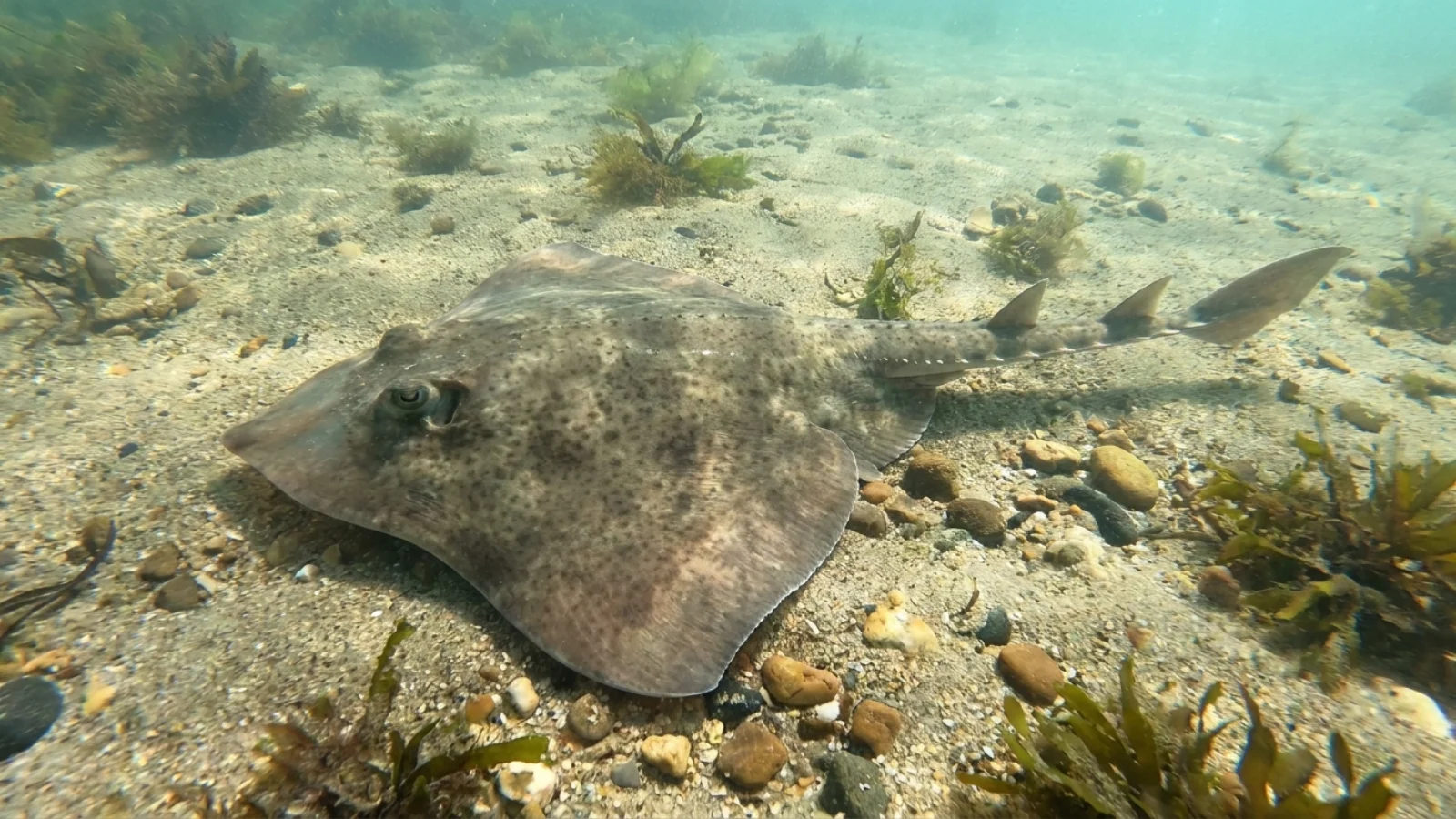
How big do skates get?
Most skates are under a metre long, but the flapper skate of the North-east Atlantic reaches about 2.5 m, roughly the width of a king-size bed.
At the small end, the little skate (Leucoraja erinacea) of the U.S. North-east is commonly 40–51 cm long and tops out around 54 cm. The clearnose skate (Rostroraja eglanteria) reaches about 84 cm (33 in) total length with a disc about 50 cm (20 in) wide. At the giant end, the flapper skate (Dipturus intermedius), once lumped with the blue skate as the “common skate,” grows to about 2.5 m, with females larger than males. Hatchlings are already about 28 cm long, and flapper skates often take more than 10 years to mature.
Where do skates live?
Skates are bottom-dwellers on soft sand, mud and gravel, from tide pools in cold seas down to the deep continental slope.
Skates are found worldwide, but they are a cool-water and deep-water group. In the North-west Atlantic, little and winter skates are among the most abundant bottom fish from Nova Scotia to the Carolinas, usually shallower than about 90 m. In the tropics and subtropics, skate diversity shifts down the slope into cold water, which is why most Floridians never see one. The clearnose skate is the exception on the Gulf and Atlantic coasts of Florida: it lives on sandy bottoms close to shore, enters the saltier lower reaches of bays and estuaries, and also ranges offshore to roughly 300 m (1,000 ft). The flapper skate’s stronghold is western Scotland, Orkney and Shetland, where the Loch Sunart to the Sound of Jura Marine Protected Area was created largely around it.
What do skates eat?
Skates are ambush and search predators of the seabed, finding buried prey with electroreception and smell.
A skate settles over the bottom, pins prey under its disc, and sucks it into the mouth on the underside. Diets shift with size: small skates take amphipods, shrimp, worms and small crabs, while larger skates take hermit crabs, bivalves, squid and small fish. Like sharks, skates carry ampullae of Lorenzini on the snout that detect the faint electric fields of a buried animal. Skates also have weak electric organs in the tail. Unlike an electric ray, they cannot stun anything; the fields are thought to work as communication, helping skates find and recognise mates.
How do skates reproduce?
Every skate lays eggs. Each embryo grows inside a tough, horned capsule that rests on the seabed for months before a miniature skate wriggles out.
Fertilisation is internal: the male uses his claspers, then the female lays egg cases in pairs, often anchored in sand, weed or gravel by sticky fibres and the horns at each corner. Development takes months. Little skate embryos hatch in about 5–6 months in aquariums and probably longer in the wild; a female lays roughly 10–35 eggs a year. Clearnose skates can lay up to 66 cases in a season. Flapper skate cases are 20–25 cm long and incubate for more than a year, sometimes 18 months. After hatching, the empty cases dry out and wash ashore as the mermaid’s purse beachcombers find.
Are skates dangerous?
No. Skates have no venomous spine and do not bite people, though the thorns on their back and tail can scratch a careless hand.
Florida wildlife officials note that the clearnose skate has no venomous spine, but its tail thorns can cause injury if handled. That makes skates a different proposition from stingrays, whose barb can deliver a painful venomous wound. The same goes for divers: skates are shy and tend to stay put, relying on camouflage, so you can usually approach one slowly for a photograph.
Are skates endangered?
Some skates are abundant, but the big, slow-growing species have been fished out of whole regions.
Skates make easy bycatch for trawls, and large species mature late and lay relatively few eggs, so they recover slowly. The flapper skate is listed as Critically Endangered by the IUCN, and landing or keeping one has been illegal in Scotland since 2009. Smaller, faster-breeding species such as the little skate are not considered threatened. Skate wings are sold for food in Europe and North America, so buying from well-managed fisheries matters.
| Species | Max size | Max weight | Tail sting? | IUCN |
|---|---|---|---|---|
| Flapper skate | 2.5 m length | n/a | No | CR |
| Southern stingray | 2.0 m disc | 97 kg | Yes | NT |
| Cownose ray | 0.9 m disc | n/a | Yes | VU |
| Smalltooth sawfish | 5.5 m length | 350 kg | No | CR |
| Atlantic torpedo | 1.8 m length | 90 kg | No (220 V) | LC |
| Giant manta ray | 7 m disc | ~2,000 kg | No | EN |
Sizes are maximum recorded disc width (stingrays, eagle rays) or total length (sawfish, skates, guitarfish, torpedo). IUCN: LC Least Concern, NT Near Threatened, VU Vulnerable, EN Endangered, CR Critically Endangered, DD Data Deficient.
Is a skate a fish?
Yes. A skate is a cartilaginous fish, in the same class as sharks and rays. It breathes with gills and has a skeleton of cartilage rather than bone.
What is the difference between a skate and a ray?
A skate is a kind of ray. Compared with stingrays, skates have a thick tail with two small dorsal fins, no venomous spine, a usually pointed snout, and they lay egg cases instead of giving live birth.
Do skates sting?
No. Skates have no stinging spine. Some have sharp thorns on the back and tail that can scratch if the fish is handled.
How big is the biggest skate?
The flapper skate (Dipturus intermedius) reaches about 2.5 m (8 ft) long. It is Critically Endangered and protected in Scottish waters.
What is a skate egg called?
A skate egg case is called a mermaid’s purse. It is a leathery, rectangular capsule with a horn at each corner, usually found empty on beaches after the young skate has hatched.
Are there skates in Florida?
Yes. The clearnose skate lives on sandy bottoms along Florida’s Atlantic and Gulf coasts and enters the lower reaches of bays. The roundel skate, with two eye-spots on its back, also occurs in the Gulf.
Can you eat skate?
Yes. Skate wings are a traditional dish in Europe and are sold in North America. Choose species from well-managed fisheries, because large skates such as the flapper are protected.
Do skates have electric organs?
Yes, but weak ones. Organs in the tail produce small electric fields thought to help skates communicate and find mates. They cannot stun prey the way electric rays do.
Blane Perun has been exploring Earth’s oceans and marine life for over 25 years. Founder of TheSea.Org in 1999, underwater photographer, coral aquaculture pioneer, and explorer of 80+ countries. Based in Southwest Florida, where stingrays work the grass flats and smalltooth sawfish still raise their young in the mangroves of Charlotte Harbor and the Ten Thousand Islands.
About Blane Perun → All Rays, Skates & Sawfish →