Sawfish — The Endangered Ray With a Chainsaw Face
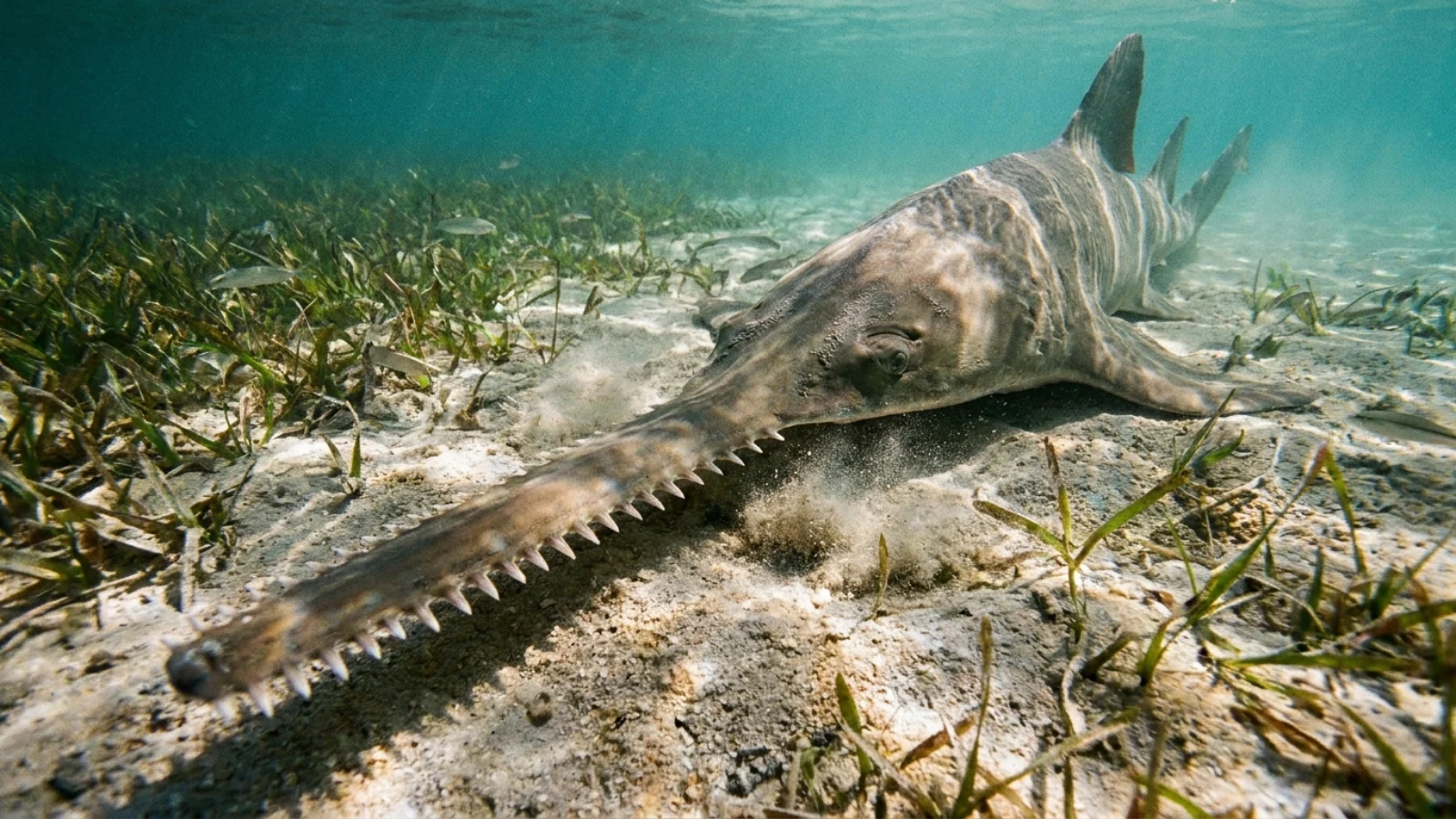
A sawfish is a large ray in the family Pristidae with a long, flat snout (the rostrum or “saw”) lined with 14 to 37 tooth-like denticles on each side. There are five species, and the biggest reach about 7 m (23 ft), making them among the largest fish in coastal and fresh waters. Despite their shark-like bodies, sawfish are rays: their gill slits are on the underside. Every species is listed as Endangered or Critically Endangered, and sawfish are now presumed extinct in 55 of the roughly 90 countries where they once lived.
Sawfish
What are the five species of sawfish?
Four sawfish belong to the genus Pristis and one, the narrow sawfish, to Anoxypristis. Three of them reach about 7 m.
| Species | Scientific name | Max length | Range | IUCN |
|---|---|---|---|---|
| Largetooth sawfish | Pristis pristis | ~7 m | Tropical Atlantic, E. Pacific, Indo-West Pacific; enters rivers | Critically Endangered |
| Smalltooth sawfish | Pristis pectinata | ~5.5 m confirmed | Atlantic; U.S. population in Florida | Critically Endangered |
| Green sawfish | Pristis zijsron | ~7 m | Indo-West Pacific, northern Australia | Critically Endangered |
| Dwarf sawfish | Pristis clavata | ~3.2 m | Northern Australia | Endangered |
| Narrow sawfish | Anoxypristis cuspidata | ~3.5 m | Indo-West Pacific | Endangered |
Lengths for the three giants are often quoted at 7–7.6 m, though the largest reliably measured smalltooth sawfish was about 5.5 m (18 ft); NOAA lists the species at about 16 ft. Narrow sawfish are the oddballs: their saw teeth are flat and triangular rather than peg-like. In the Americas only two species occur, the largetooth and the smalltooth sawfish, and only the smalltooth still lives in U.S. waters.
Is a sawfish a shark or a ray?
A sawfish is a ray. It just has a shark’s body plan from the pectoral fins back.
Flip a sawfish over and the answer is obvious: the five pairs of gill slits are on the underside, and the pectoral fins are fused to the sides of the head — the two defining traits of batoids. Sawfish sit with the guitarfish and wedgefish in the order Rhinopristiformes, the so-called rhino rays. They are often confused with the sawshark, a small deep-water shark with barbels halfway down its saw and gill slits on the side of its head. Sawsharks rarely exceed 1.5 m; sawfish grow several times bigger and live in shallow water.
What does a sawfish use its saw for?
The saw is both a sensor and a weapon. It detects prey electrically, then slashes, stuns and pins it.
The rostrum carries thousands of ampullae of Lorenzini, electroreceptors that pick up the nerve and muscle signals of fish from about 40 cm away, even in murky water. Researchers have documented three ways sawfish use it: sweeping sideways through a school of fish (“saw in water”), raking the bottom to flush prey (“saw on substrate”), and pinning a fish to the seabed before swinging around to swallow it. The mouth is on the underside and has small crushing teeth; prey is swallowed whole. The “teeth” on the saw are not true teeth but modified dermal denticles that grow continuously and are not replaced if lost.
Where do sawfish live?
Sawfish are creatures of the shallows: mangrove shorelines, estuaries, river mouths and, for some species, far up into fresh water.
Most records come from water less than 10 m deep, though one sawfish was taken below 175 m. Juveniles use the most sheltered habitat of all, red mangrove roots and shallow mud banks where big sharks cannot follow. The largetooth sawfish is the freshwater champion: it has been recorded 1,340 km up the Amazon and in Lake Nicaragua. In the United States the smalltooth sawfish once ranged from Texas to New York; today it is essentially restricted to Florida, with its last stronghold between Charlotte Harbor and the Florida Keys, including Everglades National Park and the Ten Thousand Islands — the water I know best on the Southwest Florida coast.
How do sawfish reproduce?
Sawfish give birth to live pups whose saws are soft and wrapped in a sheath, so the mother is not injured during birth.
Sawfish are ovoviviparous: embryos develop in the uterus on yolk, and females give birth roughly once every one or two years to litters of 1 to 23 pups, each 60–90 cm long. The embryonic rostrum is flexible and its teeth are covered by a sheath that falls away soon after birth. In Florida, smalltooth pups are about 2–2.5 ft at birth and roughly double in length in their first year. Maturity comes late, around 7–11 years for smalltooth sawfish. Remarkably, genetic studies in a Florida estuary found that about 3% of young smalltooth sawfish were produced by parthenogenesis — virgin birth — the first time this was documented in a wild vertebrate.
Why are sawfish endangered?
The saw that makes a sawfish a superb hunter also makes it impossible to untangle from a net.
A sawfish that swims into a gillnet or trawl wraps its toothed rostrum in the mesh and cannot escape. Add shark-fin and rostrum trade, the loss of mangrove nurseries to coastal development, and a slow life history, and populations collapsed worldwide during the twentieth century. Sawfish are now presumed extinct in 55 countries, and 20 nations have lost every species. All sawfish have been on CITES Appendix I since 2007, banning international commercial trade, and the U.S. listed the smalltooth sawfish as endangered under the Endangered Species Act on April 1, 2003. In Florida the U.S. population is estimated at under 5% of historical levels, but it appears stable to slowly increasing in the Everglades.
| Species | Max size | Max weight | Tail sting? | IUCN |
|---|---|---|---|---|
| Smalltooth sawfish | 5.5 m length | 350 kg | No | CR |
| Flapper skate | 2.5 m length | n/a | No | CR |
| Giant freshwater stingray | 2.2 m disc | 300+ kg | Yes (38 cm) | EN |
| Southern stingray | 2.0 m disc | 97 kg | Yes | NT |
| Atlantic torpedo | 1.8 m length | 90 kg | No (220 V) | LC |
| Giant manta ray | 7 m disc | ~2,000 kg | No | EN |
Sizes are maximum recorded disc width (stingrays, eagle rays) or total length (sawfish, skates, guitarfish, torpedo). IUCN: LC Least Concern, NT Near Threatened, VU Vulnerable, EN Endangered, CR Critically Endangered, DD Data Deficient.
How big do sawfish get?
The largest species, the largetooth, green and smalltooth sawfish, are often reported to about 7 m (23 ft). The largest reliably measured smalltooth sawfish was about 5.5 m (18 ft) and weighed around 350 kg.
Is a sawfish a shark?
No. A sawfish is a ray. Its gill slits are on the underside and its pectoral fins join its head. The similar-looking sawshark is a true shark.
Are sawfish dangerous to humans?
Sawfish do not attack people. Injuries happen when a captured sawfish thrashes its saw, so anglers should keep it in the water and cut the line rather than handle it.
Why are sawfish endangered?
Their saws tangle in fishing nets, their fins and rostra are traded, and their mangrove nursery habitat has been lost. They also mature late and have few young, so populations recover slowly.
Where can you see a sawfish?
In the wild, the best chance in the U.S. is Southwest Florida, from Charlotte Harbor through the Ten Thousand Islands and Everglades to the Florida Keys. Several public aquariums also keep sawfish.
Do sawfish live in fresh water?
Some do. The largetooth sawfish has been recorded 1,340 km up the Amazon and in Lake Nicaragua. Juvenile smalltooth sawfish use low-salinity river mouths such as the Caloosahatchee and Peace rivers.
Do sawfish teeth grow back?
The teeth on the saw are modified scales that grow throughout life but are not replaced if lost. The small crushing teeth in the mouth are different and are replaced like other rays’ teeth.
How many sawfish are left?
No reliable global count exists. Sawfish are presumed extinct in 55 of about 90 former range countries, and the U.S. smalltooth population is estimated at under 5% of historical numbers.
Blane Perun has been exploring Earth’s oceans and marine life for over 25 years. Founder of TheSea.Org in 1999, underwater photographer, coral aquaculture pioneer, and explorer of 80+ countries. Based in Southwest Florida, where stingrays work the grass flats and smalltooth sawfish still raise their young in the mangroves of Charlotte Harbor and the Ten Thousand Islands.
About Blane Perun → All Rays, Skates & Sawfish →