Guitarfish — Half Shark, Half Ray, and in Deep Trouble
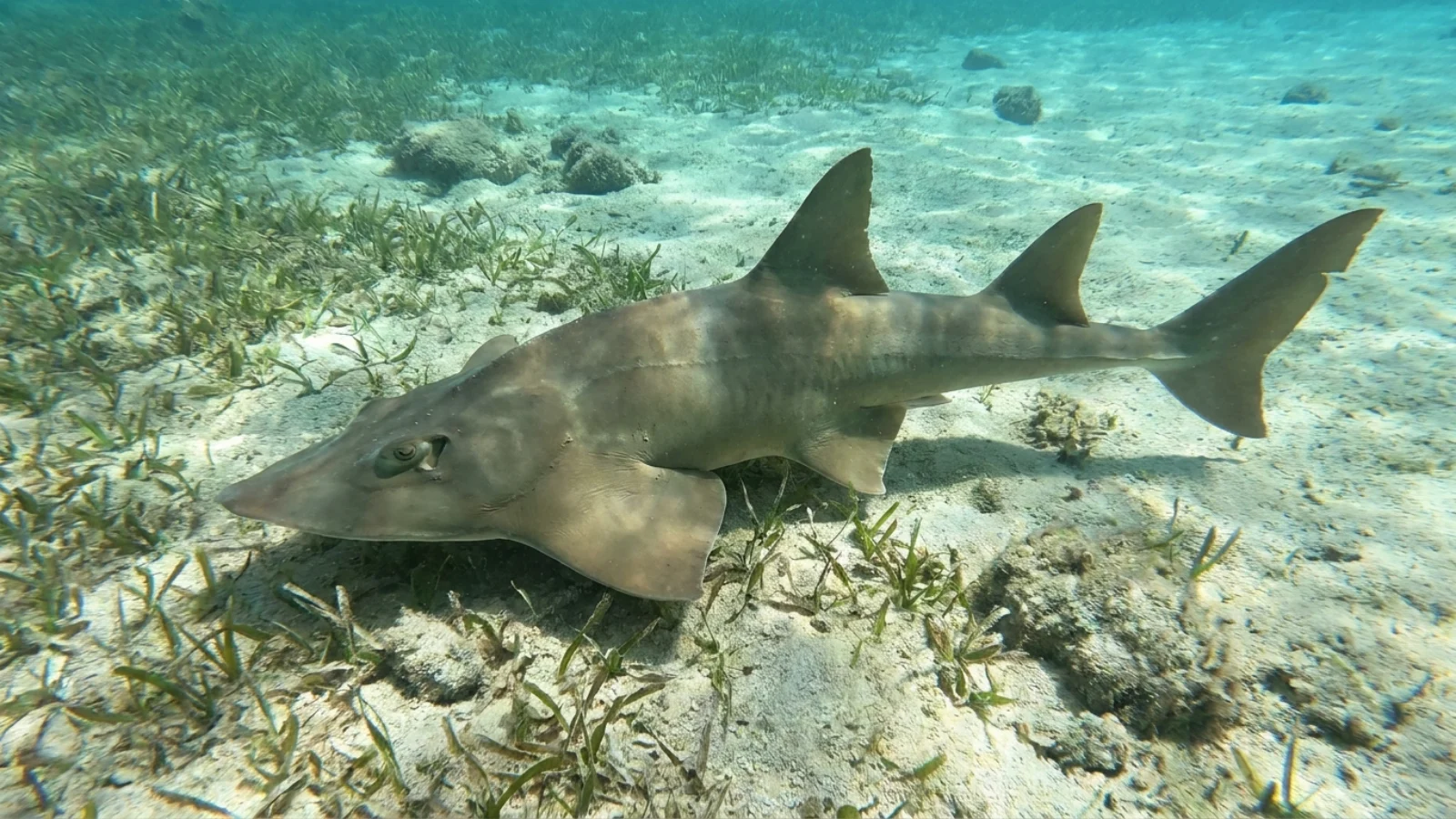
A guitarfish is a ray with a flattened, guitar-shaped front half and a thick, shark-like tail carrying two dorsal fins and a tail fin. The true guitarfishes (family Rhinobatidae) and their larger relatives, the giant guitarfishes and wedgefishes, belong to the order Rhinopristiformes with the sawfish — together nicknamed rhino rays. Most guitarfish are 0.6–1.4 m long, live on sandy coastal bottoms, eat crabs, shrimp and small fish, and have no tail sting. In 2019 the IUCN listed 15 of the 16 wedgefish and giant guitarfish species as Critically Endangered.
Guitarfish
Is a guitarfish a shark or a ray?
A guitarfish is a ray. It has the ray’s two giveaways — gill slits under the head and pectoral fins fused to the head — on a body that looks like a shark from the hips back.
Early naturalists did take some guitarfish for sharks because of their two prominent dorsal fins and muscular tail, and the shovelnose guitarfish of California was first considered a shark for exactly that reason. But turn one over and you will find five pairs of gill slits on the underside and a mouth full of small, blunt crushing teeth. Guitarfish swim with their tails, like sharks, rather than by flapping or rippling the disc like stingrays, which makes them a useful “missing link” for understanding how rays evolved. Their lineage goes back more than 100 million years. Their closest relatives are the sawfish, essentially guitarfish with a toothed saw, and the wedgefishes.
How do you identify a guitarfish?
Look for a flat, triangular or heart-shaped head and disc, a pointed snout, and a thick tail with two tall dorsal fins well behind the disc.
| Feature | Guitarfish | Stingray | Shark |
|---|---|---|---|
| Gill slits | Underneath | Underneath | On the sides |
| Head & pectoral fins | Fused, flat | Fused, flat disc | Separate |
| Tail | Thick, 2 dorsal fins, tail fin | Thin whip with barb | Thick, tail fin |
| Swims with | Tail | Disc edges or wings | Tail |
| Sting | No | Yes (most) | No |
Colour is usually sandy grey, olive or brown, often with pale freckles (Atlantic guitarfish) or spots. Wedgefishes have a more shark-like, pointed head and long sickle-shaped fins; the bowmouth guitarfish of the Indo-West Pacific has a rounded snout, ridges of thorns over the head, and large dorsal fins. If the animal has a saw, it is a sawfish; if it has a thin whip tail, it is a stingray — see types of stingrays.
What are the main kinds of guitarfish?
Guitarfish range from small, freckled coastal species under a metre to 3 m wedgefishes that roam coral reefs.
| Group | Example | Size | Where |
|---|---|---|---|
| True guitarfishes (Rhinobatidae) | Shovelnose guitarfish, Pseudobatos productus | to ~1.4 m | California & Gulf of California |
| True guitarfishes (Rhinobatidae) | Atlantic guitarfish, Pseudobatos lentiginosus | to ~75 cm | North Carolina to Gulf of Mexico & Yucatán |
| Giant guitarfishes (Glaucostegidae) | 6 species, Glaucostegus | to ~3 m | Indo-West Pacific, Mediterranean, E. Atlantic |
| Wedgefishes (Rhinidae) | Bowmouth guitarfish, Rhina ancylostoma | to ~3 m | Indo-West Pacific |
In Florida, the species you are most likely to meet is the Atlantic guitarfish. It is one of the smaller guitarfish, reaching about 75 cm (30 in), with a grey, olive or chocolate-brown back sprinkled with white freckles and a white to pale-yellow belly. It lives from the shoreline to about 30 m on sand, mud and seagrass, often near patch reefs, and tolerates brackish and even fresh water. In Southwest Florida, wading anglers on the grass flats sometimes hook one by mistake and assume they have caught a small shark.
What do guitarfish eat?
Guitarfish are bottom hunters that bury themselves in sand and ambush crabs, shrimp and small fish.
A guitarfish settles into the sand with a few flaps of its pectoral fins until only its eyes and spiracles show. When a crab or shrimp wanders close, it lunges and traps the prey under its head. Florida Museum biologists describe the Atlantic guitarfish pinning prey to the bottom with its snout and blocking its escape. Diets include scallops and other bivalves, shrimp and crabs, worms and small fishes; the mouth carries dozens of rows of blunt, rectangular teeth (56–80 rows in the upper jaw of the Atlantic guitarfish) for crushing shells. Larger wedgefishes take more fish and squid.
How do guitarfish reproduce?
Guitarfish give birth to live young after a gestation of about a year in many species, and some can pause embryo development.
Fertilisation is internal and the embryos develop in the uterus on yolk. Atlantic guitarfish have litters of up to six pups, each about 20 cm long at birth. Shovelnose guitarfish average five embryos per litter (up to ten), with a gestation of about 12 months; the embryos appear to go through a period of diapause, a pause in development linked to water temperature. Maturity takes years — around seven to eight for the shovelnose — which limits how fast populations can recover from fishing.
Why are guitarfish endangered?
Guitarfish fins are among the most valuable in the shark-fin trade, and their shallow, sandy habitat overlaps with the world’s busiest coastal fisheries.
Wedgefish and giant guitarfish fins are sold as top-grade “qun” and can fetch more than US$700 per dried kilo in South-East Asian markets. Combine that with intense trawling and gillnetting across the Indo-West Pacific and the result was the IUCN’s July 2019 update: all six giant guitarfishes and nine of ten wedgefishes listed as Critically Endangered, putting rhino rays among the most threatened marine fish on Earth. Governments responded at CITES CoP18 in August 2019, listing all 16 species on Appendix II (approved by 112–30 for wedgefishes and 109–30 for giant guitarfishes). In November 2022, CITES CoP19 parties voted to extend Appendix II to the true guitarfish family, Rhinobatidae. U.S. species such as the shovelnose guitarfish are in better shape, listed as Near Threatened.
| Species | Max size | Max weight | Tail sting? | IUCN |
|---|---|---|---|---|
| Shovelnose guitarfish | 1.37 m length | n/a | No | NT |
| Smalltooth sawfish | 5.5 m length | 350 kg | No | CR |
| Flapper skate | 2.5 m length | n/a | No | CR |
| Southern stingray | 2.0 m disc | 97 kg | Yes | NT |
| Atlantic torpedo | 1.8 m length | 90 kg | No (220 V) | LC |
Sizes are maximum recorded disc width (stingrays, eagle rays) or total length (sawfish, skates, guitarfish, torpedo). IUCN: LC Least Concern, NT Near Threatened, VU Vulnerable, EN Endangered, CR Critically Endangered, DD Data Deficient.
Is a guitarfish a shark?
No. A guitarfish is a ray. It has gill slits on the underside of its head and pectoral fins fused to the head, even though its tail looks like a shark’s.
Do guitarfish sting?
No. Guitarfish have no venomous tail spine. Some have rows of thorns on the back, and they are harmless to people.
How big do guitarfish get?
Most true guitarfish are under 1.4 m. The Atlantic guitarfish reaches about 75 cm, while wedgefishes and giant guitarfishes reach about 3 m.
Are there guitarfish in Florida?
Yes. The Atlantic guitarfish lives along Florida’s coasts from the shoreline to about 30 m, on sand, mud and seagrass.
Why are guitarfish endangered?
Their fins are highly valued in the shark-fin trade and they are caught heavily as trawl and gillnet bycatch. In 2019, 15 of 16 wedgefish and giant guitarfish species were listed as Critically Endangered.
What do guitarfish eat?
Crabs, shrimp, clams, worms and small fish, which they ambush from the sand and crush with blunt teeth.
Are guitarfish related to sawfish?
Yes. Guitarfish, wedgefish and sawfish are all rhino rays in the order Rhinopristiformes.
Can you keep a guitarfish in an aquarium?
Public aquariums keep several species, but guitarfish grow large and need big sand-bottomed tanks, so they are not suited to home aquariums.
Blane Perun has been exploring Earth’s oceans and marine life for over 25 years. Founder of TheSea.Org in 1999, underwater photographer, coral aquaculture pioneer, and explorer of 80+ countries. Based in Southwest Florida, where stingrays work the grass flats and smalltooth sawfish still raise their young in the mangroves of Charlotte Harbor and the Ten Thousand Islands.
About Blane Perun → All Rays, Skates & Sawfish →