Horned Sea Snake — The Only Sea Snake With “Horns” Over Its Eyes
The horned sea snake (Hydrophis peronii, formerly Acalyptophis peronii), also called Peron’s or the spiny-headed sea snake, is the only sea snake with “horns”: the scales above its eyes are raised into pointed, horn-like spines. It lives on sandy and silty shelf seabeds near reefs, mostly shallower than about 20 m, from the Gulf of Thailand and southern China to the Philippines, Indonesia, Papua New Guinea, New Caledonia and northern Australia. It specialises in burrowing gobies, bears up to about 10 live young, and its main neurotoxin is extremely potent in laboratory tests.
Among the roughly 70 species of sea snakes, the horned sea snake is the only one whose face bristles with spines. The scales that roof each eye rise into stiff points, and the other head shields break up into a rough, fragmented mosaic as the snake ages. Behind that striking face sits a quiet specialist: a snake of soft, open seabeds that spends its working life searching the burrows of small gobies, armed with a compact but extraordinarily potent venom.
What does the horned sea snake look like?
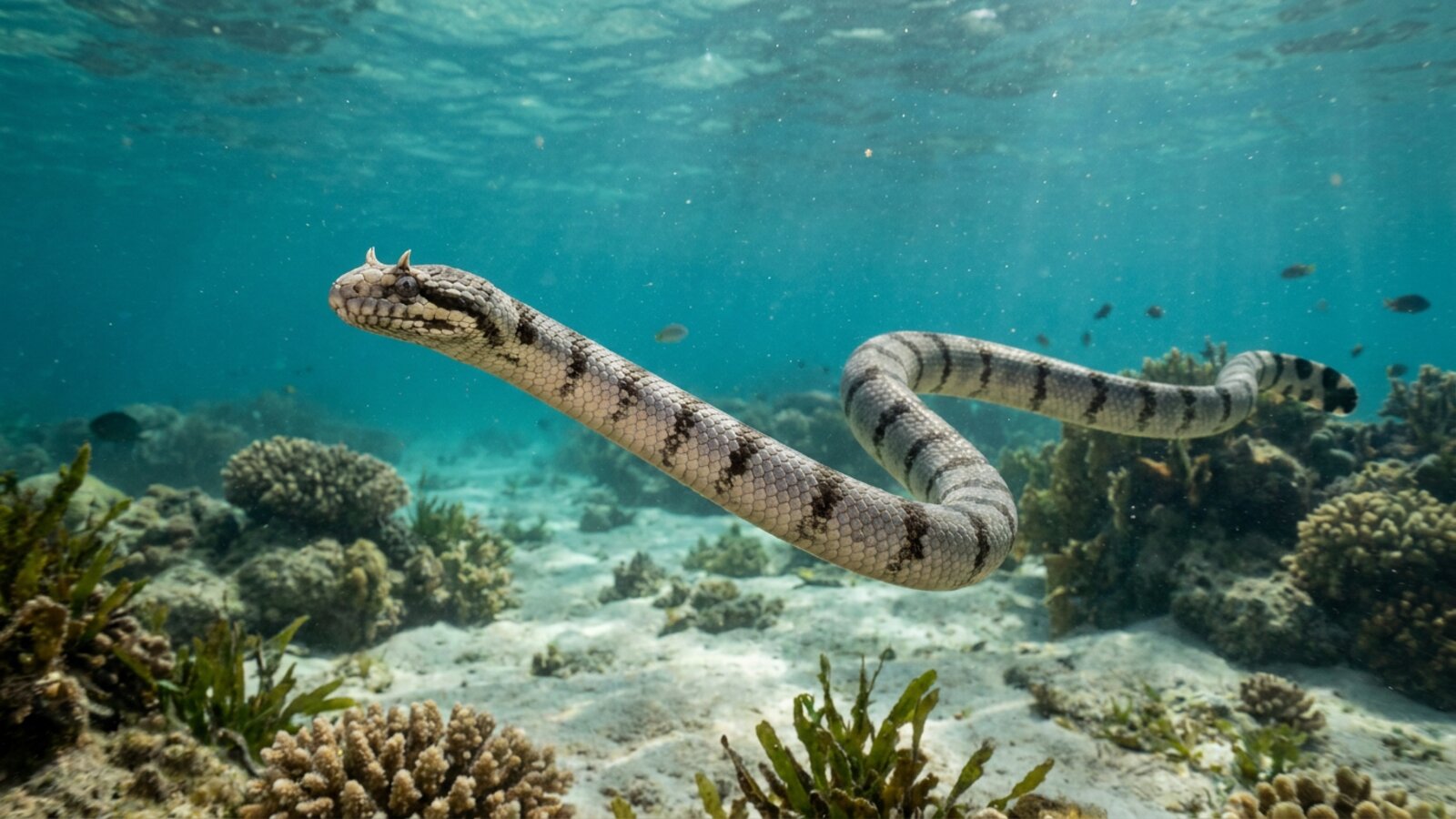
It is a medium-sized, banded sea snake with a small head, a neck one-third to two-fifths as thick as the widest part of the body, and raised, pointed scales above the eyes that no other sea snake possesses.
The feature that gives the species its common names is formed by the supraocular scales, the plates that sit directly over each eye. In the horned sea snake their rear edges are lifted and free, ending in sharp points, and several neighbouring scales around the eye are raised in the same way. SeaLifeBase notes that the head shields become irregular and fragmented in adults, and that the prefrontal scales, a standard pair of plates in front of the eyes in most snakes, are missing altogether. The overall effect is a rough, armoured-looking head that reads clearly in photographs even at a distance.
The body is marked with dark crossbands on a ground colour that ranges from grey to pale olive, tan or pale brown. The bands are widest along the back and taper to points on the flanks, and the pale gaps between them are broader than the bands themselves. Some individuals carry incomplete secondary bands between the main ones, and scales in the paler areas may have dark centres. The underside is whitish, either plain or with a row of dark bars alternating with spots. On the tail the banding is usually less distinct, and the whole pattern tends to become more obscure in older adults, so a large, old snake can look rather dull apart from its spiky head.
Like every true sea snake, it has a tail flattened from side to side into a vertical paddle, valvular nostrils that close underwater, and a body that is noticeably deeper toward the rear than at the neck. That slim forebody matters: it lets the snake push its head and neck into narrow holes in the sand without forcing a thick body in after it.
How do you tell it apart from other banded sea snakes?
The head is the giveaway. Several sea snakes share the general recipe of a grey or olive body with dark bands, among them the ringed sea snake and other members of the large genus Hydrophis, and in poor visibility a banded snake crossing open sand can be any of them. None of those relatives has spiny scales over the eyes, so a clear view of the head settles the question. The spine-bellied or Shaw’s sea snake, Hydrophis curtus, is also rough-scaled, but its spines are on the body, especially the enlarged belly scales of males, while its head shields remain smooth. In trawl catches, where snakes are often tangled or damaged, the missing prefrontal scales and the broken-up head shields of an adult horned sea snake are useful backup characters for specialists.
How big does the horned sea snake get?
Published maximum sizes differ slightly. The species account on Wikipedia, drawing on Australian field guides, gives a snout–vent length of up to 1.23 m, while SeaLifeBase lists a maximum of 130 cm snout–vent length and a common length of about 110 cm. Because the tail adds a further section beyond the vent, the largest animals are well over a metre in total length. SeaLifeBase gives length at first maturity as about 72 cm, with a range of roughly 70 to 111 cm across the studies it summarises.
Snakes measured in the wild are often much smaller than those maximums. In a veterinary study that took blood from healthy sea snakes caught in Australian waters and published reference ranges in The Veterinary Journal in 2015, the 11 horned sea snakes sampled measured 55 to 83 cm snout–vent length. Eight of those 11 were males, an imbalance the authors recorded but which a sample that small cannot explain.
Where does the horned sea snake live?
It lives in the tropical western Pacific and the seas north of Australia: the Gulf of Thailand, Vietnam, southern China, the Philippines, Indonesia, Papua New Guinea, New Caledonia and northern Australia.
The Reptile Database lists its range as the Gulf of Thailand, Vietnam and Thailand; China, including the South China Sea, the coast of Guangdong and the Taiwan Strait; Indonesia; the Philippines; Papua New Guinea; New Caledonia; and Australia, where it is recorded from the Northern Territory, Queensland and Western Australia. Older accounts sometimes add New South Wales, but a 2017 Australian field guide cited by the database does not accept records from that state. SeaLifeBase places the species broadly between about 26° north and 26° south. The type specimen, held in the national natural history museum in Paris, carries only the vague locality “New Holland”, the old European name for Australia.
What kind of habitat does it prefer?
This is a snake of continental shelves rather than oceanic waters. SeaLifeBase describes it as demersal, living on or near the bottom, and records it on loose sandy and silty bottoms, in seagrass beds, on harder substrates and in lagoons, mostly at depths from the surface to about 20 m. It is reported as not often close to shore, yet it is also frequently seen at the surface in reef waters and open channels, where it rises to breathe. A 2007 venom study described it more narrowly as an inhabitant of sandy areas between coral reefs, in contrast to generalist species that range through estuaries, open water and reefs alike.
That preference for soft sediment makes sense once its diet is known. Sand and silt flats between reefs are where burrowing gobies and their partner shrimps dig their homes, and an animal that hunts in burrows needs ground soft enough for burrows to exist. SeaLifeBase also notes that the snake is sometimes active at night, which would give it access to prey at different times of day as burrow residents emerge and retreat.
What does the horned sea snake eat?
It is a goby specialist. Its recorded diet is dominated by burrowing gobies, with commensal snapping shrimps of the genus Alpheus also reported.
A 2020 study of sea snake venoms in the International Journal of Molecular Sciences, summarising the classic dietary survey of marine snakes by Harold and Helen Voris, states that the horned sea snake and its relative Hydrophis caerulescens feed predominantly on burrowing gobies of the group formerly treated as the family Trypauchenidae. These are elongated fishes that live in burrows in mud and sand. A 2007 study comparing the venom glands of two Australian sea snakes likewise described the horned sea snake as a diet and habitat specialist whose prey is confined mainly to gobies. SeaLifeBase adds a variety of other fishes and snapping shrimps of the genus Alpheus, the same group of pistol shrimps that share burrows with many partner gobies.
Hunting in burrows shapes the whole animal. A 2018 analysis in Royal Society Open Science of 47 sea snake species found that body shape and size are strongly linked to how much burrowing prey a species eats. Snakes that specialise on burrowing eels have repeatedly evolved tiny heads on thread-thin forebodies. The six species that feed mainly on burrowing gobies did not converge on one shape in the same way; at least four of them kept a fairly standard snake outline but stayed small, so that their heads and necks were still narrow enough to fit into burrows. The horned sea snake, with its modestly slim neck and medium size, fits that second solution rather than the extreme microcephalic one.
How does a goby diet shape its venom?
A goby caught at the mouth of its burrow has one good escape route: straight down. A predator that strikes into a burrow therefore needs a venom that stops the fish before it can wedge itself out of reach. Research on this species points to exactly that kind of weapon.
In 1988 N. Mori and Anthony Tu isolated the main toxin from horned sea snakes caught in the Gulf of Thailand. It was a short neurotoxin of 60 amino acids with a molecular weight of about 6,600, and its lethal dose (LD50) in mice was 0.125 micrograms per gram of body weight, a figure the authors called extremely toxic. The toxin displaced alpha-bungarotoxin from the acetylcholine receptor, which means it blocks the same site on muscle that carries nerve signals; a second, minor neurotoxin from the same venom was sequenced in a follow-up paper.
The 2007 study, based on venom glands from a single snake caught in Albatross Bay near Weipa in Queensland, found that three-finger toxins made up about 64 percent of the transcripts and phospholipase A2 enzymes about 5 percent. That is a simpler mix than the venom of the generalist spine-bellied sea snake, which eats fishes from more than 30 families and carries a wider range of toxin families. The authors suggested that a narrow diet favours a streamlined venom.
The 2020 venom study added a twist. When crude venom from the horned sea snake was tested against synthetic copies of the main toxin-binding site on receptors from fish and other prey, it did not bind. Yet on a nerve-and-muscle preparation from a chick it abolished muscle twitches quickly and blocked the response to acetylcholine. The researchers concluded that the venom probably acts on the receptor at a different, allosteric site, and proposed that a diet of burrowing gobies with a high chance of escape may have favoured that unusual mode of action. The idea is a hypothesis drawn from a laboratory assay, not a measured fact about hunting in the wild.
Is the horned sea snake dangerous to people?
Its venom must be treated as potentially lethal. Laboratory potency is high, and the toxins it contains are of the same class that cause paralysis in sea snake bite victims elsewhere. In practice, documented bites from this particular species are scarce in the literature. Like most sea snakes it is generally reluctant to bite, and the people most exposed are fishers who handle snakes caught in nets, not swimmers or divers.
That exposure is real. A 2014 study in Conservation Biology on the sea snake trade from the Gulf of Thailand reported that bites are an occupational hazard for the squid fishers who bring snakes ashore, and noted that some bites were being treated with rhinoceros horn, a remedy with no medical value. Anyone bitten by a sea snake needs urgent hospital care, where staff can monitor for muscle weakness and breathing failure and give antivenom if signs develop. Background on symptoms and treatment is on the pages on how venomous sea snakes are and whether sea snakes are dangerous.
How well can the horned sea snake see?
Better than many people assume. In a 2012 study in The Journal of Comparative Neurology, Nathan Hart and colleagues examined the retinas of the horned and spine-bellied sea snakes with microspectrophotometry. Both had three types of visual pigment, sensitive to short wavelengths with peak absorbance around 428–430 nm, to medium wavelengths around 496 nm, and to long wavelengths around 555–559 nm, each housed in a different type of cone-like single photoreceptor. They also had a double cone in which both members held the long-wavelength pigment. The team found no conventional rods; the medium-wavelength cell may be a rod that has evolved a cone-like form, a process that snake biologists call transmutation.
Three spectrally distinct pigments are the raw material for colour vision, although the study measured pigments rather than testing colour discrimination in behaving snakes. For a predator working bright, shallow sand flats by day, that equipment is plausible enough. It also fits wider research showing that sea snakes, despite their reputation as tactile hunters, use vision when foraging and when recognising mates.
How does the horned sea snake reproduce?
Like nearly all true sea snakes it is viviparous, carrying developing young inside the body and giving birth at sea. The Reptile Database records the reproductive mode as live-bearing (listed as ovoviviparous), and Australian sources summarised on Wikipedia give litters of up to 10 young per female. Details such as the breeding season, gestation length and size at birth do not appear in the main references for this species. Because the young are born fully formed in the water, the snake never needs to come ashore, and it is helpless on land.
What parasites does it carry?
One of the more unexpected findings about this species comes from parasitology. In 2022, researchers genetically characterising nematodes of the genus Echinocephalus in Australian waters reported larvae from three horned sea snakes collected on Cape York Peninsula, Queensland. It was the first time a sea snake had been recorded as an intermediate host for this worm genus, whose adults live in stingrays and sharks. The snake larvae were genetically very close to larvae later found in lizardfish and red porgy from the Red Sea, according to a 2023 follow-up study, a hint that these parasites move through food webs across a very wide area.
Why does it have horns?
No published study has tested what the supraocular spines actually do, so every explanation remains a guess. Protection for the eyes while the snake probes into sand and rubble is the idea most often suggested, and a rough, spiny head might make the snake a little harder for a predatory fish to swallow. Display or recognition between the sexes is another possibility. None has evidence behind it, and the honest answer is that the function is unknown.
What is clear is that the spines made taxonomists treat the species as something apart for well over a century. Its uniquely armoured head was the main reason it was placed in its own genus for most of that time.
How did the horned sea snake get its names?
The French zoologist André Marie Constant Duméril described the species in 1853 as Acalyptus peronii. That genus name turned out to be already in use for a weevil named by Carl Johan Schoenherr in 1836, so in 1896 George Albert Boulenger of the British Museum created the replacement genus Acalyptophis, with this species as its type. In 1926 the Australian herpetologist James Roy Kinghorn described what he thought was a new snake, Pseudodisteira horrida, which is now treated as the same species.
The genus Acalyptophis lasted until molecular studies of the rapidly evolving Hydrophis group. A multilocus phylogeny by Kate Sanders and colleagues, published online in 2012 and in print in 2013, placed the horned sea snake inside Hydrophis, and most recent works use Hydrophis peronii. Some field guides still prefer Acalyptophis, so both names appear in modern literature.
The species name honours François Péron (1775–1810), the zoologist of Nicolas Baudin’s expedition to Australia. Péron joined as a trainee zoologist and, after colleagues died, became the voyage’s leading naturalist. Working with the artist Charles-Alexandre Lesueur, he gathered roughly 100,000 zoological specimens, the largest Australian natural history collection of its time, though he died at 35 before he could study most of them. Common names in use today include horned sea snake, spiny-headed seasnake and Peron’s sea snake.
Is the horned sea snake endangered?
The IUCN Red List assesses it as Least Concern, based on an assessment by Vimoksalehi Lukoschek and colleagues dated February 2009. That listing reflects its wide range rather than detailed population data, which do not exist for most sea snakes.
The clearest pressure comes from fisheries. In the 2014 Gulf of Thailand study, squid boats landing at two ports in Ca Mau Province, Vietnam, brought in about 82 tonnes of live sea snakes a year, roughly 225,500 animals, for food and traditional medicine markets in Vietnam and China. Two species made up about 85 percent of that biomass; the horned sea snake was among six species that formed the rest. Total landings fell by roughly 30 percent by mass over the four years of the study, which the authors flagged as a warning sign.
In northern Australia, sea snakes of many species are caught as bycatch in prawn trawls. Studies in the Gulf of Carpentaria and across the northern shelf in the 1990s estimated catches of roughly 80,000 to more than 100,000 snakes a season, with a substantial share dying. Later trials in the Northern Prawn Fishery showed that well-placed bycatch reduction devices could cut sea snake catches by 43 to 85 percent with almost no loss of prawns. Those figures cover sea snakes as a group rather than this species alone. SeaLifeBase’s modelled estimate rates the horned sea snake as highly vulnerable to fishing, at 63 on a scale of 100, which suggests that local declines could go unnoticed without monitoring.
Where can you see a horned sea snake?
Most sightings come from divers and snorkellers crossing sand and seagrass near reefs in Southeast Asia, New Caledonia and northern Australia, and from scientists sorting trawl catches. Because it favours open, soft bottoms rather than the reef itself, the best chance of meeting one is over sand patches and flats where gobies keep burrows. It is not a species seen in public aquariums. If one approaches, the right response is to stay still and let it pass: sea snakes are curious and sometimes investigate divers, and almost all bites happen when the animal is grabbed, trapped or stepped on. More on where the family lives is on where sea snakes live.
Why is it called the horned sea snake?
Because the scales above its eyes are raised into pointed spines. No other sea snake has them.
Is the horned sea snake venomous?
Yes. Its main neurotoxin had an LD50 of 0.125 micrograms per gram in mice, which is extremely potent. Any bite needs urgent hospital care.
What does the horned sea snake eat?
Mainly burrowing gobies, which it hunts in their holes on sandy and silty seabeds. Snapping shrimps that share goby burrows have also been recorded.
How big is the horned sea snake?
Sources give a maximum snout-vent length of 1.23 m to 1.30 m. Most wild snakes are smaller, and maturity starts at roughly 70 cm.
Where does the horned sea snake live?
On shallow shelf seabeds from the Gulf of Thailand and southern China to the Philippines, Indonesia, Papua New Guinea, New Caledonia and northern Australia.
Is it Hydrophis or Acalyptophis?
Both names are in use. DNA work since 2012 places it in Hydrophis, but some field guides keep the older genus Acalyptophis.
Is the horned sea snake endangered?
No. The IUCN lists it as Least Concern (2009), but it is harvested in the Gulf of Thailand and caught as bycatch in prawn trawls.
- Mori N. & Tu A.T. (1988). Isolation and primary structure of the major toxin from sea snake, Acalyptophis peronii, venom. Archives of Biochemistry and Biophysics 260. doi:10.1016/0003-9861(88)90418-3
- Pahari S., Bickford D., Fry B.G. & Kini R.M. (2007). Expression pattern of three-finger toxin and phospholipase A2 genes in the venom glands of two sea snakes, Lapemis curtus and Acalyptophis peronii. BMC Evolutionary Biology 7:175. doi:10.1186/1471-2148-7-175
- Harris R.J. et al. (2020). Assessing the binding of venoms from aquatic elapids to the nicotinic acetylcholine receptor orthosteric site of different prey models. International Journal of Molecular Sciences 21:7377. doi:10.3390/ijms21197377
- Hart N.S., Coimbra J.P., Collin S.P. & Westhoff G. (2012). Photoreceptor types, visual pigments, and topographic specializations in the retinas of hydrophiid sea snakes. Journal of Comparative Neurology 520. doi:10.1002/cne.22784
- Sherratt E., Rasmussen A.R. & Sanders K.L. (2018). Trophic specialization drives morphological evolution in sea snakes. Royal Society Open Science 5:172141. doi:10.1098/rsos.172141
- Sanders K.L., Lee M.S.Y., Mumpuni, Bertozzi T. & Rasmussen A.R. (2013). Multilocus phylogeny and recent rapid radiation of the viviparous sea snakes. Molecular Phylogenetics and Evolution 66. doi:10.1016/j.ympev.2012.09.021
- Gillett A.K. et al. (2015). Haematological and biochemical reference intervals for three species of hydrophiine sea snakes (Hydrophis curtus, H. elegans and H. peronii) in Australia. The Veterinary Journal 204. doi:10.1016/j.tvjl.2015.04.008
- Karagiorgis C. et al. (2022). Genetic characterisation of Echinocephalus spp. from marine hosts in Australia. International Journal for Parasitology: Parasites and Wildlife 17. doi:10.1016/j.ijppaw.2021.12.012
- Van Cao N. et al. (2014). Sea snake harvest in the Gulf of Thailand. Conservation Biology 28. doi:10.1111/cobi.12387
- Milton D.A., Fry G.C. & Dell Q. (2009). Reducing impacts of trawling on protected sea snakes: by-catch reduction devices improve escapement and survival. Marine and Freshwater Research 60. doi:10.1071/MF08221
- Wassenberg T.J. et al. (1994) and Ward T.M. (1996). Sea snake bycatch of prawn trawlers in northern Australia. Aust. J. Mar. Freshw. Res. 45; Mar. Freshw. Res. 47. doi:10.1071/MF9940429; doi:10.1071/MF9960631
- IUCN Red List (Lukoschek V. et al., assessed 2009). Acalyptophis peronii. Least Concern. doi:10.2305/IUCN.UK.2010-4.RLTS.T176756A7298218.en
- The Reptile Database (Uetz P. et al.). Hydrophis peronii (Duméril, 1853): synonymy, distribution, etymology.
- SeaLifeBase. Hydrophis peronii, spiny-headed seasnake: morphology, ecology, size at maturity.
- Wikipedia. Hydrophis peronii; François Péron.
Blane Perun has been exploring Earth’s oceans and marine life for over 25 years. Founder of TheSea.Org in 1999, underwater photographer, coral aquaculture pioneer, and explorer of 80+ countries.
About Blane Perun → More on Sea Snakes →