Spectacled Sea Snake — King’s Sea Snake of Northern Australia
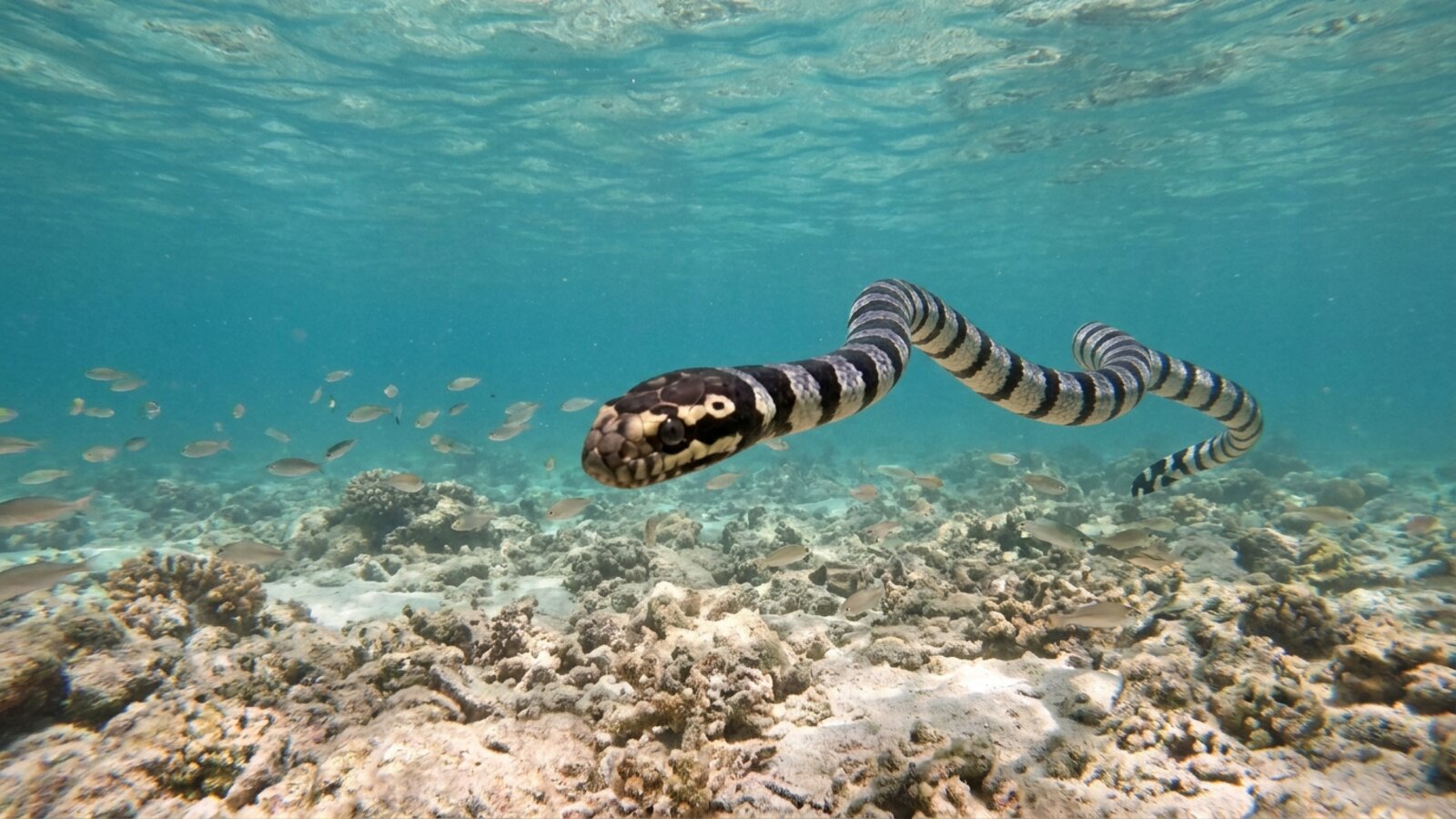
The spectacled sea snake (Hydrophis kingii), also called King’s sea snake, is a dangerously venomous sea snake found in waters off northern Australia and the southern coast of New Guinea. It is named for the white ring around each eye on its black head, which looks like a pair of spectacles. It usually grows to no more than about 1.9 m, has keeled, overlapping scales, and lives over muddy or sandy bottoms down to about 22 m, where it hunts small fish.
Northern Australia has one of the richest sea snake faunas on Earth, and the spectacled sea snake is one of its more distinctive members. Few people ever see it alive: it lives over turbid, soft-bottomed coastal waters rather than clear reefs, and most specimens come from prawn-trawl bycatch. But the pale “spectacles” around its eyes make it one of the easier sea snakes to identify once it is in hand.
What does the spectacled sea snake look like?
Its head is black with a conspicuous white ring around each eye; the body is banded, with keeled, overlapping scales.
The anterior chin shields touch the mental groove on the underside of the jaw, a technical feature used to separate it from relatives. The body scales are keeled and imbricate (overlapping), giving a rougher texture than smooth-scaled species. The black head with pale eye-rings contrasts with a paler, banded body, a pattern unlike other sea snakes in its range.
Who was King?
The species name honours Phillip Parker King, the Australian-born Royal Navy officer and marine surveyor who charted much of northern and western Australia’s coastline in the 1810s and 1820s and later commanded HMS Adventure on the first Beagle survey voyage. Many Australian animals and places bear his name.
Where does the spectacled sea snake live?
It lives in tropical waters off northern Australia — Western Australia, the Northern Territory and Queensland — and along the southern coast of New Guinea.
Its preferred habitat is marine water down to about 22 m with a muddy or sandy bottom, typical of the Gulf of Carpentaria, the Arafura Sea and other shallow shelf areas. Because these are the grounds fished by prawn trawlers, much of what is known comes from bycatch surveys. See the Timor Sea and Coral Sea.
What does the spectacled sea snake eat?
It preys on small fishes, which it finds on or near the soft seabed. Like other Hydrophis, it likely forages by probing burrows and depressions, envenoming prey before swallowing. See what do sea snakes eat.
Is the spectacled sea snake dangerous?
It is described as dangerously venomous, with venom typical of Hydrophis sea snakes that can cause muscle damage and paralysis. Bites are rare because few people encounter it, but trawler crews sorting catches should never handle sea snakes barehanded. Any bite needs urgent hospital assessment. See are sea snakes dangerous and how venomous are sea snakes.
How does the spectacled sea snake reproduce?
It is viviparous, giving birth to live young at sea, like all true sea snakes. Litter details are poorly documented.
How does the spectacled sea snake breathe and dive?
It breathes air with a long lung and closes valved nostrils underwater, with some oxygen uptake through the skin. In its shallow habitat it makes frequent trips between the bottom and the surface. See how do sea snakes breathe.
Is the spectacled sea snake endangered?
It is not considered globally threatened, but it is poorly studied. The main pressure is bycatch in northern Australian prawn trawls, now reduced by mandatory bycatch reduction devices, along with changes to coastal habitats.
What does a spectacled sea snake bite do?
There are few, if any, well-documented bites from this particular species, so doctors work from what is known about Hydrophis sea snakes in general: their venom mainly attacks muscles and the nerve–muscle junction.
Sea snake bites are often almost painless at first and may leave only small puncture marks, which can give a false sense of safety. When envenoming does happen, symptoms usually develop over the following hours and can include muscle aches and stiffness, pain on moving, drooping eyelids, difficulty swallowing or speaking, and dark, cola-coloured urine as damaged muscle breaks down. In severe cases, paralysis of the breathing muscles and kidney damage can be life-threatening.
Many sea snake bites are “dry,” with little or no venom injected, but there is no way to tell at the scene. First aid in Australia is to keep the person still and calm, apply a firm pressure immobilisation bandage over the bitten limb if trained to do so, and call emergency services. Do not cut, suck or wash the bite. Hospitals monitor patients with blood and urine tests and give antivenom if signs of envenoming appear.
Is the spectacled sea snake aggressive?
No. Like most sea snakes, it is not aggressive toward people and has no reason to attack anything it cannot eat.
Bites from sea snakes generally happen when the snake is grabbed, stepped on in murky water, or tangled in a net and handled while sorting catch. Because the spectacled sea snake lives over turbid, soft-bottomed habitats that divers rarely visit, the people most likely to meet it are trawler crews, fisheries observers and researchers. Using a hook, tongs or a gloved, tool-assisted release and returning the snake to the water quickly protects both the crew and the snake.
What was its old scientific name?
For much of the 20th century it was known as Disteira kingii. It was moved into the large genus Hydrophis when sea snake classification was revised using DNA evidence.
Genetic studies showed that many of the small genera once used for sea snakes were nested inside Hydrophis, so several were merged into it, and Hydrophis is now by far the largest sea snake genus. As a result, older field guides, museum labels and fisheries reports may list the spectacled sea snake under Disteira, and the same is true for some of its relatives. If you are searching older scientific literature, it is worth looking under both names.
Which other sea snakes share its waters?
Northern Australia supports one of the most diverse sea snake communities in the world, with around 30 species recorded in Australian waters.
| Species | How to tell it from the spectacled sea snake |
|---|---|
| Elegant sea snake (Hydrophis elegans) | Long and slender, with a small head and dark bands or blotches; lacks the black head with white eye-rings |
| Stokes’s sea snake (Hydrophis stokesii) | Very heavy-bodied with a large head and big fangs |
| Olive sea snake (Aipysurus laevis) | Bulky and mostly olive-brown; common on clear coral reefs |
| Mosaic sea snake (Aipysurus mosaicus) | Pale with irregular offset bands; eats fish eggs |
Many of these species overlap in the Gulf of Carpentaria, the Arafura Sea and the Timor Sea, where several can turn up in a single trawl. Sorting them reliably takes training, which is why fisheries observers use identification keys based on head pattern, scales and body shape. See also the stagger-banded sea snake.
What eats spectacled sea snakes?
Despite their venom, sea snakes have predators, including sharks, large fish and sea birds.
Tiger sharks are well known to eat sea snakes in Australian waters, and large groupers and other predatory fish also take them. White-bellied sea eagles snatch sea snakes from the surface when they come up to breathe. Young snakes, which are born at sea and fend for themselves immediately, are probably most at risk. Because spectacled sea snakes must surface regularly to breathe, these trips up through the water column are moments of particular danger.
Why is it called the spectacled sea snake?
Because it has a white ring around each eye on its black head, resembling a pair of spectacles.
Is the spectacled sea snake venomous?
Yes, it is considered dangerously venomous, though bites are rare.
Where does the spectacled sea snake live?
In tropical waters off northern Australia and the southern coast of New Guinea, over muddy or sandy bottoms down to about 22 m.
How big does the spectacled sea snake get?
Usually no more than about 1.9 m.
What does the spectacled sea snake eat?
Small fishes.
Who is King’s sea snake named after?
Phillip Parker King, the Australian marine surveyor who charted much of northern Australia’s coast.
Is the spectacled sea snake aggressive?
No. It is not aggressive toward people; bites usually happen only when a snake is handled or trapped, for example while sorting a trawl catch.
What was the spectacled sea snake’s old scientific name?
It was long known as Disteira kingii before being moved into the genus Hydrophis on the basis of genetic studies.
Blane Perun has been exploring Earth’s oceans and marine life for over 25 years. Founder of TheSea.Org in 1999, underwater photographer, coral aquaculture pioneer, and explorer of 80+ countries.
About Blane Perun → More on Sea Snakes →