How Venomous Are Sea Snakes? — Among the Most Toxic Snakes on Earth
Sea snakes are among the most venomous snakes in the world. By the standard mouse LD50 test, Dubois’ sea snake is the most toxic at 0.044 mg/kg, ranking third of all snakes behind the inland taipan and eastern brown snake. The yellow-bellied and beaked sea snakes are also extremely potent. But toxicity is not danger: most sea snakes deliver small amounts of venom, have short fangs and rarely bite.
What does LD50 mean?
LD50, the “median lethal dose,” is the amount of venom per kilogram of body weight that kills half of a group of test animals, usually mice. The lower the number, the more toxic the venom. Results only compare fairly when measured the same way: subcutaneous injection (under the skin) gives different numbers from intramuscular or intravenous injection. Mixing methods caused the myth that Belcher’s sea snake is the world’s most venomous snake.
| Species | LD50 (mg/kg) | Typical yield |
|---|---|---|
| Inland taipan (land) | ~0.025 | ~44 mg |
| Eastern brown snake (land) | ~0.036 | ~2–5 mg |
| Dubois’ sea snake | 0.044 | ~0.43 mg |
| Yellow-bellied sea snake | ~0.067 | ~1–4 mg |
| Beaked sea snake | ~0.11 | ~8–9 mg |
| Yellow-lipped sea krait | ~0.45 | small |
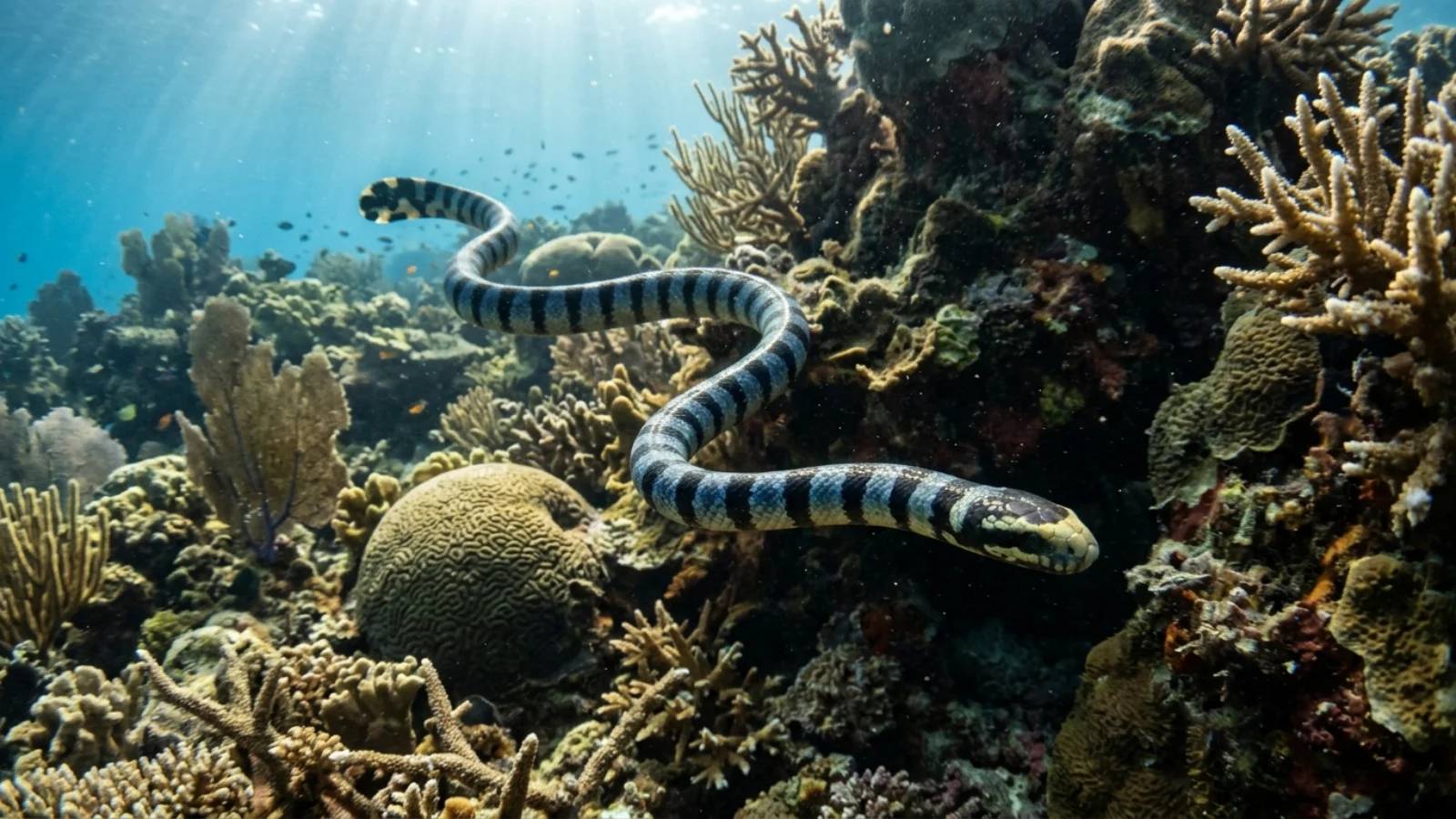
Which sea snake is the most venomous?
Dubois’ sea snake (Aipysurus duboisii), with a subcutaneous LD50 of 0.044 mg/kg. It is followed among sea snakes by species such as the yellow-bellied sea snake (about 0.067 mg/kg) and the beaked sea snake (about 0.11 mg/kg). Many species have never been properly tested.
What does sea snake venom do?
Most sea snake venoms combine short-chain three-finger neurotoxins, which block acetylcholine receptors where nerves meet muscles, with phospholipase A2 myotoxins that destroy muscle. In people, the commonest serious effect is widespread muscle damage, which can lead to kidney failure, followed by paralysis. Prey fish are even more sensitive than mammals, which is why the venom is so fast-acting: a bitten fish must be stopped before it swims away.
Are any sea snakes harmless?
A few are close to it. The egg-eating turtle-headed and spine-tailed sea snakes have tiny fangs and greatly weakened venom because they no longer need to subdue prey. In the spine-tailed sea snake, a two-nucleotide deletion in a toxin gene cut toxicity roughly 50- to 100-fold.
How does sea snake venom compare with a cobra’s?
Drop for drop, many sea snake venoms are several times more toxic than cobra venom in mice. The beaked sea snake, for example, is often described as about four times as toxic as the Indian cobra. See is the beaked sea snake deadlier than a cobra? and are sea snakes dangerous.
What are the limits of LD50 rankings?
LD50 tells you how toxic a venom is to laboratory mice under one set of conditions. It does not tell you how likely a snake is to bite, how much venom it injects or how a human body will respond.
- Mice are not people. Different animals react differently to the same toxins, and some venoms are far more potent against their natural prey than against mammals.
- Route matters. Subcutaneous, intramuscular and intravenous tests give different numbers, so tables that mix methods can rank species wrongly.
- Venom varies. The venom of a single species can differ between regions, seasons and even between young and adult snakes.
- Many species are untested. Only a minority of sea snake species have been measured with comparable methods.
- Small samples. Some published values rest on a handful of tests and are best treated as approximate.
Because of these limits, toxicologists treat LD50 rankings as a rough guide to potency rather than a list of the “deadliest” snakes.
What makes a sea snake dangerous in real life?
Danger is a combination of venom potency, the amount injected, how often the snake meets people and how it behaves when it does.
| Factor | Raises danger when… | Example |
|---|---|---|
| Potency | Venom is highly toxic per milligram | Dubois’ sea snake |
| Yield | The snake can inject a large dose | Beaked sea snake |
| Fang length | Fangs can penetrate skin or thin gloves easily | Larger species |
| Habitat overlap | The snake lives where people fish, wade or work | Estuarine species in muddy water |
| Temperament | The snake bites readily when handled | Species often caught in nets |
This is why the beaked sea snake, with venom less potent than Dubois’ sea snake, is generally regarded as the more dangerous species. It lives in murky coastal waters and estuaries, is frequently caught in fishing nets and can deliver a larger dose. See the beaked sea snake profile.
Why is sea snake venom so potent?
Because of what sea snakes eat and where they hunt. A bitten fish or eel can swim away or vanish into a crevice in seconds, so natural selection favours venom that acts extremely quickly.
Fish appear to be especially sensitive to the neurotoxins in sea snake venom, and the snakes need relatively little of it to subdue prey. Diet also shapes venom chemistry. Species that specialise in eels, for example, tend to have venoms tuned to that prey, while egg-eating species have lost much of their venom because they no longer need it. Our article on what sea snakes eat covers their diets.
How many people do sea snakes kill?
Very few compared with land snakes. Deaths are rare, under-reported and concentrated among fishers in parts of South and Southeast Asia, where access to antivenom and hospital care can be limited.
In regions with good medical care, such as Australia, sea snake bites are uncommon and deaths are very rare. Most bites happen when people handle snakes in nets, step on them in shallow, murky water or pick up stranded animals. Divers and snorkellers who leave sea snakes alone face an extremely low risk. Prompt hospital observation is the key safeguard, since symptoms can be delayed and antivenom works best when given early. For bite statistics and first aid, see are sea snakes dangerous?
Is the yellow-bellied sea snake dangerous?
Its venom is potent, but encounters are uncommon because it lives far out at sea, drifting along slicks and current lines.
The yellow-bellied sea snake is the most widespread snake in the world, ranging across the tropical Indian and Pacific Oceans, and it is the species most likely to wash up on beaches outside the usual sea snake range. A beached snake can still bite, so it should never be picked up. In the water, it rarely interacts with people. See our yellow-bellied sea snake profile.
- Heatwole, H. (1999). Sea Snakes. 2nd ed. UNSW Press, Sydney.
- Rasmussen, A. R., Murphy, J. C., Ompi, M., Gibbons, J. W. & Uetz, P. (2011). Marine reptiles. PLoS ONE 6(11): e27373.
- The Reptile Database (reptile-database.reptarium.cz), species accounts for Hydrophiinae.
- Broad, A. J., Sutherland, S. K. & Coulter, A. R. (1979). The lethality in mice of dangerous Australian and other snake venom. Toxicon 17: 661–664.
- Li, M., Fry, B. G. & Kini, R. M. (2005). Eggs-only diet: its implications for the toxin profile changes and ecology of the marbled sea snake. Journal of Molecular Evolution 60: 81–89.
How venomous are sea snakes?
Very. Several are among the most toxic snakes known; Dubois’ sea snake has an LD50 of 0.044 mg/kg in mice.
What is the most venomous sea snake?
Dubois’ sea snake (Aipysurus duboisii).
Is a sea snake more venomous than a cobra?
Many are. The beaked sea snake’s venom is roughly four times as toxic as the Indian cobra’s in mice.
Is Belcher’s sea snake the most venomous snake?
No, that is a myth caused by comparing different test methods.
Are there non-venomous sea snakes?
The egg-eating turtle-headed and spine-tailed sea snakes have greatly reduced venom and are nearly harmless.
Why is sea snake venom so strong?
It evolved to stop fish instantly before they escape, and fish are especially sensitive to it.
Which sea snake is the most dangerous to humans?
The beaked sea snake is generally regarded as the most dangerous, because it lives in murky coastal waters, is often caught in nets and can inject a large dose.
Is LD50 a reliable measure of how deadly a snake is?
Only partly. It measures venom potency in mice, not how much venom a snake injects or how often it bites people.
Blane Perun has been exploring Earth’s oceans and marine life for over 25 years. Founder of TheSea.Org in 1999, underwater photographer, coral aquaculture pioneer, and explorer of 80+ countries.
About Blane Perun → More on Sea Snakes →