Stagger-Banded Sea Snake — Australia’s Egg-Eating Mosaic Sea Snake
“Stagger-banded sea snake” is an Australian common name for egg-eating Aipysurus sea snakes with irregular, offset dark bands. It was long applied to Aipysurus eydouxii, but the Australian and New Guinean population is now recognised as a separate species, the mosaic sea snake (Aipysurus mosaicus), described in 2012. These snakes average about 1 m, live in shallow, often turbid coastal waters, feed only on fish eggs, and have weak venom. They are reluctant to bite and pose little risk to people.
Australian field guides list a “stagger-banded sea snake,” and many websites treat it as identical to the Asian spine-tailed sea snake. The real story is more interesting. Detailed genetic and anatomical work showed that the egg-eating Aipysurus of northern Australia and New Guinea is its own species, now called the mosaic sea snake. This page covers that Australian snake; the spine-tailed sea snake page covers its Southeast Asian relative.
Why is it called stagger-banded?
Because its dark bands are irregular and offset along the body, as if staggered rather than forming neat rings.
The bands often break into blotches that do not line up across the back, giving a mosaic or staggered look — which inspired the newer name “mosaic sea snake” as well. The ground colour is typically cream to light brown, and the head is relatively small with large, regular head shields, typical of Aipysurus. Belly scales are broad and distinct.
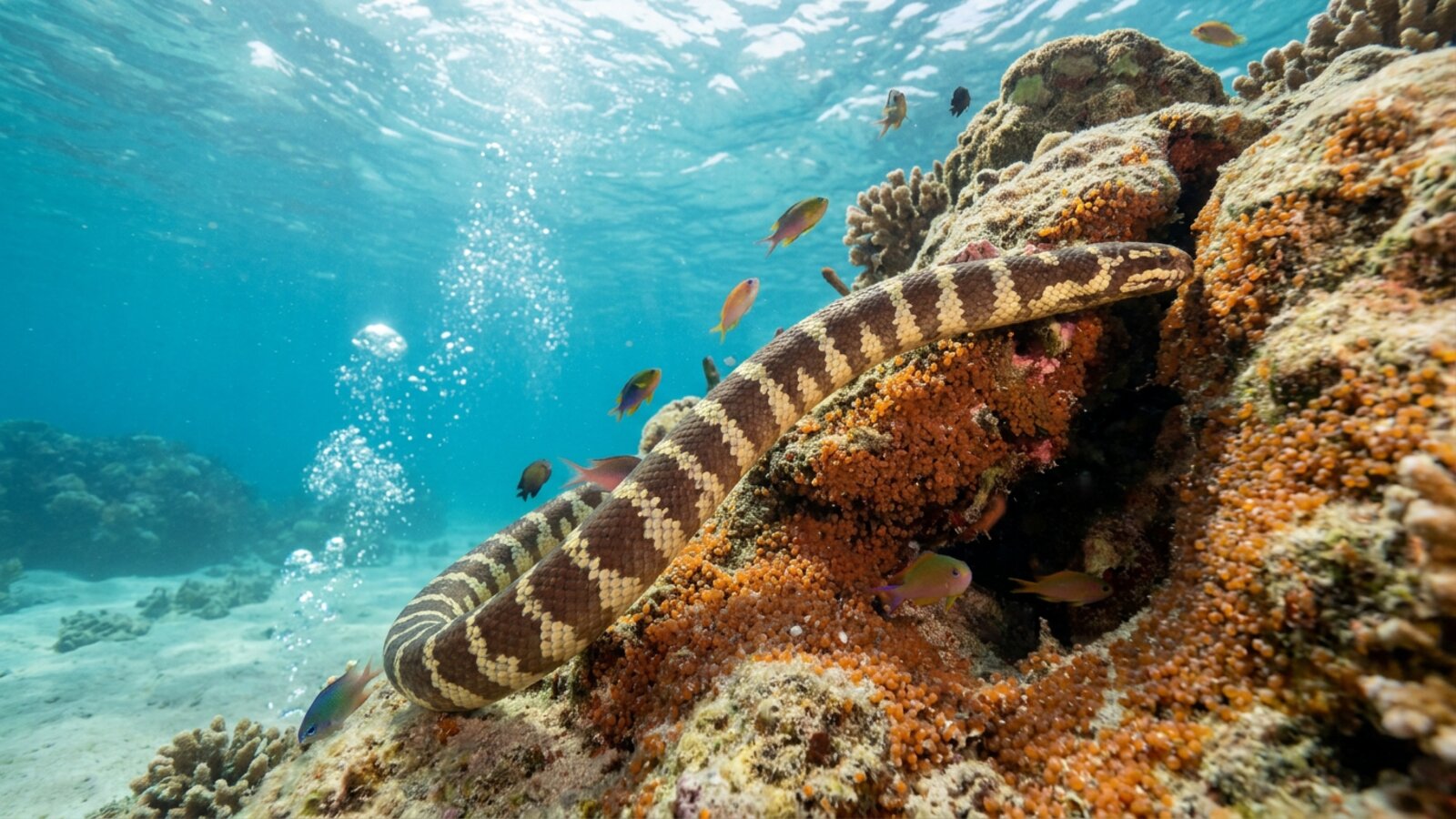
Is the stagger-banded sea snake a separate species?
Yes, according to current taxonomy. In 2012 researchers comparing DNA and body features of egg-eating Aipysurus across their range found that snakes from Australia and New Guinea differ consistently from those of Southeast Asia and described them as Aipysurus mosaicus. The Australian Reptile Online Database now notes that the Australia–New Guinea population belongs to A. mosaicus, with only a single Australian record (from Queensland’s Great Sandy region) attributed to A. eydouxii. Older books and many websites still use A. eydouxii for Australian snakes.
Where does the stagger-banded sea snake live?
It lives in the shallow coastal waters of northern Australia and southern New Guinea, often in turbid bays and estuaries with soft or mixed bottoms.
It is recorded from Western Australia’s north coast through the Northern Territory and the Gulf of Carpentaria to Queensland, and from the Gulf of Papua. Many specimens come from prawn-trawl bycatch, because it shares habitat with trawled grounds. See the Timor Sea and Coral Sea.
What does the stagger-banded sea snake eat?
Fish eggs, especially those of blennies, which it finds by probing shells, rubble and burrows on the seabed.
Egg-eating Aipysurus have strong throat muscles, scraping lip scales and reduced teeth, and they forage slowly over the bottom checking likely nest sites. Because eggs do not fight back, they need no potent venom. See blennies and what do sea snakes eat.
How does the stagger-banded sea snake reproduce?
It is live-bearing. Australian records give an average litter of about four young, with a range of one to twelve. Young are born at sea and are independent immediately.
How is it related to other egg-eating sea snakes?
Egg-eating evolved twice in sea snakes: once in this Aipysurus lineage and once in the turtle-headed sea snakes (Emydocephalus). Both lineages independently lost much of their venom. In the Asian spine-tailed sea snake, researchers traced part of that loss to a two-nucleotide deletion in a key three-finger toxin gene. See the turtle-headed sea snake.
Is the stagger-banded sea snake endangered?
It does not appear to be of conservation concern, according to the Australian Reptile Online Database. Its main threat is incidental capture in prawn trawls, reduced in Australia by bycatch reduction devices, and degradation of shallow coastal habitats. Like other sea snakes, it is protected in Australian waters.
How can you tell it apart from similar sea snakes?
Look at the pattern, the head and the body shape: a fairly slender, pale snake with irregular, offset dark bands and a small head is most likely a mosaic (stagger-banded) sea snake in northern Australian waters.
| Species | Typical look | Diet |
|---|---|---|
| Stagger-banded / mosaic sea snake (Aipysurus mosaicus) | Cream to light brown with irregular, broken dark bands; small head | Fish eggs |
| Olive sea snake (Aipysurus laevis) | Large, heavy-bodied, mostly olive-brown to purplish, often with no clear bands | Fish, crabs, fish eggs |
| Turtle-headed sea snake (Emydocephalus annulatus) | Short blunt head; colour varies from banded to all-black | Fish eggs |
| Spine-tailed sea snake (Aipysurus eydouxii) | Similar banded pattern; Southeast Asian waters | Fish eggs |
In the field, size alone helps: the olive sea snake is a much bulkier animal that commonly exceeds the mosaic sea snake’s average length. Range is also a strong clue, because the spine-tailed sea snake is essentially a Southeast Asian species. Positive identification of egg-eating Aipysurus often needs a close look at scales or a photograph checked by a specialist.
How is it adapted to life at sea?
Like other true sea snakes, it spends its whole life in the water, from birth to death, and has a set of adaptations for breathing, swimming and dealing with salt.
- Paddle-shaped tail: the flattened tail works like an oar, giving strong propulsion in the water but making the snake clumsy on land.
- Valved nostrils: nostrils on the top of the snout can close underwater and open at the surface for a quick breath.
- A long lung: the single lung runs much of the body length and helps with both oxygen storage and buoyancy.
- Salt gland: a gland under the tongue removes excess salt taken in with food and seawater.
- Skin breathing: many sea snakes can absorb some oxygen through the skin, which helps extend dives.
Sea snakes still need fresh water to drink. Studies on other species suggest they rely on rainfall, which can form a thin freshwater layer on the sea surface, and on freshwater runoff near coasts. More on the group at do sea snakes have gills?
Where does it fit in the Aipysurus family?
Aipysurus is a small genus of Australasian sea snakes, and the mosaic sea snake is one of its egg-eating members.
The genus includes the large olive sea snake, the dusky sea snake and several rare, range-restricted species from reefs off northwestern Australia, including the short-nosed sea snake, which was rediscovered at Ningaloo Reef in 2015 after it had not been seen for many years. Most Aipysurus species hunt fish, which makes the egg-eating forms an interesting example of how diet shapes anatomy and venom. Their reduced fangs and weak venom, compared with fish-eating relatives, are a textbook case of a predator dropping a costly weapon it no longer needs.
What should you do if you meet one?
Keep your distance and let it go about its business. Bites are rare and almost always happen when a snake is handled, trapped or caught in nets.
Divers and snorkellers in northern Australia rarely see this species because it favours turbid water, but fishers and trawler crews do encounter it when it comes up in nets. Snakes in bycatch should be released back into the water as quickly as possible using a hook or tool, never bare hands. Even though egg-eating sea snakes have weak venom, any sea snake bite should be treated as a medical emergency in Australia: keep the person still, apply a pressure immobilisation bandage to the bitten limb if trained to do so, and call emergency services. Hospitals in Australia stock sea snake antivenom, and doctors will monitor for signs of envenoming before deciding whether it is needed.
What is the stagger-banded sea snake?
An Australian name for egg-eating Aipysurus sea snakes with irregular dark bands, now recognised in Australia and New Guinea as the mosaic sea snake, Aipysurus mosaicus.
Is the stagger-banded sea snake venomous?
Only weakly. It is reluctant to bite and has much-reduced venom, though no sea snake should be handled.
What does the stagger-banded sea snake eat?
Fish eggs, especially blenny eggs, found on the seabed.
Where does the stagger-banded sea snake live?
In shallow coastal waters of northern Australia and southern New Guinea.
Is the stagger-banded sea snake the same as the spine-tailed sea snake?
They were once treated as one species, Aipysurus eydouxii, but the Australian and New Guinean snakes are now considered a separate species, A. mosaicus.
How many babies does it have?
About four on average, with a range of one to twelve, born live at sea.
How can you tell a stagger-banded sea snake from an olive sea snake?
The stagger-banded (mosaic) sea snake is slimmer and paler, with irregular offset dark bands; the olive sea snake is a much bulkier, mostly olive-brown snake usually without clear bands.
What should you do if a sea snake bites you in Australia?
Treat it as an emergency: keep still, apply a pressure immobilisation bandage if trained, and call emergency services. Australian hospitals stock sea snake antivenom.
Blane Perun has been exploring Earth’s oceans and marine life for over 25 years. Founder of TheSea.Org in 1999, underwater photographer, coral aquaculture pioneer, and explorer of 80+ countries.
About Blane Perun → More on Sea Snakes →