Shipwrecks of Baja California — Galleons, Ferries and Artificial Reefs
Baja California’s best-known wrecks are the Salvatierra, a ferry that struck a reef in the San Lorenzo Channel near La Paz in 1976 and now lies at about 18 metres, and the Fang Ming and Lapas 03, two seized smuggling ships sunk as artificial reefs near Isla Ballena after a 1999 decision. On the Pacific coast, the remains of the Manila galleon San Juanillo, lost in 1578–79, are the oldest known shipwreck on the coast of the Californias.
Baja’s Pacific coast is a graveyard of sailing ships and galleons driven ashore by wind and fog, while its sheltered Gulf of California side holds the modern ferries and fishing boats that divers visit today.
Baja California is a long, narrow peninsula with two very different coasts. To the west is the open Pacific, cold and rough, swept by the California Current and frequent fog. To the east is the Gulf of California, also called the Sea of Cortez, sheltered and warm, with hundreds of islands and some of the richest marine life in the world. Both coasts have claimed ships for centuries, from Spanish galleons on the Manila trade route to modern ferries and fishing vessels, and a few of those wrecks have become some of Mexico’s most interesting dive sites.
For divers, the centre of Baja wreck diving is La Paz, the capital of Baja California Sur. Within a short boat ride lie the Salvatierra ferry and the artificial reefs of the Fang Ming and Lapas 03, along with the famous sea lion colony at Los Islotes and the islands of Espíritu Santo. For historians, the most remarkable discoveries lie on the Pacific side, where beachcombers and archaeologists have pieced together the story of a galleon wrecked more than 440 years ago.
What is the Salvatierra wreck?
The Salvatierra was a ferry that carried passengers and vehicles between La Paz and Topolobampo on the mainland. In June 1976 it struck the Suwanee reef, a rock that lies just below the surface in the San Lorenzo Channel between the Baja mainland and Isla Espíritu Santo, and sank. Accounts give its length as around 90 to 100 metres. Later the same year, Hurricane Liza passed through the region and tore away much of its superstructure, leaving the hull lying on a sandy bottom in roughly 18 metres of water.
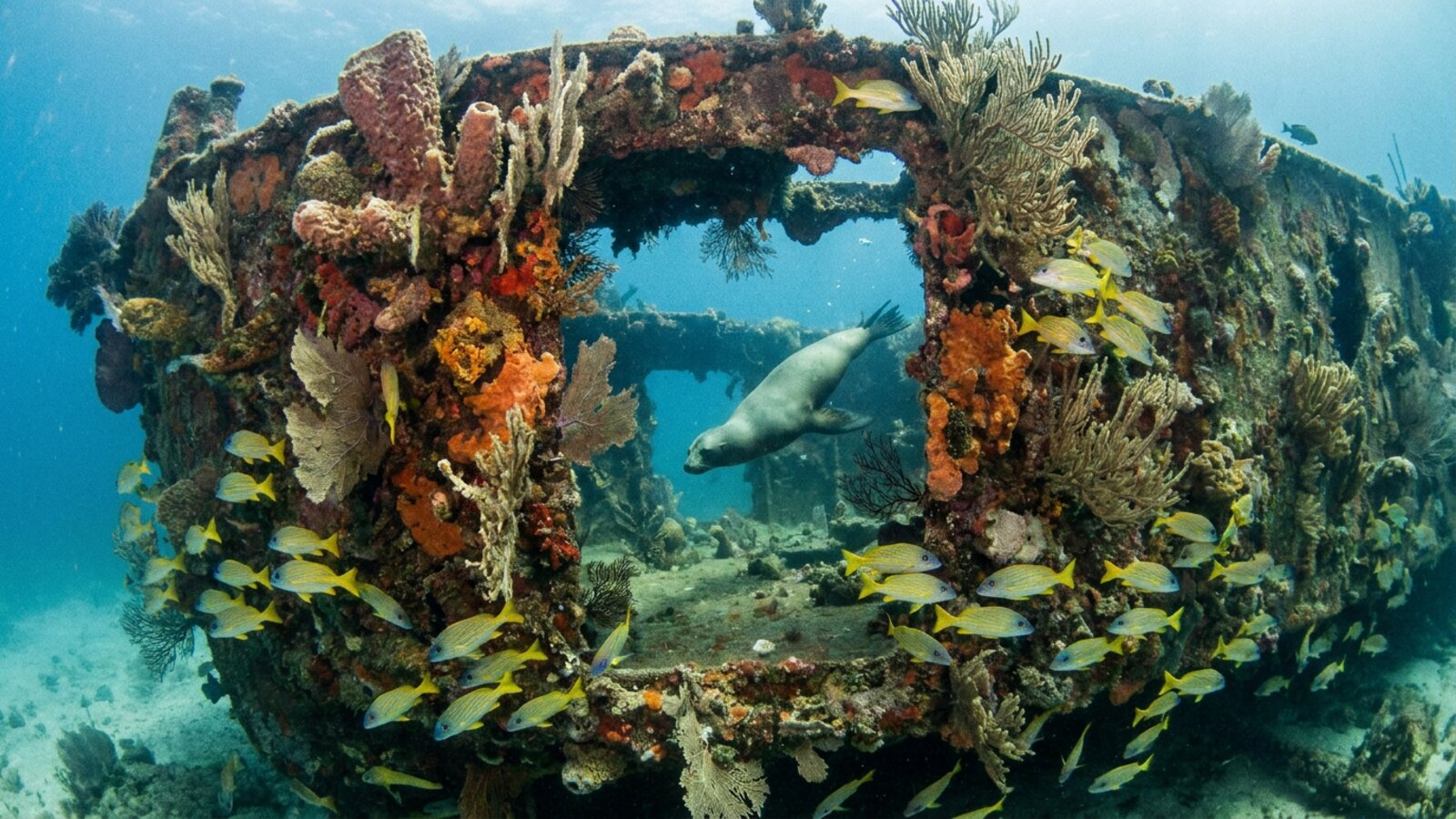
Nearly fifty years on, the Salvatierra is one of the most popular dives in the La Paz area. The wreck is heavily encrusted with sponges, gorgonians and cup corals, and it shelters large numbers of fish: grunts, snappers, angelfish, pufferfish, moray eels and schools of baitfish that attract jacks and other predators. Parts of the wreck have collapsed and some sections are open enough for trained divers to look inside, though the structure has weakened over time and penetration requires care.
What are the Fang Ming and Lapas 03?
They are two vessels that were used to smuggle migrants from China towards North America. After Mexican authorities seized them and took the people aboard to safety, the ships were cleaned and sunk as artificial reefs, following a decision made in 1999. The Fang Ming is usually given as about 55 metres long and the Lapas 03 as about 36 metres. Both lie near Isla Ballena, close to Espíritu Santo, at depths that make them suitable for most certified divers.
The two wrecks have become rich artificial reefs in the years since. Their hulls are covered with encrusting life, and they attract groupers, snappers, angelfish, pufferfish, rays and schools of grunts. The Fang Ming in particular is popular because it can be explored from end to end, with open holds and deck structures that make for striking photographs. Because they were prepared and sunk deliberately, they are generally safer to explore than older accidental wrecks, though any penetration still needs training.
Are there other wrecks near La Paz?
Several smaller ones. Two wooden boats lie in shallow water off Isla Gaviota, inside La Paz Bay, and are sometimes used for training dives and snorkelling. Other vessels have been lost in the channels and islands around Espíritu Santo over the years, and local dive centres can advise on which are currently diveable. Further south, at Cabo Pulmo, the remains of the fishing boat El Vencedor lie in shallow water and have become a popular dive for their schools of fish.
What is the San Juanillo?
The San Juanillo was a Manila galleon, one of the great Spanish ships that sailed once or twice a year between Manila in the Philippines and Acapulco in Mexico, carrying Chinese porcelain, silk, spices and other luxury goods east and silver west. Under its captain, Juan de Ribera, it disappeared on the crossing of 1578. Its crew were probably weakened by months at sea, scurvy and disease, and the ship appears to have been driven onto a beach on the Pacific coast of Baja California in late 1578 or early 1579.
For centuries its fate was unknown. Then, in the late twentieth century, American beachcombers began finding fragments of Ming dynasty porcelain and pieces of beeswax on a remote stretch of Baja coast. Their finds came to the attention of researchers Edward and Saryl Von der Porten after a 1997 exhibition at the Los Angeles County Museum of Art. Working with Mexico’s Instituto Nacional de Antropología e Historia (INAH), teams carried out nearly twenty expeditions, recovering thousands of porcelain sherds and other finds. The evidence pointed to a galleon of the late 1570s, and the San Juanillo became the leading identification. Edward Von der Porten told the story in his book Ghost Galleon, published in 2019.
Why is the San Juanillo important?
It is the earliest known shipwreck on the coast of the Californias and one of the earliest archaeological sites linked to the Manila galleon trade, which connected Asia, the Americas and Europe for 250 years, from 1565 to 1815. The galleons are sometimes described as the first truly global trade network, and their wrecks are time capsules of that exchange. The porcelain from the San Juanillo, made in the kilns of Jingdezhen in China, can be dated closely by its style, which helps date the wreck.
The site also shows how fragile such remains are. The ship did not survive as a hull; it was broken up by storms and its cargo scattered along miles of beach and dunes. Shipworms attacked the wooden parts and even bored into the blocks of beeswax that formed part of the cargo. Unregulated collecting by beachcombers removed material before archaeologists could record it, which is why INAH now protects the site and its location is not publicised.
What happened to the Santa Ana off Cabo San Lucas?
In November 1587, the English privateer Thomas Cavendish waited off Cabo San Lucas, at the southern tip of the peninsula, for the Manila galleon Santa Ana to arrive after its long Pacific crossing. After a battle lasting several hours, the Spanish crew surrendered. Cavendish’s men took the richest part of the cargo, put the Spanish crew ashore and set the galleon on fire. The burning ship drifted ashore, and the Spanish survivors later managed to repair what remained enough to sail it to the mainland.
The capture of the Santa Ana showed how vulnerable the galleons were at the end of their crossing, when crews were exhausted and the ships were laden with treasure. It led Spain to pay more attention to protecting the route, and in later centuries Cabo San Lucas and the bays of southern Baja became regular stops for galleons, pirates and whalers.
Why are there so many wrecks on Baja’s Pacific coast?
Because it is a hard coast to sail. Ships coming from Asia on the Manila galleon route made landfall on the Californias after months at sea, often with sick crews and damaged rigging. Coming south along the coast, ships faced strong northwesterly winds, heavy swell, frequent fog and a coastline with few safe harbours. Rocky headlands, offshore islands and shoals caught many vessels, from Spanish galleons and nineteenth-century steamships to modern fishing boats.
Many of these wrecks are poorly known. Few were dived or recorded, and the open Pacific has broken most of them apart. Remote beaches still occasionally yield fragments of porcelain, timbers or metal fittings, but removing them is illegal in Mexico, where underwater and coastal cultural heritage is protected by law and managed by INAH.
How do wrecks in the Sea of Cortez change over time?
Quickly, by the standards of colder seas. Warm water, strong currents and abundant plankton mean that a newly sunk hull is colonised within weeks by algae, hydroids and barnacles, and within a few years by sponges, cup corals, gorgonians and oysters. Fish arrive almost at once, using the structure as shelter and as a landmark on otherwise open sand. Over decades the original shape of the ship softens under layers of growth, and the steel corrodes, thins and eventually collapses.
The Salvatierra shows every stage of that process. Parts of its hull remain recognisable, while others have folded and fallen in, and hurricanes and winter storms continue to rework the wreck. The artificial reefs at Isla Ballena are younger and more intact, but they will follow the same path. For divers, that means each visit is slightly different, and that today’s swim-throughs may not be safe in a few years’ time.
When is the best time to dive Baja’s wrecks?
In the La Paz area, diving runs year-round, but conditions change with the seasons. The water is coolest from about January to April, when temperatures can fall to around 20°C and strong northerly winds can make crossings rough. From late summer into autumn the water warms to the upper twenties and visibility is often at its best, though this is also hurricane season, which peaks from August to October. Many divers consider the period from about July to November the best time for warm water and clear conditions, while the winter months are known for encounters with whale sharks near La Paz and humpback whales offshore.
Visibility in the Gulf of California varies widely with plankton. Plankton blooms reduce visibility but also feed the huge schools of fish and the mantas, mobulas and whale sharks for which the region is famous.
What marine life will you see on the wrecks?
The Gulf of California is one of the most productive seas on Earth; Jacques Cousteau is often quoted as calling it “the world’s aquarium”. The wrecks near La Paz attract a mixture of tropical and temperate species. Common sights include king angelfish, Cortez angelfish, giant hawkfish, groupers, barberfish, Panamic green morays, jewel morays, guineafowl puffers and schools of grunts and snappers. Bull’s-eye electric rays and stingrays rest on the sand nearby, and in season mobula rays gather in large numbers.
Sea lions from the colony at Los Islotes sometimes visit nearby dive sites, and whale sharks feed in La Paz Bay in the cooler months. These are wild animals; encounters cannot be guaranteed, and divers should follow local guidelines on keeping distance.
What should divers know before diving Baja wrecks?
Most wreck diving in Baja is done from boats run by dive centres in La Paz or Cabo San Lucas. The Salvatierra and the Fang Ming are suitable for most certified divers in normal conditions, but currents in the San Lorenzo Channel can be strong, and the depth and silt around the wrecks call for good buoyancy. Penetration should only be attempted with training and an experienced guide. Many sites around Espíritu Santo lie within a national park, where park fees and rules apply.
Bring an appropriate wetsuit. Even in summer, a thermocline can bring cooler water at depth, and winter diving calls for a thicker suit. The region is remote compared with the Caribbean, so plan for longer boat rides and check that your operator carries oxygen and emergency equipment.
How are Baja’s marine areas protected?
Mexico has created a network of marine protected areas around the Gulf of California. The islands and protected areas of the Gulf of California are a UNESCO World Heritage Site, and the Espíritu Santo archipelago is a national park. At the southern tip of the peninsula, the Cabo Pulmo National Park, created in 1995 after local fishing families pushed for protection, has become one of the world’s best-known examples of a recovered reef: studies found that fish biomass in the park increased several-fold within about a decade of protection.
That success is relevant to wreck diving too. Artificial reefs such as the Fang Ming work best when the surrounding sea is healthy and fishing pressure is controlled. In protected areas, the fish populations around wrecks are larger and more diverse, and divers see more. Supporting operators who follow park rules and avoid touching or collecting helps keep these sites healthy.
What is the best wreck dive in Baja?
The Salvatierra ferry near La Paz is the best known; the Fang Ming is a close second.
How deep is the Salvatierra wreck?
About 18 metres, on a sandy bottom in the San Lorenzo Channel.
When did the Salvatierra sink?
In June 1976, after striking the Suwanee reef.
What is the oldest shipwreck in Baja California?
The Manila galleon San Juanillo, lost in 1578–79, is the oldest known.
Why were the Fang Ming and Lapas 03 sunk?
They were seized smuggling ships, cleaned and sunk as artificial reefs.
Can I keep porcelain I find on a Baja beach?
No. Archaeological material is protected by Mexican law and managed by INAH.
When is the best season for diving La Paz?
Roughly July to November for warm, clear water; winter for whale sharks.
- Von der Porten, E. (2019), Ghost Galleon: The Discovery and Archaeology of the San Juanillo on the Shores of Baja California, Texas A&M University Press
- Aburto-Oropeza, O. et al. (2011), Large recovery of fish biomass in a no-take marine reserve, PLoS ONE 6
- UNESCO World Heritage Centre: Islands and Protected Areas of the Gulf of California
- Just Gotta Dive: La Paz wreck guides
Blane Perun has been exploring Earth’s oceans and marine life for over 25 years. Founder of TheSea.Org in 1999, underwater photographer, coral aquaculture pioneer, and explorer of 80+ countries.
About Blane Perun →