Are Sea Snakes Venomous? — Yes — Nearly Every Species Has Venom
Yes. Almost all sea snakes are venomous. They belong to the Elapidae, the same family as cobras, mambas, kraits and taipans, and they inject venom through short, fixed front fangs. Their venom mostly attacks nerves and muscles, and some species rank among the most toxic snakes in the world. The main exceptions are a few egg-eating sea snakes whose venom has largely withered away.
Why are sea snakes venomous?
Sea snakes inherited their venom from their land ancestors, Australasian elapids, and kept it because it is ideal for catching fish. A fish bitten by a non-venomous predator can wriggle free and dart into a crevice; a fish injected with fast-acting neurotoxin is paralysed within seconds. That is especially important for snakes that hunt in holes and burrows, where prey could otherwise escape out of reach.
What is in sea snake venom?
Are any sea snakes not venomous?
All sea snakes have venom glands, but in two egg-eating lineages they are greatly reduced. The turtle-headed sea snake and the spine-tailed sea snake eat only fish eggs, which need no subduing, and their fangs and venom have shrunk. In the spine-tailed sea snake, a small mutation in a toxin gene cut its toxicity by roughly 50 to 100 times. These snakes are practically harmless to people.
How potent is sea snake venom?
Very. Dubois’ sea snake has the most toxic venom of any sea snake tested and ranks third among all snakes. The yellow-bellied and beaked sea snakes are also among the most toxic. See how venomous are sea snakes for the full ranking.
What happens if a sea snake bites a human?
Often very little at first. Symptoms of envenoming can be delayed for hours and include muscle aches and stiffness, weakness, drooping eyelids, difficulty swallowing and dark urine; severe cases can progress to paralysis and kidney failure. Hospital observation and, when needed, sea snake antivenom are highly effective. See are sea snakes dangerous.
Is venomous the same as poisonous?
No. Venomous animals inject toxins, usually by biting or stinging. Poisonous animals are toxic to touch or eat. Sea snakes are venomous, not poisonous, and are eaten in parts of Asia. See are sea snakes poisonous.
How do sea snakes deliver their venom?
Through a pair of short, fixed fangs at the front of the upper jaw, connected to venom glands behind the eyes. Muscles around the glands squeeze venom down grooves or canals in the fangs as the snake bites.
Because the fangs are short, sea snakes usually need a firm bite to inject venom, and thick wetsuits or gloves can reduce the risk. Many bites deliver only a small amount of venom, and some deliver none at all. That is one reason sea snake bites are often less serious than the raw toxicity of the venom suggests. The snake also controls how much venom it uses: a defensive bite at a large animal is not the same as a feeding bite on a fish it intends to swallow.
How do sea snakes use venom to hunt?
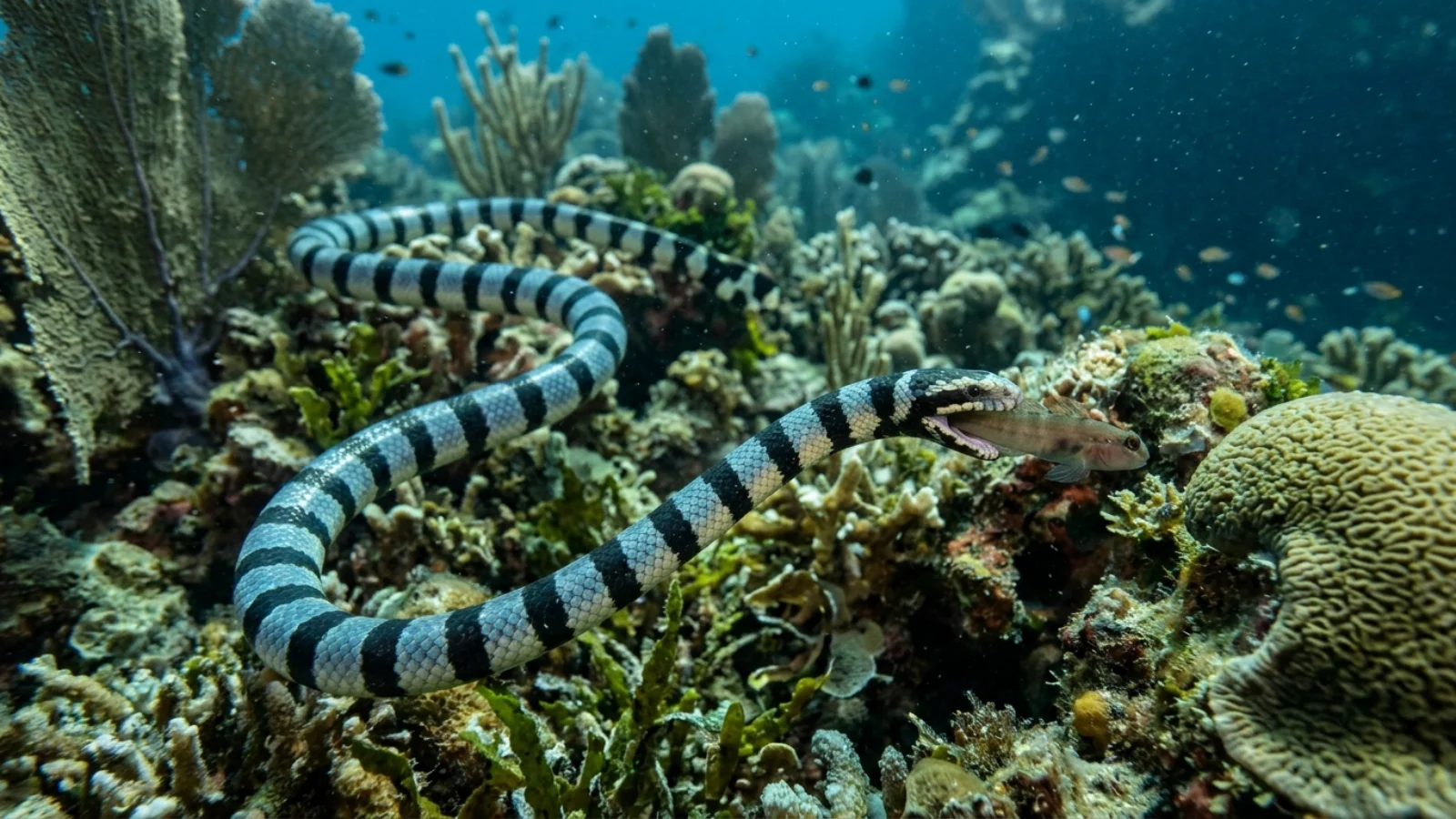
Most sea snakes hunt by probing crevices, burrows and coral heads with the head, then biting fish or eels they find and waiting for the venom to work before swallowing them whole.
| Diet type | Examples of prey | Venom importance |
|---|---|---|
| Eel specialists | Moray and other eels in reef crevices | High: slippery, strong prey must be paralysed quickly |
| Generalist fish eaters | Gobies, blennies, catfish and other bottom fish | High |
| Surface drifters | Small fish sheltering under floating debris (yellow-bellied sea snake) | High: prey must not escape in open water |
| Egg eaters | Fish eggs in nests and on reefs | Low: venom system much reduced |
Sea snakes must breathe at the surface, so every hunt is limited by how long they can stay down. Fast-acting venom shortens the struggle and saves precious oxygen. More on prey in what do sea snakes eat?
How did sea snakes become venomous sea creatures?
They descend from venomous land elapids in the Australasian region. Venom came first; the move to the sea came later.
Two separate groups made the transition. Sea kraits (genus Laticauda) still lay eggs on land and spend time ashore, while the true sea snakes evolved from Australian land elapids and became fully marine, giving birth to live young at sea. Both groups developed paddle-shaped tails, valves to close their nostrils underwater and glands to remove excess salt. Their venom has continued to evolve with diet, which is why eel-eating species, fish-eating species and egg-eating species differ so much in venom potency and composition.
Are sea snakes aggressive toward people?
Generally not. Most sea snakes are calm or curious and bite only when grabbed, trapped or stepped on.
Divers sometimes report sea snakes approaching closely, wrapping briefly around a fin or investigating a mask. In some species, including the olive sea snake, this is more common during the breeding season, when males may mistake a diver’s long fins for a potential mate. The right response is to stay calm, keep still and let the snake move on; quick, flailing movements are more likely to provoke a defensive bite. See are sea snakes aggressive? for more.
- Never pick up or corner a sea snake, alive or dead.
- Wear gloves and take care when sorting nets or handling bycatch.
- In murky estuaries, shuffle your feet and avoid wading where sea snakes are common.
- Seek medical help immediately after any bite, even if there is no pain.
Is sea snake venom useful to science?
Yes. Sea snake neurotoxins bind very precisely to the receptors that link nerves to muscles, which made them useful tools for studying how those receptors work.
Toxins from sea kraits were among the early snake toxins studied in detail by biochemists. Venom research also underpins antivenom production: the antivenom used for sea snake bites is made by immunising animals with venom and purifying the resulting antibodies. Studying how venom varies between species helps doctors understand which antivenoms are likely to work across a region. For a species-by-species look at toxicity, see how venomous are sea snakes?
- Heatwole, H. (1999). Sea Snakes. 2nd ed. UNSW Press, Sydney.
- Rasmussen, A. R., Murphy, J. C., Ompi, M., Gibbons, J. W. & Uetz, P. (2011). Marine reptiles. PLoS ONE 6(11): e27373.
- The Reptile Database (reptile-database.reptarium.cz), species accounts for Hydrophiinae.
- Li, M., Fry, B. G. & Kini, R. M. (2005). Eggs-only diet: its implications for the toxin profile changes and ecology of the marbled sea snake. Journal of Molecular Evolution 60: 81–89.
Are all sea snakes venomous?
Almost all are. The egg-eating turtle-headed and spine-tailed sea snakes have greatly reduced venom and are nearly harmless.
What family do sea snakes belong to?
Elapidae, the family of cobras, kraits, mambas and taipans.
What does sea snake venom do?
It blocks nerve signals to muscles and breaks down muscle tissue; severe cases cause paralysis and kidney failure.
Is there antivenom for sea snakes?
Yes. Australian CSL sea snake antivenom is effective against most species.
Are sea snakes poisonous to eat?
No. They are venomous, not poisonous, and are eaten in parts of Asia.
Which sea snake has the strongest venom?
Dubois’ sea snake, with an LD50 of 0.044 mg/kg in mice.
How do sea snakes use their venom?
To paralyse fish and eels quickly so prey cannot escape into crevices; they then swallow it whole.
Are sea snakes aggressive?
Rarely. Most bite only when grabbed, trapped or stepped on, though some may approach divers out of curiosity.
Blane Perun has been exploring Earth’s oceans and marine life for over 25 years. Founder of TheSea.Org in 1999, underwater photographer, coral aquaculture pioneer, and explorer of 80+ countries.
About Blane Perun → More on Sea Snakes →