Sea Snakes — The Venomous Reptiles That Never Need to Leave the Ocean
Sea snakes are venomous, air-breathing reptiles of the cobra family (Elapidae) that live in the warm coastal waters of the Indian and Pacific oceans. There are about 70 species: roughly 62 “true” sea snakes (tribe Hydrophiini), which give birth at sea and never need to come ashore, and 8 sea kraits (Laticauda), which return to land to digest and lay eggs. All have a flattened, paddle-shaped tail, many carry some of the most potent venoms of any snake, yet most are reluctant to bite and serious bites are rare outside the fishing industry.
People are often surprised to learn that sea snakes are not eels, are not fish, and are close cousins of Australia’s deadly land snakes. Two separate lineages of Australasian elapids made the move from land to sea, the sea kraits first and the true sea snakes later — one of the clearest examples of convergent evolution among reptiles. The result is a group of animals that are, along with whales and dolphins, among the most completely aquatic air-breathing vertebrates on Earth. This guide covers the essentials, with links to every species and question we cover in the sea snakes section.
How many species of sea snakes are there?
There are roughly 70 species of sea snakes, split into two groups that evolved their marine lifestyle independently.
The true sea snakes (Hydrophiini) number about 62 species in around 15 genera. Most are now placed in the huge genus Hydrophis, which absorbed older names such as Lapemis, Enhydrina, Pelamis, Acalyptophis and Astrotia after DNA studies. Other genera include Aipysurus (olive and Dubois’ sea snakes) and Emydocephalus (turtle-headed sea snakes). True sea snakes are fully marine: they mate, give birth, feed and sleep at sea, and they are nearly helpless on land.
The sea kraits (Laticauda) are eight species that branched off earlier. They keep the broad belly scales of land snakes, crawl well on rocks, and come ashore to digest, shed, mate and lay eggs. The banded yellow-lipped sea krait and the black-banded sea krait are the ones divers meet most often.
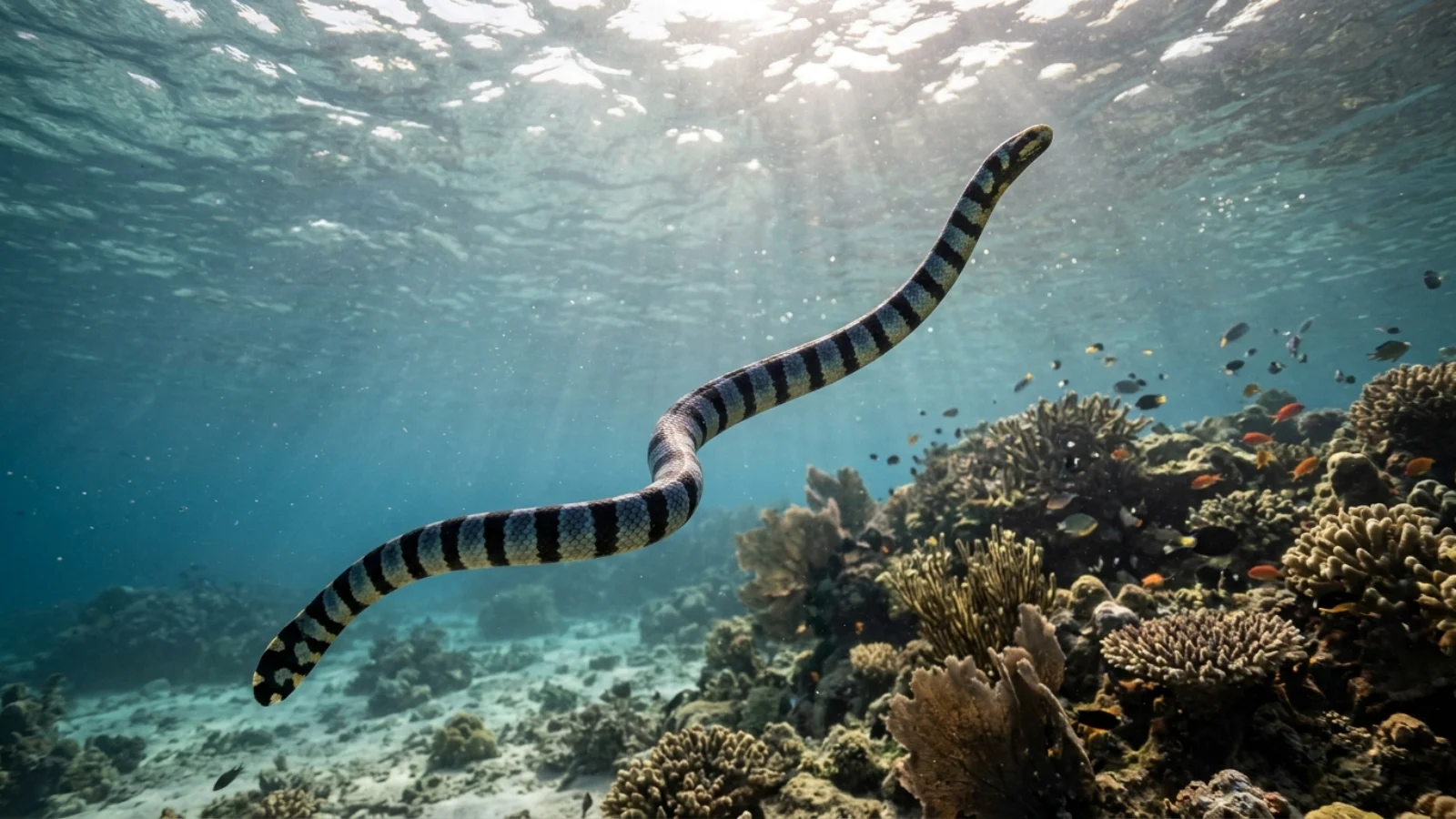
Where do sea snakes live?
Sea snakes live in warm tropical and subtropical waters of the Indian and Pacific oceans, from the Persian Gulf to Japan, Australia and the islands of the western Pacific.
The centre of diversity is the shallow seas of northern Australia, New Guinea and Southeast Asia. Most species are bottom feeders in water less than about 30 m deep: coral reefs, seagrass beds, muddy estuaries and mangrove channels. One species, the yellow-bellied sea snake, is truly oceanic and drifts across the entire tropical Pacific to the coasts of Central America. One population, Hydrophis semperi, lives only in freshwater Lake Taal in the Philippines.
No sea snakes live in the Atlantic or the Red Sea. Cold currents off southern Africa and South America block the pelagic yellow-bellied sea snake from rounding the continents, and the freshwater of the Panama Canal stops it crossing into the Caribbean. For the full map, see where do sea snakes live and where are sea snakes found.
How do sea snakes breathe underwater?
Sea snakes breathe air with a lung, not gills, but they can stay underwater for up to several hours thanks to an enormous lung, skin breathing and a slow metabolism.
A sea snake’s right lung runs almost the whole length of its body; the rear portion acts more like a buoyancy and air-storage sac than a gas-exchange organ. Valves seal the nostrils, which sit on top of the snout so the snake can breathe with only its head tip at the surface. Many species also absorb oxygen through their skin: experiments on the yellow-bellied sea snake show it can meet about 30% of its oxygen needs this way, and dump carbon dioxide through the skin as well.
Typical dives last 30 minutes to two hours, with longer dives when the snake is resting in cool water. Most species forage in shallow water, but industry ROV footage off north-western Australia has recorded sea snakes at around 240 m. Our breathing questions dig deeper: how do sea snakes breathe, do sea snakes have gills and how long a sea snake can hold its breath.
How have sea snakes adapted to the ocean?
Beyond breathing, true sea snakes have rebuilt the land-snake body plan for the sea:
- Paddle tail: the tail is flattened side to side into an oar, and many species also have compressed bodies, giving them an eel-like profile.
- Salt gland: a gland under the tongue sheath (the posterior sublingual gland) removes excess salt, which is flicked out with the tongue.
- Fresh water: despite living in the sea, sea snakes can become dehydrated and drink fresh water from rain lenses on the sea surface; some go months without a drink during droughts.
- Reduced belly scales: most true sea snakes have lost the wide belly scales land snakes use to grip, so they struggle to move on land.
- Light-sensing tails: the olive sea snake has light-sensitive cells in its tail skin, probably so it knows when its tail is hidden while it rests in a crevice.
- Smell: they have lost the main olfactory system and “smell” only through the tongue-fed Jacobson’s organ.
What do sea snakes eat?
Most sea snakes eat fish, and many specialise: eels, gobies, catfish, or even only fish eggs.
Reef species like the olive sea snake probe crevices for sleeping fish; sea kraits hunt moray and conger eels; the beaked sea snake takes catfish and pufferfish in murky estuaries. A few have abandoned hunting altogether. The turtle-headed sea snake and the spine-tailed sea snake eat only fish eggs, scraped from nests, and have nearly lost their venom. The yellow-bellied sea snake floats in surface slicks and ambushes small fish that shelter beneath it. More detail: what do sea snakes eat.
Are sea snakes dangerous to humans?
Sea snakes carry potent venom, but most are reluctant to bite, and nearly all serious bites happen to fishermen handling snakes caught in nets.
Many sea snakes have venom that, drop for drop, is among the most toxic of any snake. Their fangs are short and the amount of venom delivered is usually small, and a large share of defensive bites inject little or no venom. In people, severe sea snake envenoming most often destroys skeletal muscle (myotoxicity), releasing myoglobin that can damage the kidneys, along with paralysing neurotoxic effects. Symptoms can take several hours to appear, so any bite needs hospital assessment. A sea snake antivenom made in Australia is effective.
Divers who leave snakes alone are rarely at risk. Some species, including the olive sea snake, Stokes’ sea snake and the beaked sea snake, are known to be more defensive, and curious males in the breeding season sometimes approach divers, apparently mistaking fins for a mate. Read are sea snakes dangerous, how venomous are sea snakes and are sea snakes aggressive for the details.
How do sea snakes reproduce?
True sea snakes are viviparous: the young develop inside the mother and are born live in the water, typically in litters of a few to around 20 depending on species and the mother’s size. This live birth is what freed them from land entirely. Sea kraits, in contrast, lay eggs in rock crevices and caves above the high-tide line, which is why they must still crawl ashore. Many species mature in two to four years and live perhaps ten years, though data are limited for most.
Which sea snake species should you know?
Some of the most notable species we profile:
- Beaked sea snake — blamed for most serious bites in South and Southeast Asia.
- Dubois’ sea snake — one of the most toxic snake venoms ever measured in mice.
- Belcher’s sea snake — often wrongly called the world’s most venomous snake.
- Stokes’ sea snake — the heaviest, with the longest fangs.
- Horned sea snake — spiny “horns” over each eye.
- Yellow sea snake — the longest sea snake, up to about 3 m.
Are sea snakes endangered?
Most sea snakes are listed as Least Concern or Data Deficient by the IUCN, but some are in real trouble. On Australia’s Ashmore Reef, sea snakes declined dramatically from the late 1990s and two endemic species, the short-nosed and leaf-scaled sea snakes, have not been seen there in years and are listed as Critically Endangered. Bycatch in prawn trawls, the skin trade, habitat loss and warming seas are the main threats.
How many species of sea snakes are there?
About 70: roughly 62 true sea snakes (tribe Hydrophiini) and 8 sea kraits (genus Laticauda). Taxonomy keeps changing as DNA studies split and merge species.
Are sea snakes venomous?
Yes. Almost all sea snakes are venomous and many have extremely potent venom. The fish-egg specialists of the genus Emydocephalus and Aipysurus eydouxii have greatly reduced venom.
Can a sea snake kill you?
It can, but it is rare. Most serious and fatal bites involve fishermen handling snakes caught in nets. With prompt hospital care and antivenom, most victims recover.
Do sea snakes have gills?
No. Sea snakes breathe air with lungs and must surface to breathe, although many species absorb some oxygen through their skin.
How long can sea snakes stay underwater?
Typical dives last 30 minutes to 2 hours, and resting snakes in cool water can stay down for several hours.
Are there sea snakes in the Atlantic Ocean or Caribbean?
No. Sea snakes live only in the Indian and Pacific oceans. Cold currents and the freshwater Panama Canal keep them out of the Atlantic and Caribbean.
What is the difference between a sea snake and a sea krait?
True sea snakes are fully marine and give live birth at sea. Sea kraits have wide belly scales, come ashore to rest and digest, and lay eggs on land.
What is the biggest sea snake?
The yellow sea snake, Hydrophis spiralis, is the longest at up to about 3 m. Stokes’ sea snake is the heaviest-bodied.
Are sea snakes aggressive?
Most are not. They are curious and may approach divers, especially males during breeding season, but they rarely bite unless grabbed, stepped on or trapped.
Blane Perun has been exploring Earth’s oceans and marine life for over 25 years. Founder of TheSea.Org in 1999, underwater photographer, coral aquaculture pioneer, and explorer of 80+ countries.
About Blane Perun → More on Sea Snakes →