Where Are Sea Snakes Found? — From the Persian Gulf to Panama, but Never the Atlantic
Sea snakes are found across the warm Indian and Pacific oceans: from the Persian Gulf and the east coast of Africa through South and Southeast Asia to Japan, northern Australia and the Pacific islands, and — for the yellow-bellied sea snake — to the Pacific coast of the Americas and Hawaii. The richest region is northern Australia and Southeast Asia. They are absent from the Atlantic, the Caribbean, the Mediterranean and the Red Sea.
Where are sea snakes most common?
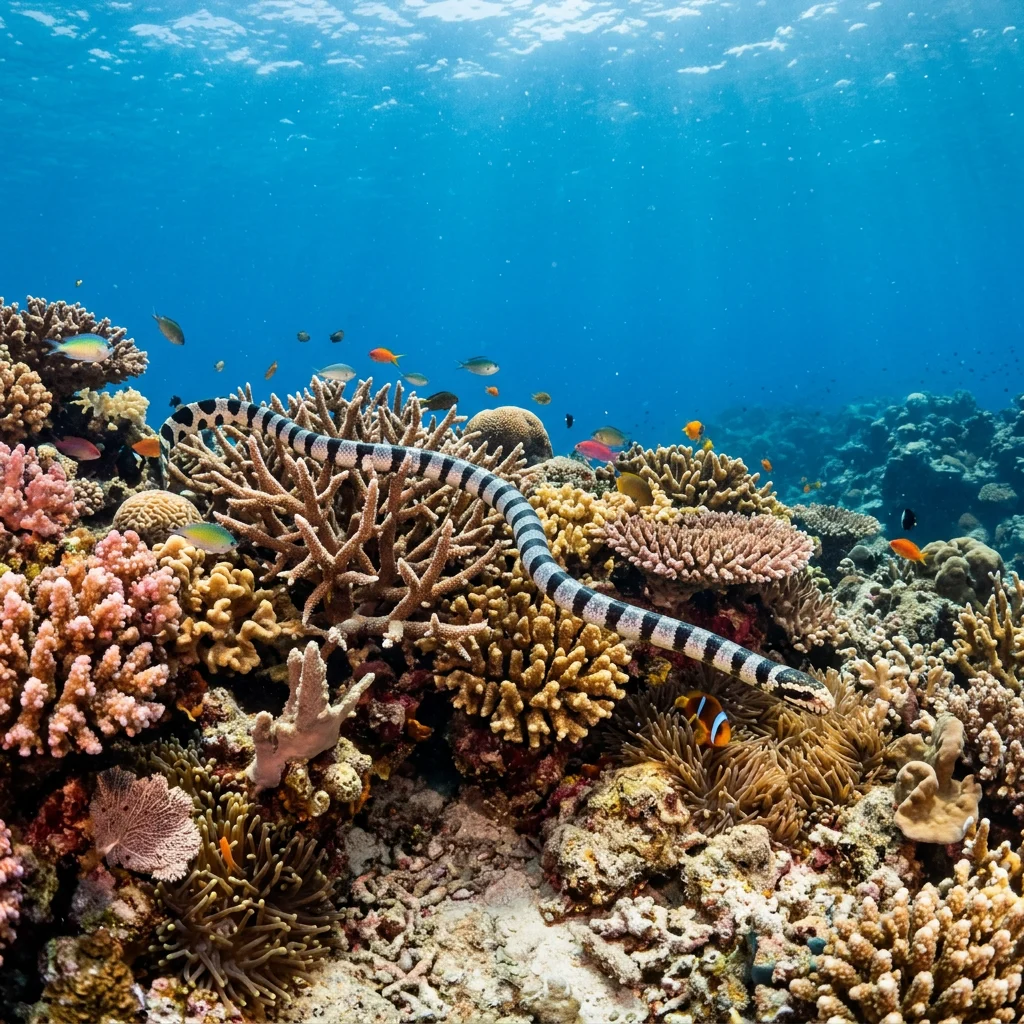
Diversity peaks in the shallow seas of northern Australia, New Guinea and Southeast Asia, including the Gulf of Thailand, the Java and South China seas and the Indonesian archipelago. Northern Australia alone has around 30 species, and reefs such as Ashmore Reef in the Timor Sea once had the highest sea snake densities recorded anywhere.
How many sea snakes are there, and do they all live in the same places?
About 69 species of sea snake live in the sea, divided between two quite different groups, and the two groups are found in different kinds of places. The “true” sea snakes (tribe Hydrophiini) are fully marine. They give birth to live young in the water, cannot move properly on land, and are closely related to the venomous land snakes of Australia, such as taipans and tiger snakes. A 2013 study counted 62 species in 16 genera in this group. The sea kraits (genus Laticauda) are only semi-aquatic: they keep the wide belly scales of land snakes, come ashore to digest their prey, mate and lay eggs, and so need rocky islands and shorelines as well as reefs.
That difference shapes their maps. True sea snakes reach their greatest diversity in the shallow seas around northern Australia and New Guinea, where their land-snake relatives also live, and they spread out from there through Southeast Asia and the Indian Ocean. Sea kraits are island specialists, found from India and the Bay of Bengal through Southeast Asia north to Japan and east to Fiji and neighbouring Pacific islands. Despite their abundance in the western Pacific, there is no evidence of breeding sea krait populations in Australian waters, according to a 2014 review of the Australian sea snake fauna, although individuals occasionally wander to the east coast of Australia and to New Zealand.
Breeding explains much of this pattern. Every true sea snake is live-bearing: the young are born in the water, in some species at up to half the length of their mother, and never need to touch land, so a true sea snake can live anywhere the water is warm and shallow enough to feed. Sea kraits, by contrast, are the only egg-laying sea snakes. Females must haul out to lay their eggs on land, and although kraits can gather in high densities on suitable islands, their nests are very rarely found, which suggests they need particular conditions. Kraits also return to shore to digest their meals, although they have never been seen feeding on land. Their range is therefore limited to coasts with suitable rocky islands, caves and crevices close to good hunting reefs.
Australia sits at the heart of the true sea snakes’ range. Australian waters hold roughly 32 species, more than half of global diversity, including 13 found nowhere else. They live in a wide range of shallow habitats across the north of the continent, including estuaries, coral reefs, soft-sediment seabeds and seagrass meadows.
What kinds of habitat do sea snakes use within their range?
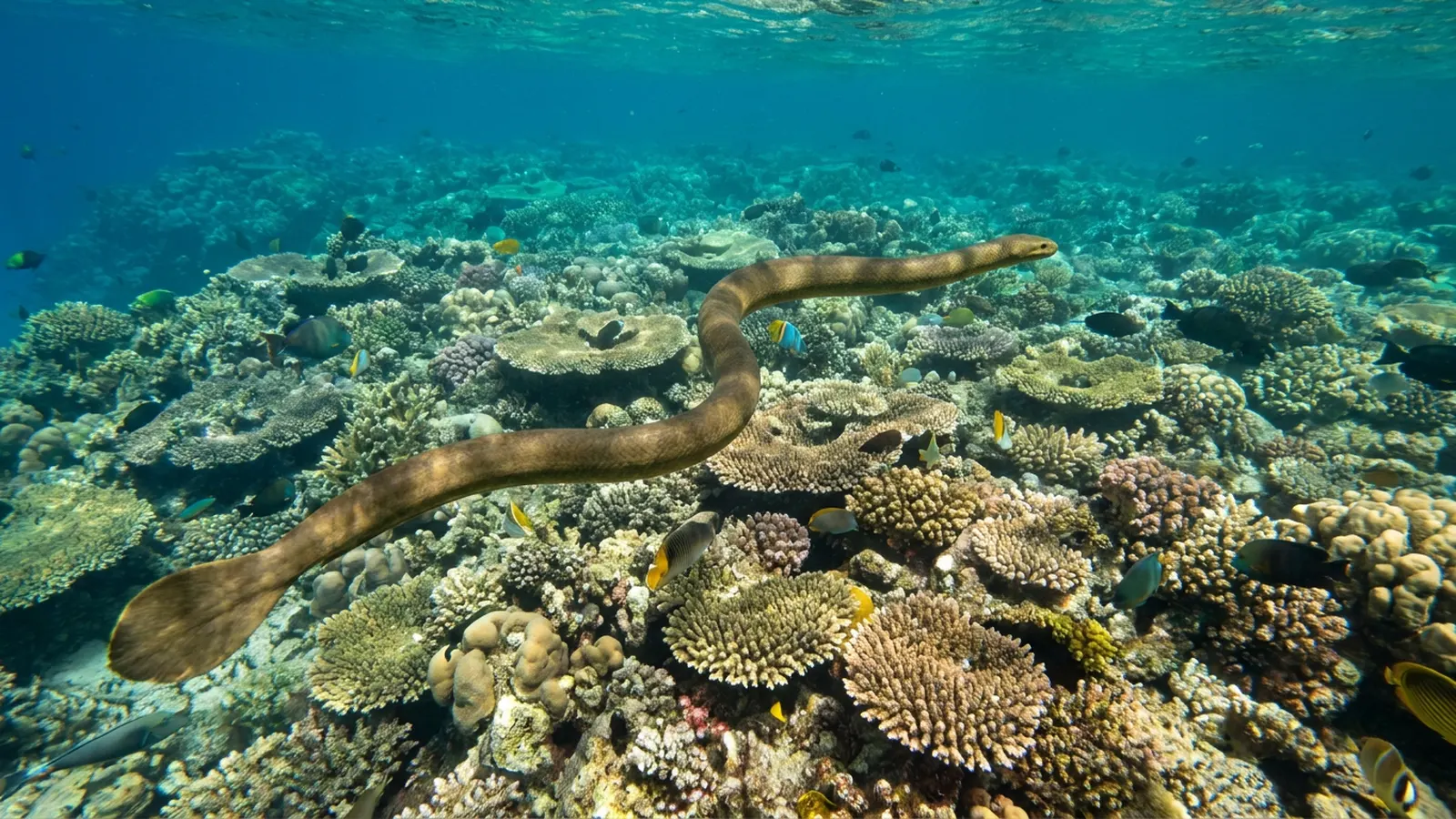
Most sea snakes prefer shallow, fairly sheltered water near land: coral and rocky reefs, lagoons, the waters around islands, estuaries, mangroves and muddy bays. Some species swim up rivers, and sea snakes have been reported as far as 160 km from the sea. They can dive to more than 90 m and stay submerged for long periods, depending on temperature and activity, but most foraging happens much shallower, among reef crevices and on the seabed where they hunt fish, eels and fish eggs. Reef-dwelling species such as the olive sea snake (Aipysurus laevis) have overlapping scales that protect them against sharp coral, while open-water species tend to have smaller, non-overlapping scales.
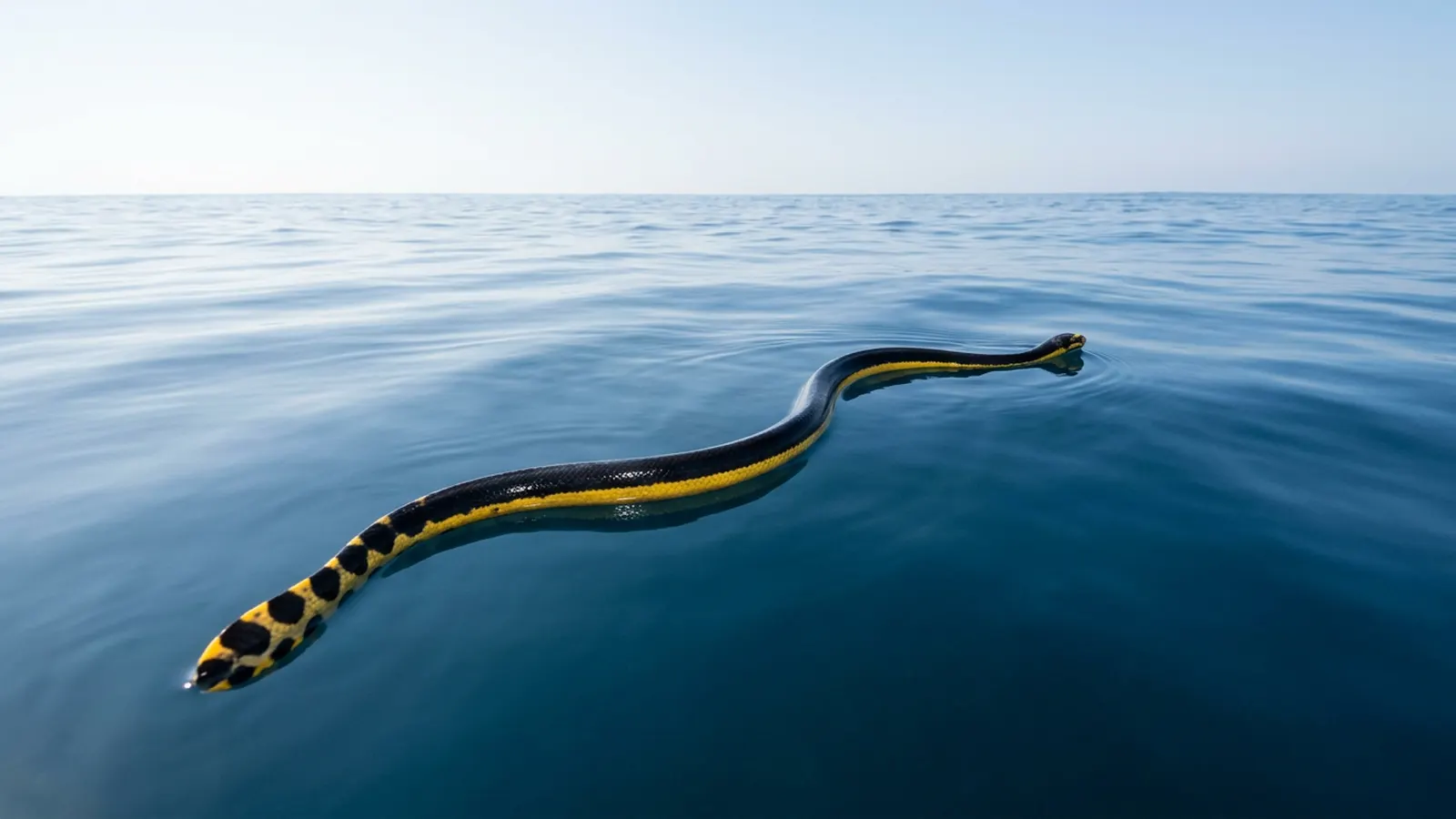
The yellow-bellied sea snake (Hydrophis platurus) is the great exception. It lives in the open ocean, drifting with surface currents and gathering in slicks of floating debris, where small fish shelter and become its prey. That drifting lifestyle is why it has one of the widest ranges of any snake, covering the whole tropical Indian and Pacific oceans from the coast of East Africa to the Pacific coast of the Americas, and why it is the only sea snake to have reached Hawaii.
A few sea snakes have even returned to fresh water. Hydrophis semperi, the Lake Taal snake, lives only in Lake Taal, a volcanic lake on Luzon in the Philippines, and the sea krait Laticauda crockeri is found only in Lake Te-Nggano, a brackish lake on Rennell Island in the Solomon Islands. Both are relics of marine ancestors that became trapped inland and adapted to low-salinity water.
| Region | Examples of species | Notes |
|---|---|---|
| Persian Gulf & Arabian Sea | Beaked, yellow, Shaw’s, ringed | Western edge of the range |
| South Asia (India, Sri Lanka, Bangladesh) | Beaked, Jerdon’s, dwarf, ringed | Most bites to fishers |
| Southeast Asia | Shaw’s, bighead, spine-tailed, viperine | High diversity, heavy bycatch |
| Northern Australia & New Guinea | Olive, Dubois’, elegant, Stokes’ | Global hotspot (~30 species) |
| East Asia (China, Taiwan, Japan) | Black-banded sea krait, ringed | Northern limit near Korea/Japan |
| Pacific islands | Yellow-lipped sea krait | Kraits common around Fiji, Vanuatu |
| Eastern Pacific & Hawaii | Yellow-bellied only | Open-ocean drifters |
Why are there no sea snakes in the Atlantic?
Sea snakes evolved in the Indo-Australian region, and by the time they had diversified, the Isthmus of Panama had closed off the tropical connection between the Pacific and Atlantic. The only route left is around the southern tips of Africa and South America, where cold currents such as the Benguela and Humboldt block tropical snakes. The pelagic yellow-bellied sea snake has occasionally been found in the Benguela Current off Namibia and South Africa, and it has been recorded four times in the Colombian Caribbean, the only sea snake ever found there, although how those animals arrived is unclear. The fresh water of the Panama Canal, which passes through Gatun Lake, is thought to stop natural crossings.
Where did sea snakes come from?
Sea snakes are a young group in evolutionary terms. Molecular dating suggests that all living true sea snakes shared a common ancestor only about 6 million years ago, and that most living lineages arose within the last 3.5 million years. The “core” Hydrophis group, which holds many of the species divers see today, is dated at only 1.5 to 3 million years old, making it one of the fastest-speciating groups of reptiles known. Their ancestors were Australasian land elapids that moved into the sea, and the shallow shelves and shifting coastlines of the Indo-Australian archipelago during the ice ages, when sea levels rose and fell repeatedly, probably helped split populations into new species.
This recent origin is a big part of why sea snakes never colonised the Atlantic. By the time the group had diversified, the Isthmus of Panama, which closed roughly 3 million years ago, had already shut the tropical seaway between the Pacific and the Caribbean. Any later colonist would have had to travel around the cold southern tips of Africa or South America. Sea snakes are tropical animals that cannot tolerate cold water for long, so those routes have stayed closed.
Why are there no sea snakes in the Red Sea?
The Red Sea has none, probably because of its high salinity and the narrow, shallow Bab-el-Mandeb strait, though sea snakes live nearby in the Gulf of Aden and Arabian Sea. The Mediterranean also has none.
Are there sea snakes in Hawaii, California or Mexico?
Only the yellow-bellied sea snake. It is the only sea snake recorded in Hawaii, and it occurs along the Pacific coast from Mexico’s Gulf of California to northern Peru. Strays have washed up in southern California during warm-water events, most famously in October 2015.
How far do sea snakes stray outside their normal range?
Warm currents and storms occasionally carry sea snakes far beyond the tropics. Yellow-bellied sea snakes have been recorded on the coasts of Tasmania, New Zealand and southern California. In October 2015, during a strong warm-water event in the eastern Pacific, yellow-bellied sea snakes were photographed on beaches in Ventura County, California, the first reports there in 30 years. New Zealand, which has no land snakes, receives occasional visits from yellow-bellied sea snakes and banded sea kraits.
These strays are unlikely to survive long, because sea snakes are tropical reptiles that depend on warm water to stay active. The same physiological limit sets the edges of their normal range. On the African Atlantic coast, yellow-bellied sea snakes have been found in the Benguela Current off Namibia and South Africa, but the cold water there prevents them from settling and moving north into the tropical Atlantic. On the Pacific coast of South America they rarely occur beyond northern Peru, where the cold Humboldt Current takes over.
Are there sea snakes in Australia, Thailand and the Philippines?
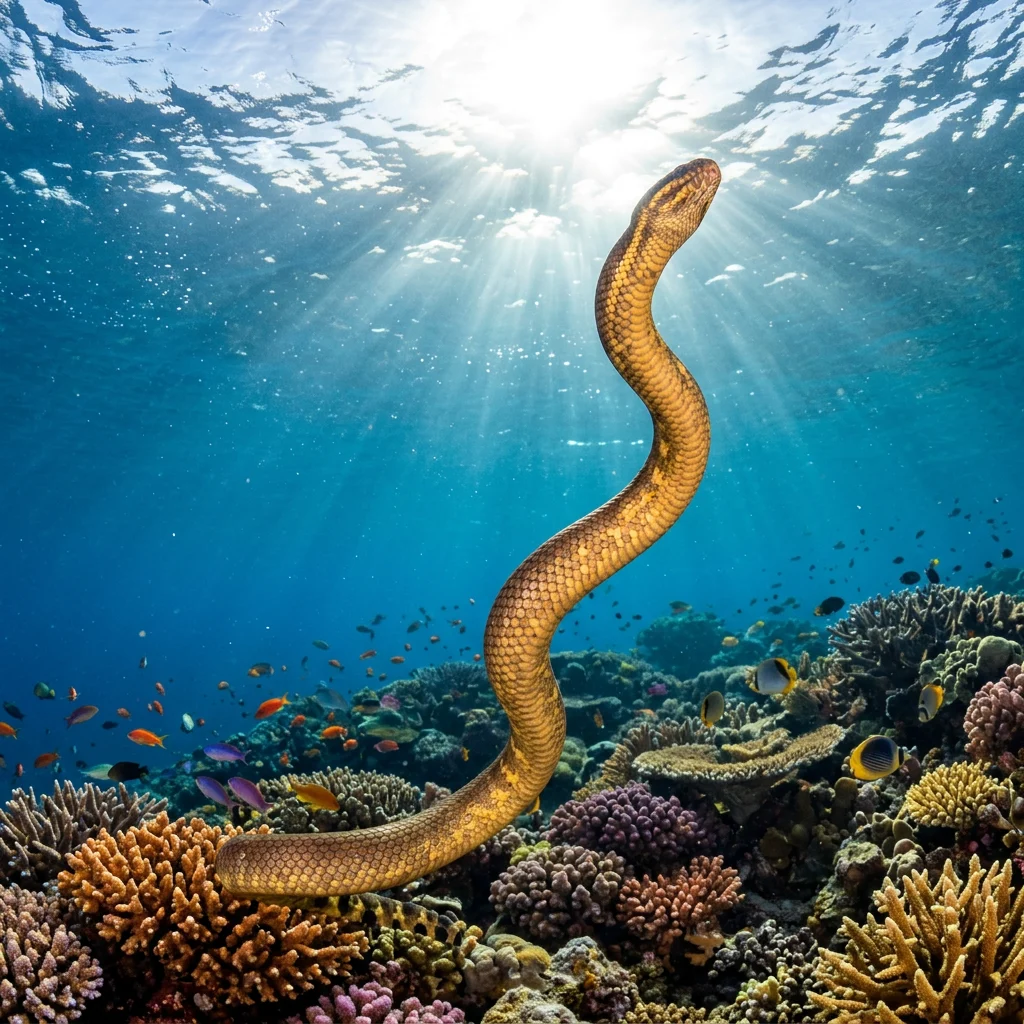
Yes, all three have many species. Australia’s tropical waters from Western Australia to Queensland are a global hotspot; Thailand’s Andaman Sea and Gulf of Thailand coasts and the Philippines’ reefs host numerous sea snakes and kraits. See where do sea snakes live for habitats.
Which sea snakes live in each region?
At the western edge of the range, the Persian Gulf and Arabian Sea hold several species, of which the beaked sea snake (Hydrophis schistosus) is the most important to people. It ranges from the Gulf and the Arabian Sea south to the Seychelles and Madagascar, along the coasts of Pakistan, India, Sri Lanka and Bangladesh and on into Southeast Asia and northern Australia. It favours muddy estuaries and coastal waters where fishers work, and it is implicated in more than half of all sea snake bites and the great majority of deaths, which is why South Asia is the region where sea snakes matter most for public health.
Southeast Asia, from the Andaman Sea and the Gulf of Thailand to the South China Sea and the Indonesian archipelago, combines high diversity with heavy fishing pressure, and many sea snakes are caught as bycatch in trawls and nets. Further north, the yellow-lipped sea krait (Laticauda colubrina) ranges from the Bay of Bengal through Southeast Asia to southern China, Taiwan and the Ryukyu Islands, and the black-banded sea krait (Laticauda semifasciata), known in Okinawa as the irabu, has long been eaten there as a smoked ingredient in a traditional soup, irabu-jiru. In the western Pacific, sea kraits are common around Fiji and neighbouring islands, and stray kraits have occasionally reached New Zealand, with six yellow-lipped sea kraits found around the North Island between 1880 and 2005.
What happened to the sea snakes of Ashmore Reef?
Ashmore Reef, an isolated reef in the Timor Sea between Australia and Indonesia, was once the best place in the world to see sea snakes. Surveys there in 1973 and 1994 recorded an average of 42 to 46 snakes a day and nine species. By 2002 abundance had fallen by more than half, to about 21 snakes a day, with only five species seen. Since 2005 counts have stayed between one and seven snakes a day, and only two species, the olive sea snake and the turtle-headed sea snake (Emydocephalus annulatus), are still recorded in any numbers.
Five species that were once common at Ashmore have not been seen there despite extensive searches, especially in 2010, and are presumed locally extinct. They include three Timor Sea endemics, the short-nosed sea snake (Aipysurus apraefrontalis), the leaf-scaled sea snake (A. foliosquama) and the dusky sea snake (A. fuscus), as well as Dubois’ sea snake (A. duboisii). The decline is a puzzle, because Ashmore has been a protected National Nature Reserve since 1983, and the researchers who documented it could not identify a cause.
There was some good news later. In a study published in Biological Conservation, Blanche D’Anastasi and colleagues reported living short-nosed sea snakes on Ningaloo Reef in Western Australia, a species that had not been seen alive for about 15 years, as well as leaf-scaled sea snakes in Western Australian waters more than 1,000 miles from Ashmore. The short-nosed sea snake is listed as Critically Endangered, and its rediscovery shows how little is known about where some sea snakes actually live.
Where can you see sea snakes safely?
Divers and snorkellers most often meet sea snakes on reefs in northern Australia, including the Coral Sea and Western Australia, in Southeast Asia from Thailand’s Andaman coast to Indonesia and the Philippines, and around Pacific islands such as Fiji, Vanuatu and New Caledonia, where banded sea kraits are often seen resting on rocks or hunting through the reef. Curious species such as the olive sea snake may approach divers closely, which can be alarming but is rarely dangerous.
Sea snakes are generally reluctant to bite and are considered mild-tempered, although behaviour varies between species and individuals. Most are highly venomous, but they rarely inject venom when they bite people, so serious envenomations are uncommon. The highest risk is to fishers who handle snakes caught in nets and trawls, especially in South and Southeast Asia. In Australia, the death of a trawler fisherman in 2018 was reported as the region’s first sea snake fatality since a pearl diver died in 1935. The safe approach is simple: watch from a distance, never handle a sea snake, and take care when sorting a fishing catch in waters where they occur.
- Heatwole, H. (1999). Sea Snakes. 2nd ed. UNSW Press, Sydney.
- Rasmussen, A. R., Murphy, J. C., Ompi, M., Gibbons, J. W. & Uetz, P. (2011). Marine reptiles. PLoS ONE 6(11): e27373.
- The Reptile Database (reptile-database.reptarium.cz), species accounts for Hydrophiinae.
- Sanders, K.L. et al. (2013). Multilocus phylogeny and recent rapid radiation of the viviparous sea snakes (Elapidae: Hydrophiinae). Molecular Phylogenetics and Evolution.
- Lukoschek, V. et al. (2013). Enigmatic declines of Australia’s sea snakes from a biodiversity hotspot. Biological Conservation.
- Ukuwela, K.D.B. et al. (2014). Sea snakes in Australian waters: a review with an updated identification key. Zootaxa 3869.
- State of the Environment 2016 (Australia). Marine chapter expert assessment: sea snakes.
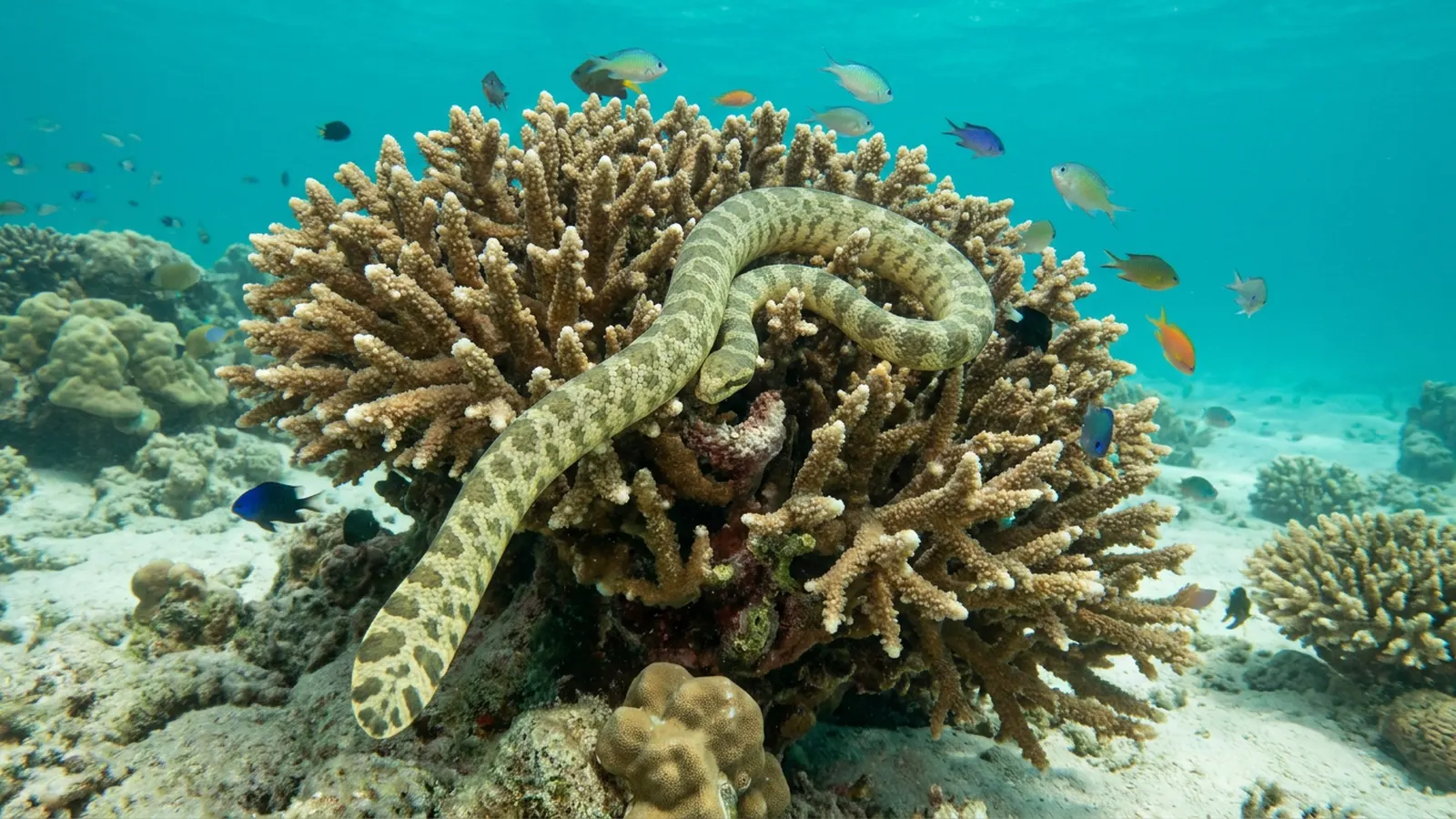
Where are sea snakes found?
In the tropical and subtropical Indian and Pacific oceans, from the Persian Gulf and East Africa to Japan, Australia, the Pacific islands and the Pacific coast of the Americas.
Are there sea snakes in the Atlantic Ocean?
No native populations. Cold currents and the Isthmus of Panama keep them out.
Are there sea snakes in the Caribbean?
No native ones. Yellow-bellied sea snakes have been recorded four times off Colombia’s Caribbean coast, but no population lives there.
Are there sea snakes in the Red Sea?
No, although they occur in the nearby Gulf of Aden and Arabian Sea.
Where is the best place to see sea snakes?
Northern Australia, Southeast Asia and Pacific islands such as Fiji and Vanuatu, where reef species and sea kraits are common.
Are there sea snakes in Hawaii?
Only the yellow-bellied sea snake, which is occasionally seen in Hawaiian waters.
Can sea snakes live in fresh water?
Two species do: the Lake Taal snake in the Philippines and the sea krait Laticauda crockeri of Lake Te-Nggano in the Solomon Islands.
Which country has the most sea snakes?
Australia, with about 32 species, more than half of the world’s sea snake diversity.
