Turtle-Headed Sea Snake — The Sea Snake That Only Eats Fish Eggs
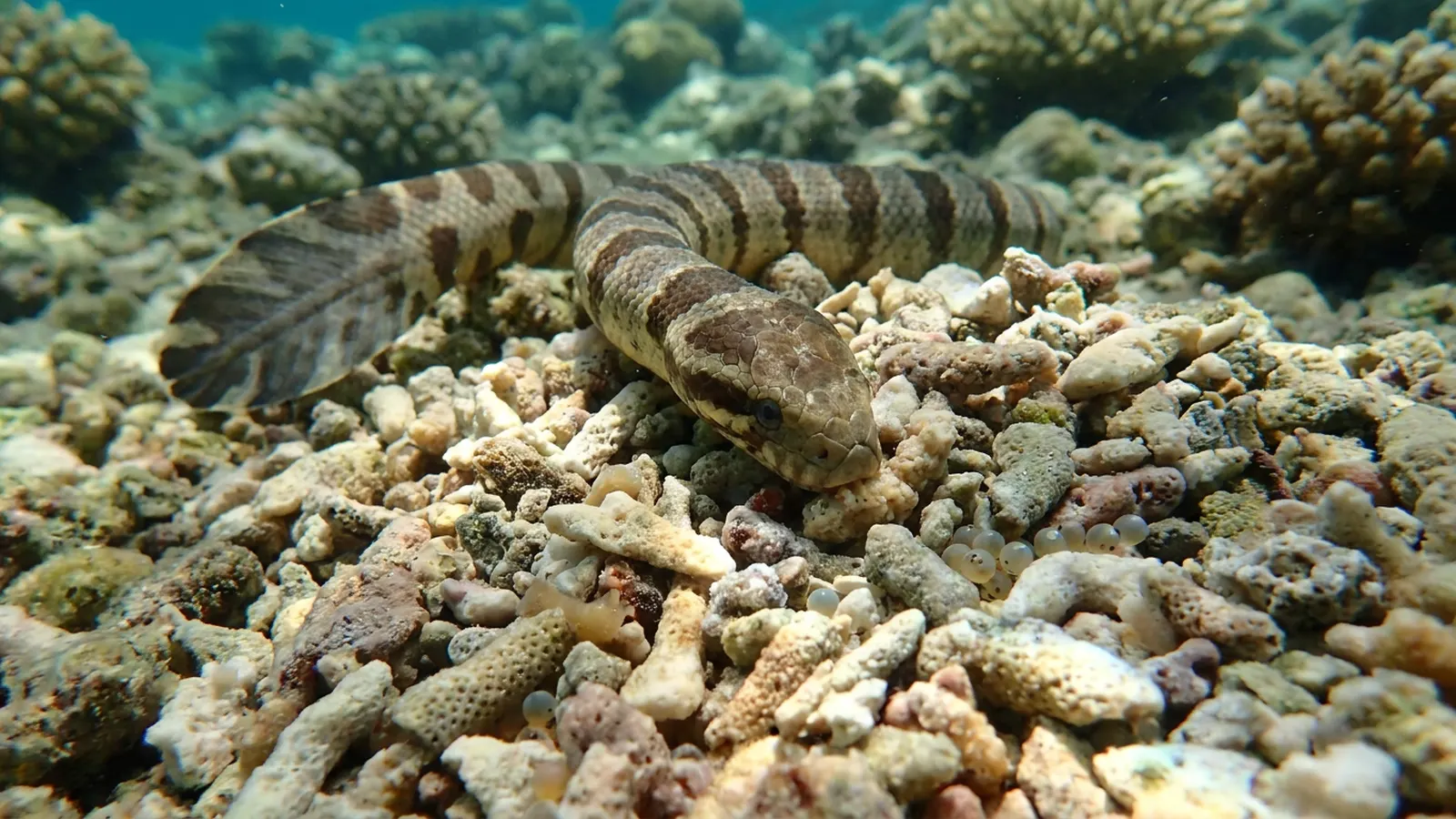
The turtle-headed sea snake (Emydocephalus annulatus), also called the egg-eating sea snake, is a medium-sized reef sea snake of the western Pacific, found on the Great Barrier Reef, Timor Sea reefs, New Caledonia and nearby islands. It is named for its short, blunt, turtle-like head. Uniquely among sea snakes, it feeds only on the eggs of reef fish, scraping them off rocks and coral, and its fangs and venom have dwindled so much that it is practically harmless to people. It grows to about 1 m.
Most sea snakes are hunters with potent venom. The turtle-headed sea snake gave all that up. Over millions of years it switched to a diet that cannot run, bite or fight back — fish eggs — and its fangs, venom glands and even many of its teeth shrank accordingly. Herpetologists have compared its feeding to a grazing mammal more than a predator, and it is one of the most closely studied sea snakes in the world, thanks to long-term research on the reefs of Nouméa, New Caledonia.
What does the turtle-headed sea snake look like?
It has a short, blunt, rounded head that really does resemble a turtle’s, a slender body and a paddle tail, and its colour ranges from plain black or brown to boldly banded in cream, yellow or white.
The large head shields are regular and entire, and the tip of the snout carries a conical rostral scale; in males it bears a small spine used in courtship. The body has 15–17 rows of smooth, overlapping scales and 125–145 belly scales. Colour is highly variable even within a single reef: some individuals are uniformly black, others are ringed with pale bands on a dark background, and some are mostly pale. Males have much rougher scales than females, which are the larger sex.

How big is the turtle-headed sea snake?
Adults typically measure 60–90 cm, with a maximum recorded length of about 103 cm. Females grow larger than males. It is a relatively slim snake compared with heavy-bodied species such as Stokes’ sea snake or the olive sea snake that share its reefs.
Where does the turtle-headed sea snake live?
It lives on shallow coral reefs and in lagoons in a patchy range: Queensland’s Great Barrier Reef and the Coral Sea, reefs of the Timor Sea off north-western Australia, and New Caledonia and the Loyalty Islands.
It is absent from the Gulf of Carpentaria between those regions, so its distribution is split into eastern and western populations. Within a reef, individuals are strongly sedentary, often living their whole lives within a small home range. Researchers believe this lets them learn and revisit the locations of fish nests. In New Caledonia it is a familiar sight to snorkellers in shallow bays such as the Baie des Citrons in Nouméa; see New Caledonia coral reef maps.
What does the turtle-headed sea snake eat?
It eats only fish eggs, specifically the eggs that bottom-dwelling reef fish attach to rocks, coral and the inside of crevices.
Favourite sources are the egg clutches of damselfish, blennies and gobies. The snake moves slowly over the reef, tongue-flicking to detect nests, then presses its mouth against the eggs and scrapes them off with enlarged, specialised scales on its lips. It has lost the palatal teeth other sea snakes use to grip prey. Unlike most snakes, which eat large meals infrequently, it eats many small meals often. Larger snakes take more damselfish eggs, which are laid in exposed spots, while smaller snakes can squeeze into the narrow crevices where gobies and blennies hide theirs. Guarding damselfish often attack the snake while it feeds, to little effect.
Is the turtle-headed sea snake dangerous?
Not in any meaningful way. Its reduced fangs and weak venom make it effectively harmless, and it is placid and curious. That said, it is still a wild animal and should not be handled. Snorkellers in New Caledonia sometimes report males approaching and following them; this is thought to be mistaken courtship, as males use vision to find females in the water and investigate any moving object of about the right size. See are sea snakes aggressive.

How do turtle-headed sea snakes find mates?
Land snakes track mates by scent trails on the ground, which do not work in water. Turtle-headed sea snake males instead search visually, reacting to the size, movement and colour pattern of nearby objects — which is why they sometimes chase divers’ fins. Once a male reaches a female, he tongue-flicks her skin, and chemical signals from lipids on her skin confirm she is a female of the right species before courtship continues. Studies in New Caledonia found males prefer to court females whose colour matches their own. Like other true sea snakes it gives birth to live young, usually small litters of a few babies.
Why are some turtle-headed sea snakes black?
Colour affects their lives in surprising ways. Darker, plain snakes collect more algae on their skin than pale, banded ones, which can slow them by up to about 20% and makes them more likely to hide. More strikingly, a 2017 study in New Caledonia found that black (melanic) turtle-headed sea snakes were more common near industrial and urban areas. Dark skin binds more trace metals, and dark snakes also shed their skin more often, which may help them get rid of pollutants — a possible marine example of “industrial melanism,” like the famous peppered moth.
Are there other turtle-headed sea snakes?
Emydocephalus annulatus is one of three species in its genus, all egg specialists. Ijima’s turtle-headed sea snake (E. ijimae) lives around the Ryukyu Islands of southern Japan and Taiwan, and E. szczerbaki is known from the coast of Vietnam. Their scattered distribution across the western Pacific suggests the genus once had a wider range. All three share the blunt head, reduced venom apparatus and egg-scraping lip scales, and DNA studies place Emydocephalus close to Aipysurus, the genus of the olive sea snake and Dubois’ sea snake.
How does the turtle-headed sea snake breathe and rest?
Like all true sea snakes it breathes air and must surface regularly, but its shallow reef habitat means a breath is never far away. Studies of free-ranging snakes show it typically makes short foraging dives across the reef, surfacing every so often, and rests for longer periods tucked under ledges or in crevices. Its single elongated lung acts as both an oxygen store and a buoyancy aid. Because it never needs to chase prey, its energy needs are modest, which helps it stay submerged while slowly working over a reef. See do sea snakes breathe air.
| Trait | Turtle-headed sea snake | Typical fish-eating sea snake |
|---|---|---|
| Diet | Fish eggs only | Fish, eels |
| Fangs | Tiny | Short but functional |
| Venom | Greatly reduced | Potent |
| Palatal teeth | Absent | Present |
| Meal pattern | Small, frequent meals | Large, infrequent meals |
Is the turtle-headed sea snake declining?
It is listed as Least Concern overall, but local declines are worrying. In Nouméa’s protected snorkelling area, volunteers recorded an average of more than six snakes a day in 2003 but fewer than two a day by 2011, and turtle-headed sea snakes also declined at Ashmore Reef in the Timor Sea, along with other sea snakes there. Suggested causes include habitat degradation, coral bleaching, pollution and tourism pressure, though no single cause has been proven. Because the species is so sedentary, local populations that disappear may be slow to recover.
Why is it called the turtle-headed sea snake?
Because its short, blunt, rounded head looks remarkably like a turtle’s.
What does the turtle-headed sea snake eat?
Only fish eggs, mainly those of damselfish, blennies and gobies, which it scrapes off rocks and coral.
Is the turtle-headed sea snake venomous?
It is technically venomous, but its fangs and venom glands are so reduced, and its venom so weak, that it is considered practically harmless to humans.
Where does the turtle-headed sea snake live?
On shallow coral reefs of the Great Barrier Reef, the Timor Sea reefs off north-western Australia, New Caledonia and the Loyalty Islands.
How big does the turtle-headed sea snake get?
Up to about 1 m (103 cm); most adults are 60–90 cm.
Why do turtle-headed sea snakes follow divers?
Males find mates by sight and may mistake a diver’s moving fins for a female, approaching to investigate.
Is the turtle-headed sea snake endangered?
It is listed as Least Concern, but populations have declined in New Caledonia and at Ashmore Reef.
Blane Perun has been exploring Earth’s oceans and marine life for over 25 years. Founder of TheSea.Org in 1999, underwater photographer, coral aquaculture pioneer, and explorer of 80+ countries.
About Blane Perun → More on Sea Snakes →