Snorkeling — How It Works, How to Stay Safe, and Where to Go
Snorkeling is swimming face-down at the surface while you breathe through a short tube, the snorkel, and look through a mask at the water below. Add fins and you can cover a reef with very little effort. It needs no certification and little equipment, which makes it the easiest way to see coral reefs, turtles, rays and reef fish in the wild.
Some of the richest reef life lives in the top few metres of water, where light is strongest and corals grow fastest. A calm lagoon at sunrise is often better from the surface than from 20 m down on scuba. This hub explains how snorkels work and why they are so short, where the activity came from, what the research says about the risks, how to snorkel without harming the reef, and where to go next on TheSea.Org.
What do you need to go snorkeling?
A mask, a snorkel and usually fins, plus protection from sun, cold and stings.
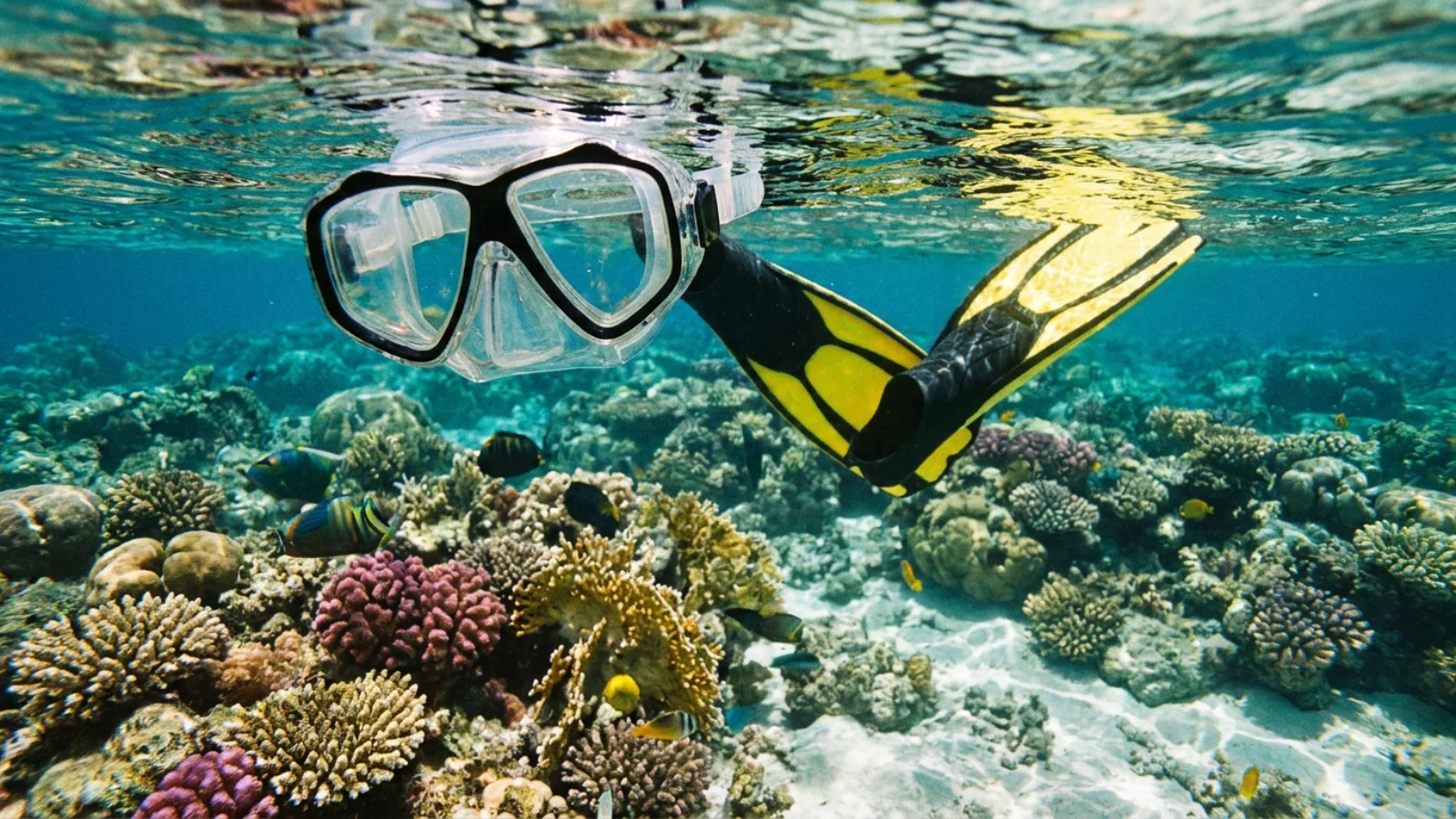
The essential kit is short. A diving mask, or for surface swimming simple goggles, creates an air space in front of your eyes so that you can see clearly underwater. A standard mask has a tempered glass faceplate, a soft silicone or rubber skirt that encloses the nose and seals against the face, and a strap. Enclosing the nose matters if you plan to duck-dive, because you need to breathe out through it to equalise the mask as you go down. If you only stay on the surface, swimming goggles that leave the nose free are enough.
The snorkel is a J-shaped tube with a mouthpiece, clipped to the mask strap. Fins are optional but almost universal, because human feet are too small and the wrong shape to give much thrust. Fins let you cruise with slow, relaxed kicks from the hips, which saves energy and keeps you calmer. Open-heel fins worn with neoprene booties are better for rocky entries and cooler water; full-foot fins are lighter for warm-water beaches.
Most snorkelers also need protection. A rash guard or thin wetsuit prevents sunburn on the back and legs, which are exposed for hours, and protects against stinging jellyfish and coral scrapes. A brightly coloured snorkel vest or float lets you rest without treading water and makes you visible to boats. For detailed buying advice see our snorkel gear guide.
How does a snorkel work?
It is a tube that keeps your mouth connected to the air while your face is underwater.
You bite gently on the mouthpiece and breathe in and out through your mouth while the top of the tube stays above the surface. Because the nose is inside the mask, you learn to breathe only through your mouth, which takes a few minutes of practice for most beginners. Snorkels come in several styles. The simplest is an open J-tube. Many modern snorkels add a splash guard or a “dry top”, a float valve that closes when the top goes under, and a purge valve near the mouthpiece. If water gets into the tube, a sharp exhalation blasts it out through the top or through the purge valve.
Design involves trade-offs. A long or narrow tube, or one with sharp bends or rough internal surfaces, has more breathing resistance. A wide tube breathes easily but holds more water and has a larger dead space. The best everyday snorkel is a fairly straight tube of moderate width with a comfortable mouthpiece, and that matters for safety as well as comfort, as the Hawaii research below shows.
Why can’t a snorkel be longer?
Water pressure on the chest and the stale air trapped in the tube both put a hard limit on length.
The first problem is pressure. If you tried to breathe through a long tube from a metre or more below the surface, your lungs would sit in water where the surrounding pressure is higher than that of the air in the tube. Your breathing muscles are not strong enough to expand the chest against that difference. The pressure gap across the lung tissue between blood capillaries and air spaces would also rise, increasing the risk of fluid leaking into the lungs.
The second problem is dead space. At the end of each breath out, the tube is still full of exhaled air, which you breathe back in at the start of the next breath. The bigger the tube, the more carbon dioxide you rebreathe. Breathing slowly and deeply reduces the share of each breath that is dead space, which is one reason relaxed snorkelers feel better than anxious ones who take fast, shallow breaths.
Standards reflect both limits. The current European standard, EN 1972, was first published in July 1997 and revised in December 2015. It sets maximum sizes for two classes of snorkel, and earlier national standards in Germany (DIN 7878, 1980) and Austria (ÖNORM S 4223, 1988) set similar rules.
| EN 1972 (2015) class | Intended user | Max length | Max internal volume |
|---|---|---|---|
| Class A | Users with larger lung capacity | 38 cm (15 in) | 230 ml |
| Class B | Users with smaller lung capacity, e.g. children | 35 cm (14 in) | 150 ml |
Full-face snorkel masks change the picture because the mask itself becomes part of the breathing circuit. Well-designed models separate the inhaled and exhaled air into different channels, but if those channels or valves do not work as intended, the internal volume of the mask can add to the dead space. Full-face masks also cannot be equalised by pinching the nose, so they are only suitable on the surface or within a few feet of it. See our guide to full-face snorkel masks.
Where did snorkeling come from?
Breathing tubes are ancient, but the modern snorkel dates from the late 1930s.
The idea of breathing through a tube underwater is very old. Aristotle mentions it in his Parts of Animals, and some writers suggest that sponge gatherers on Crete used hollow reeds thousands of years ago, though the evidence for that is thin. In the fifteenth century Leonardo da Vinci sketched a breathing device of cane tubes with a mouth cover at one end and a float at the other.
The swimmer’s snorkel as we know it appeared at the end of the 1930s, when spearfishing was taking off on the French Riviera. In December 1938 the French spearfisherman Maxime Forjot and his partner Albert Méjean filed a patent for a breathing tube worn over the front of the head with a single-lens diving mask; it was granted in July 1939. The same year, French naval officer Yves Le Prieur introduced his “Nautilus” full-face mask with tubes and a ball valve that closed when submerged. Front-mounted snorkels stayed popular in Europe until the late 1950s, when the side-mounted J-tube took over. They returned a decade later as training snorkels for competitive swimmers and finswimmers, because they are more streamlined.
The word itself came from the war. Schnorchel was the German name for the air-intake mast that let U-boats run their diesel engines and recharge their batteries while cruising just below the surface at periscope depth. By November 1950 a Honolulu sporting goods company was selling a “swim-pipe” and urging customers to “try the human version of the submarine snorkel”. The 1950s became the heyday of masks with built-in breathing tubes, made by companies from the United States to Japan. Scubapro co-founder Dick Bonin is credited with introducing the flexible-hose snorkel in the mid-1950s and the purge valve in 1980. The modern full-face snorkel mask arrived in 2014, when Decathlon filed the design that became its Easybreath mask.
Is snorkeling safe?
For most people, yes, but snorkeling causes more visitor deaths in Hawaii than almost any other ocean activity, and the reasons are not obvious.
The common dangers are easy to understand: exhaustion and panic in open water, currents that carry swimmers away from shore, boat traffic, sunburn and stings. The less obvious danger is medical. Hawaii, where snorkeling is one of the most popular visitor activities, has studied snorkel deaths more closely than anywhere else. In 2017 the state Department of Health ordered a two-year Snorkel Safety Study led by Oahu pulmonologist Dr Philip Foti, with former Ocean Safety Division director Ralph Goto as project administrator.
| Finding (Hawaii snorkel safety work) | Figure |
|---|---|
| Drownings 2009–2018 linked by the Department of Health to rapid onset pulmonary edema | 206, of which 189 were visitors |
| Snorkel-related deaths 2012–2021 | 204, about 90% tourists |
| Near-fatal survivors who reported calm conditions | 71% of 131 surveyed |
| Survivors who reported at least sufficient swimming ability | 88% |
| Drownings where the mask type was known | 16% (5 full-face, 11 conventional) |
The study’s interim findings, released in January 2021, linked 206 drownings from 2009 to 2018 to rapid onset pulmonary edema, or ROPE, a condition in which fluid seeps from the blood into the lungs. Of those 206 people, 189 were visitors. The investigators concluded that hypoxia from ROPE was the cause of “some, probably most” fatal and near-fatal snorkel drownings. Unlike a classic drowning, it can lead to fatigue and loss of consciousness without any visible struggle, which explains why victims are often found floating quietly face-down.
Several risk factors emerged. Breathing through a snorkel with high air-flow resistance increases the negative pressure in the lungs during each breath in, which can draw fluid into them. The team tested 49 snorkel models and found that simple snorkels generally had the least resistance. A heart condition that limits how well the heart fills between beats may help explain why middle-aged men are more often affected. The study also raised the hypothesis that a long flight shortly before snorkeling may predispose visitors to the condition, and found that entering deep water from a boat is riskier than wading in where you can stand. Surprisingly, most survivors were not novices in rough seas: of 131 near-fatal survivors surveyed, 71% reported calm conditions, 87% good visibility and 88% at least sufficient swimming ability.
Full-face masks drew attention after a cluster of deaths, but the evidence is unclear. The mask type was known in only 16% of the drownings studied, five involving full-face masks and 11 conventional masks. The report found no inherent advantage or disadvantage in their air-flow resistance, but noted practical problems: they are hard to remove quickly, water in the tube cannot be blasted out, and a valve failure can let in a lot of water. Hawaii has since begun recording the equipment used in snorkel fatalities.
The same condition is known elsewhere as swimming-induced pulmonary edema, or SIPE. It has been reported in scuba divers, breath-hold divers, combat swimmers and triathletes, with estimates of about 1 to 2% in competitive open-water swimmers. Known risk factors include heart disease and high blood pressure, cold water, exertion and stress, and breathing against negative pressure through a snorkel. The warning signs are breathlessness out of proportion to effort, a cough that may bring up frothy or pink sputum, and a crackling feeling in the chest. Anyone who feels this way should stop, float on their back with the snorkel out, signal for help and get out of the water.
How do you snorkel safely?
Swim with a buddy, check conditions, use a float and treat breathlessness as an emergency.
Always snorkel with a buddy who stays within reach and keeps an eye on you. Before you get in, ask lifeguards, dive shops or locals about currents, surf, tides and boat lanes, and choose a site where you can enter and leave the water easily. If there is a current, swim into it at the start so it brings you back when you are tired. Wear a snorkel vest or carry a float, which lets you rest without lifting your head or treading water and makes you easier to spot.
Choose simple gear that fits: a mask that seals, a fairly straight snorkel with a mouthpiece large enough to breathe freely, and fins that do not rub. Practise in shallow water before heading out. If you have flown in recently, are older, or have heart or lung problems or high blood pressure, take it easy on your first day and talk to your doctor before a trip built around snorkeling. If you start to feel short of breath, stop, roll onto your back, take the snorkel out and breathe normally. Do not push on to finish the swim.
How do you snorkel without damaging the reef?
Float, do not stand; keep fins off the bottom; touch nothing; and protect yourself from the sun with clothing.
A coral colony is a thin layer of living animals over a limestone skeleton, and fin contact is a well-known cause of reef damage. Standing on coral or kicking it can kill colonies that took decades to grow. Keep your body horizontal at the surface, kick gently from the hips, and stay well above the bottom. Do not touch or feed animals, and give turtles, seals and rays plenty of space. Some animals defend themselves: avoid fire coral, which often grows right at the surface on reef crests, and do not poke into holes where moray eels may be hiding.
Sunscreen is a second concern. Hawaii banned the sale of sunscreens containing oxybenzone and octinoxate from 2021, and Palau and the US Virgin Islands brought in their own bans from 2020; Bonaire approved a ban that took effect on 1 January 2021. Mineral sunscreens with zinc oxide or titanium dioxide are the usual alternative, but the best protection for both you and the reef is a rash guard or skin suit.
Hanauma Bay on Oahu shows why rules matter. It was made a Marine Life Conservation District in 1967, the first in Hawaii, and about 400 species of fish have been recorded there. By the 1980s crowds of up to 13,000 people on peak days had trampled the reef nearest the beach, which died. Visitors must now watch a short educational video, non-residents need reservations, daily numbers are capped and the preserve closes two days a week to give the bay a rest. Read more in our guide to Hanauma Bay.
Snorkeling or scuba diving?
Snorkeling is easier, cheaper and better for shallow reefs; scuba opens up deeper water.
Snorkeling needs no training card, costs little and lets you see the most colourful, light-loving parts of a reef. Its limits are depth and time: you stay at the surface and see deeper features from above, or hold your breath for short dives. Scuba diving lets you stay underwater for an hour or more and visit walls, wrecks and deeper reefs, but it requires certification, more equipment and attention to depth, air supply and decompression. Many people start with snorkeling and move on to diving; many experienced divers still snorkel on every trip. Our snorkeling vs scuba guide compares the two in detail, and snorkeling for beginners walks through your first sessions step by step.
Where is the best snorkeling?
Calm, clear, shallow reefs with healthy coral and easy entries.
The best snorkeling sites combine warm, clear water with reefs that rise close to the surface and sheltered entries from a beach or a boat. Start with our ranked list of the top 10 snorkel sites, then explore the regional guides to Hawaii, the Caribbean and the Florida Keys. Wherever you go, the quietest hours, usually early morning before the wind picks up, give the clearest water and the most active fish.
What is snorkeling?
Swimming face-down at the surface while breathing through a short tube and looking through a mask, usually with fins.
Do you need to know how to swim to snorkel?
You should be comfortable in water; weaker swimmers should use flotation and stay in calm, shallow, supervised areas.
Why are snorkels short?
Water pressure stops your lungs inflating through a long tube, and longer tubes trap more stale air. EN 1972 limits adult snorkels to 38 cm and 230 ml.
Is snorkeling dangerous?
Usually not, but Hawaii linked 206 drownings in 2009–2018 to rapid onset pulmonary edema. Use a buddy, a float and simple gear, and stop if breathless.
Are full-face snorkel masks safe?
The evidence is unclear. Hawaii’s study found no inherent difference in airflow resistance but noted they are hard to remove and cannot be blast-cleared.
Where does the word snorkel come from?
From German Schnorchel, the air-intake mast that let U-boats run diesel engines at periscope depth.
What sunscreen is reef safe?
Mineral sunscreens with zinc oxide or titanium dioxide avoid the oxybenzone and octinoxate banned in Hawaii; a rash guard is better still.
Do you need a certification to snorkel?
No. Snorkeling needs no certification, unlike scuba diving.
- European Committee for Standardization (2015). EN 1972: Diving equipment. Snorkels. Requirements and test methods.
- Associated Press / Hawaii News Now (19 January 2021). Study links pulmonary condition to Hawaii snorkeling deaths (Hawaii Department of Health Snorkel Safety Study, Foti P et al.).
- Undercurrent (2022). Snorkel deaths in Hawaii: summary of the Department of Health study (Wilcox C, Foti P).
- Wikipedia: Snorkel (swimming); Snorkeling; Swimming-induced pulmonary edema; Hanauma Bay.
- Cruise Critic: ports and regions that have banned sunscreens containing oxybenzone and octinoxate.
Blane Perun has been exploring Earth’s oceans and marine life for over 25 years. Founder of TheSea.Org in 1999, underwater photographer, coral aquaculture pioneer, and explorer of 80+ countries.
About Blane Perun →