Why Is Coral an Animal? — Not a Plant, Not a Rock
Coral is an animal because it is made of polyps — tiny, soft-bodied, multicellular creatures that eat other organisms rather than making their own food, have animal cells without cell walls, possess muscles, a nerve net and stinging cells, and reproduce with eggs and sperm that develop into a swimming larva. Corals belong to the kingdom Animalia, phylum Cnidaria (with jellyfish and sea anemones) and class Anthozoa. They are often mistaken for plants because they stay fixed in one place, grow in branching shapes and host photosynthetic algae in their tissue, and mistaken for rocks because reef-building corals secrete a limestone skeleton. But the living coral is the animal on top.
It’s one of the most common questions about the ocean: is coral a plant, an animal or a rock? The confusion is understandable. Coral sits still like a plant, branches like a tree, often looks green or brown, and feels as hard as stone. Yet biologists are unanimous that coral is an animal. Here is the evidence, along with the reasons coral fooled naturalists for centuries.
Coral passes every biological test for an animal
Biologists define animals by a handful of features, and coral polyps have all of them.
Animals are multicellular and their cells lack cell walls. Plant cells are boxed in by stiff walls of cellulose; animal cells are bounded only by flexible membranes. Coral tissue is made of soft animal cells, organised into true tissue layers.
Animals are heterotrophs: they eat. Plants make their own food from sunlight. Coral polyps capture and digest other living things — zooplankton, larvae and organic particles — using a mouth, a gut and digestive enzymes. Even the energy they get from their algae is food made by another organism, not by the coral itself.
Animals have muscles and nerves. Coral polyps contract their bodies, extend and retract their tentacles, and react to touch, light and chemicals, all coordinated by a simple nerve net. Plants have no muscles or nerves.
Animals develop from an embryo. Corals reproduce with eggs and sperm, and the fertilised egg develops through embryonic stages into a swimming larva — a classic animal pattern. The steps are described on the page about the life cycle of a coral polyp.
On every count, coral sits firmly in the animal kingdom.
| Trait | Coral | Plant | Rock |
|---|---|---|---|
| Alive? | Yes | Yes | No |
| Cell walls | No (animal cells) | Yes (cellulose) | No cells |
| Makes own food? | No — eats prey; algae partners help | Yes, by photosynthesis | No |
| Mouth and gut | Yes | No | No |
| Muscles and nerves | Yes | No | No |
| Reproduction | Eggs, sperm, swimming larva; budding | Seeds, spores, cuttings | None |
| Hard part | Limestone skeleton it secretes | Wood (cellulose and lignin) | Entirely mineral |
Coral’s place in the animal kingdom
Corals are cnidarians — members of the same animal phylum as jellyfish, sea anemones and hydroids.
The phylum Cnidaria is named after the cnidocytes, specialised stinging cells that every member uses to catch prey. Cnidarians have simple, radially symmetrical bodies with a single opening serving as both mouth and anus, and a ring of tentacles. Within the phylum, corals belong to the class Anthozoa, a name meaning “flower animals” — an apt description for polyps that look like tiny blossoms. Anthozoans live their whole adult lives as polyps and, unlike many jellyfish, never have a free-swimming medusa stage.
Anthozoa splits into two big branches: the hexacorals, which include stony reef-building corals, sea anemones and black corals, and the octocorals, which include soft corals, sea fans and sea pens. The differences between them are laid out on the page about types of coral polyps. A sea anemone is, in effect, a large coral polyp without a skeleton — a helpful way to picture what a single coral animal is like.
Why coral looks like a plant
Several features make coral look plant-like, but each has an animal explanation.
It stays in one place. Adult corals are sessile, fixed to the seabed, which we tend to associate with plants. But many animals are sessile, including sponges, barnacles, mussels and sea squirts. Corals do move in their own way: polyps constantly extend and retract, the larvae swim, and free-living mushroom corals can even shift position slowly on the reef.
It grows in branches. Branching shapes are an efficient way to reach light and catch food in flowing water, so animals and plants have both evolved them. A coral’s branches are made by budding polyps, not by leaves and stems.
It is green or brown and uses sunlight. This is the most convincing disguise, and it isn’t the coral’s doing. Reef-building corals host millions of microscopic algae called zooxanthellae in their tissue. The algae photosynthesise and share food with the coral, and their pigments give corals their brown, golden and green tones. The coral is the animal host; the algae are the plant-like lodgers. That is also why coral colour fades when the algae are lost.
Why coral looks like a rock
Reef-building corals really do make rock — but the rock is something the animal builds, not the animal itself.
Each stony coral polyp secretes a cup of calcium carbonate (limestone) beneath and around its soft body. In a colony these cups fuse into a hard skeleton, and over centuries countless skeletons accumulate into reefs. Only a thin layer of living tissue covers the surface; underneath is mineral skeleton laid down in earlier years. So when you touch a reef, you’re touching the animal’s skin stretched over the stone it made, in the same way a snail’s shell or a clam’s shell is made by a living animal. The process is described on the page about how coral is formed.
When coral dies, the tissue disappears and only the white skeleton remains, which is why dead coral and coral sold as decoration look like rock. The living animal is gone.
How coral hunts and behaves like an animal
Watch a coral at night and its animal nature becomes obvious.
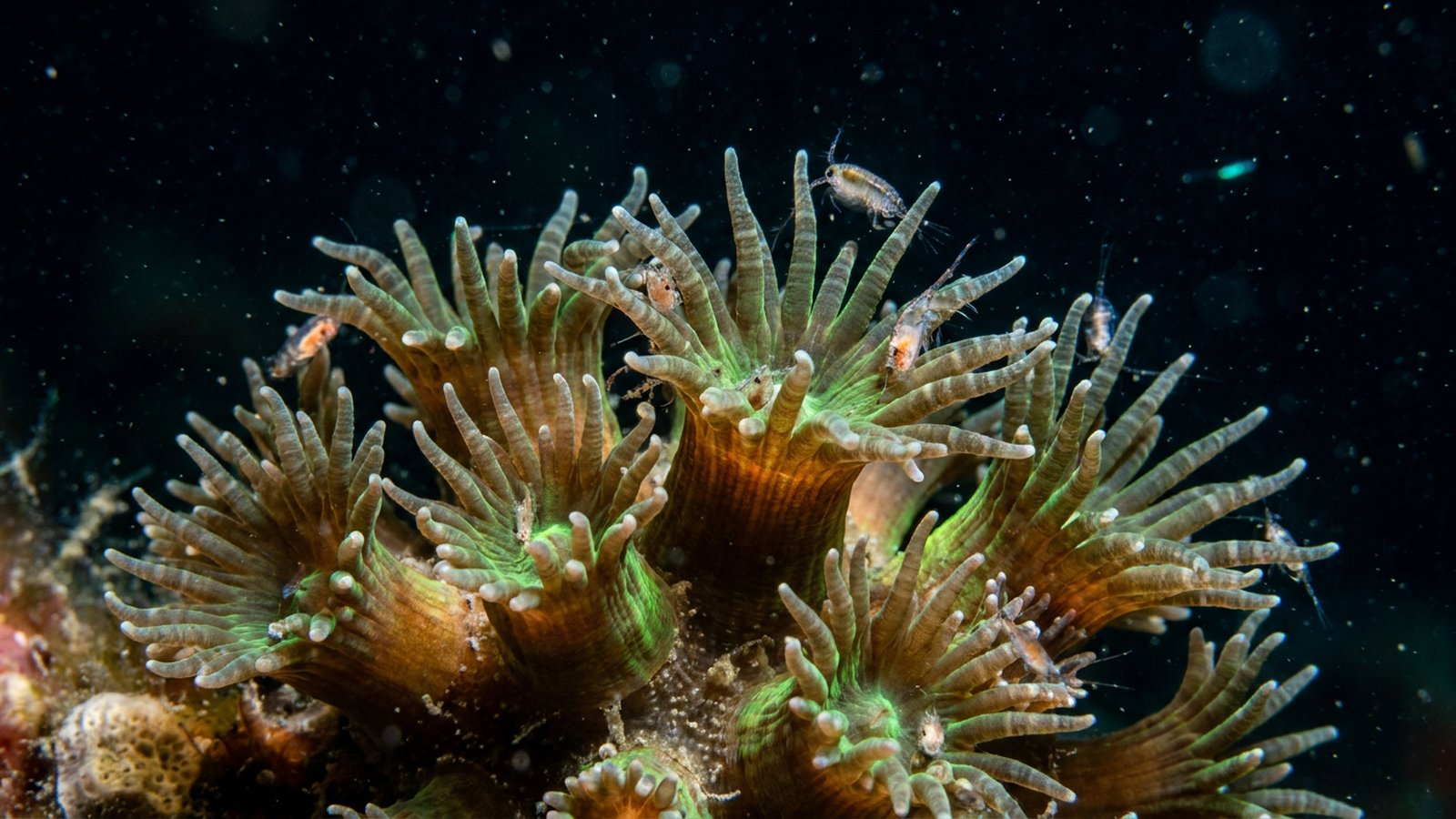
After dark, many corals extend their tentacles to hunt. When tiny animals drift into them, stinging cells called nematocysts fire harpoon-like threads, paralysing the prey, and the tentacles pass it to the mouth. The page on the purpose of coral polyp tentacles describes this in detail, and how coral polyps eat covers the rest of their diet.
Corals also fight. Neighbouring colonies compete for space by stinging each other with long sweeper tentacles or by pushing digestive filaments out of their guts to digest a rival’s tissue. They clean themselves with mucus, respond to light and touch, and many spawn in precisely timed mass events. Feeding, fighting and synchronised reproduction are all distinctly animal behaviours.
Why it matters that coral is an animal
Recognising coral as an animal explains why reefs are so vulnerable.
Corals are living animals with soft, thin tissue, and they depend on a delicate partnership with their algae. When seas get too warm, that partnership breaks down and corals bleach; if the stress lasts, the animals starve and die. Pollution, disease, sediment and physical damage all harm the living tissue. Because the polyps build the reef, losing the animals means the reef stops growing and begins to erode. Understanding coral as an animal — and as a colonial animal at that — is the first step to understanding why coral is important and why reef conservation matters.
Related on TheSea
- How Does Coral Protect Itself?
- How Fast Does Living Coral Grow?
- Why Is Coral Bleaching A Problem?
- How Many Known Species of Coral Are There?
- How Fast Does Coral Grow? Growth Rates by Coral Type
- How Do Coral Polyps Reproduce?
- Coral Species
- How Do Corals Eat?
- Why Do Corals Expel Zooxanthellae?
- How Do Corals Reproduce?
Is coral a plant or an animal?
Coral is an animal. It is made of tiny polyps related to jellyfish and sea anemones that catch and digest prey. Its plant-like appearance comes from symbiotic algae living in its tissue.
Why is coral considered an animal and not a plant?
Coral cells have no cell walls, coral cannot make its own food, it has a mouth, gut, muscles and nerve net, and it reproduces with eggs and sperm that develop into a swimming larva — all animal traits.
Is coral a rock?
No. Reef-building corals secrete a limestone skeleton that feels like rock, but the coral itself is the thin layer of living animal tissue covering that skeleton.
What kind of animal is coral?
Coral is a cnidarian in the class Anthozoa. It is closely related to sea anemones and more distantly to jellyfish and hydroids.
Does coral photosynthesize?
The coral animal does not. The zooxanthellae algae living inside its tissue photosynthesise and share much of the food they make with the coral.
Can coral move?
Adult corals are mostly fixed in place, but their polyps move constantly, their larvae swim, and some free-living corals such as mushroom corals can slowly move across the reef.
Blane Perun has been exploring Earth’s oceans and marine life for over 25 years. Founder of TheSea.Org in 1999, underwater photographer, coral aquaculture pioneer, and explorer of 80+ countries.
About Blane Perun → More Coral Species →