Coral Species — Hard, Soft and Deep-Sea Corals Explained
A coral species is one distinct kind of coral — a colonial animal in the phylum Cnidaria, related to jellyfish and sea anemones. Scientists have described roughly 1,500 stony (hard) coral species, about half of which are shallow-water reef-builders, and around 3,500 soft corals (octocorals) such as sea fans and sea whips. Add the black corals and other smaller groups and the total runs well past 5,000 named coral species. Only a fraction of them build reefs: the reef-builders are the stony corals that host symbiotic algae and lay down limestone skeletons in warm, sunlit water. The rest live as flexible soft corals on reefs or as slow-growing corals in cold, dark water thousands of metres deep.
Ask most people to picture a coral and they imagine a single thing: a branching, rock-like object on a tropical reef. In reality “coral” is a sprawling family of thousands of species that look, grow and live in very different ways. Some build boulders that last for centuries; others grow as delicate fans that sway with the current; still others live in the cold dark of the deep sea, far beyond the reach of sunlight. This guide explains what a coral species is, how scientists group them, how many there are, where they are most diverse, and why that diversity matters for the future of the world’s reefs.
What counts as a coral species
Every coral is an animal — a cnidarian built from small polyps — but “coral” covers several only distantly related lineages, which is why counting them can be confusing.
A coral polyp is a tiny, soft-bodied animal with a tube-shaped body, a single mouth ringed by tentacles, and stinging cells called nematocysts for catching food. In most species, thousands of genetically identical polyps live joined together in a colony, sharing tissue and nutrients. A coral species is one genetically distinct kind of these animals — for example the elkhorn coral (Acropora palmata) or the giant brain coral (Colpophyllia natans). Despite their plant-like or rock-like appearance, corals are firmly animals; see why coral is an animal for the full explanation.
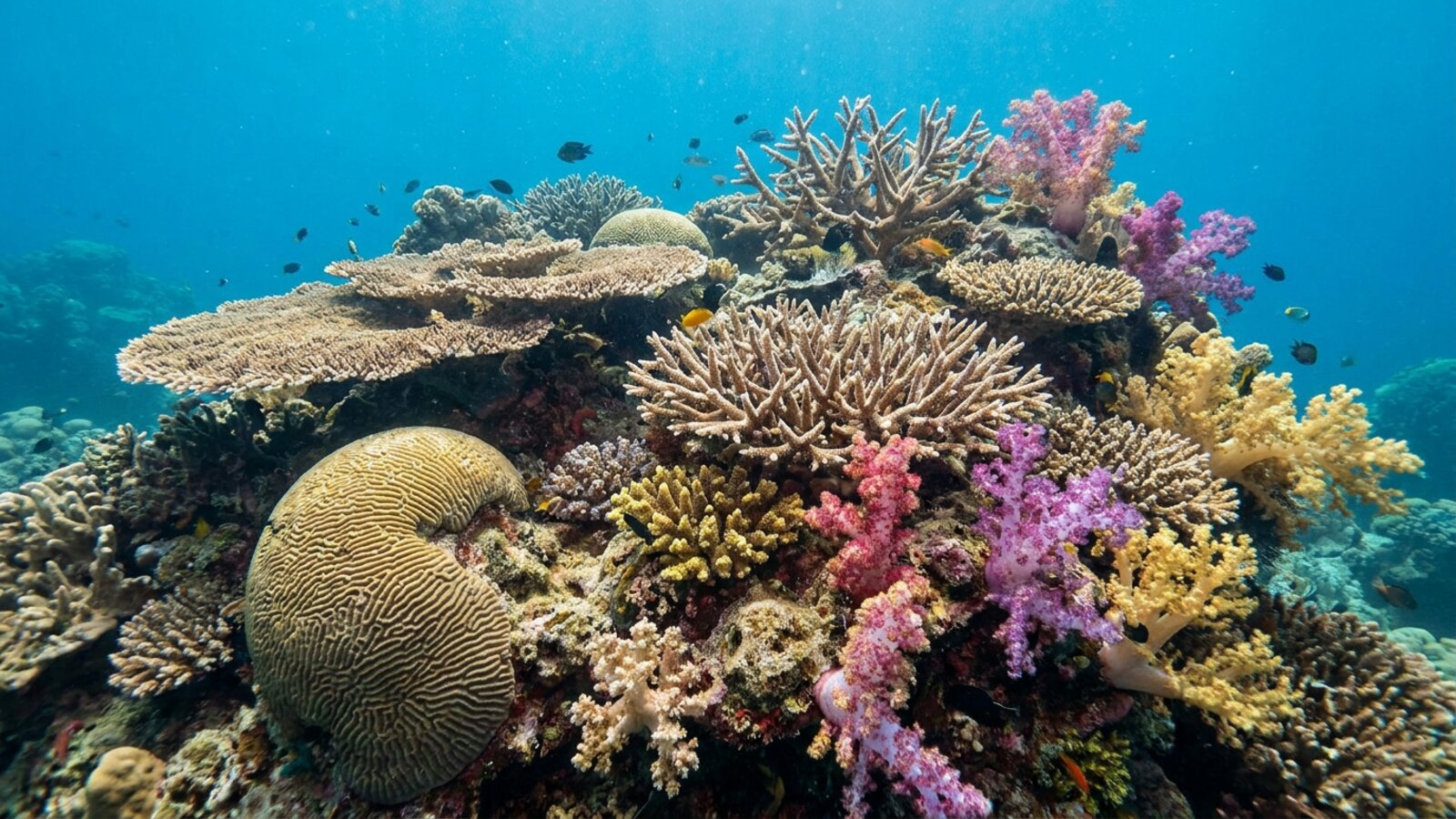
Within that umbrella, biologists recognise several major groups. The stony or hard corals (order Scleractinia) lay down a rigid skeleton of calcium carbonate and have polyps with tentacles in multiples of six. The soft corals (subclass Octocorallia) — sea fans, sea whips, sea pens and leather corals — have polyps with exactly eight feathery tentacles and stay flexible because they build only tiny mineral spicules, called sclerites, rather than a solid frame. The black corals (order Antipatharia) form tree- or whip-shaped colonies with a dark, horn-like protein skeleton. And the fire corals (Millepora) and lace corals are not true corals at all but hydrozoans that happen to build hard skeletons and sting on contact.
The single most important distinction for reefs is not shape but partnership. Many stony corals carry zooxanthellae, microscopic algae living inside their tissue that photosynthesise and pass most of their sugars to the coral. These zooxanthellate species must live in clear, sunlit, shallow water but can grow fast enough to build reefs. Azooxanthellate corals lack the algae, feed entirely by catching plankton and particles, and can therefore live in cold, dark water at almost any depth.
| Group | Polyp tentacles | Skeleton | Builds reef? | Examples |
|---|---|---|---|---|
| Stony / hard corals (Scleractinia) | Multiples of six | Hard calcium carbonate | Yes — the main framework builders | Acropora, Porites, brain corals |
| Soft corals (Octocorallia) | Eight, feathery | Flexible, with embedded sclerites | Mostly no | Sea fans, sea whips, leather corals |
| Black corals (Antipatharia) | Six, non-retractile | Horn-like protein | No | Antipathes |
| Fire corals (Hydrozoa) | Tiny, hair-like | Hard calcium carbonate | Adds to reef structure | Millepora |
How many coral species are there?
There is no single tidy number, because the answer depends on which group you count and on how taxonomists divide closely related forms. Among the stony corals, roughly 1,500 living species are recognised, split fairly evenly between shallow, reef-building zooxanthellate kinds (around 800) and azooxanthellate species that grow without sunlight, many of them in the deep sea. The soft corals are even more numerous, with about 3,500 described species of sea fans, sea whips, sea pens and leather corals. Black corals add a few hundred more. Altogether, well over 5,000 coral species have names, and new ones are still being described every year, especially from deep water.
The counts also shift as science improves. Coral skeletons can vary enormously with water depth, light and wave exposure, so a single species may look different on a sheltered lagoon and an exposed reef front. Genetic studies over the past two decades have reshuffled many long-established families and genera, merging some “species” that turned out to be the same animal and splitting others that turned out to be several. For a focused look at the headcount itself, see how many known species of coral there are.
Not all of those species build reefs. Only the reef-building stony corals do the heavy construction, and a relatively small number of genera dominate. Acropora, the staghorn, elkhorn and table corals, is the largest reef-building genus, with well over a hundred species, and forms much of the framework across the Indo-Pacific. Massive Porites corals grow slowly but can live for centuries and form some of the largest single colonies on any reef.
Well-known coral species and how to recognise them
You do not need to be a taxonomist to recognise the major coral types on a dive or snorkel. Growth form — branching, massive, plating, encrusting, solitary or fan-shaped — is the first clue, and many common names describe it directly. The table below lists some of the corals reef visitors most often meet, from both the Caribbean and the Indo-Pacific.
| Common name | Scientific name | Type | Where found | How to recognise it |
|---|---|---|---|---|
| Elkhorn coral | Acropora palmata | Stony, branching | Caribbean | Thick, flattened branches like moose or elk antlers |
| Staghorn coral | Acropora cervicornis | Stony, branching | Caribbean | Cylindrical branches like deer antlers |
| Table corals | Acropora spp. | Stony, plating | Indo-Pacific | Flat, table-like tops on a central stalk |
| Brain corals | Diploria, Colpophyllia and others | Stony, massive | Worldwide tropics | Rounded heads with maze-like grooves |
| Lobe and finger corals | Porites spp. | Stony, massive or branching | Worldwide tropics | Smooth boulders or stubby fingers with tiny polyps |
| Mushroom corals | Family Fungiidae | Stony, solitary | Indo-Pacific | A single large, free-living disc on sand |
| Common sea fan | Gorgonia ventalina | Soft (octocoral) | Caribbean | Purple, net-like fan facing the current |
| Leather corals | Sarcophyton, Sinularia | Soft (octocoral) | Indo-Pacific | Rubbery, mushroom-shaped or lobed colonies |
| Deep-water reef coral | Desmophyllum pertusum (formerly Lophelia) | Stony, azooxanthellate | Cold deep water worldwide | White branching thickets on slopes and seamounts |
Some corals defy these simple categories. Organ-pipe coral and blue coral are octocorals that nevertheless build hard skeletons, and fire coral looks like a stony coral but is a stinging hydrozoan. For a deeper look at polyp anatomy and the different ways corals are built, see types of coral polyps, parts of a coral polyp and what soft coral is.
Where the most coral species live
Coral diversity peaks dramatically in the Coral Triangle of Southeast Asia and thins out steadily in every direction, reaching its lowest tropical levels in the Atlantic.
The Coral Triangle — the seas around Indonesia, the Philippines, Malaysia, Papua New Guinea, Timor-Leste and the Solomon Islands — holds more than 600 species of reef-building coral, roughly three-quarters of all known reef-building species. From that centre, the number of coral species falls with distance. The wider Indian Ocean and the Red Sea hold rich but smaller assemblages, the central Pacific islands fewer still, and the tropical Atlantic, including the Caribbean Sea, supports only a few dozen reef-building species.
That pattern reflects both environment and history. Reef-building corals need warm water, generally staying within a band of about 30° north and south of the equator, plus clear water and plenty of light. The vast, warm and geologically complex Indo-Pacific has offered stable habitat and countless isolated basins in which new species could form over millions of years. The Atlantic, by contrast, is smaller and lost many of its coral lineages during past climate shifts and the closing of the seaway between the Americas, leaving a distinctive but species-poor coral fauna.
Isolated places also matter. Remote islands and coasts, such as Hawaii, the Red Sea and southern Japan, have produced many endemic corals found nowhere else, even though their total number of species is lower than in the Coral Triangle. Deep-sea corals follow a completely different map, growing on cold seamounts and continental margins around the world; explore them in our guide to deep-sea coral reef ecosystems, and browse the world’s reefs region by region on our coral reef maps.
Why coral species diversity matters
A reef is not built by one coral but by dozens of species working in parallel, and that variety is what makes the structure resilient. Branching Acropora grow fast and create three-dimensional shelter. Massive Porites and brain corals grow slowly but survive storms that snap branches. Plating, encrusting and solitary species fill the gaps and cement rubble together. When a reef holds many coral species, a disturbance that hits one growth form hard often spares another, so the reef can keep functioning and rebuild.
Diversity ripples outward to the rest of the reef. The thousands of fish and invertebrates described in our guide to coral reef species depend on the physical complexity that varied coral shapes create — one reason reefs are home to roughly a quarter of all known marine species despite covering a tiny fraction of the seafloor. Different corals also grow and reproduce in different ways: some spread quickly by fragmentation, others release eggs and sperm in synchronised mass spawning events. You can read more in how corals reproduce and how fast coral grows.
Species diversity is also a kind of insurance against the future. Corals vary widely in how much heat they tolerate. Populations in naturally hot places, such as parts of the Red Sea and Persian Gulf, survive temperatures that would bleach corals elsewhere, and researchers are studying them as a possible source of resilience for reef restoration.
Threats to coral species today
The same sensitivity that confines reef-building corals to warm, clear water now endangers them. When the sea stays too hot for too long, corals expel their zooxanthellae and turn pale — coral bleaching — and they starve if the stress continues. Ocean acidification makes it harder for stony corals to build skeletons, while overfishing, pollution, sediment and disease weaken colonies that are already under pressure.
The toll is measurable. The first global assessment of reef-building corals for the IUCN Red List, published in 2008, found about one-third of species at elevated risk of extinction. A reassessment released in 2024 raised that figure to 44%. Fast-growing branching corals are among the hardest hit: the Caribbean’s elkhorn and staghorn corals are listed as critically endangered after decades of disease and bleaching, while many slow, hardy boulder corals have fared better.
The picture is not uniformly bleak. Where local pressures are reduced — through marine protected areas, better water quality and healthy populations of grazing fish — reefs recover faster from bleaching. Coral nurseries, assisted breeding and outplanting are helping restore threatened species such as staghorn coral in places like Florida and the Caribbean. Learn more about the pressures on reefs in coral reef threats and what is being done about them in coral reef conservation.
See also: The Coral Reef Ecosystem and What Are Coral Reefs Made Of?
Related on TheSea
How many species of coral are there?
Roughly 1,500 stony (hard) coral species and about 3,500 soft corals have been described, plus black corals and other smaller groups, so well over 5,000 coral species are known. Around 800 of them are the shallow-water reef-builders.
What is the difference between hard and soft coral?
Hard corals (Scleractinia) build a rigid calcium carbonate skeleton and have polyps with tentacles in multiples of six; they are the reef-builders. Soft corals (Octocorallia) such as sea fans and leather corals have eight-tentacled polyps and stay flexible, adding little permanent structure to a reef.
What is the most common type of coral?
No single species dominates worldwide, but the genus Acropora — staghorn, elkhorn and table corals — is the largest and most widespread group of reef-building corals. Massive Porites corals are also extremely common.
Are there corals that do not live on tropical reefs?
Yes. Many corals live in cold, deep water on seamounts and continental slopes, far from sunlight. They lack symbiotic algae and feed by capturing plankton and particles, and some form large deep-water reefs.
Which region has the most coral species?
The Coral Triangle in Southeast Asia, around Indonesia, the Philippines, Malaysia and Papua New Guinea, holds more than 600 reef-building coral species, roughly three-quarters of all known reef-building corals.
Is coral a plant, animal or rock?
Coral is an animal. Each polyp is a small invertebrate in the phylum Cnidaria. It can look plant-like or rock-like because it stays in one place and many species build a mineral skeleton, but the living coral is an animal.
Are coral species endangered?
Many are. The IUCN’s 2024 reassessment found that 44% of reef-building coral species are threatened with extinction, mainly because of ocean warming and bleaching, with disease, pollution and overfishing adding pressure.
Blane Perun has been exploring Earth’s oceans and marine life for over 25 years. Founder of TheSea.Org in 1999, underwater photographer, coral aquaculture pioneer, and explorer of 80+ countries.
About Blane Perun → More on coral reefs →