Fur Seals — Eared Seals With the Densest Fur in the Ocean
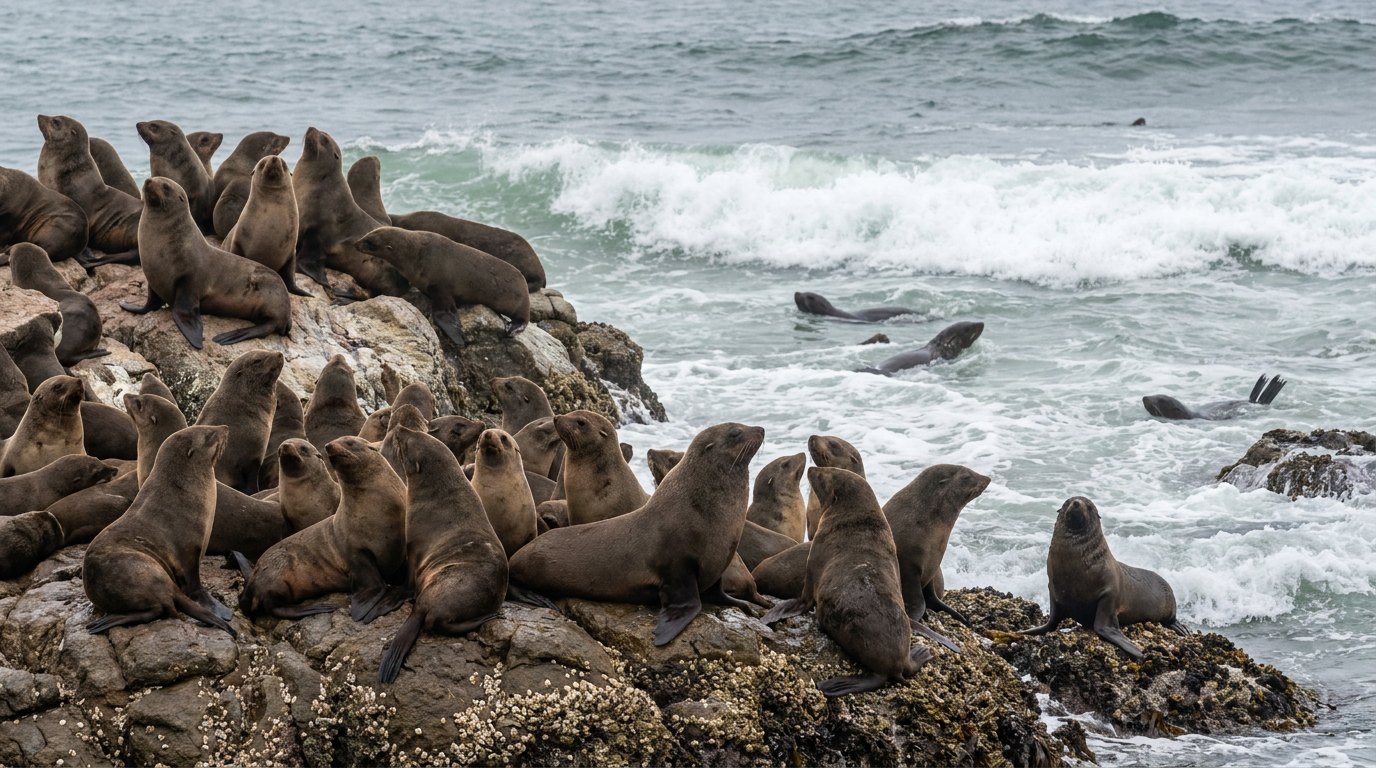
Fur seals are nine species of eared seal (family Otariidae) — close relatives of sea lions — famous for a thick, two-layered coat with up to about 350,000 hairs per square inch. They have small external ears, long fore-flippers they swim with, and hind flippers they can rotate forward to walk on land. Males are much larger than females. Eight species live in the Southern Hemisphere (genus Arctocephalus) and one, the northern fur seal (Callorhinus ursinus), in the North Pacific.
Fur seals are the seals most people mistake for sea lions, and with good reason: they belong to the same family, walk on all four flippers, and bark from crowded rocky beaches. What sets them apart is the coat. Fur seals carry one of the densest pelts of any animal, and in the 18th and 19th centuries that pelt nearly wiped them out. Their recovery, and now a fresh decline in the Antarctic, makes them one of the most instructive stories in marine conservation.
Is a fur seal a seal or a sea lion?
Biologically, fur seals are eared seals in the same family as sea lions (Otariidae), not “true” seals (Phocidae) like harbor or elephant seals.
| Feature | Fur seals | Sea lions | True seals |
|---|---|---|---|
| Family | Otariidae | Otariidae | Phocidae |
| External ears | Yes, small flaps | Yes | No (ear holes only) |
| Swim with | Fore-flippers | Fore-flippers | Hind flippers |
| Walk on land | Yes — rotate hind flippers forward | Yes | No — wriggle on belly |
| Coat | Dense underfur + guard hairs | Short, coarse, little underfur | Short hair, rely on blubber |
| Snout | Pointed | Broad, blunt | Varies |
The quickest field mark is the face: fur seals have a short, pointed snout and longer ear flaps, while sea lions have a broader, blunter head. In the water, a fur seal floating with flippers held up in the air is a common sight. Read more in our sea lion profile and in does a sea lion have fur.
Why is fur seal fur so dense?
Because fur seals rely on trapped air in their fur, rather than mainly on blubber, to stay warm in cold water.
Each fur seal coat has two layers: long, coarse guard hairs on the outside, and a dense, waterproof underfur beneath. The northern fur seal’s underfur holds over 350,000 hairs per square inch (about 60,000 per cm²), according to the Alaska Department of Fish and Game. Oil from skin glands keeps the underfur dry, so a layer of air stays next to the skin even when the animal dives. Fur seals do have some blubber, but much less than true seals.
That insulation has a downside in warm weather. Fur seals on sunny beaches overheat easily, which is why they often wave flippers in the air or rest in the water to dump heat through their thinly furred flippers.
What are the nine species of fur seal?
Eight southern fur seals in the genus Arctocephalus and one northern fur seal in its own genus.
| Species | Main range | Note |
|---|---|---|
| Northern fur seal (Callorhinus ursinus) | North Pacific, Pribilof Islands | “Depleted” under US MMPA |
| Antarctic fur seal (A. gazella) | South Georgia, Southern Ocean | Endangered (IUCN 2026) |
| Subantarctic fur seal (A. tropicalis) | Gough, Amsterdam and other islands | Pale chest, crested head |
| Brown / Cape and Australian fur seal (A. pusillus) | Southern Africa, southeast Australia | Largest fur seal |
| New Zealand fur seal (A. forsteri) | New Zealand, southern Australia | Kekeno in Māori |
| South American fur seal (A. australis) | South America coasts | Includes Falklands |
| Galápagos fur seal (A. galapagoensis) | Galápagos Islands | Smallest eared seal; Endangered |
| Juan Fernández fur seal (A. philippii) | Juan Fernández and Desventuradas Is., Chile | Once thought extinct |
| Guadalupe fur seal (A. townsendi) | Isla Guadalupe, Mexico | Rediscovered 1954 after presumed extinction |
What do fur seals eat?
Fur seals eat fish, squid and crustaceans, with the mix depending on species and place. Antarctic fur seals in the Atlantic sector depend heavily on Antarctic krill.
Most fur seals forage at night, when prey such as lanternfish and squid rise toward the surface, and typically dive to tens of metres; northern fur seals have been recorded diving to about 180 m. Females make repeated foraging trips of several days, returning to shore to nurse their pups between trips — a pattern called the “foraging cycle” that makes their breeding success closely tied to how far away food is. Some fur seals also take penguins and other seabirds.
How do fur seals breed?
Fur seals breed in dense colonies called rookeries, where large territorial males defend patches of beach containing groups of females.
Northern fur seal bulls hold territories for an average of about 50 days and may have 20–60 females in their area, sometimes up to 100. Males can weigh four or five times as much as females and fast while they defend territory. Females give birth to a single pup, mate again within about a week, and then alternate between nursing on shore and feeding at sea for several months. Northern fur seals then make long migrations: females and juveniles travel south as far as California, while adult males winter in the Gulf of Alaska and Bering Sea.
Why were fur seals nearly wiped out?
Commercial sealing for pelts in the 1700s and 1800s killed millions of fur seals and drove several species to near extinction.
Antarctic fur seals at South Georgia were hunted almost to oblivion soon after Captain Cook reported the island’s seals in 1775. The Guadalupe and Juan Fernández fur seals were believed extinct before small colonies were rediscovered in the 20th century. Northern fur seals on the Pribilof Islands were the subject of the 1911 North Pacific Fur Seal Convention, one of the first international wildlife treaties.
Protection allowed spectacular recoveries. Antarctic fur seals grew from a few survivors to millions, with about 95% breeding at South Georgia. But the northern fur seal has declined by more than half since the 1950s, and is listed as depleted under the US Marine Mammal Protection Act.
Are fur seals endangered?
Some are. In April 2026 the IUCN moved the Antarctic fur seal from Least Concern to Endangered, and the Galápagos fur seal is also Endangered.
The Antarctic fur seal assessment found that the number of mature animals fell by more than half, from an estimated 2.19 million in 1999 to about 944,000 in 2025. Scientists link the decline to climate change reducing the availability of krill near breeding colonies, which means mothers struggle to feed pups. The same IUCN update listed the emperor penguin as Endangered. Highly pathogenic avian influenza has also reached sub-Antarctic seal colonies since 2023.
Other fur seals face bycatch, entanglement in plastic and fishing gear, El Niño-driven food shortages (especially in the Galápagos), and conflict with fisheries. Some, such as the New Zealand and Cape fur seals, are abundant and increasing.
Is a fur seal a seal or a sea lion?
Fur seals are eared seals in the family Otariidae, the same family as sea lions. They are not “true” seals like harbor or elephant seals.
How many species of fur seal are there?
Nine: the northern fur seal and eight southern fur seals in the genus Arctocephalus.
How dense is fur seal fur?
The northern fur seal has over 350,000 hairs per square inch in its underfur, among the densest of any mammal.
What do fur seals eat?
Fish, squid and crustaceans such as krill. Antarctic fur seals in the Atlantic sector depend heavily on krill.
Are Antarctic fur seals endangered?
Yes. In April 2026 the IUCN uplisted the Antarctic fur seal to Endangered after mature numbers fell from about 2.19 million in 1999 to 944,000 in 2025.
Where do fur seals live?
Mostly in the Southern Hemisphere, from South Georgia and sub-Antarctic islands to southern Africa, Australia, New Zealand and South America. The northern fur seal lives in the North Pacific.
Are fur seals dangerous?
Breeding males are territorial and can bite. Visitors to colonies should keep their distance, especially in the breeding season.
How can you tell a fur seal from a sea lion?
Fur seals have a pointed snout, longer ear flaps and thick fur; sea lions have broader, blunter heads and short, coarse hair.
- Alaska Department of Fish and Game. Northern fur seal fact sheet — fur density, size, population, breeding, migration.
- IUCN (April 2026). Red List update: emperor penguin and Antarctic fur seal listed as Endangered (reported by Mongabay and others).
- Forcada, J. & Staniland, I. J. Antarctic fur seal research at South Georgia, British Antarctic Survey.
- NOAA Fisheries. Northern fur seal — depleted status under the MMPA.
Blane Perun has been exploring Earth’s oceans and marine life for over 25 years. Founder of TheSea.Org in 1999, underwater photographer, coral aquaculture pioneer, and explorer of 80+ countries.
About Blane Perun → More on Seals →