Sea Turtle Nesting Season in Florida — Dates, Hatching and Beach Rules
Florida’s sea turtle nesting season runs from about March to the end of October. On the southeast Atlantic coast, from Brevard County south to Broward, turtles typically start nesting in March; on the Gulf coast and in north Florida, nesting begins in April or May. Many coastal ordinances cover March 1 to October 31 on the Atlantic side and May 1 to October 31 on the Gulf. Eggs incubate for roughly 50 to 80 days, so hatchlings emerge from about June into late October. During the season, beachgoers should keep lights off or shielded, avoid flashlights and phone lights on the beach at night, fill holes, remove furniture by sunset and stay more than 50 feet from nesting turtles.
In Florida, sea turtles nest from March (Atlantic) or April-May (Gulf) through summer, hatchlings emerge into late October, and lights-out and clear-beach rules apply until October 31.
When is sea turtle nesting season in Florida?
Sea turtle nesting season in Florida runs from early spring to the end of October, but the start date depends on where you are. According to the Florida Fish and Wildlife Conservation Commission (FWC), along the southeast Atlantic coast, from Brevard County south to Broward County, sea turtles typically return to nest in March. On the Gulf coast and on north Florida’s beaches, nesting begins in April or May.
Local rules follow the same pattern. Many Atlantic coast communities apply sea turtle protection rules from March 1 to October 31; Indian River Shores, for example, publishes an annual nesting season notice running from March 1 to October 31. On the Gulf coast, many rules start on May 1. The City of Naples, for example, describes the official season as beginning May 1, with nesting continuing through August and hatching running from June through late October. Collier County describes its season as running from spring through the end of October.
The real season is set by the turtles, not the calendar, and nests often appear before the official start. In 2018 the first nest on a City of Naples beach was laid on April 22, more than a week before the official May 1 start. In 2026, Collier County’s sea turtle team began daily surveys on April 15, and the county’s first nests were found on April 28 on Keewaydin Island and April 29 on Barefoot Beach, both by loggerheads.
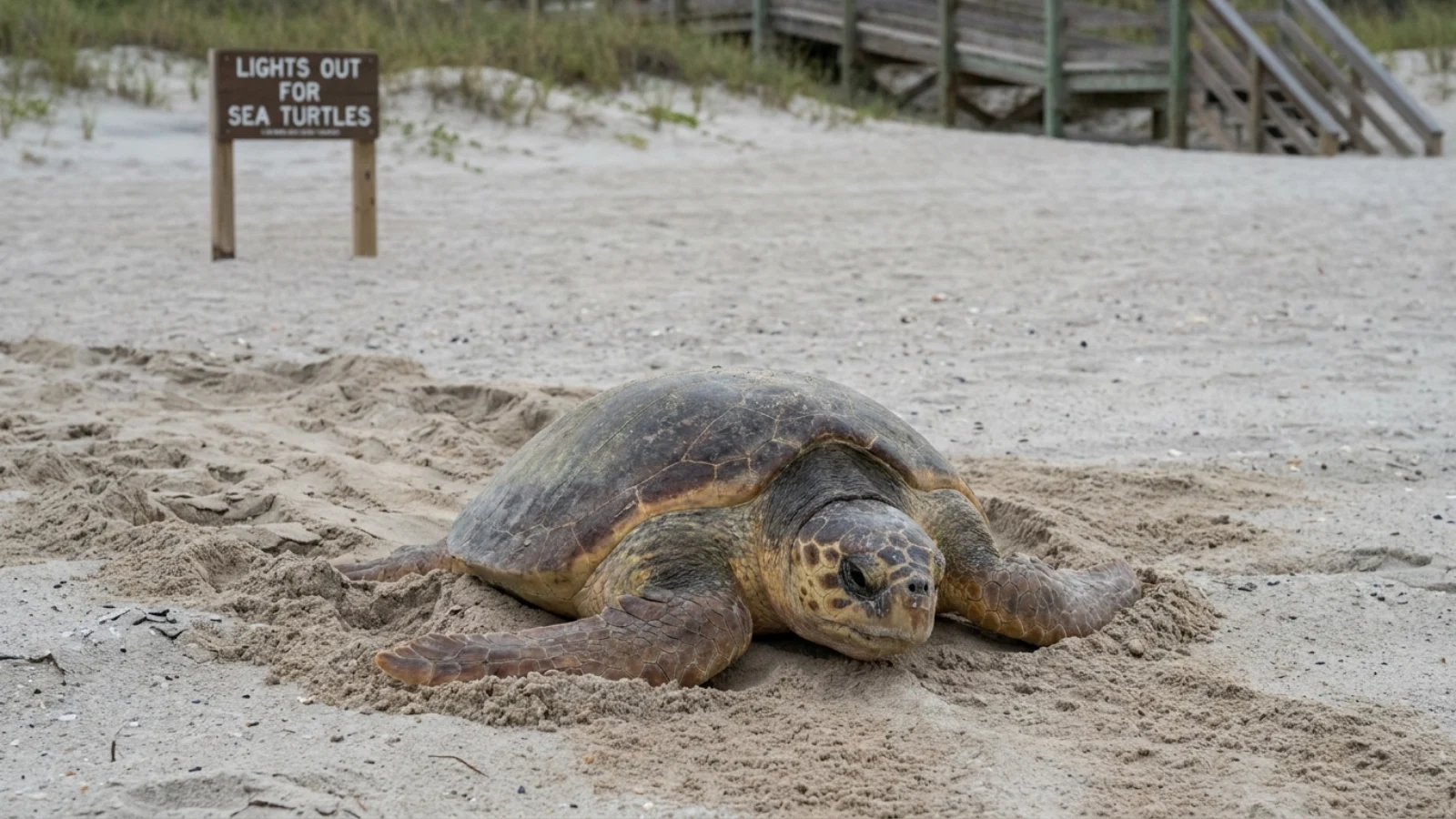
Nesting season month by month
March. Nesting begins on the southeast Atlantic coast, from Brevard south to Broward, and many Atlantic ordinances take effect on March 1. This stretch is also where Florida’s leatherbacks nest, mainly in Martin, Palm Beach and St. Lucie counties.
April. Nesting spreads up the coast and onto the Gulf. Nest surveys start on many Gulf beaches; Collier County’s daily surveys began on April 15 in 2026. Kemp’s ridleys, which nest only rarely in Florida, have a nesting season of April to July and are the only sea turtles that routinely nest during the day.
May. Nesting picks up statewide, and Gulf coast rules typically begin on May 1. Loggerheads, Florida’s most common sea turtle, are nesting on both coasts.
June and July. The busiest part of the season. Loggerheads and green turtles nest in large numbers, and permitted public turtle watches run on the Atlantic coast in June and July. The earliest nests begin to hatch.
August. Nesting continues but slows; in Naples, nesting continues through August. Hatching is now in full swing.
September and October. Few new nests are laid, but hatchlings continue to emerge from late nests until late October. Most protection rules end on October 31, when the last hatchlings have usually left the beach.
How sea turtles nest
A nesting female comes ashore nearly always at night, crawls above the high-tide line and finds suitable sand. Using her hind flippers, she digs a circular egg chamber about 40 to 50 centimetres (16 to 20 inches) deep and fills it with soft-shelled eggs. Depending on the species, a typical clutch may contain 50 to 350 eggs, although Florida’s species usually lay around 100 eggs per nest: NOAA Fisheries gives about 100 eggs for loggerheads, about 110 for green turtles and about 100 for leatherbacks. She then covers the eggs and returns to the sea.
Females do not nest just once a season. Loggerheads lay three to five nests a season, sometimes more, about two weeks apart. Green turtles nest about every two weeks over several months. Leatherbacks nest several times at intervals of 8 to 12 days, and a single female can lay up to 11 clutches in a season. That is why the nesting season lasts so long: each female is returning to the beach again and again over several months.
Not every trip ashore produces a nest. A turtle may crawl up the beach, find the conditions wrong because of hard sand, debris, lights or people, and go back to the water without laying. These non-nesting emergences, or false crawls, are common. In 2025 FWC recorded 162,408 loggerhead false crawls alongside 100,951 nests, and 128,226 green turtle false crawls alongside 66,476 nests. Reducing disturbances such as lights, people, holes and beach furniture helps more crawls end in nests.
How long until the eggs hatch?
Sea turtle eggs incubate in the warm sand for roughly 50 to 80 days, depending on the species and the temperature. NOAA says green turtle eggs incubate for about two months, and Kemp’s ridley eggs for 50 to 60 days. Warmer nests develop faster than cooler ones.
Sand temperature also decides whether hatchlings are male or female. Sea turtles have temperature-dependent sex determination: warmer temperatures produce females and cooler temperatures produce males. That makes Florida’s hot summer beaches especially important, and it is one reason scientists monitor nest temperatures as the climate warms.
When they are ready, the hatchlings break out of their eggs and dig their way up through the sand. Most species of sea turtle hatch at night, and the hatchlings head for the ocean by crawling towards the brightest horizon, which on a natural beach is the open sky over the water. Once at sea, sea turtles navigate using Earth’s magnetic field, a sense scientists think is inherited. For what happens next, see baby sea turtles.
Why lights are the biggest problem
Artificial light is one of the biggest threats to sea turtles on Florida’s developed coast. Because hatchlings crawl towards the brightest horizon, streetlights, porch lights and lit windows can lure them inland instead of out to sea, where many never reach the sea. On Florida’s Atlantic coast, some beaches with high nesting density have lost thousands of hatchlings to artificial light.
The solution is simple: keep the beach dark. FWC asks beachfront residents and visitors to turn off porch, parking and deck lights when not in use and to close curtains after dark. Lights that can still be seen from the beach should be long, low and shielded, meaning mounted low, pointed down and covered so the bulb cannot be seen from the sand. Sea turtle-safe lighting uses amber or red LEDs, long-wavelength light that is less disruptive to turtles than white light. The City of Naples, for example, asks residents to keep lights low and shielded, use long-wavelength amber LEDs, turn off unnecessary landscape, decorative and accent lights, and move lamps away from windows.
Some counties set deadlines. Collier County requires lights near the beach to be turned off or shaded by 9 p.m. during nesting season.
Sea turtle beach rules in Florida
FWC and local governments ask beachgoers to follow a set of simple rules during nesting season. These are the main ones.
Keep the beach dark. Avoid flashlights and cellphones on the beach at night, including phone flashlights and flash photography, since light can disorient turtles and hatchlings. Use natural starlight to see.
Keep your distance. Stay more than 50 feet from nesting turtles. Getting closer can make a turtle leave before she has finished nesting. If an animal changes its behaviour, you are probably too close. Stay quiet, and never block a turtle returning to the water.
Fill in holes. Fill in any holes you dig in the sand before you leave. Holes can trap nesting females and stop hatchlings reaching the water.
Clear the beach. Remove beach toys, gear and furniture from the sand before sunset. Collier County requires beach furniture to be removed by 9:30 p.m. during the season, and the City of Naples asks people to take back everything they bring, including chairs, umbrellas, coolers and trash.
Take your trash. Pack out or recycle all trash. Food scraps attract predators such as raccoons and crows that dig up nests. Dispose of fishing line properly, using monofilament recycling bins where available.
Leave nests and hatchlings alone. Do not touch or move nests, eggs or hatchlings, and do not pick up hatchlings. It is illegal to harm or disturb nesting turtles, their nests or eggs, or to pick up hatchlings. Do not interfere with hatchlings heading to the water.
Protect the dunes. The City of Naples asks people not to trim beach vegetation, which helps hold the dunes where many turtles nest.
What do the stakes and tape on the beach mean?
During nesting season you will often see small areas of beach marked off with wooden stakes and tape, sometimes with a sign or a protective screen. These mark sea turtle nests. Trained, permitted surveyors check the beaches every day during the season, read the tracks left by turtles during the night, identify new nests and mark them so beachgoers, cleaners and vehicles avoid them. In Collier County, surveyors patrol 22.5 miles of beachfront every day, recording both nests and false crawls, and stake each nest until the eggs hatch. Some nests in high-risk places are covered with screens to keep predators out.
Do not move, step over or disturb the markers. They protect the eggs underneath, and the data surveyors collect feed into Florida’s statewide monitoring programmes.
How the season differs between the coasts
The Atlantic and Gulf coasts do not just start at different times; they also see very different numbers and mixes of turtles. The Atlantic coast from Brevard to Palm Beach is the centre of Florida nesting. In 2025, Brevard County recorded 22,716 loggerhead, 30,431 green turtle and 129 leatherback nests, and Palm Beach County 25,614 loggerhead, 13,202 green and 493 leatherback nests. Martin County, with 915 leatherback nests, was the leatherback hotspot.
The Gulf coast season is quieter and dominated by loggerheads. In 2025, Sarasota County recorded 8,197 loggerhead and 1,043 green turtle nests, Lee County 2,381 loggerhead and 84 green turtle nests, and Collier County 2,115 loggerhead nests, 39 green turtle nests and a single leatherback nest. Further north, Panhandle counties such as Franklin and Gulf recorded several hundred loggerhead nests each. Because Gulf beaches start later and hold fewer nests, their rules often begin on May 1 rather than March 1, but the October 31 end date is common to both coasts.
How Florida monitors the nesting season
Florida has some of the most thorough sea turtle nesting surveys in the world. FWC’s Statewide Nesting Beach Survey began in 1979 and covers nearly all of Florida’s sandy beaches; in 2021 that meant 228 beach sites totalling 1,351 kilometres, monitored daily for at least four months a year. The Index Nesting Beach Survey, which began in 1989, uses a standardised set of beaches to track long-term trends. About 3,000 trained surveyors take part.
These surveys show how big the season is. In 2025, surveyors recorded 100,951 loggerhead nests, 66,476 green turtle nests and a record 2,012 leatherback nests across about 822 miles of beach. Managers use the data to decide when and whether projects such as beach sand placement or construction on nesting beaches can go ahead, and to minimise harm during events such as oil spills. For a species-by-species look at Florida’s nesting turtles, see sea turtles in Florida.
Can you watch sea turtles nest in Florida?
Yes, but the best way is on a permitted, guided turtle watch. On the Atlantic coast these run in June and July, during the height of loggerhead nesting. At the Archie Carr National Wildlife Refuge between Melbourne Beach and Wabasso Beach, for example, guided watches run on weekday evenings in June and July; walks can cover up to a mile, and flashlights, flash photography and filming are not permitted.
If you come across a nesting turtle by chance, stay back more than 50 feet, keep still and quiet, keep lights off and let her finish. Never touch her or the eggs.
What to do if you find a turtle in trouble
If you find a sick, injured, entangled or dead sea turtle, or hatchlings wandering away from the water, call the FWC Wildlife Alert Hotline at 888-404-FWCC (3922), or *FWC from a cell phone. Note the exact location, and do not try to pick up or move the turtle yourself unless instructed. For more advice, see sea turtle rescue.
So, when is sea turtle nesting season in Florida?
On Florida’s southeast Atlantic coast, from Brevard to Broward County, nesting typically starts in March, and many local rules run from March 1 to October 31. On the Gulf coast and in north Florida, nesting begins in April or May, with many rules starting on May 1, as in Naples and Collier County. Nesting continues through the summer, peaking in June and July, and hatchlings emerge from about June until late October. During the season, keep lights off or shielded, avoid flashlights on the beach, fill holes, clear furniture and trash by sunset and give turtles plenty of space.
| Region | Nesting begins | Typical rule window | Hatching |
|---|---|---|---|
| Southeast Atlantic (Brevard to Broward) | March | March 1 – October 31 | June – late October |
| Gulf coast (e.g. Naples, Collier) | April – May | May 1 – October 31 | June – late October |
| North Florida and Panhandle | April – May | Varies by county | Summer – October |
When does sea turtle nesting season start in Florida?
In March on the southeast Atlantic coast and in April or May on the Gulf coast and in north Florida.
When does sea turtle nesting season end in Florida?
Most rules run until October 31, when the last hatchlings have usually emerged.
When do sea turtles hatch in Florida?
From about June to late October; eggs incubate roughly 50 to 80 days.
What time do sea turtles nest?
Nearly always at night; Kemp’s ridleys are the exception and routinely nest by day.
Can you use a flashlight on the beach during nesting season?
No. FWC asks people to avoid flashlights and phone lights on the beach at night.
How far should you stay from a nesting sea turtle?
More than 50 feet, keeping quiet and with all lights off.
What time must beach furniture be removed in Collier County?
By 9:30 p.m. during nesting season, with lights off or shaded by 9 p.m.
Is it illegal to touch a sea turtle nest in Florida?
Yes. It is illegal to disturb nesting turtles, nests, eggs or hatchlings.
- Florida Fish and Wildlife Conservation Commission news bulletin, “Help sea turtles have nesting success this year” (18 March 2025); FWC research pages on sea turtle nesting and 2025 statewide nesting totals.
- City of Naples Natural Resources Division, “Sea turtle nesting season”; WGCU/WUSF (3 May 2026), “Collier County’s first 2026 sea turtle nests appear on Keewaydin Island and Barefoot Beach”.
- Town of Indian River Shores, “Sea Turtle Nesting Season Notice, March 1 – October 31, 2025”.
- NOAA Fisheries species pages: loggerhead, green, leatherback and Kemp’s ridley turtles; Florida Wildlife Viewing, Archie Carr NWR turtle watches; Wikipedia contributors, “Sea turtle” and “Leatherback sea turtle” (accessed November 2026).
Blane Perun has been exploring Earth’s oceans and marine life for over 25 years. Founder of TheSea.Org in 1999, underwater photographer, coral aquaculture pioneer, and explorer of 80+ countries.
About Blane Perun →