The Lusitania — The Liner Sunk by a U-boat in 18 Minutes
RMS Lusitania was a British Cunard liner torpedoed by the German submarine U-20 about 11 nautical miles off the Old Head of Kinsale, Ireland, at about 2:10 p.m. on 7 May 1915. A single torpedo struck the starboard side, a second explosion followed inside the ship, and she sank in about 18 minutes. Of the 1,959 people aboard, 1,198 died and 761 survived; 128 of the dead were American citizens. The sinking turned public opinion in many countries against Germany and contributed to the United States entering the First World War two years later. The wreck lies on its starboard side in about 93 m (305 ft) of water.
She was a civilian liner sunk without warning, with heavy loss of women, children and neutral Americans, yet she was also carrying rifle ammunition. Whether she was a legitimate target, and what caused the second explosion, have been argued over for more than a century.
A record-breaking liner
Lusitania was named after the Roman province that roughly corresponds to modern Portugal. She was built by John Brown and Company at Clydebank in Scotland, laid down on 17 August 1904 and launched on 7 June 1906, eight weeks late because of labour strikes. Her construction and operating costs were subsidised by the British government, on condition that she could be converted into an armed merchant cruiser in wartime, and she and her sister Mauretania were designed to be faster and larger than the most modern German liners of the day. At 787 ft long, driven by four direct-acting Parsons steam turbines producing 76,000 horsepower and turning four propellers, she was briefly the largest passenger ship in the world, until Mauretania was completed three months later.
She delivered on her promise. On her second voyage, in better weather, she arrived at Sandy Hook off New York on 11 October 1907 in a record time of 4 days, 19 hours and 53 minutes, winning the Blue Riband for the fastest Atlantic crossing; she held the Blue Riband in 1908. A fleet of small boats with whistles blaring met her as she waited for the tide. She sailed the route between Liverpool and New York, calling at Queenstown in Ireland.
The Lusitania at war
When the First World War began in 1914, the Admiralty listed Lusitania as an armed merchant cruiser, and Jane’s All the World’s Fighting Ships recorded her as an auxiliary cruiser. In practice the Admiralty decided not to use her. Express liners burned enormous amounts of coal, about 910 tons a day, and were easy to recognise, so smaller ships were used instead. For her first wartime eastbound crossing she was painted drab grey, but the German surface fleet was soon bottled up by the Royal Navy, and she returned to Cunard livery. To save coal and crew, her No. 4 boiler room was shut down, cutting her top speed from more than 25 knots to 21. Even so, she was still the fastest first-class passenger liner left in commercial service.
The danger came from beneath. In February 1915, in response to the Allied naval blockade, Germany declared the waters around the British Isles a war zone in which enemy merchant ships could be sunk without warning. Under the old “cruiser rules”, warships were expected to stop merchant ships and allow passengers and crew to abandon ship before sinking them. Germany’s new submarine campaign set those rules aside for British ships in the war zone.
The warning in the newspapers
Before Lusitania sailed, the Imperial German Embassy placed a notice in American newspapers. It reminded travellers “that a state of war exists between Germany and her allies and Great Britain and her allies; that the zone of war includes the waters adjacent to the British Isles; that, in accordance with formal notice given by the Imperial German Government, vessels flying the flag of Great Britain, or any of her allies, are liable to destruction in those waters” and that travellers sailing in the war zone on British or Allied ships did so at their own risk.
Lusitania left Pier 54 in New York on 1 May 1915 for Liverpool, with 1,959 people aboard by the usual count: 1,266 passengers and 696 crew according to another tally in the same sources, a small discrepancy that reflects the confusion of the records. Her captain was William Thomas Turner, an experienced Cunard master who had commanded Lusitania, Mauretania and Aquitania before the war. His predecessor, Captain Dow, had left the ship after the strain of operating in the war zone.
U-20’s patrol and the Admiralty’s secrets
The waters off southern Ireland were especially dangerous in early May 1915. British intelligence, preparing for the Gallipoli landings, had been running a misinformation campaign to convince Germany that an attack on its northern coast was coming, including leaked false reports of troopship movements from Britain’s western and southern ports. The result was a surge of German submarine activity off the British west coast. The fleet was warned to expect more submarines, but the warning was not passed on to the parts of the navy responsible for merchant shipping. The Admiralty’s codebreakers in Room 40 knew when U-20 had sailed and where it was heading, but their work was so secret that the information was not shared even with the trade division that warned merchant ships. Room 40 also knew from an intercepted message of 27 March that the Germans had broken the code used to send directions to British merchant ships, yet the naval base at Queenstown was not told and kept using the compromised code until after Lusitania was lost.
U-20 was busy in the days before the attack. On 5 May it stopped the schooner Earl of Lathom off the Old Head of Kinsale, ordered the crew off and sank her with gunfire. On 6 May it narrowly missed the steamer Cayo Romano off Fastnet Rock with a torpedo, sank the 6,000-ton steamer Candidate, failed to get a shot at the fast 16,000-ton liner Arabic, and then sank another 6,000-ton cargo ship, Centurion, near the Coningbeg lightship. At 10:30 p.m. on 5 May the Royal Navy had broadcast an uncoded warning to all ships that submarines were active off the south coast of Ireland, but the specific mention of a submarine was dropped from the midnight broadcast of 6 to 7 May because news of the new sinkings had not yet reached Queenstown.
The attack
On 7 May, as the liner approached the south coast of Ireland, Turner received warnings of submarine activity, including a report of a submarine south of Cape Clear. Thinking that submarines were more likely to keep to the open sea, he steered closer to land. Upon entering the war zone he had 22 lifeboats swung out so that they could be launched quickly.
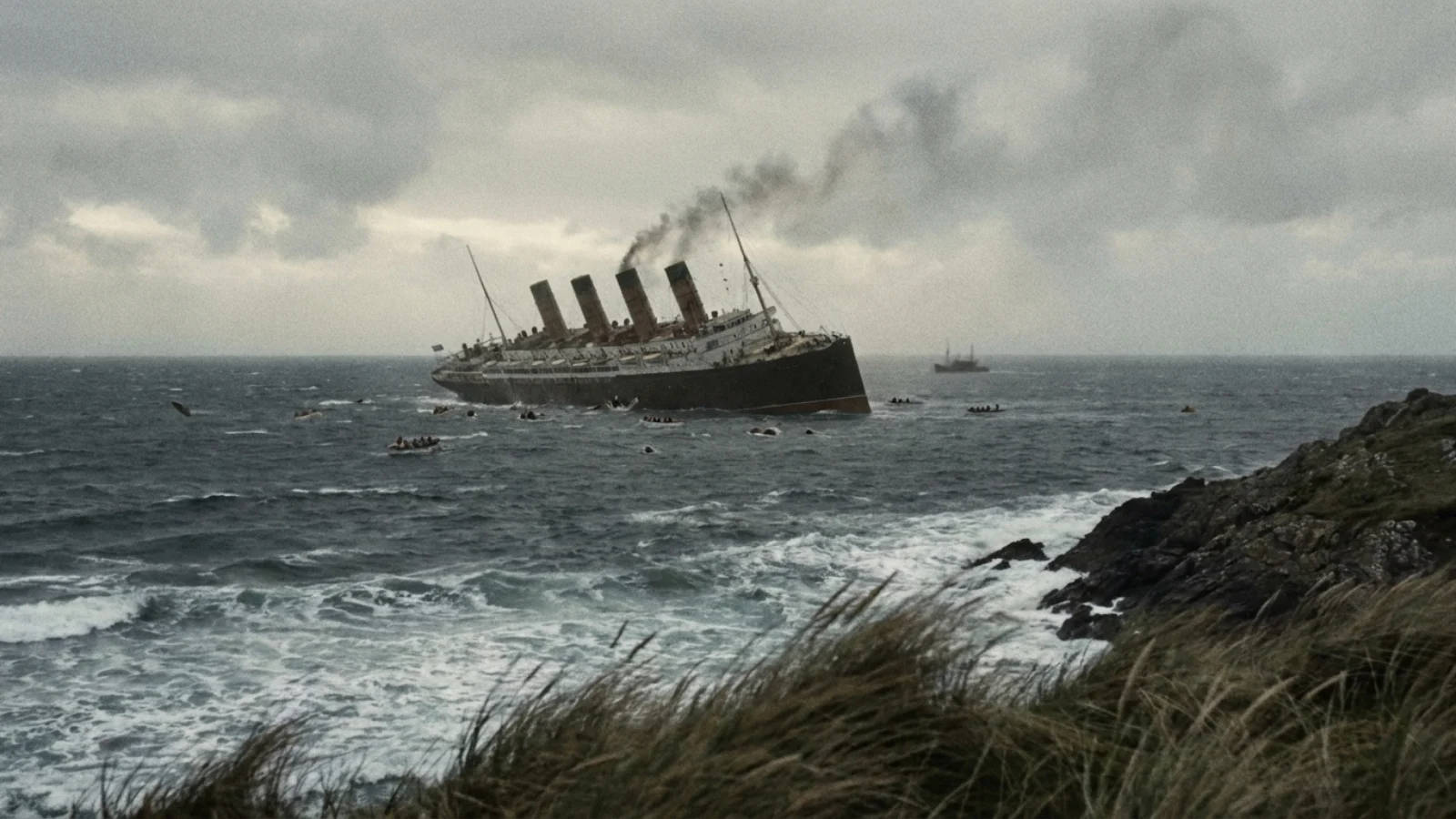
The submarine U-20, commanded by Kapitanleutnant Walther Schwieger, was waiting off the Old Head of Kinsale on a mission to attack warships and liners in the area. At 1:25 p.m. it submerged to periscope depth and set a course to intercept at its maximum submerged speed of 9 knots. At about 2:10 p.m. Schwieger fired a single torpedo. His log recorded: “Torpedo hits starboard side right behind the bridge. An unusually heavy detonation takes place with a very strong explosive cloud.” Moments later, a second explosion tore through the ship from inside, and many passengers believed she had been torpedoed twice.
The liner took on a heavy list and sank in about 18 minutes, between 14:10 and 14:28 by the usual timing. The list made the lifeboats almost impossible to launch. Lusitania carried 48 lifeboats, more than enough for everyone aboard, but only six were successfully lowered, all from the starboard side; lifeboat 1 capsized while being lowered and righted itself later. Captain Turner was on deck near the bridge, holding the logbook and charts, when a wave swept up over the forward superstructure and carried him into the sea; he survived.
Of the 1,959 people on board, 1,198 died and 761 survived. Among the dead were 128 American citizens, including the millionaire Alfred Gwynne Vanderbilt and the theatrical producer Charles Frohman.
What caused the second explosion?
The second explosion has been debated ever since, because it explains why a single torpedo sank a large, compartmented liner so quickly. Several explanations have been proposed.
Munitions. Lusitania was carrying war materiel for Britain: 4,200,000 rounds of Remington .303 rifle and machine-gun cartridges, almost 5,000 shrapnel shell casings, for a total of some 50 tons, and 3,240 brass percussion artillery fuses. Critics of the British government argued that the cargo exploded, and that the ship was therefore a legitimate target. Military ammunition has indeed been found in the wreck. Whether this cargo of small-arms ammunition, casings and fuses could have caused such a blast is disputed.
Coal dust. Robert Ballard, who explored the wreck in depth, noticed a large quantity of coal on the sea bed nearby and, after consulting an explosives expert, suggested that the torpedo stirred up coal dust in the nearly empty bunkers, which was then ignited by a spark. Critics argue that the coal dust would have been too damp to form an explosive cloud. Ballard also searched for a large hole on the port side reported by an earlier diver, John Light, and found nothing.
Steam. Another explanation places the second explosion in the ship’s high-pressure steam lines to the turbines, ruptured by the torpedo strike on the starboard coal bunker of the boiler rooms, releasing steam with explosive force and adding to the flooding.
No single theory has been proved, and the wreck’s collapsed condition makes it difficult to settle the question.
The inquiries
The British Board of Trade investigation was presided over by the Wreck Commissioner, Lord Mersey, who had also led the inquiry into the loss of the Titanic. It met at Westminster Central Hall from 15 to 18 June 1915, with further sessions in July. Mersey found that Captain Turner “exercised his judgment for the best” and that blame for the disaster “must rest solely with those who plotted and with those who committed the crime”. Two days after closing the inquiry he waived his fees and resigned, reportedly calling it “a damned, dirty business”. The full report has never been made public. Both the British and American investigations were shaped by wartime secrecy and by a propaganda effort to ensure that all blame fell on Germany.
Propaganda and the road to war
The sinking caused outrage in Britain and the United States. Images of the stricken liner were used heavily in American propaganda and military recruiting. In August 1915 the Munich medallist Karl X. Goetz privately struck fewer than 500 satirical medals blaming the British government and Cunard for letting the ship sail despite the warnings. British officials seized on it, and in 1916 Lord Newton, head of propaganda at the Foreign Office, arranged for the department-store owner Harry Gordon Selfridge to produce copies, sold for a shilling each in cases claiming the medal had been distributed in Germany to commemorate the sinking.
President Woodrow Wilson refused to over-react, and his Secretary of State, William Jennings Bryan, urged restraint and compromise. After further sinkings, including the White Star liner Arabic in August 1915, Germany recalled its U-boats from the waters west of Britain in September 1915 and ordered that passenger liners were not to be attacked. In January 1917 it announced full unrestricted submarine warfare, and on 6 April 1917 Congress, at Wilson’s request, declared war on Germany. The Lusitania was not the immediate cause of American entry into the war, but it did much to turn American opinion against Germany. Schwieger did not survive the war: he was killed on 5 September 1917 when his submarine, U-88, struck a British mine north of Terschelling.
The wreck today
The wreck of Lusitania lies on its starboard side at an angle of about 30 degrees in some 93 m (305 ft) of water off the Old Head of Kinsale. She struck the sea floor with such force that the hull has collapsed onto its starboard side, and over the decades she has deteriorated much faster than the Titanic, because of corrosion in the winter tides. In 1982 one of her four-bladed propellers was raised; it is now displayed at the Albert Dock in Liverpool, the former home port of Cunard, where the Merseyside Maritime Museum has a large exhibition about the ship. Other propellers were salvaged at the same time.
The wreck was owned for decades by the American businessman Gregg Bemis, who organised expeditions to investigate the sinking, including a 2011 dive featured in the National Geographic documentary Dark Secrets of the Lusitania. Bemis died at the age of 91. The site is protected by an Irish Underwater Heritage Order, and any dive or recovery requires a licence from the Irish government. In 2016 and 2017 licensed divers, working under the supervision of an archaeologist from the National Monuments Service and with Bemis’s consent, recovered two of the ship’s telegraphs; the main telegraph was described as undamaged and in excellent condition. A 2016 attempt to raise one of them failed when equipment malfunctioned.
The last survivors have now died. Audrey Johnston, the last British survivor, died on 11 January 2011, a month before her 96th birthday, and the last American survivor was Barbara McDermott, born Barbara Anderson in Connecticut in 1912.
The Lusitania and other great liner losses
The Lusitania is often compared with the Titanic, lost three years earlier, but the disasters were very different. The Titanic took more than two and a half hours to sink after striking an iceberg and lacked lifeboats for everyone; the Lusitania had more than enough lifeboats but sank so quickly, and listed so steeply, that most could not be used. See our account of the Titanic, the Edmund Fitzgerald and our shipwrecks hub. The Empress of Ireland, lost in 1914, is covered in our guide to the shipwrecks of Canada.
When did the Lusitania sink?
On 7 May 1915, between about 2:10 and 2:28 p.m., off the Old Head of Kinsale, Ireland.
How many people died on the Lusitania?
1,198 of the 1,959 people aboard died; 761 survived. 128 of the dead were Americans.
Who sank the Lusitania?
The German submarine U-20, commanded by Kapitanleutnant Walther Schwieger, with a single torpedo.
How long did the Lusitania take to sink?
About 18 minutes.
Was the Lusitania carrying weapons?
It carried about 4.2 million rifle and machine-gun cartridges, almost 5,000 shrapnel shell casings and 3,240 artillery fuses; ammunition has been found in the wreck.
What caused the second explosion on the Lusitania?
It is still debated: theories include ammunition, coal dust in the bunkers and ruptured high-pressure steam lines.
Did the Lusitania bring the US into World War I?
Not directly. The US declared war on 6 April 1917, after Germany resumed unrestricted submarine warfare, but the sinking turned opinion against Germany.
How deep is the Lusitania wreck?
About 93 m (305 ft), lying on its starboard side off the Old Head of Kinsale.
- Wikipedia contributors, “RMS Lusitania” and “Sinking of the RMS Lusitania” (2023 snapshot, accessed November 2026).
- Divernet (29 July 2017), “Divers retrieve Lusitania’s main telegraph”.
- Ballard, R. D. (1995), Exploring the Lusitania (as summarised in the sources above).
Blane Perun has been exploring Earth’s oceans and marine life for over 25 years. Founder of TheSea.Org in 1999, underwater photographer, coral aquaculture pioneer, and explorer of 80+ countries.
About Blane Perun →