Elegant Sea Snake — The Long, Banded Eel-Hunter of Northern Australia
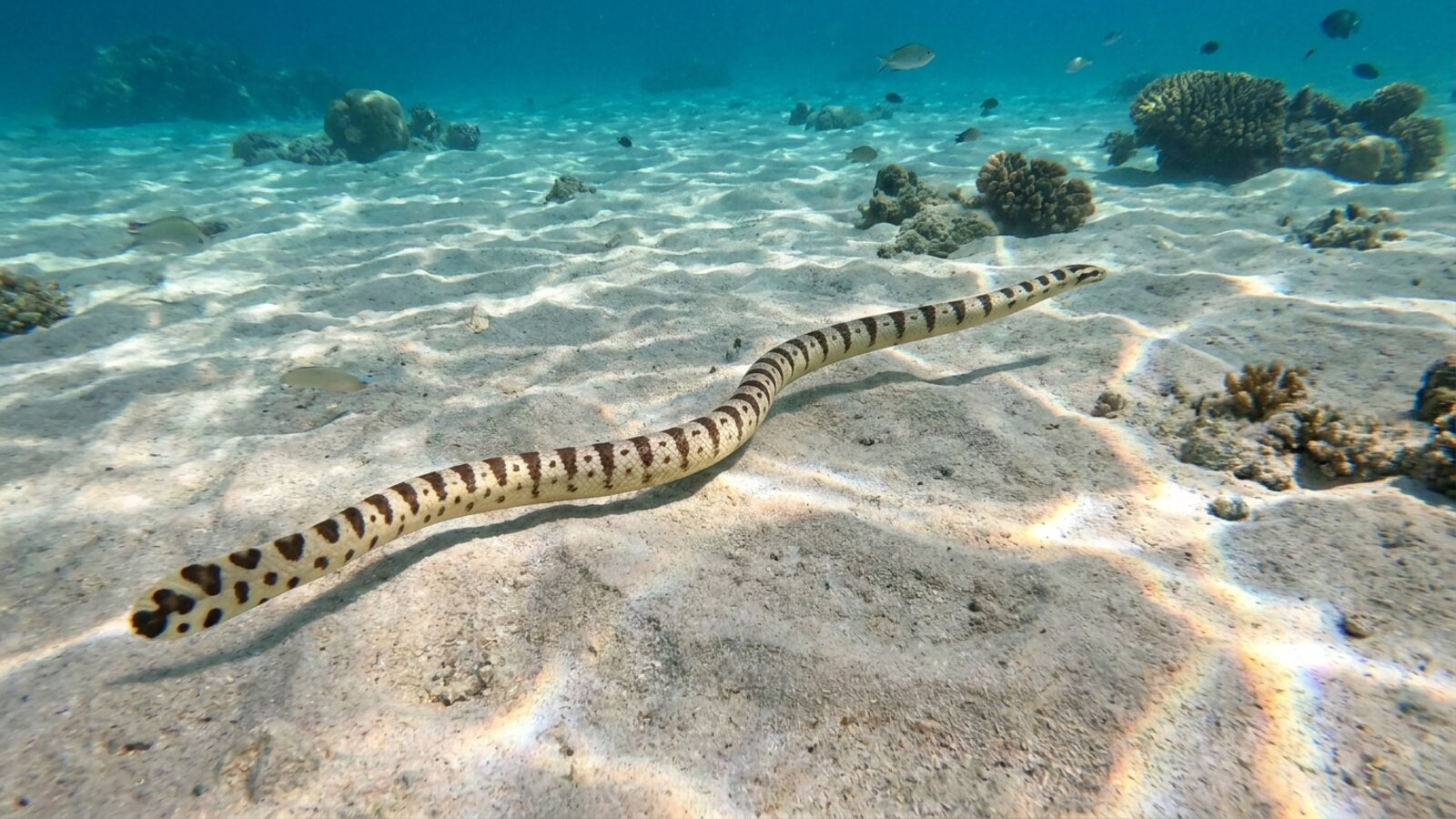
The elegant sea snake (Hydrophis elegans) is a highly venomous sea snake found in the tropical coastal waters of northern Australia, from Western Australia through the Northern Territory to Queensland, and into southern New Guinea. It is a slender, small-headed snake marked with up to about 44 dark bands along its body, and it is one of the longest sea snakes, commonly reaching about 2 m, with a record of about 2.6 m found in 2008. It lives mainly over soft, muddy and sandy seabeds, where it hunts eels in their burrows.
The elegant sea snake earns its name from its long, graceful build and neat banding. It is one of the characteristic sea snakes of northern Australia’s muddy bays and shallow shelf, and one of the species most often hauled up in prawn trawls in the Gulf of Carpentaria and adjacent waters. Few divers see it, because it prefers turbid water over open sediment rather than clear coral reefs, but fishers across northern Australia know it well.
What does the elegant sea snake look like?
It is a long, slender sea snake with a small head and narrow neck that widens into a deeper, laterally flattened body, marked with up to around 44 grey-black to black bands on a paler grey, cream or yellowish background.
Its head shields are large and regular, and like other true sea snakes it has valves that close its nostrils during dives. The body scales overlap and are arranged in about 37–49 rows at mid-body. The belly scales are small — usually undivided and about as wide as or slightly wider than neighbouring scales — and there are about 345–432 of them, a high count reflecting the snake’s long body. The flattened tail is an efficient paddle. The narrow head and front body are typical of Hydrophis species that probe burrows for eels.
How long does the elegant sea snake get?
Elegant sea snakes commonly reach about 2 m, making them among the longest sea snakes in Australian waters, and a specimen of about 2.6 m was recorded in 2008. Much of that length is a slim body; the head and neck are proportionally small. Only the yellow sea snake and a few other species regularly exceed that length.
Where does the elegant sea snake live?
It lives along the tropical coasts of northern Australia, from Western Australia’s Pilbara and Kimberley through the Northern Territory to Queensland, and in southern New Guinea.
Its typical habitat is shallow-to-moderately deep inshore water over soft sediments: muddy bays, estuary mouths and the sandy and silty floors of the continental shelf, often in turbid water. It is common in the Gulf of Carpentaria and the Arafura and Timor seas. Because these are the same habitats worked by prawn trawlers, it appears frequently in bycatch studies, which provide much of what is known about it.
What does the elegant sea snake eat?
It specialises in eels, particularly burrowing species such as snake eels and garden eels that live in holes in soft sediment.
Its small head and narrow neck allow it to slide into eel burrows and seize prey in the confined space, a hunting style shared by several other small-headed Hydrophis species. Eels are slippery, strong and can bite back, so a fast-acting venom is an advantage. Studies of trawl-caught snakes in northern Australia found eels to be the dominant prey. See snake eels, garden eels and what do sea snakes eat.
How venomous is the elegant sea snake?
It is highly venomous, with venom typical of Hydrophis sea snakes containing neurotoxins and myotoxins, but bites on people are rare.
Most encounters happen on trawler decks, where snakes are sorted from the catch. Handling them barehanded is risky, and any bite should be treated as an emergency because symptoms such as muscle pain, weakness and dark urine can take hours to develop. Australian sea snake antivenom covers the venoms of the main sea snake species in the region. In the water, the elegant sea snake is generally not aggressive. See are sea snakes dangerous and how venomous are sea snakes.
How does the elegant sea snake reproduce?
Like all true sea snakes, it is viviparous and gives birth to live young at sea. Litter size varies with the size of the mother, as in other sea snakes, and the young are born fully formed and independent after a gestation of several months. Much of what is known about its breeding comes from females examined in trawl bycatch studies in northern Australia.
How does the elegant sea snake breathe and dive?
It breathes air with a long lung that runs much of its body length and absorbs some oxygen through its skin, letting it forage on the bottom for extended periods. Over the shallow shelf it rarely needs to dive deeply, typically working depths of a few metres to several tens of metres. It surfaces briefly to breathe and then returns to the bottom to continue searching for burrows. More detail in how do sea snakes breathe and how long sea snakes can hold their breath.
How do you tell the elegant sea snake from similar species?
Several banded Hydrophis species share its range. The elegant sea snake’s combination of great length, very small head and narrow neck, and numerous dark bands is distinctive. The ringed sea snake has a larger head and more robust body; spectacled sea snakes have pale markings around the eyes; and Shaw’s (spine-bellied) sea snake is shorter and stockier with rough belly scales.
| Species | Typical max length | Key feature |
|---|---|---|
| Elegant sea snake | ~2 m (record 2.6 m) | Small head, many dark bands |
| Yellow sea snake | ~1.8–3 m | Yellow body, narrow black rings |
| Ringed sea snake | ~1.5–1.9 m | Larger head, bold rings |
| Spectacled sea snake | ~1.5 m | Pale “spectacles” around eyes |
What role does the elegant sea snake play in its ecosystem?
On the soft-bottom shelf of northern Australia, sea snakes are among the main predators of burrowing eels, fish that few other hunters can reach. In turn, sea snakes are eaten by tiger sharks and sea eagles and are hosts for barnacles, algae and parasites. Because they are long-lived, slow to reproduce and easy to count in trawl surveys, sea snakes like the elegant sea snake are also used by researchers as indicators of the health of these little-seen seabed ecosystems.
Is the elegant sea snake endangered?
It is assessed as Least Concern because it is widespread and common across northern Australia. Its main threats are fisheries bycatch, now reduced by mandatory bycatch reduction devices in Australian prawn trawls, and degradation of coastal habitats. Because it lives over open soft sediment rather than coral, it may be less exposed than reef sea snakes to coral bleaching, but warming seas could still change its prey and habitat.
Is the elegant sea snake venomous?
Yes, it is highly venomous, like most Hydrophis sea snakes, though bites on people are rare and mostly involve fishers handling trawl catches.
How long is the elegant sea snake?
It commonly reaches about 2 m, and one was recorded at about 2.6 m in 2008.
Where does the elegant sea snake live?
In tropical coastal waters of northern Australia, from Western Australia to Queensland, and southern New Guinea, mainly over soft muddy and sandy seabeds.
What does the elegant sea snake eat?
Mainly eels, especially burrowing snake eels and garden eels, which it catches in their burrows.
Is the elegant sea snake aggressive?
No. It is generally not aggressive in the water and bites mostly when handled.
Is the elegant sea snake endangered?
No. It is listed as Least Concern, though many are caught as bycatch in prawn trawls.
How many bands does the elegant sea snake have?
Up to about 44 grey-black to black bands along its body.
Blane Perun has been exploring Earth’s oceans and marine life for over 25 years. Founder of TheSea.Org in 1999, underwater photographer, coral aquaculture pioneer, and explorer of 80+ countries.
About Blane Perun → More on Sea Snakes →