Sea Turtles in Florida — 5 Species, Where They Nest and Where to See Them
Five species of sea turtle live in Florida waters: the loggerhead, green turtle, leatherback, Kemp’s ridley and hawksbill. Three of them nest on Florida beaches in large numbers. In 2025 Florida’s Statewide Nesting Beach Survey recorded 100,951 loggerhead nests, 66,476 green turtle nests and 2,012 leatherback nests, a record for leatherbacks, plus a handful of Kemp’s ridley nests. Florida hosts more nesting loggerheads than anywhere else in the world, and most nesting happens on the Atlantic coast between Brevard and Palm Beach counties. Turtles feed in places such as the Indian River Lagoon, the Florida Keys, Florida Bay and the Big Bend coast.
Florida’s beaches host more nesting loggerheads than anywhere else on Earth, along with tens of thousands of green turtle nests and the only regular leatherback nesting in the continental US.
Which sea turtles live in Florida?
Florida’s warm coastal waters, seagrass beds, coral reefs and long sandy beaches make it one of the most important places in the world for sea turtles. Five of the world’s seven species occur in Florida waters: the loggerhead, the green turtle, the leatherback, the Kemp’s ridley and the hawksbill. Only the olive ridley, a mainly tropical species, and the flatback, which lives only around Australia, are missing.
The five species use Florida in different ways. Loggerheads, green turtles and leatherbacks nest on Florida beaches in large numbers. Kemp’s ridleys nest only occasionally, but their juveniles forage in Florida’s coastal waters. Hawksbills are found mainly on the reefs of the Florida Keys and along the southeastern Atlantic coast, and they rarely nest in the state. All five are protected under the federal Endangered Species Act and by Florida law, and it is illegal to harm or disturb nesting turtles, their nests, eggs or hatchlings.
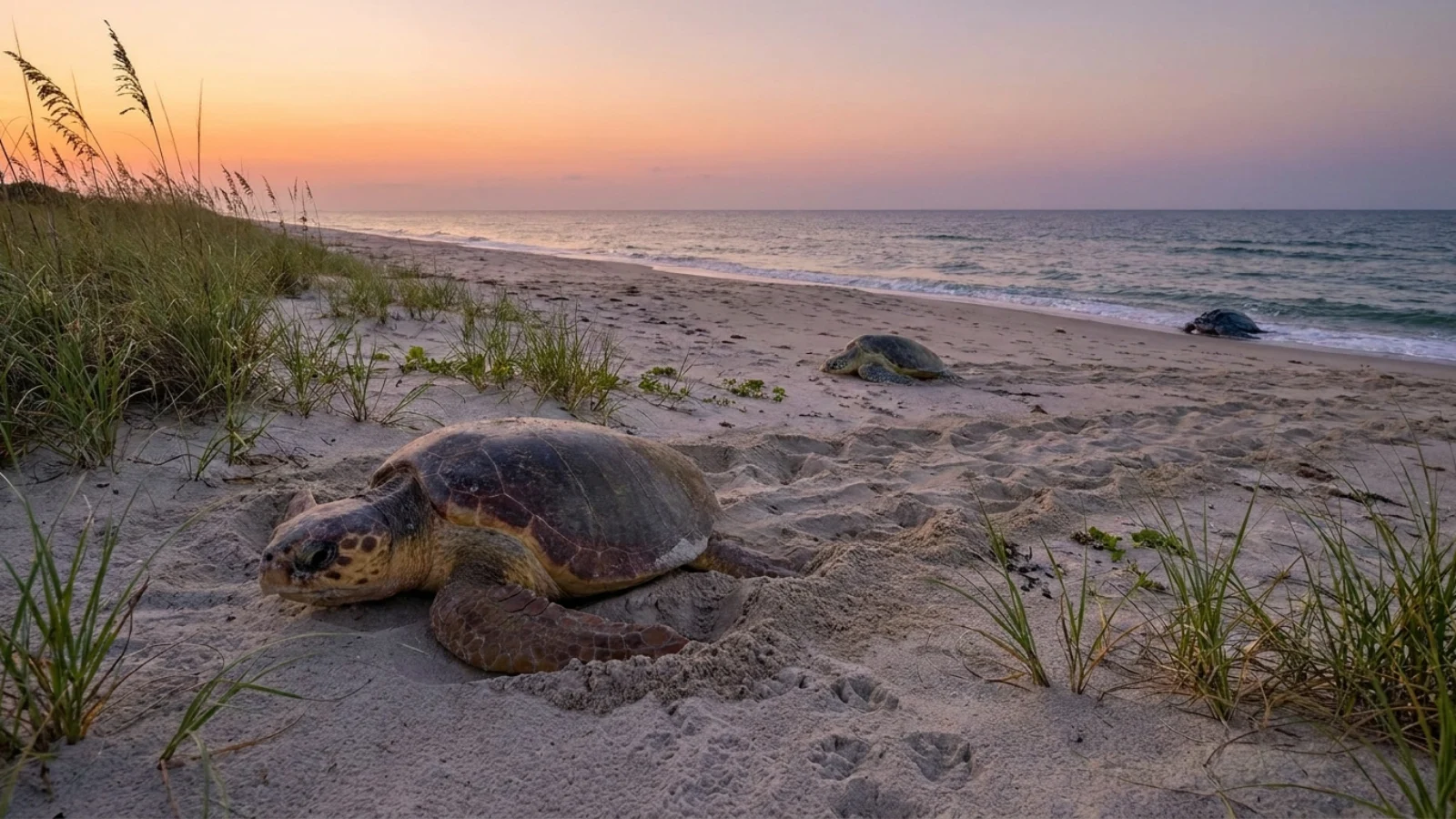
How many sea turtles nest in Florida?
The numbers are enormous. Florida’s Fish and Wildlife Conservation Commission (FWC) runs the Statewide Nesting Beach Survey, which began in 1979 and covers nearly all of Florida’s sandy beaches. In 2025 it surveyed about 1,322.6 kilometres, or roughly 822 miles, of beach, split between 637.2 kilometres on the east coast across 13 counties and 685.4 kilometres on the west coast across 14 counties. About 3,000 trained surveyors, including government staff, conservation groups, university researchers and private citizens, take part.
In 2025 the survey recorded 100,951 loggerhead nests, 66,476 green turtle nests and 2,012 leatherback nests. The leatherback total was a new state record, beating the previous high set in 2022, and the green turtle total was the second highest on record. Twelve Kemp’s ridley nests were confirmed, with 21 more awaiting genetic confirmation, and no hawksbill nests were reported. Surveyors also recorded tens of thousands of non-nesting emergences, also called false crawls, in which a turtle comes ashore and leaves a track but does not lay eggs: 162,408 for loggerheads and 128,226 for green turtles.
FWC’s five-year averages put these numbers in context. From 2018 to 2022, Florida averaged about 103,342 loggerhead clutches, 30,785 green turtle clutches and 1,389 leatherback clutches a year. The 2025 green turtle count was therefore more than double that recent average, while loggerheads were close to normal.
| Species | 2025 nests | Average 2018-2022 |
|---|---|---|
| Loggerhead | 100,951 | ~103,342 |
| Green turtle | 66,476 | ~30,785 |
| Leatherback | 2,012 (record) | ~1,389 |
| Kemp’s ridley | 12 confirmed (+21 pending) | Rare |
| Hawksbill | 0 | Very rare |
Loggerheads: Florida’s signature sea turtle
The loggerhead is Florida’s most common nesting sea turtle, and Florida matters more to loggerheads than any other place on Earth. FWC says Florida hosts more nesting loggerheads than anywhere else in the world, and that the southeastern United States has the world’s largest loggerhead nesting aggregation. NOAA Fisheries describes peninsular Florida as one of only two loggerhead nesting aggregations with more than 10,000 females nesting a year; the other is in Oman.
Loggerhead nesting is concentrated on the Atlantic coast. FWC reports that central-east and southeast Florida account for about 82 percent of nests. In 2025, Palm Beach County led with 25,614 loggerhead nests, followed by Brevard with 22,716, Martin with 11,985, St. Lucie with 7,346 and Indian River with 6,630. The Gulf coast has important loggerhead beaches too: Sarasota County recorded 8,197 loggerhead nests in 2025, Lee County 2,381 and Collier County 2,115.
Despite these big numbers, FWC researchers have found no clear sign of a strong population recovery for Florida loggerheads. Loggerhead nesting in Florida also differs genetically from the north: turtles nesting between North Carolina and northern Florida form a different genetic population from those in southern Florida. For more on the species, see our loggerhead sea turtle profile.
Green turtles: Florida’s comeback story
Florida’s green turtles are one of the great conservation successes of recent decades. FWC says green turtle nest counts have increased about eightyfold since standardised counts began on its index beaches in 1989, and Florida’s green turtle nesting population is now the second largest in the western Atlantic. Green turtle nesting also follows a two-year cycle, with high and low years alternating, which is why the 2025 count could jump so far above the five-year average.
Brevard County dominates green turtle nesting. In 2025 it recorded 30,431 green turtle nests, close to half of the state total. Palm Beach followed with 13,202, Martin with 9,666, Indian River with 4,598 and Volusia with 3,920. On the Gulf coast, green turtle nesting is much lighter: Sarasota had 1,043 nests in 2025, Lee 84 and Collier 39.
Adult green turtles feed mainly on seagrass and algae, and Florida has some of the best feeding grounds in the region. Important feeding areas include the Indian River Lagoon, the Florida Keys, Florida Bay, Homosassa, Crystal River and Cedar Key. For more, see our green sea turtle guide.
Leatherbacks: Florida’s giant visitors
The leatherback, the largest living turtle, nests in only small numbers in Florida, but the state is still important for it. FWC notes that Florida is the only state in the continental United States where leatherbacks regularly nest. The 2025 count of 2,012 nests set a new state record.
Leatherback nesting is concentrated in southeast Florida. In 2025 Martin County recorded 915 leatherback nests, Palm Beach 493 and St. Lucie 286, with smaller numbers in Brevard, Indian River, Broward and Volusia. No leatherback nests were recorded in Gulf coast counties such as Lee and Collier. Because a single leatherback female can lay up to 11 clutches in one season, FWC cautions that small changes in the number of nesting females can cause large swings in nest counts from year to year.
Kemp’s ridleys and hawksbills
Kemp’s ridley, the smallest and rarest sea turtle, nests mainly in Mexico, around Rancho Nuevo, but Florida matters to it at sea. Adults live mainly in the Gulf of Mexico, with females ranging from the southern Florida peninsula to the Yucatán, and juveniles regularly move into the Atlantic, living along the continental shelf from southern Florida to Cape Cod. Kemp’s ridley nests in Florida are rare enough that each one needs genetic confirmation: in 2025, 12 were confirmed and 21 more were awaiting results.
Florida played a role in an unusual rescue effort for Kemp’s ridleys after the 2010 Deepwater Horizon oil spill. To protect hatchlings from oil in the Gulf, scientists collected sea turtle eggs from nests in Alabama and Florida and incubated them elsewhere. On 26 June 2010, 67 eggs were collected from a Kemp’s ridley nest on the Florida Panhandle and taken to a temperature-controlled facility at NASA’s Kennedy Space Center, where 56 hatched; 22 hatchlings were released on 11 July 2010. The overall plan aimed to collect eggs from about 700 nests.
Hawksbills are reef turtles that specialise in eating sponges. In Florida they are found mainly on the reefs of the Florida Keys and along the southeastern Atlantic coast. The Florida Hawksbill Project, hosted by the National Save the Sea Turtle Foundation in Fort Lauderdale, studies the hawksbill aggregations of the Southeast Florida Reef Tract and works with local divers to protect them.
Where do sea turtles nest in Florida?
Sea turtles nest on almost every stretch of sandy beach in Florida, but some places are far more important than others. The Atlantic coast from Brevard County south to Palm Beach County is the heart of Florida nesting for all three main species. In 2025, Brevard County alone recorded more than 53,000 nests of all species, and Palm Beach more than 39,000.
Within Brevard, the Archie Carr National Wildlife Refuge, a stretch of beach between Melbourne Beach and Wabasso Beach, is described as the most important loggerhead nesting area in the western hemisphere and has more nesting green turtles than any other place in North America. As many as 1,000 nests per mile have been recorded there.
The Gulf coast has lower densities but long stretches of important nesting habitat, especially in Sarasota, Charlotte, Lee and Collier counties in southwest Florida, and in the Panhandle counties of Franklin and Gulf. In Collier County, surveyors patrol about 22.5 miles of beachfront daily during the season. The Florida Keys, despite their reefs, record relatively few nests: Monroe County had 321 loggerhead and 298 green turtle nests in 2025.
Where to see sea turtles in Florida
The best way to see a nesting sea turtle in Florida is on a guided, permitted turtle watch. These run mainly in June and July on the Atlantic coast, during the peak of loggerhead nesting, and let small groups watch quietly without disturbing the turtles. Watches at the Archie Carr refuge, for example, run in the evening on weekdays in June and July, and flashlights, flash photography and filming are not permitted.
Sea turtle rehabilitation centres offer another way to see turtles up close and learn about them. In the water, green turtles feed on seagrass in places such as the Florida Keys and Florida Bay, and hawksbills live on the reefs of the Keys and southeast Florida, so snorkelers and divers may encounter them. Wherever you see sea turtles, keep your distance: FWC advises staying more than 50 feet from nesting turtles, and if a turtle changes its behaviour, you are too close.
Threats to sea turtles in Florida
Lighting is one of the biggest problems on Florida’s crowded coast. Hatchlings find their way to the ocean by crawling toward the brightest horizon, and artificial light from streetlights and buildings can lead them inland instead. On Florida’s Atlantic coast, some beaches with high nesting density have lost thousands of hatchlings because of artificial light. Sea turtle-friendly lighting uses amber or red LEDs that are less visible to turtles, and many coastal counties have lighting ordinances; for the rules, see sea turtle nesting season in Florida.
Cold snaps are another Florida-specific danger. When water temperatures drop to about 7 to 10 degrees Celsius (45 to 50 degrees Fahrenheit), sea turtles can become cold-stunned: they float helplessly at the surface and cannot swim. Loggerheads take on a floating, cold-stunned posture at around 10 degrees Celsius.
Disease, coastal development, boats and fishing gear add to the toll. Fibropapillomatosis, a disease linked to a herpes-type virus, causes tumours on sea turtles’ skin and internal organs and affects several species, including green turtles and loggerheads. Loss of nesting habitat to coastal development, predators digging up nests and human disturbance also take their toll; mortality of nearly 100 percent of all clutches laid in a season has been recorded on some Florida beaches. In Florida, 603 leatherback strandings were recorded between 1980 and 2014.
How Florida protects its sea turtles
Florida’s nesting surveys are some of the most detailed in the world, and they are used directly in conservation. FWC’s Index Nesting Beach Survey, which began in 1989, tracks trends on a standard set of beaches; as of 2016, 36 beaches covering 445 kilometres took part. Statewide nesting data are used by state and federal managers to decide when and whether projects such as beach sand placement or coastal construction can go ahead, and to reduce harm during events such as oil spill responses.
On the east coast, parts of some beaches known to hold sea turtle nests are protected by fences, and nests on busy beaches are often staked and marked. Local governments enforce lighting rules and require beach furniture to be removed at night. Collier County, for example, requires lights near the beach to be turned off or shaded by 9 p.m. and beach furniture removed by 9:30 p.m. during nesting season.
How you can help Florida’s sea turtles
Anyone visiting or living on the Florida coast can help. Turn off or shield lights visible from the beach, avoid flashlights and phone lights on the beach at night, fill in any holes you dig, and take furniture, toys and trash off the beach at the end of the day. Never touch a nesting turtle, a nest or a hatchling. Dispose of fishing line properly, since entanglement injures turtles. If you find a sick, injured, entangled or dead sea turtle, call the FWC Wildlife Alert Hotline at 888-404-FWCC (3922).
So, which sea turtles live in Florida?
Five species: loggerheads, green turtles, leatherbacks, Kemp’s ridleys and hawksbills. Florida is the world’s most important nesting area for loggerheads, with about 100,951 nests in 2025, has a fast-growing green turtle population that laid 66,476 nests in 2025, and is the only continental US state where leatherbacks nest regularly, with a record 2,012 nests in 2025. Most nesting happens on the Atlantic coast from Brevard to Palm Beach County, while the Gulf coast, the Florida Keys and lagoons such as the Indian River provide crucial feeding grounds. For more on these animals, see our sea turtles hub and how long do sea turtles live?
What sea turtles live in Florida?
Loggerheads, green turtles, leatherbacks, Kemp’s ridleys and hawksbills.
How many sea turtle nests are in Florida each year?
In 2025: 100,951 loggerhead, 66,476 green and 2,012 leatherback nests.
Where do the most sea turtles nest in Florida?
On the Atlantic coast, especially Brevard, Palm Beach, Martin and St. Lucie counties.
What is the most common sea turtle in Florida?
The loggerhead, which makes up most nests in most years.
Do sea turtles nest on Florida’s Gulf coast?
Yes, mainly loggerheads; Sarasota had 8,197 loggerhead nests in 2025.
Where can I see sea turtles in Florida?
On permitted turtle watches in June and July, at rehab centres, or while snorkelling.
Is it illegal to touch a sea turtle in Florida?
Yes. It is illegal to harm or disturb turtles, nests, eggs or hatchlings.
Who do I call about an injured sea turtle in Florida?
The FWC Wildlife Alert Hotline: 888-404-FWCC (3922).
- Florida Fish and Wildlife Conservation Commission, “2025 Statewide Nesting Totals” and “Sea turtle nesting” research pages (Fish and Wildlife Research Institute).
- FWC news bulletin, “Help sea turtles have nesting success this year” (18 March 2025); WGCU/WUSF (3 May 2026), Collier County first 2026 nests.
- Fox 4 (2025), “Leatherback sea turtles set Florida nesting record in 2025”; NOAA Fisheries, loggerhead and green turtle species pages.
- Florida Wildlife Viewing, “Archie Carr NWR nesting sea turtle watch”; Wikipedia contributors, “Green sea turtle”, “Loggerhead sea turtle”, “Kemp’s ridley sea turtle”, “Leatherback sea turtle”, “Hawksbill sea turtle” and “Sea turtle” (accessed November 2026).
Blane Perun has been exploring Earth’s oceans and marine life for over 25 years. Founder of TheSea.Org in 1999, underwater photographer, coral aquaculture pioneer, and explorer of 80+ countries.
About Blane Perun →