The Pirate Code — Real Articles From Bartholomew Roberts’ Crew
The pirate code was real. In the late 1600s and early 1700s, pirate crews drew up written “articles of agreement” that every member had to sign or make his mark on and swear to before he could share in the plunder. The articles gave every man a vote, fixed each man’s share of the loot, paid compensation for lost limbs, and set out punishments, from marooning to death, for stealing, deserting, fighting on board or bringing a woman aboard in disguise. Nine complete or nearly complete sets survive, the most detailed being those of Bartholomew Roberts, published in 1724. They were not a single universal code but crew-by-crew contracts, borrowed from privateering and merchant traditions.
Each pirate crew wrote and signed its own set of rules, called articles, covering votes, shares, injuries and punishments.
Was there really a pirate code?
Yes, though not in the way films suggest. There was no single code shared by all pirates. Instead, each crew drew up its own written agreement, known as the ship’s articles or articles of agreement, usually at the start of a voyage. Pirate articles were a code of conduct for governing pirate ships, especially between the seventeenth and eighteenth centuries, during the so-called Golden Age of Piracy. They varied from one captain to another, and sometimes from one voyage to another, but they were generally alike in providing for discipline, setting out each crewman’s share of the treasure and compensating the injured.
The typical pirate crew was a mixture of former sailors, escaped convicts, the disillusioned and possibly escaped slaves, among others. Once aboard, the crew drew up articles listing its policies on matters such as drunkenness, fighting and contact with women, along with the punishments for breaking them. Failing to honour the articles could get a pirate marooned, whipped, beaten or even executed. Above all, the articles existed to keep order, to prevent quarrels and mutinies, and to secure the crew’s loyalty, all of which were essential to the group’s survival.
Buccaneers, the seventeenth-century raiders of the Caribbean, sailed under similar agreements, known variously as the chasse-partie, charterparty, custom of the sea or Jamaica Discipline. Only in modern times have all of these come to be known collectively as the “pirate code”.
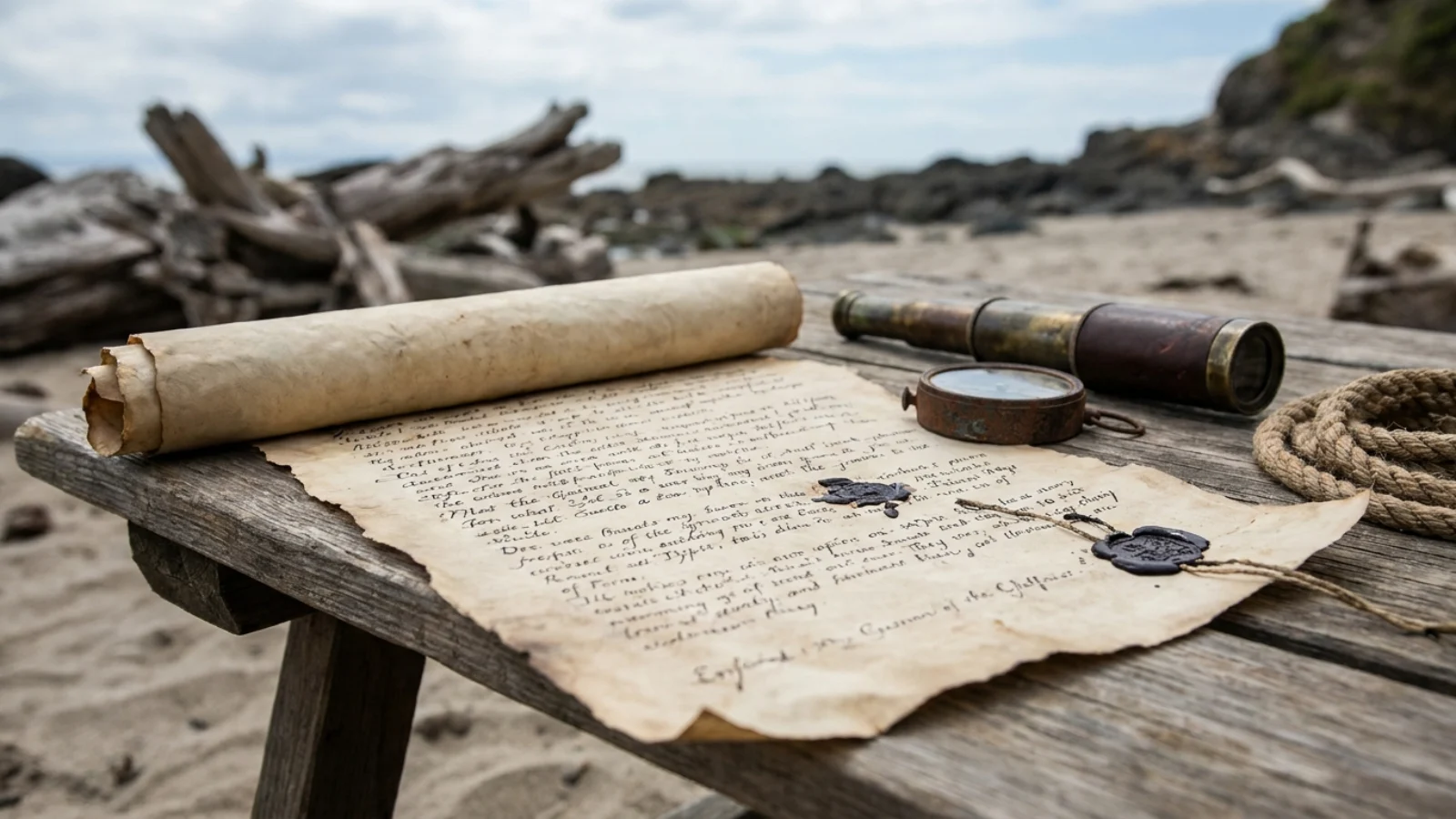
Where did pirate articles come from?
Legend says the first pirate code was written by the Portuguese buccaneer Bartolomeu Portugues sometime in the early 1660s, but the first formally recorded set belonged to George Cusack, who was active from 1668 to 1675. These early buccaneer articles drew on older maritime law and privateering codes, such as the twelfth-century Rolls of Oleron, a set of medieval sea laws. Pirate articles were in turn closely related to the articles used on privateers and merchant ships of the period, which also provided for discipline and the division of prizes, though usually far less equally than pirate articles did. Merchant and privateering articles can be traced back to medieval Europe, where “joint hands” agreements between merchants, ship owners and seamen allowed them to share profits.
In other words, pirates did not invent the idea of a written shipboard contract. What they did was strip out the owners and investors and turn it into an agreement among equals, in which the crew elected its officers, shared the plunder among themselves and decided together how to punish those who broke the rules.
How did a pirate sign the articles?
Each crew member was asked to sign or make his mark on the articles and then swear an oath. The oath was sometimes taken on a Bible, but John Phillips’ men, lacking one, swore on an axe. Legend has other pirates swearing on crossed pistols or swords, a human skull or while sitting astride a cannon, though those versions are less well documented. Signing formally made a man a member of the crew and generally entitled him to vote for officers and on other “affairs of moment”, to bear arms, and to his share of the plunder. The signed articles were then posted in a prominent place, often on the door of the captain’s cabin.
Not every signature was voluntary. After a cruise began, new recruits from captured ships would sometimes sign, some willingly and others under threat of torture or death. Skilled men such as carpenters, surgeons, blacksmiths and navigators were especially likely to be forced, and were rarely released whether they signed or not. Some willing recruits even asked the pirates to pretend to force them, so that they could claim coercion if they were ever caught. That was a sensible precaution: men who had not signed the articles had a much better chance of being acquitted at trial.
The articles of Bartholomew Roberts
The most famous pirate code belonged to Bartholomew Roberts (1682 to 1722), the Welsh pirate who was, measured by vessels captured, the most successful of the Golden Age. He took more than 400 prizes between 1719 and 1722, although most were small fishing boats. His articles were preserved by Captain Charles Johnson in A General History of the Pyrates, first published in 1724, and are among the most detailed to survive. They were similar to, but not identical to, those of his former captain, Howell Davis, and they in turn influenced the articles of pirates such as Thomas Anstis, who had served under Roberts. Here they are, in summary, with Johnson’s own explanatory notes.
I. Votes and provisions. Every man has a vote in affairs of moment and equal title to the fresh provisions or strong liquor seized at any time, which he may use at pleasure, unless a scarcity makes it necessary, for the good of all, to vote a cut in rations.
II. Turns on prizes and theft. Every man is called fairly in turn, by list, to go aboard captured ships, because on these occasions he was allowed a change of clothes on top of his share. Anyone who defrauded the company of as much as a dollar in plate, jewels or money was marooned. If one man robbed another, the crew slit the thief’s ears and nose and put him ashore somewhere he was sure to meet hardship.
III. No gambling. No one was to play at cards or dice for money.
IV. Lights out. Lights and candles were to be put out at eight o’clock at night, and anyone who still wanted to drink after that had to do it on the open deck.
V. Weapons. Every man was to keep his musket, pistols and cutlass clean and fit for service.
VI. No boys or women. No boy or woman was allowed among them, and any man found to have seduced a woman and brought her to sea in disguise was to suffer death. Johnson added a cynical note: when a woman fell into their hands, as happened when they captured the Onslow, they placed a sentinel over her, and the crew competed for the job.
VII. Desertion. Deserting the ship or one’s post in battle was punished with death or marooning.
VIII. No fighting aboard. No striking one another on board; quarrels were to be settled on shore with sword and pistol. The quartermaster took the two men ashore, set them back to back, and at his word they turned and fired. If both missed, they fought with cutlasses, and the first to draw blood won.
IX. The pension clause. No man was to talk of breaking up their way of life until each had shared £1,000. Any man who lost a limb or was crippled in their service was to receive 800 dollars from the common fund, and proportionately less for lesser injuries.
X. Shares. The captain and quartermaster were to receive two shares of a prize; the master, boatswain and gunner one and a half; and other officers one and a quarter.
XI. Musicians. The musicians were to have rest on the Sabbath, but on the other six days and nights none without special favour.
Roberts’ code says a good deal about him. He is said to have been unusual among pirates in preferring tea to rum, and article XI has sometimes been read as a sign of religious observance. The more likely explanation is simpler: the musicians had to play whenever the crew demanded, and the clause guaranteed them a day off. Roberts’ career ended on 10 February 1722, when HMS Swallow under Captain Chaloner Ogle caught his ships at Cape Lopez, off West Africa. Roberts was killed by grapeshot that struck him in the throat as he stood on deck. Of his men later tried, 54 were condemned to death; 52 were hanged and two reprieved.
Other surviving pirate codes
Only nine complete or nearly complete sets of pirate articles survive, mainly in Johnson’s General History and in the records of Admiralty Court trials. One reason so few survive is that pirates on the verge of capture often burned their articles or threw them overboard so they could not be used as evidence. A partial code from Henry Morgan‘s era is preserved in Alexandre Exquemelin’s 1678 book The Buccaneers of America, and the late-seventeenth-century articles of George Cusack and Nicholas Clough have also survived intact.
John Phillips (1724). Phillips, captain of the Revenge, set out nine articles. The captain was to receive a share and a half of every prize; the master, carpenter, boatswain and gunner a share and a quarter. A man who tried to run away or kept a secret from the company was to be marooned with one bottle of powder, one bottle of water, one small arm and shot. Stealing or gambling to the value of a piece of eight meant marooning or shooting. Striking another man earned “Moses’ Law”, 40 lashes less one, on the bare back, as did smoking tobacco in the hold without a cap on the pipe or carrying a lit candle without a lantern, both serious fire risks on a wooden ship full of gunpowder. Losing a joint in battle was worth 400 pieces of eight, and a limb 800. The last article declared that any man who meddled with a “prudent woman” without her consent would “suffer present Death”.
Edward Low and George Lowther (1722 to 1723). The articles attributed to Edward Low were printed in The Boston News-Letter on 1 August 1723. The first eight are essentially identical to those Johnson attributed to George Lowther, and since the two men sailed together from about New Year to 28 May 1722, both reports are probably correct, with Low’s two extra articles added after the crews split. The captain received two full shares, the quartermaster one and a half, and the doctor, mate, gunner and boatswain one and a quarter. Anyone who found gold, jewels or silver worth a piece of eight on a prize and did not hand it to the quartermaster within 24 hours would be punished as the captain and majority decided. A lost limb was worth 600 pieces of eight, and the injured man could stay aboard as long as he liked. “Good quarters to be given when craved”, meaning that prisoners who surrendered were to be spared, and the first man to spot a sail got the best pistol aboard her.
John Gow (1720s). A set of articles in Gow’s own hand was found aboard his ship, the Revenge, formerly the George. One article forbids anyone going ashore “till the ship is off the ground”, which suggests it was written after the ship ran aground, only days before Gow and his men were captured. It ordered every man to obey his commander “as if he received monthly wages” and to stop gaming and drinking at eight in the evening, and set death as the punishment for revealing who they were.
Henry Morgan and the buccaneers (1670s). Exquemelin, who almost certainly sailed with Morgan as a surgeon, describes buccaneer articles in general terms. The principle was “no prey, no pay”: everything was paid out of what the expedition captured. The captain was compensated for the use of his ship, and fixed sums were set aside for the carpenter (usually about 150 pieces of eight), provisions (about 200) and the surgeon and his medicine chest (about 250). Exquemelin lists a precise scale of compensation for injuries: 600 pieces of eight or six slaves for the loss of a right arm, 500 for a left arm or right leg, 400 for a left leg, and 100 for an eye or a finger. The captain received five or six portions to an ordinary seaman’s one, and even boys received half a share.
Were pirates really democratic?
Pirates of the Golden Age are often imagined as lawless, but historians have shown that most crews were organised under written, democratic rules. Before a voyage the crew drafted and agreed its articles, and elected a captain and a quartermaster at the same time. Every vote carried equal weight. The captain commanded in battle and decided on navigation and when to fight, but had limited power at other times. The quartermaster, also elected, handed out plunder, settled disputes, administered punishment for minor offences and interpreted the articles. A captain judged cowardly, abusive or incompetent could be voted out.
The economist Peter T. Leeson has described this as a system of checks and balances that anticipated similar arrangements in European governments, and argued that it made pirates one of the more sophisticated criminal organisations of their time. He interpreted the compensation clauses as a form of occupational insurance, a rational answer to a dangerous trade. The historian Marcus Rediker has described the sharing scheme in Roberts’ articles as possibly one of the most egalitarian ways of distributing resources anywhere in the early eighteenth century, and emphasises its ideological side: a rejection of the harsh hierarchy of ordinary ships.
The contrast with legitimate seafaring was stark. On naval and merchant ships, the captain held absolute authority, the crew could not remove him, and wages were fixed whether the voyage succeeded or not, with no compensation for injury. Historians see that contrast as one important reason sailors turned to piracy. The pirate code was not a code of honour or chivalry. It was a practical contract to keep a crew of armed, often drunk men working together, and its punishments were brutal: marooning, flogging, slit noses and execution.
Myths about the pirate code
Several popular ideas about pirate codes do not fit the evidence. There was no universal code agreed between pirate crews; each crew wrote its own, and the surviving sets differ in important details, such as the captain’s share, which ranged from one and a half shares under Phillips to two under Roberts and Low, and five or six among Morgan’s buccaneers. Nor were the articles a gentleman’s code of honour: they were designed to manage risk and prevent disputes, not to make pirates noble.
The famous punishment of walking the plank does not appear in any of the surviving articles. The punishments they actually specify are marooning, flogging, mutilation and death. Our page on whether pirates made people walk the plank looks at that myth. Likewise, the oath on a skull or astride a cannon belongs to legend rather than to the documented record, while the oath on an axe by Phillips’ crew is recorded.
Finally, a caution about the sources. Much of what we know comes from Johnson’s General History. It is an extensive account of the period, but its accuracy has been questioned, and it gives an almost mythical status to colourful characters such as Blackbeard and Calico Jack Rackham. The naval historian David Cordingly wrote that “Captain Johnson created the modern conception of pirates.” Articles printed in contemporary newspapers and trial records, such as Low’s, are an important check on Johnson’s versions.
Why the pirate code still matters
The surviving articles are some of the few documents written by pirates themselves, or at least close to them, rather than by the officials who hunted them. They show crews dealing with the same problems every workplace faces, such as pay, injury, discipline and who is in charge, in a setting where the usual answers did not apply. They also help explain why piracy was attractive to ordinary sailors in the early 1700s: a share of the plunder, a vote, and a promise of support if you lost an arm were better terms than most seamen could get legally.
For more on the era that produced these codes, see our guides to the Golden Age of Piracy, the buccaneers and privateers, and the pirates hub.
Was the pirate code real?
Yes. Pirate crews signed written articles setting out votes, shares and punishments.
Who wrote the most famous pirate code?
Bartholomew Roberts; his 11 articles were published in 1724.
Was there one code for all pirates?
No. Each crew wrote its own articles, which varied in detail.
What happened if a pirate broke the code?
Punishments included marooning, flogging, slit ears and nose, and death.
Did pirates get compensation for injuries?
Yes. Roberts paid 800 dollars for a lost limb; Low paid 600 pieces of eight.
How was pirate loot divided?
By shares; ordinary crew got one, captains usually one and a half to two.
Were pirates allowed to have women on board?
Several codes banned them, and Roberts’ punished smuggling one aboard with death.
How many pirate codes survive?
Nine complete or nearly complete sets, plus partial codes such as Morgan’s.
- Johnson, C. (1724), A General History of the Pyrates (articles of Roberts, Lowther and Phillips); Exquemelin, A.O. (1678), The Buccaneers of America; The Boston News-Letter, 1 August 1723 (Low’s articles).
- Wikipedia contributors, “Pirate code”, “Bartholomew Roberts” and “Golden Age of Piracy” (accessed November 2026), summarising Leeson and Rediker on pirate governance.
Blane Perun has been exploring Earth’s oceans and marine life for over 25 years. Founder of TheSea.Org in 1999, underwater photographer, coral aquaculture pioneer, and explorer of 80+ countries.
About Blane Perun →