Gasparilla — How Tampa’s Pirate Invasion Began
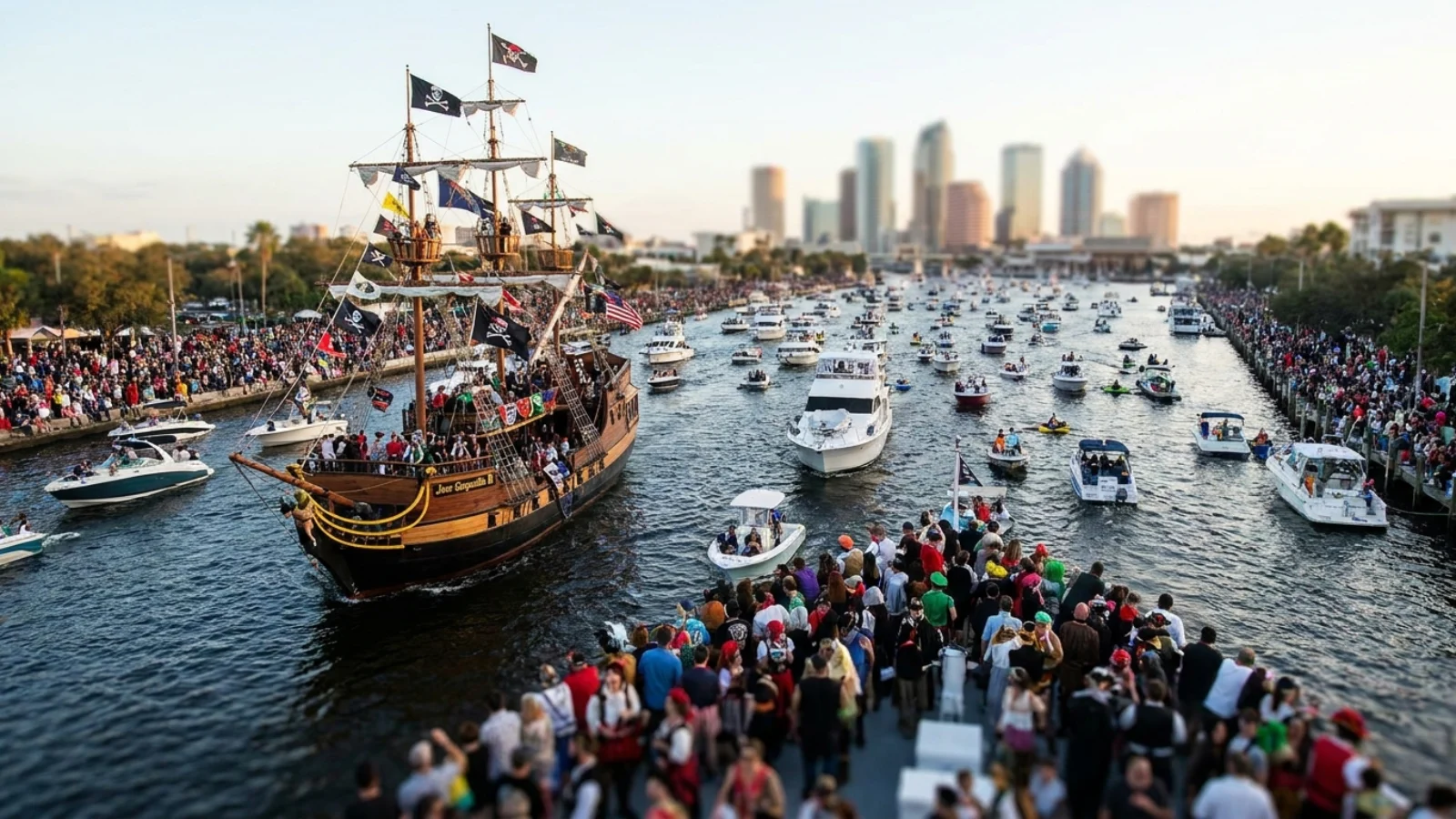
Gasparilla is Tampa’s pirate festival, held most years since 1904. Its centrepiece, the Parade of Pirates, is staged as a friendly “invasion” by the crew of the legendary pirate Jose Gaspar, played by members of Ye Mystic Krewe of Gasparilla. They sail across Tampa Bay on the Jose Gasparilla II, a 137-foot steel barge dressed as an eighteenth-century ship, demand the key to the city from the mayor, and lead a 4.5-mile victory parade down Bayshore Boulevard watched by about 300,000 people. It began as a surprise stunt at the city’s May Day festival in 1904, became a stand-alone event in 1913 and now anchors a whole “Gasparilla Season” from January to March. The pirate it honours never existed.
A 1904 civic publicity stunt, built on a hotel-brochure pirate legend, that grew into one of the largest annual parades in the United States.
What is Gasparilla?
Gasparilla, officially the Gasparilla Pirate Festival, is a large parade and a series of related community events held in Tampa, Florida, in most years since 1904. Its centrepiece is the Parade of Pirates, which locals usually call the Gasparilla Parade, held on what is known as Gasparilla Day. The whole thing is framed as a friendly invasion of the city by the crew of Jose Gaspar, also known as Gasparilla, a pirate of Florida folklore who is supposed to have raided the Gulf of Mexico from Southwest Florida in the late 1700s and early 1800s.
The parade and several related events are organised by Ye Mystic Krewe of Gasparilla, or YMKG, a local club modelled on the krewes of Mardi Gras in New Orleans. On Gasparilla Day its members dress as Gaspar and his crew, sail across Tampa Bay on a replica pirate ship, and demand the key to the city from the mayor before staging a victory parade. A crowd of about 300,000 usually turns out, making the Parade of Pirates one of the largest annual parades in the United States.
Gasparilla is no longer a single day. Over time it has grown into a “Gasparilla Season” that runs from about the beginning of the year until mid-March, with two other major parades and a long list of festivals, races and sporting events using the name. Together, these events have an estimated local economic impact of more than $40 million.
How does the Gasparilla invasion work?
Around noon on Gasparilla Day, members of YMKG set sail from the Tampa Yacht Club near Ballast Point Park aboard the Jose Gasparilla II. Firing an almost continuous barrage of loud mini-cannons and escorted by hundreds of private boats, the ship makes its way across the bay between Davis Island and Harbour Island into the Garrison Channel, where it moors along the Tampa Riverwalk behind the Tampa Convention Center. The krewe comes ashore into a crowd of revellers, and the pirate captain demands that the mayor hand over the key to the city in a playful ceremony that has ended differently in different years. Whether or not the mayor “surrenders”, the pirates then stage their victory parade.
The parade runs north along Bayshore Boulevard into downtown Tampa, a route of roughly 4.5 miles (7.2 kilometres). Since 2011 it has ended at Curtis Hixon Waterfront Park on the Riverwalk, where the party continues into the evening. YMKG and about fifty other krewes ride more than 100 floats, most of them pirate-themed, throwing beads, coins and souvenirs to the crowd, alongside high school and university marching bands, drill teams, and floats entered by local businesses and organisations. The parade has been broadcast live on local television for decades; WFLA-TV has covered it since 1955.
The invasion has its own build-up. A few days before the parade, pirates in full costume “kidnap” the mayor from city hall and carry them to a downtown park in front of local media to demand the city’s surrender. The mayor playfully refuses, and the pirates warn that Gaspar will arrive with an invasion force on Saturday. For decades, about two weeks before the parade, a US Navy ship also volunteered to be attacked by the small boats of the “Ybor City Navy”, armed with stale loaves of Cuban bread and water hoses. That event began in the early 1950s, was dropped after the 11 September 2001 attacks, and has since taken place only intermittently, with the museum ship SS American Victory standing in for the Navy.
The season ends with the Outbound Voyage, revived in 2008 after being discontinued in 1964. The pirates return the key to the mayor, board the Jose Gasparilla II and sail away across Tampa Bay, usually on the first Saturday in March.
How did Gasparilla begin?
The first Gasparilla was a publicity stunt. In 1904, Louise Frances Dodge, the society editor of the Tampa Tribune, and George Hardee, Tampa’s director of customs, decided to enliven the city’s May Day celebration by combining elements of New Orleans Mardi Gras with a local pirate legend. Hardee had lived in both New Orleans and Fort Myers. From Southwest Florida he knew the story of Jose Gaspar, a pirate supposedly based on Gasparilla Island in Charlotte Harbor, about 100 miles south of Tampa, whose legend was then virtually unknown in Tampa itself.
On 4 May 1904, several dozen local businessmen disguised themselves as pirates, rode horses through town in a surprise “invasion”, and urged startled onlookers to follow them to the May Day festival. The group that organised it became Ye Mystic Krewe of Gasparilla. The second Gasparilla, the following year, was no surprise: every car owner in town was invited to join the mounted pirates.
The pirate festival was not held again until 1910, when it was revived as part of a community celebration marking the opening of the Panama Canal. In 1913, a Gasparilla Carnival with a pirate parade and weekend festival was organised as an independent event, and it has remained one ever since, apart from breaks during the two world wars.
From horseback to pirate ship
The first few invasions were on land, with the story imagining a pirate ship named the Octopus anchored offshore. The first seaborne invasion came in 1911, when a merchant vessel was borrowed, decorated and renamed the Jose Gaspar for the day. A series of borrowed ships was used until the 1930s, when YMKG bought an old merchant sloop and converted it into the Jose Gasparilla, which served for about twenty years.
By the early 1950s the old wooden ship badly needed repairs. With financial help from the city of Tampa and the local chamber of commerce, YMKG commissioned a $100,000 replacement, and the Jose Gasparilla II made its debut at Gasparilla’s fiftieth anniversary celebration in 1954. It has been used ever since. Although it was designed to look like an eighteenth-century West Indiaman, it is actually a steel barge 137 feet (42 metres) long and 36 feet (11 metres) wide, with tall masts, a bowsprit and other decorations added. It has neither working sails nor an engine, so on Gasparilla Day three tugboats, directed by experienced harbour pilots, guide it through the flotilla. It has led every invasion since 1954 except in 1971, when bad weather and rough seas cancelled the flotilla, though not the parade.
For more than half a century, the pirate ships sailed about half a mile up the Hillsborough River to Plant Park, on the grounds of what is now the University of Tampa, where the krewe disembarked. The construction of the Tampa Crosstown Expressway in 1976 ended that tradition, because the ship’s 100-foot (30-metre) masts do not fit under the highway bridge near the river’s mouth. Since 1992 the ship has instead docked on the Riverwalk behind the convention center. Outside the season it is usually moored near the northern end of Bayshore Boulevard, within sight of downtown.
When is Gasparilla held?
The date has moved many times. In the early years the parade was held alongside other events, on dates from February to November. It was cancelled during American involvement in the First World War, and when it resumed in 1920 it was set for mid-February to coincide with the Florida State Fair, with the parade route ending at Plant Field, where the fair was held. The parade went on hiatus again from 1942 to 1946 during the Second World War.
When it returned in 1947, it was set for a Monday in mid-February, a tradition that lasted almost four decades. During that time Gasparilla Day was an official holiday in Hillsborough County, and local schools and government offices closed. In 1988 the parade moved to the first Saturday in February so that visitors could more easily attend, and since 2005 it has been held on the last Saturday in January. The only exception was 2021, when all the major events of the season were cancelled because of the COVID-19 pandemic.
The other Gasparilla parades
Two other big parades are now part of the season. The Children’s Gasparilla Extravaganza is held the Saturday before the main parade. It is billed as family-friendly, with no alcohol allowed along the route, which runs along Bayshore Boulevard and is about half as long as the main parade’s. It was first held in 1947 as a simple affair of schools and children’s groups pulling homemade floats a few blocks through downtown, moved to its current route in 2002, and now usually draws about 100,000 people. Children of krewe members ride the floats and throw beads, and the day ends with fireworks over Tampa Bay.
The Sant’ Yago Illuminated Knight Parade, sometimes called the Gasparilla night parade, has been organised since 1974 by the Krewe of the Knights of Sant’ Yago. It is held after dark in the historic neighbourhood of Ybor City, usually two weeks after the Parade of Pirates, with most floats brightly lit. Once considered the most adult-oriented parade of the season, it has been promoted in recent years as a family event.
The season also includes the Gasparilla Festival of the Arts (established 1970), the Gasparilla Distance Classic road race (1978), the Gasparilla Film Festival (2006), the Gasparilla Music Festival (2013) and the Gasparilla Bowl college football game, which took that name in 2018. One of the earliest spin-offs was the Gasparilla Open, a PGA Tour event sponsored by YMKG from 1932 to 1935, whose 1935 edition had the largest prize purse on that year’s tour, $4,000. It was dropped as the Great Depression deepened, and returned in 1956 as an amateur tournament.
Krewes, floats and throws
The krewes are social and charitable organisations modelled on those of New Orleans. YMKG, which came together informally in 1904, has become an exclusive social club and registered non-profit that elects a King and Queen of Gasparilla each year, holds private events, and raises money for charity, including college scholarships. For decades it was the only recognised Gasparilla krewe. The co-ed Krewe of Venus was organised in 1965, followed by the Krewe of the Knights of Sant’ Yago in 1972, the Tampa Rough Riders in 1978 and, in 1992, the first all-female krewe, Ye Loyal Krewe of Grace O’Malley, named after the Irish pirate queen. More krewes formed after YMKG opened up the parade in the 1990s. Today more than fifty krewes take part, with smaller ones rotating because slots are limited.
Floats have grown from decorated wagons and trucks pulled by horses into elaborate creations. In 2024, 115 floats took part, 14 of them YMKG’s. Recent floats have added lights, moving animatronics, water and smoke effects, and even hidden bars and bathrooms for riders, with some costing as much as $100,000 to build. Out of season, many are stored in YMKG’s “float barn”.
The throws have changed too. Plastic beads like those of Mardi Gras are now by far the most common, but they were rarely seen before the mid-1980s. Before then, the favourite souvenirs were commemorative coins and spent gun cartridges: for decades many YMKG members walked the route firing blank rounds from six-shooters, and children scrambled for the empty shells. That tradition was restricted for safety in 1992 and ended a few years later, although trained members still fire mini-cannons from specialised floats and from the ship. So many beads are thrown today that the city organises volunteer clean-ups that collect thousands of pounds of plastic from the parade route and from Tampa Bay itself.
The 1991 controversy
Gasparilla has faced criticism throughout its history, from complaints about drunken crowds to the observation that local elites dressing up as pirates to plunder the city is an odd tradition to celebrate. The most serious criticism concerned who was allowed to take part.
YMKG was founded by Tampa’s business and civic elite during the Jim Crow era, when the city, like the rest of the Deep South, was strictly segregated, and the private, somewhat secretive club remained all-white and all-male long after public segregation had ended. The parade made small steps: female relatives of members formed the Krewe of Venus, which joined the parade in 1967, and leaders of Tampa’s Latin community formed the Krewe of the Knights of Sant’ Yago. But African Americans could only watch. By the 1980s, local minority organisations were pointing out that exclusion from YMKG, whose membership overlapped heavily with the Chamber of Commerce and key yacht and country clubs, symbolised their exclusion from the city’s top social and economic circles.
The issue came to a head in 1990. Tampa and YMKG had agreed to stage the 1991 parade a week early to coincide with Super Bowl XXV, to be played at Tampa Stadium. Local chapters of the NAACP and the Urban League used the international attention on the Super Bowl to highlight the krewe’s segregated membership, and the city and the National Football League pressed YMKG to admit its first African American members. In September 1990 the krewe, saying it was not racist but that it was “too late” to change its membership before the 1991 parade, cancelled the Parade of Pirates instead. The city put together a replacement, a “multicultural festival” called Bamboleo with no pirate theme, which rain helped turn into what some called a flop.
Later in 1991, YMKG admitted two Black members and agreed to let additional krewes join the main parade. The Parade of Pirates returned in 1992 with a broader set of participants. When Tampa hosted Super Bowl XXXV in 2001, the parade did move to the Saturday before the game, and an integrated YMKG, joined by more than thirty other krewes, drew a record crowd of 750,000. The city has not repeated the scheduling for later Super Bowls because of the crowds and traffic.
Gasparilla and Tampa’s pirate identity
The festival has shaped Tampa’s identity far beyond January. When the city was awarded an NFL franchise in 1974, a “name the team” contest was won easily by “Buccaneers”, because of the area’s association with Gasparilla and pirates. The Tampa Bay Buccaneers took the field in 1976, and when Raymond James Stadium opened in 1998 it included a replica pirate ship behind the north end zone, from which cannons are fired during games. The Tampa Bay Lightning have worn Gasparilla-themed uniforms for games on parade day, and when Tampa hosted the 2018 NHL All-Star Game on Gasparilla weekend, the Stanley Cup rode on the Jose Gasparilla II wearing a lifejacket.
The name itself is everywhere. According to the Florida Department of State, more than 100 entities have registered names using “Gaspar” or “Gasparilla”, from restaurants to beauty pageants. Neither YMKG nor the city owns the name, and in 2019 YMKG began trying to trademark it, prompting counterclaims from others who use it; the dispute went to the US Trademark Trial and Appeal Board in 2020.
The pirate who never was
The irony at the heart of Gasparilla is that the pirate it celebrates almost certainly never existed. No record of Jose Gaspar has been found in Spanish or American archives, and the first written account of him appeared in a promotional brochure for the Gasparilla Inn at Boca Grande in the early 1900s, whose author later admitted it was “without a true fact in it”. Place names such as Gasparilla, Captiva and Sanibel, which the legend claims came from the pirate, appear on maps from the early 1700s, decades before he was supposedly born. Our article on Jose Gaspar explains the legend, the Southwest Florida places tied to it and how it was debunked.
Ye Mystic Krewe of Gasparilla itself now acknowledges the point. Its 2004 centennial history conceded that research in Spanish and American archives had found no evidence of Gaspar, and concluded that “the legend exists, and that’s what matters”. Florida’s real pirate history, from the pirates of the Golden Age who used the Bahamas and the Florida Straits to legends such as Black Caesar in the Keys, is covered in our pirates hub. Gasparilla is something different: not a piece of pirate history, but a century-old piece of Tampa history, and one of the most entertaining ways a city has ever chosen to tell a story about itself.
What is Gasparilla?
Tampa’s pirate festival, built around a mock pirate invasion and parade held since 1904.
When is Gasparilla held?
The Parade of Pirates is held on the last Saturday in January.
Who was Gasparilla?
Jose Gaspar, a legendary Florida pirate for whom no historical evidence exists.
How many people attend Gasparilla?
About 300,000 usually watch the Parade of Pirates; 750,000 attended in 2001.
What is the Gasparilla pirate ship?
The Jose Gasparilla II, a 137-foot steel barge dressed as a pirate ship, in use since 1954.
Who organises Gasparilla?
Ye Mystic Krewe of Gasparilla, founded in 1904, with more than fifty other krewes.
Why was Gasparilla cancelled in 1991?
The krewe cancelled it rather than integrate its all-white membership before the Super Bowl.
Are the Tampa Bay Buccaneers named after Gasparilla?
Indirectly. The name won a 1970s contest because of Tampa’s Gasparilla pirate tradition.
- Wikipedia contributors, “Gasparilla Pirate Festival” (accessed November 2026), citing the Tampa Bay Times, Tampa Bay History Center and Ye Mystic Krewe of Gasparilla.
- Wikipedia contributors, “Jose Gaspar” (accessed November 2026).
Blane Perun has been exploring Earth’s oceans and marine life for over 25 years. Founder of TheSea.Org in 1999, underwater photographer, coral aquaculture pioneer, and explorer of 80+ countries.
About Blane Perun →