Pirate Swords: Cutlasses, Sabers, and Boarding Blades
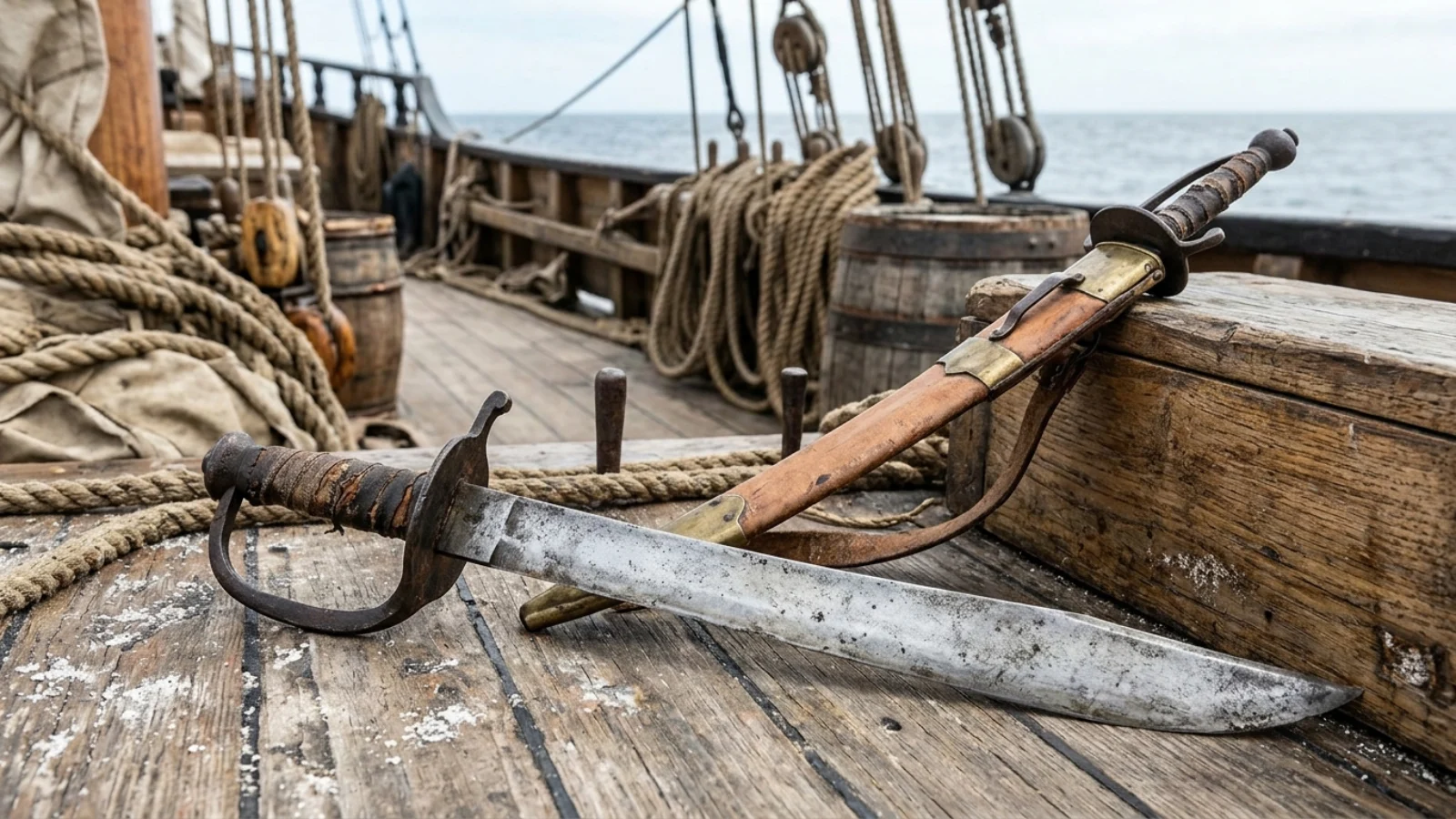
The cutlass was the dominant pirate edged weapon of the Golden Age, favoured for practical reasons specific to maritime combat: its short, broad blade worked effectively in the confined spaces of a ship’s deck, it was simple to use without extensive training, it doubled as a working tool for cutting rope and canvas, and it was widely available through naval and merchant supply chains. The romantic image of elaborate fencing with rapiers represents naval officer culture, not the working-class maritime reality of most pirate crews. Combat aboard a boarded vessel was fast, brutal, and close-quarters — the cutlass was exactly suited to it.
Pirate swords were not chosen for elegance or tradition but for effectiveness in a specific and demanding operational context: boarding and hand-to-hand combat on the confined, moving, cluttered deck of a ship that has just been brought alongside another ship by force. That context explains why the cutlass dominated and why the rapier, despite its fencing associations, was largely irrelevant to working pirate combat.
Why the cutlass dominated pirate combat
The cutlass’s dominance among pirate crews was not cultural preference or romanticism — it was the product of specific operational requirements that the cutlass met and competing designs did not.
The short, broad blade (typically 60 to 70 centimetres) was the defining feature. In the cramped spaces of a ship’s deck — between cannon carriages, below low beams, among ropes and rigging — a long blade was a liability. It snagged, it was difficult to manoeuvre, and it transferred less force to a slashing blow when swing arc was constrained. The cutlass’s shorter blade worked effectively in these spaces. A powerful slash with a broad, slightly curved blade could be delivered even when movement was restricted to a few feet.
The cutlass also required far less training to use effectively than a rapier or smallsword. Thrust-focused weapons like the rapier depended on precise footwork, blade control, and targeting of specific anatomical points — skills that took years to develop. The cutlass was a slashing weapon where raw force and aggression compensated for technical deficiency. A newly recruited pirate with a cutlass was more immediately dangerous than the same person with a rapier. For crews assembled quickly from diverse backgrounds with no common training tradition, this simplicity was operationally significant.
The cutlass as a working tool
One of the least-discussed aspects of the cutlass’s dominance is its dual function as both weapon and shipboard working tool. This utility value separated it from purely martial edged weapons in a way that mattered for practical crew operations.
A cutlass blade could cut rope, canvas, and light timber. It was used to clear fouled rigging, cut away damaged sails, hack through boarding nets stretched across an enemy vessel’s deck, and perform dozens of routine shipboard cutting tasks. A sailor who carried a cutlass carried a tool that was useful every day — not just in combat. This meant pirates maintained their cutlasses regularly (oiling against corrosion, sharpening against a stone) because daily use required it, which in turn meant the blade was in better condition when combat occurred.
The boarding axe served a similar dual function — it could breach hatches, cut ropes, and act as a close-combat weapon — and was commonly carried alongside the cutlass by boarding parties. Belaying pins (wooden or iron rods used to secure rigging) were improvised weapons in situations where a dedicated weapon was not to hand. The practical maritime environment was one of improvisation, and the weapons that dominated it were those that served multiple purposes.
Blade construction and maintenance
The metallurgy of Golden Age cutlasses reflected the manufacturing technology of the period, producing blades that were functional and durable but considerably less sophisticated than the swords of aristocratic or specialist military tradition.
Cutlass blades were typically forged from high-carbon steel, heated and shaped by blacksmiths rather than specialist swordsmiths. The tempering process — heating and cooling the blade to achieve the balance of hardness and flexibility required for a useful weapon — was understood empirically by experienced smiths even without the metallurgical science to explain it. A well-tempered cutlass blade held an edge reasonably well and could flex without snapping under lateral force.
Maritime maintenance was demanding. Salt air corroded steel rapidly, and a blade left unattended in the maritime environment would develop surface rust within days. Pirates who depended on their cutlasses maintained them with oil applied to the blade and guard, wrapping the scabbard tightly when not in use, and sharpening the edge regularly on a whetstone. These were not optional refinements but operational necessities — a corroded or blunt blade was a hazard in combat, not an asset.
Boarding combat: the context that explains the weapon
Understanding why the cutlass dominated requires picturing what boarding combat actually looked like — which was considerably less organised and more chaotic than the theatrical swordfights of popular culture.
When a pirate vessel came alongside a prize, boarding parties crossed using grappling hooks, thrown ropes, and whatever physical contact the vessels’ hulls allowed. The boarding party arrived on the prize’s deck in a compressed group, in the middle of a vessel that had just been bombarded, among crew members who might be armed and willing to resist or might be in the process of surrendering. The space was filled with debris, ropes, damaged rigging, and cannon equipment.
In this environment, the fencing conventions of land-based sword combat were irrelevant. There was no room for measured footwork, no time for careful blade control, and no guarantee that opponents were armed with comparable weapons. The cutlass’s effectiveness in this context came from its ability to deliver damaging blows quickly, in small spaces, against opponents who might be using anything from dedicated weapons to belaying pins and bare hands. It was the right tool for the actual job.
What sword did pirates use?
Primarily the cutlass — a short (60–70cm), broad, single-edged blade with a slight curve and a half-basket or D-guard for hand protection. The cutlass was dominant because it worked effectively in confined shipboard spaces, required minimal training to use, and doubled as a working tool for cutting rope and canvas.
Why didn’t pirates use rapiers?
The rapier was too long for confined ship spaces, required years of thrust-focused fencing training to use effectively, and was fragile for the cutting and prying tasks of maritime work. It was a weapon of aristocratic and officer culture, not working-class maritime reality. Pirates needed a weapon that worked in chaos without training — the cutlass provided it; the rapier did not.
How did the cutlass function as a working tool?
The broad blade could cut rope, canvas, and light timber, making it useful for clearing fouled rigging, cutting away damaged sails, hacking through boarding nets, and dozens of routine shipboard cutting tasks. This daily utility meant pirates maintained their cutlasses regularly — oiling against corrosion, sharpening — so the blade was in better condition when combat occurred.
What other edged weapons did pirates carry?
Boarding axes (for breaching hatches and cutting ropes, also usable as weapons), belaying pins (improvised weapons from rigging hardware), and occasionally longer blades for specific roles. Some pirates carried knives as secondary weapons. The combination of cutlass and boarding axe was common for boarding party members.
How were pirate swords maintained at sea?
Regular oiling of the blade and guard to prevent salt air corrosion, tight wrapping of the scabbard when not in use, and periodic sharpening on a whetstone. Salt air corroded unprotected steel within days. Maintenance was not optional — a corroded or blunt blade was a liability in the combat situations pirates faced.
Blane Perun has been exploring Earth’s oceans and marine life for over 25 years. Founder of TheSea.Org in 1999, underwater photographer, coral aquaculture pioneer, and explorer of 80+ countries.
About Blane Perun →