Female Pirates — Anne Bonny, Mary Read, Ching Shih and More
Female pirates were rare but real: around a hundred women are known to have been pirates, about four of them in the Golden Age of Piracy. The most famous are Anne Bonny and Mary Read, who sailed with Calico Jack Rackham in 1720 and escaped hanging in Jamaica by declaring they were pregnant. The most powerful was Zheng Yi Sao (Ching Shih), who led a pirate confederation of hundreds of junks and tens of thousands of pirates in the South China Sea before negotiating her surrender in 1810. Others, such as Grace O’Malley in Ireland and Sayyida al-Hurra in Morocco, were rulers who used fleets at sea. Some famous names, such as Jacquotte Delahaye, have no historical evidence behind them at all.
A handful of women commanded pirate fleets or fought as pirates, and their records are often thinner, and their legends larger, than those of male pirates.
Were there really female pirates?
Yes, though not many. Although most pirates in history were men, there are around a hundred known examples of female pirates, about four of whom were active in the Golden Age of Piracy, the period roughly from the 1650s to the 1720s that produced most of the pirates of popular imagination. Some women were pirate captains, and a few commanded entire pirate fleets. The most powerful of them, such as Zheng Yi Sao in the early 1800s and Huang Bamei in the twentieth century, led tens of thousands of pirates.
Many more women were involved in piracy without going to sea. Women worked as smugglers, money lenders, buyers of stolen goods, tavern keepers and prostitutes in pirate ports, and they were the wives, mothers and daughters of both pirates and their victims. Some married pirates and turned their homes or businesses into safe havens. Powerful women could also be patrons of pirates: Queen Elizabeth I of England, who reigned from 1558 to 1603, acted as a powerful patron of pirates. Historians have paid little attention to these roles, but they mattered then and still do: modern piracy off Somalia, for example, is supported to a large extent by women on shore who help with transport, housing and recruitment.
Seafaring was overwhelmingly a male world. On many Golden Age ships, women were banned by the articles every crewman had to sign, because they were considered bad luck and because the crew feared men would fight over them. Bartholomew Roberts’ articles, for example, made it a capital offence to smuggle a woman aboard in disguise; our page on the pirate code quotes the rule. As a result, many female pirates, including Anne Bonny and Mary Read, dressed and acted as men. Because some women’s sex was only discovered after they were caught, there may have been more female pirates than the surviving records show.
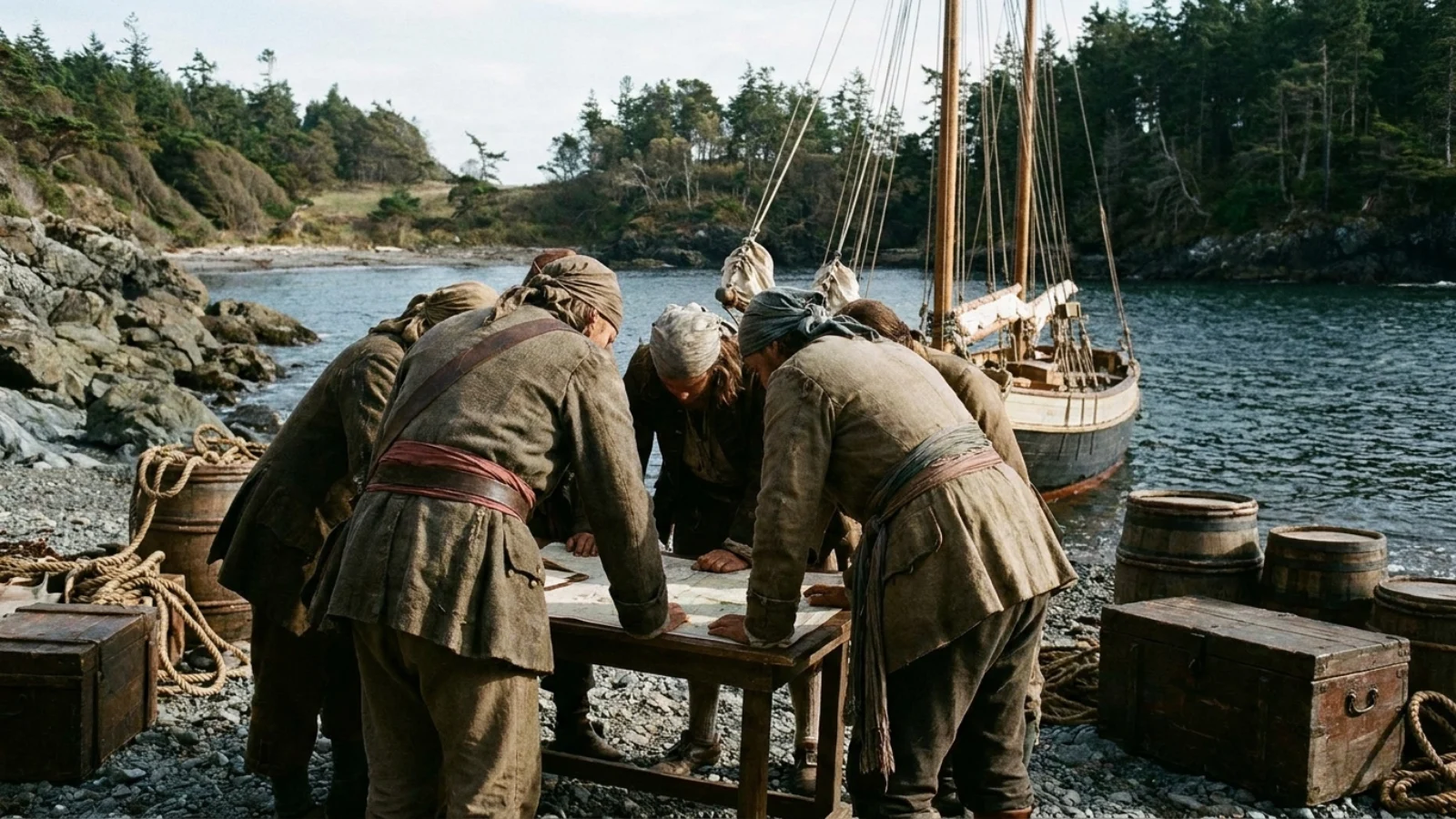
Anne Bonny and Mary Read
Anne Bonny and Mary Read are the best-known female pirates in history, and they appear in the records together. Both sailed in the crew of John “Calico Jack” Rackham in 1720.
Much of what is usually told about them comes from Captain Charles Johnson’s A General History of the Pyrates, published in 1724, and modern historians treat it with caution. According to Johnson, Bonny was born in Ireland, the illegitimate daughter of an attorney and his servant, moved with her father to Carolina and married a sailor. In Johnson’s account, Read was raised as a boy, joined the military and later went to the West Indies. There is little evidence for either story. No primary source, including the women’s own trial records, mentions their ages or where they came from. No Anne Bonny of the right period has been found in Irish baptism records, and many women named Mary Read were born in England in the late seventeenth century, making it impossible to say which, if any, was the pirate. One candidate was born in Bristol around May 1681, the daughter of a man who became a pirate on Madagascar; another signed the 1708 Breholt Petition asking Queen Anne to pardon the pirates still on Madagascar.
What the records do show is this. At some point both women came to the Bahamas, where they met Rackham. In August 1720 they joined his crew, and on 22 August 1720 the group stole the sloop William, owned by John Ham, from Nassau. Rackham’s crew attacked a number of merchant ships in the West Indies until they were captured near Jamaica by the former privateer Jonathan Barnet after a brief fight on 22 October 1720. Rackham and all the men of his crew were tried and hanged.
Bonny and Read were tried for piracy in Spanish Town, Jamaica, on 28 November 1720. One of their victims, Dorothy Thomas of Jamaica, described them in her testimony: they “wore men’s jackets, and long trousers, and handkerchiefs tied about their heads”, each carried a machete and pistol, and they “cursed and swore at the men to murder her”. She said she knew they were women “from the largeness of their breasts”. Both were convicted, but both declared that they were pregnant, and their executions were stayed. Read died in prison in Spanish Town around April 1721, of an unknown cause, probably a fever. Bonny’s fate is uncertain. She was probably released at some point, and a burial register for Saint Catherine Parish, which includes Spanish Town, records the burial of an “Ann Bonny” on 29 December 1733.
Zheng Yi Sao (Ching Shih): the most successful pirate of all?
If Bonny and Read are the most famous female pirates, Zheng Yi Sao was by far the most powerful. Born Shi Yang in 1775 near Xinhui in Guangdong, China, she is also known as Ching Shih, Shek Yeung and Zheng Yi Sao, meaning “wife of Zheng Yi”. She has been described as history’s most successful female pirate and among the most successful pirates of any kind.
In 1801, at about 26, she married the pirate Zheng Yi, who came from a family of pirates and had fought as a privateer in the wars in Vietnam. In July 1805, after a period of fighting among the pirates of Guangdong, Zheng Yi, with her capable support, united them into a confederation of six fleets, each known by the colour of its flags: red, black, blue, white, yellow and purple. Zheng Yi commanded the largest, the Red Flag Fleet of about 200 ships. By 1805 the confederation had roughly 400 junks and between 40,000 and 70,000 pirates.
On 16 November 1807, Zheng Yi fell overboard in a gale and died. Zheng Yi Sao took over his informal command of the whole confederation, balancing its factions with the support of his relatives and, above all, of his adopted son Zhang Bao, who commanded the Red Flag Fleet. A Qing official who later negotiated with them reported that “Zhang Bao obeyed Zheng Yi Sao’s orders, and consulted her on all things before acting.” She and Zhang Bao became partners and later married.
Under her leadership the confederation became more active than ever. In 1808 and 1809 it defeated Qing provincial fleets and raided deep into the Pearl River delta. In one battle in 1809 she personally led the Red and White Flag Fleets in a charge that routed a fleet of about 100 government ships. The raids were brutal: one six-week campaign by the Black Flag Fleet caused about 10,000 deaths. The pirates mainly attacked Chinese warships and merchant shipping, and occasionally European vessels. In desperation, Chinese officials turned to the Portuguese at Macau, whose warships, with modern guns, inflicted a string of defeats on the pirates in late 1809.
In 1810 Zheng Yi Sao negotiated a surrender to the Qing authorities on remarkable terms: she and Zhang Bao kept 24 ships and more than 1,400 followers and avoided prosecution. Zhang Bao went on to serve the Qing as an officer, fighting other pirate fleets. She was given land in Canton, where she ran a successful gambling house, and died in 1844 at about 68, having lived a relatively peaceful and prosperous life after piracy.
One popular claim about her is wrong. The strict codes often attributed to her, with execution for going ashore without leave, for stealing from the common fund and for raping captives, were actually issued by Zhang Bao for the Red Flag Fleet, according to the Qing account of the confederation based on first-hand testimony. The misattribution most likely began with Philip Gosse’s The History of Piracy (1932), and was repeated by Jorge Luis Borges in his 1935 story “The Widow Ching, Lady Pirate”.
Grace O’Malley: the Irish pirate queen
Grainne O’Malley, known in Irish as Grainne Ni Mhaille and often called the pirate queen, lived from about 1530 to about 1603 and was the head of the O Maille dynasty in the west of Ireland. On her father’s death she took over active leadership of the family’s lordship by land and sea, even though she had a brother. Her family’s power rested on the sea, and English officials saw her as a pirate and a rebel.
Her most famous moment came in 1593. When her sons and her half-brother were taken captive by Sir Richard Bingham, the English governor of Connacht, she sailed to England to petition for their release and presented her request in person to Queen Elizabeth I at Greenwich Palace. She is not mentioned in the Irish annals, so most of the evidence for her life comes from English sources, especially eighteen written questions, the “Articles of Interrogatory”, put to her on Elizabeth’s behalf. Our profile of Grace O’Malley tells the full story. In Tampa, the first all-female krewe of the Gasparilla parade, founded in 1992, is named after her.
Sayyida al-Hurra: the Moroccan corsair governor
Sayyida al-Hurra, whose name means “the free lady”, was a Moroccan privateer who governed the city of Tetouan from 1515 to 1542. Her birth date is uncertain, estimated between 1491 and 1495, and her death has been placed in 1552 or about a decade later. She lived during a long struggle between Christian and Muslim powers in the western Mediterranean: Portugal had begun seizing ports on the Moroccan coast, and the Reconquista had returned the Iberian Peninsula to Christian rule by 1492, eventually leading to the expulsion or forced conversion of Spain’s Muslims.
She is said to have split control of the Mediterranean with her ally, the Ottoman corsair Hayreddin Barbarossa, who operated in the east while she operated in the west. She spoke several languages, including Castilian Spanish and Portuguese, and Spanish and Portuguese sources described her as “their partner in the diplomatic game”. She later married the Moroccan king Abu al-Abbas Ahmad ibn Muhammad of the Wattasid dynasty. She has been called one of the most important female figures of the Islamic West in the early modern age. As with many privateers, whether she was a pirate depended on which side you were on.
Jeanne de Clisson: the Lioness of Brittany
One of the earliest well-known female sea raiders is Jeanne de Clisson (1300 to 1359), a French-Breton noblewoman also known as the Lioness of Brittany. During the wars between England and France, her husband, Olivier IV de Clisson, was accused of treason and beheaded in Paris on 2 August 1343 on the orders of King Philip VI of France. Seeking revenge, Jeanne became a privateer. She crossed the English Channel, attacked French ships and regularly killed almost their entire crews, reportedly leaving at least one sailor alive to carry her message of vengeance. Like many medieval figures, her story has been embellished over the centuries.
Female pirates who probably never existed
Not every famous female pirate was real. Jacquotte Delahaye, said to have been active around 1656, is often listed alongside Anne Bonny and Mary Read. In the stories, she came from Saint-Domingue in modern Haiti, faked her own death, lived as a man, returned as “Back From the Dead Red” for her red hair, led hundreds of pirates and took over Tortuga before dying in a shoot-out. There is no evidence from period sources that she was a real person. Her story is attributed to oral storytelling and to Leon Treich, a French fiction writer of the 1940s.
Florida has its own example of how pirate legends are made. Jose Gaspar, the supposed pirate of Southwest Florida, is said to have kept female captives on Captiva Island, but the island’s name appears on maps decades before he was supposedly born, and Gaspar himself appears to be a creation of a 1900s hotel brochure. Female pirates have long attracted legend too: the earliest legendary female pirate may be Atalanta of Greek mythology, said to have sailed with the Argonauts, and Scandinavian folklore is full of shield-maidens commanding ships, though none of these tales can be verified.
Why are female pirates so famous?
Given how few there were, female pirates have an outsized place in popular culture. Part of the reason is novelty: a woman dressed as a man, fighting alongside a pirate crew, was as surprising to eighteenth-century readers as it is today, and Johnson’s 1724 book made the most of it. Since the twentieth century, fictional pirate women have often been romanticised as symbols of female freedom, escaping the narrow roles open to women on land.
The reality was harder. The best-documented female pirates either escaped the gallows by pleading pregnancy, as Bonny and Read did, or survived because they were powerful enough to negotiate, as Zheng Yi Sao and Grace O’Malley were. Their stories also show how incomplete the records are. Most of what we know about Bonny and Read comes from a single trial, and most of what we know about O’Malley comes from the English officials who opposed her. For other women, such as Rachel Wall in New England, the line between history and legend is hard to draw. For more on the era, see our guides to the Golden Age of Piracy and to Calico Jack Rackham.
Who was the most famous female pirate?
Anne Bonny, with Mary Read, is the best known; Zheng Yi Sao was the most powerful.
How many female pirates were there?
Around a hundred are known, about four from the Golden Age of Piracy.
Who was the most successful female pirate?
Zheng Yi Sao (Ching Shih), who led some 400 junks and tens of thousands of pirates.
What happened to Anne Bonny and Mary Read?
Both were convicted in 1720 but spared as pregnant; Read died in prison in 1721.
Were women allowed on pirate ships?
Many pirate articles banned them, so some women disguised themselves as men.
Was Grace O’Malley a pirate?
English officials considered her one; she was an Irish clan leader who ruled by sea.
Was Jacquotte Delahaye real?
There is no period evidence that she existed; her story appears to be fiction.
Did Ching Shih write a pirate code?
The famous code is now attributed to her partner Zhang Bao, not to her.
- Wikipedia contributors, “Women in piracy”, “Anne Bonny”, “Mary Read”, “Ching Shih”, “Grace O’Malley”, “Sayyida al Hurra”, “Jeanne de Clisson” and “Jacquotte Delahaye” (accessed November 2026).
- Johnson, C. (1724), A General History of the Pyrates (source of the traditional Bonny and Read biographies); trial testimony of Dorothy Thomas, Spanish Town, Jamaica (1720).
- Yuan Yonglun, Jing hai fen ji (1830), the Qing account of the South China Sea pirate confederation; Gosse, P. (1932), The History of Piracy.
Blane Perun has been exploring Earth’s oceans and marine life for over 25 years. Founder of TheSea.Org in 1999, underwater photographer, coral aquaculture pioneer, and explorer of 80+ countries.
About Blane Perun →