Andrea Doria — The Liner Sunk in Fog and the Everest of Wreck Diving
SS Andrea Doria was an Italian Line ocean liner that sank south of Nantucket, Massachusetts, on the morning of 26 July 1956, about 11 hours after the Swedish liner Stockholm struck her starboard side in fog at about 11:10 p.m. on 25 July. She listed so steeply that half her lifeboats could not be launched, but nearby ships, led by the French liner Ile de France, rescued 1,660 of the 1,706 people aboard. Forty-six people on Andrea Doria died, most of them killed by the impact, and five Stockholm crew members also died. The wreck lies at about 70 to 75 m (230 to 250 ft) and is known as the “Mount Everest of wreck diving”; at least 22 divers have died exploring it.
It was a collision between two radar-equipped liners in a busy shipping lane, followed by a rescue that saved almost everyone despite a ship that could launch only half her boats. Its causes were never formally decided because the shipping lines settled out of court.
Italy’s floating art gallery
Andrea Doria was named after the sixteenth-century Genoese admiral, and of all Italy’s ships at the time she was the largest, the fastest and supposedly the safest. Ansaldo launched her at Genoa on 16 June 1951 and she sailed on her maiden voyage to New York on 14 January 1953. Designed with interiors by the architect Giulio Minoletti, she measured about 29,100 gross tons and some 213 m (701 ft), and her steam turbines and twin screws gave her a service speed of 23 knots and a top speed of 26. She was neither the largest nor the fastest liner of her day, a distinction that belonged to the Queen Elizabeth and the United States; her strength was luxury, with three swimming pools and lavishly decorated public rooms. She could carry 1,241 passengers, 218 in first class, 320 in cabin class and 703 in tourist class, in strictly separated parts of the ship.
On paper she was also among the safest ships afloat. Her double hull was divided into 11 watertight compartments, and any two could flood without endangering her. She carried the latest radar, and sixteen steel lifeboats, eight on each side, enough by regulation for everyone aboard.
A hidden weakness
Model tests during her design had predicted that she would develop a large list if hit by any significant force, and on her maiden voyage she rolled 28 degrees after being struck by a large wave off Nantucket. The tendency was worse when her fuel tanks were nearly empty, as they were near the end of each crossing. Two features made that dangerous. Her watertight bulkheads rose only to the top of A Deck, so a list of more than 20 degrees would let water from one flooded compartment pour over the top into the next. And her lifeboats were designed to be lowered at a list of no more than 15 degrees; beyond that, up to half of them could not be used.
The final voyage
Her 51st westbound crossing began at Genoa on 17 July 1956. She called at Cannes, Naples and Gibraltar, and when she headed out into the Atlantic she carried 1,134 passengers and 572 crew, 1,706 people in all. Among them were the Hollywood actress Ruth Roman and her three-year-old son, the songwriter Mike Stoller, and two Hungarian ballet dancers who had defected from the Soviet bloc. Most of the 744 passengers who boarded at Naples were tourist-class emigrants from the poorer regions of southern Italy, heading for new lives in America. The ship was due in New York on the morning of 26 July.
At just before noon on 25 July, the Swedish American Line’s Stockholm left New York for Gothenburg. At about 12,165 tons and 160 m she was roughly half the size of Andrea Doria and the smallest passenger liner on the North Atlantic run, but she had been built for northern waters with a strong, sharply raked ice-breaking bow. She carried 534 passengers and 208 crew. On her bridge that night was Third Officer Johan-Ernst Carstens-Johannsen, on watch alone for the first time; the captain, Harry Gunnar Nordenson, was not on the bridge. To save time she was following a course about 20 miles north of the recommended eastbound track, putting her directly into westbound traffic.
A collision in the fog
South of Nantucket the cold Labrador Current meets the warm Gulf Stream, and fog is common. Andrea Doria had been running through a heavy fog bank for hours. Captain Calamai had cut speed slightly, from 23 to 21.8 knots, sounded the fog whistle and closed the watertight doors, the customary precautions, but was still travelling far faster than the rules for poor visibility required, a common practice among liners. Stockholm, making about 18 knots in clear air, had not yet entered the fog. The ships were approaching almost head-on at a combined speed of about 40 knots, each aware of the other only as an echo on radar, and neither called the other by radio.
Each misread the other’s course. Andrea Doria edged to port, intending a starboard-to-starboard passing; Stockholm turned about 20 degrees to starboard, intending to widen a port-to-port passing. The two turns put them on a collision course. By the time they could see each other’s lights, it was too late. Stockholm turned hard to starboard and reversed her engines; Andrea Doria, hoping to outrun the collision, turned hard to port at almost 22 knots. At about 11:10 p.m. Stockholm‘s bow struck Andrea Doria almost at right angles, below the bridge about a third of the way back from the bow, and penetrated nearly 40 ft into her hull.
Why she listed so far
The impact tore open five fuel tanks on the starboard side, which filled with thousands of tons of seawater. On the port side, five mostly empty tanks held air. Within minutes the list exceeded 20 degrees. Only one watertight compartment had been breached directly, but as the ship heeled the tops of the starboard bulkheads dipped below the waterline, and water spread along corridors and down stairwells from compartment to compartment. Because the fuel tanks had not been ballasted with seawater as they emptied during the voyage, the crew could not counter-flood the port side to bring her upright.
The rescue
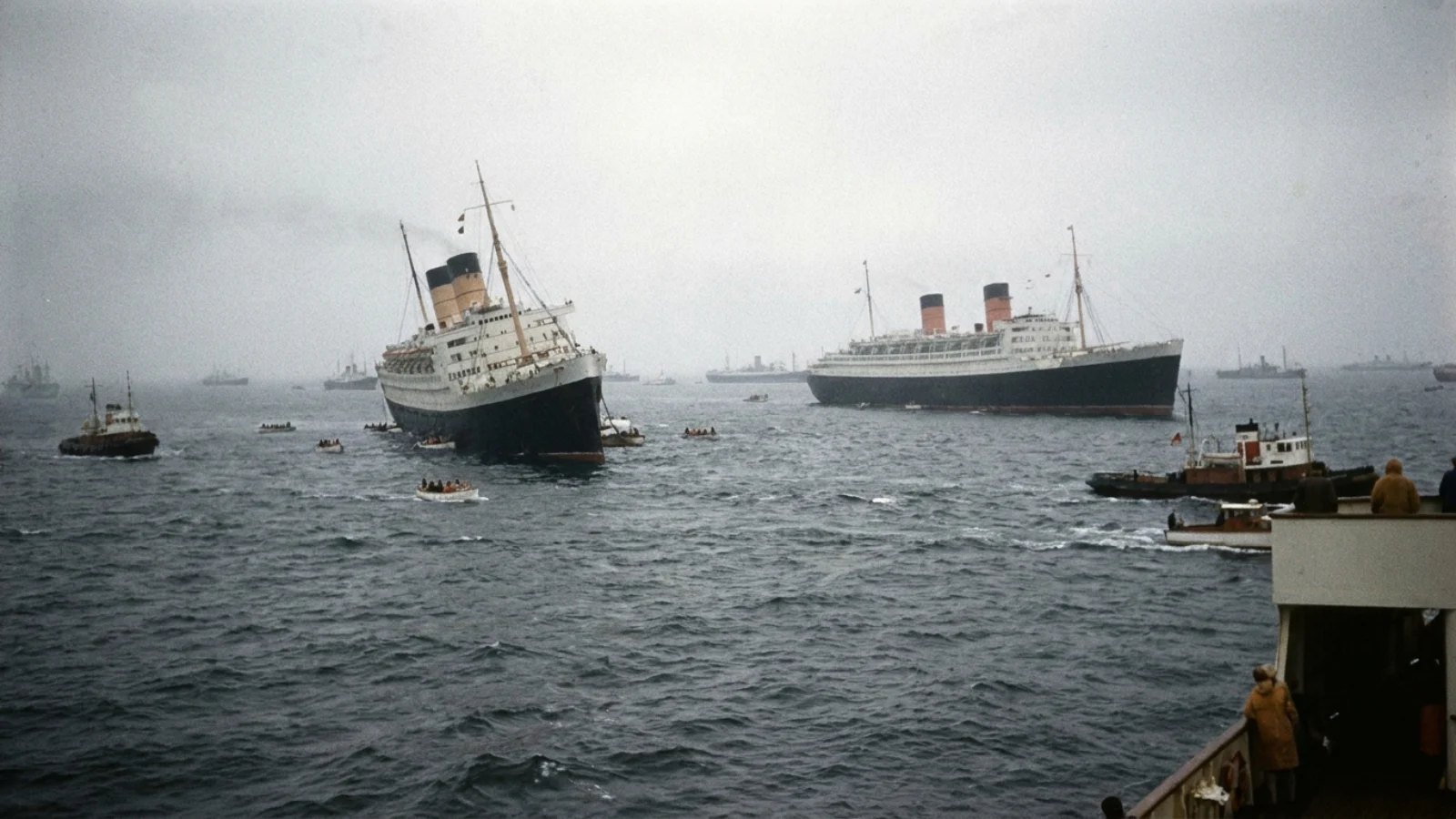
The decision to abandon ship was made within half an hour. The eight port-side lifeboats now hung high in the air over the ship’s exposed side and could not be lowered. The starboard boats had to be lowered empty and passengers brought down to them by ropes and rope ladders. Fearing a stampede for too few boats, Captain Calamai held back the formal order to abandon ship until help arrived. Several starboard boats left only partly filled, carrying about 200 crew and few passengers.
Being in a busy shipping lane saved hundreds of lives. The United Fruit freighter Cape Ann, with only two 40-person lifeboats, was first to respond. The Navy transport Private William H. Thomas and the destroyer escort USS Edward H. Allen followed. Stockholm, damaged but in no danger of sinking, sent her own boats. Most important was the French liner Ile de France, eastbound 44 nautical miles away with 940 passengers. Her captain, Raoul de Beaudean, at first doubted that a modern liner could be sinking and knew that turning back would cost his company dearly; once he understood that more than 1,600 lives were at risk, he turned round. She arrived less than three hours after the collision, just as the fog lifted, positioned herself to shelter Andrea Doria‘s starboard side and switched on every exterior light. Survivors remembered the sight of the brilliantly lit liner as an overwhelming relief.
Ile de France took aboard 753 survivors, more than any other ship. Stockholm took 545 by the usual count, including 234 of Andrea Doria‘s crew who had left ahead of the passengers; other accounts give her a figure of 572. Cape Ann took 129, Private William H. Thomas 159 and Edward H. Allen 77, including Captain Calamai and his officers. One American sailor who had slept through the whole collision was taken off the abandoned liner by the tanker Robert E. Hopkins.
The “miracle girl” and the dead
The impact zone covered five passenger decks. On the upper deck, cabins directly in the path of the bow were destroyed. The New York Times correspondent Camille Cianfarra and his eight-year-old daughter Joan were killed. His stepdaughter, 14-year-old Linda Morgan, was thrown from her bed and ended up on Stockholm‘s crumpled bow with non-life-threatening injuries; the press called her the “miracle girl”. Her father, the broadcaster Edward P. Morgan, had reported on the collision on the radio the night before without telling listeners she had been aboard and was feared dead. On the decks below, where tourist-class cabins lay, the loss of life was greater; on A Deck alone eleven passengers were killed.
In all, 51 people died: 46 from Andrea Doria, 43 of them as a direct result of the collision, and five crew members of Stockholm. The remains of those killed in the impact on Andrea Doria were never recovered and are believed to lie in the wreck. It remains the worst maritime disaster in US waters since the capsizing of the Eastland in Chicago in 1915.
The sinking
When the evacuation was complete, Captain Calamai hoped to tow the ship into shallow water, but she was clearly doomed. By 6:00 a.m. he too was in a boat. The final plunge began at about 9:45 a.m.: the starboard side dipped under and the swimming pools refilled with seawater, the bow slid under and the stern rose, and unused lifeboats broke free and floated upside down in a row. Andrea Doria sank bow first at 10:09 a.m. on 26 July, having drifted about 1.6 nautical miles from the collision point. Harry A. Trask of the Boston Traveler photographed her capsizing from the air and won the 1957 Pulitzer Prize for the pictures.
Who was to blame?
Months of hearings in New York ended abruptly with an out-of-court settlement between the two lines, before Andrea Doria‘s designers could testify, so no formal finding of cause was ever made. Each line absorbed its own losses: about $2 million for the Swedish American Line and about $30 million, the full value of the ship, for the Italian Line. Fog was named as the primary cause, but later analysis has pointed to errors on both ships. Andrea Doria‘s officers had not plotted the other ship’s radar track; she turned to port, against the long-standing rule that ships meeting head-on both turn to starboard; and she was speeding in fog. Stockholm was off the recommended track, and her officer did not consult his captain as regulations required. Later studies by Captain Robert J. Meurn of the US Merchant Marine Academy, building on work by John C. Carrothers, suggest that the officer misread his radar, believing it set to a 15-mile range when it was on 5 miles, and so badly overestimated the distance between the ships. A poorly lit radar set on a darkened bridge made such an error possible. Exploration of the wreck later showed that the gash in Andrea Doria‘s side was much larger than thought in 1956, suggesting she was doomed from the moment of impact.
The disaster changed the rules. Because it was in essence a “radar-assisted collision”, shipping lines were required to improve radar training, and approaching ships were required to make radio contact. Ships meeting head-on must turn to starboard. Captain Calamai never commanded a ship again; his daughter said he lived the rest of his life “as a man who has lost a son”.
The Mount Everest of wreck diving
Andrea Doria lies more than 60 miles off the US East Coast in international waters. Just a week after she sank, the divers Peter Gimbel and Joseph Fox reached her and photographed the wreck for Life. When she was new to the seabed the top of the hull lay in about 160 ft (50 m) of water, with the seabed some 240 to 250 ft down, and her luxurious fittings drew divers looking for china, art and souvenirs. The nickname “Mount Everest of scuba diving” came from a July 1983 CBS interview with a diver returning from the wreck. Depth, cold water, strong currents, sediment that can drop visibility to zero and a web of snagged fishing nets and lines put her beyond recreational diving, and only experienced technical divers using mixed gases and staged decompression attempt it. The danger of decompression sickness is constant.
Gimbel led several salvage efforts, raising the first-class bank safe in 1981. When it was opened on live television in 1984, it held paper money and travellers’ cheques but no jewels; most passengers had apparently collected their valuables the day before arrival. Divers have since raised a statue of Admiral Andrea Doria from the first-class lounge, cut off at the ankles, the ship’s stern bell in the late 1980s, and in June 2010 the bridge bell, found lying on the seabed at 241 ft. In 2017 one of her two foghorns was recovered and was sounded at the New Jersey Maritime Museum for the 65th anniversary in 2021. In July 2025 divers of Atlantic Wreck Salvage recovered a bronze gyro compass repeater about 5 ft tall from the bridge, wedged among cables, pipes and nets at about 230 ft, along with a porthole and hand-painted Italian ceramics.
A wreck that keeps killing
At least 22 divers have died on the wreck, beginning with a 23-year-old diver photographing her in 1956. Deaths followed through the 1980s and 1990s, with three in 1998 alone, and the leading shipwreck researcher David Bright died of decompression sickness after a dive in 2006. The British diver Steven Slater, 46, died in 2017 after being pulled unconscious from the water.
The wreck itself is collapsing. By 2010 the hull had fractured and the upper decks had slid off onto the seabed, leaving a large debris field, and once-popular entry points such as “Gimbel’s hole” were gone. Divers call her a “noisy” wreck, groaning as currents move broken metal inside. A 2016 survey by OceanGate found that she was decaying rapidly and that the bow had broken off, and the top of the wreck now lies at about 58 m (190 ft). In September 2020, Stockholm‘s original bow and anchors, lost in the collision, were found near the wreck.
What happened to the Stockholm?
Stockholm‘s crushed bow was replaced in New York at a cost of about $1 million, and she went on to a remarkably long career under several names, ending as the cruise ship Astoria, registered in Portugal and long described as the oldest ocean liner still in service. She was laid up in Rotterdam after her operator, Cruise & Maritime Voyages, collapsed in 2020. Hopes of turning her into a hotel or museum ship came to nothing; she was sold at auction on 17 June 2025 for 200,000 euros and arrived at the Galloo scrapyard in Ghent, Belgium, in early July 2025, 77 years after she was built.
The Andrea Doria among the great wrecks
The Andrea Doria is often set beside the Titanic: two celebrated liners, one lacking lifeboats and the other unable to use half of them. The difference was time and help. Titanic sank in less than three hours far from rescue; Andrea Doria stayed afloat for 11 hours in a shipping lane. For another liner lost in a collision, the Empress of Ireland of 1914, see the shipwrecks of Canada.
When did the Andrea Doria sink?
She was struck at about 11:10 p.m. on 25 July 1956 and sank at 10:09 a.m. on 26 July 1956.
Where is the Andrea Doria wreck?
South of Nantucket, Massachusetts, more than 60 miles off the US coast in international waters, at about 70 to 75 m (230 to 250 ft).
How many people died on the Andrea Doria?
46 people from Andrea Doria and five Stockholm crew members died; 1,660 of the 1,706 aboard Andrea Doria were rescued.
What ship hit the Andrea Doria?
The Swedish American Line’s MS Stockholm, which later sailed as the cruise ship Astoria and was scrapped in 2025.
Why is the Andrea Doria called the Mount Everest of wreck diving?
Its depth, cold, currents, poor visibility, nets and collapsing structure make it extremely dangerous; at least 22 divers have died there.
Can you still dive the Andrea Doria?
Yes, but only experienced technical divers using mixed gases and decompression stops; the wreck is collapsing.
Who was to blame for the Andrea Doria collision?
No formal finding was made because of an out-of-court settlement; later analysis blames errors on both ships, including radar misreading and speeding in fog.
Was there treasure on the Andrea Doria?
Her purser’s safe, opened in 1984, held only paper money and travellers’ cheques; artefacts such as bells, a statue and a gyro compass have been recovered.
- Wikipedia contributors, “SS Andrea Doria” (2023 snapshot, accessed November 2026).
- Fox Weather (30 July 2025), “Divers recover significant navigation instrument from wreckage of transatlantic ocean liner”.
- Cruise Hive (July 2025), “After 77 years, the world’s oldest cruise ship arrives for scrapping”.
Blane Perun has been exploring Earth’s oceans and marine life for over 25 years. Founder of TheSea.Org in 1999, underwater photographer, coral aquaculture pioneer, and explorer of 80+ countries.
About Blane Perun →