Green Goniopora — The Classic Flowerpot and Its Built-In Glow
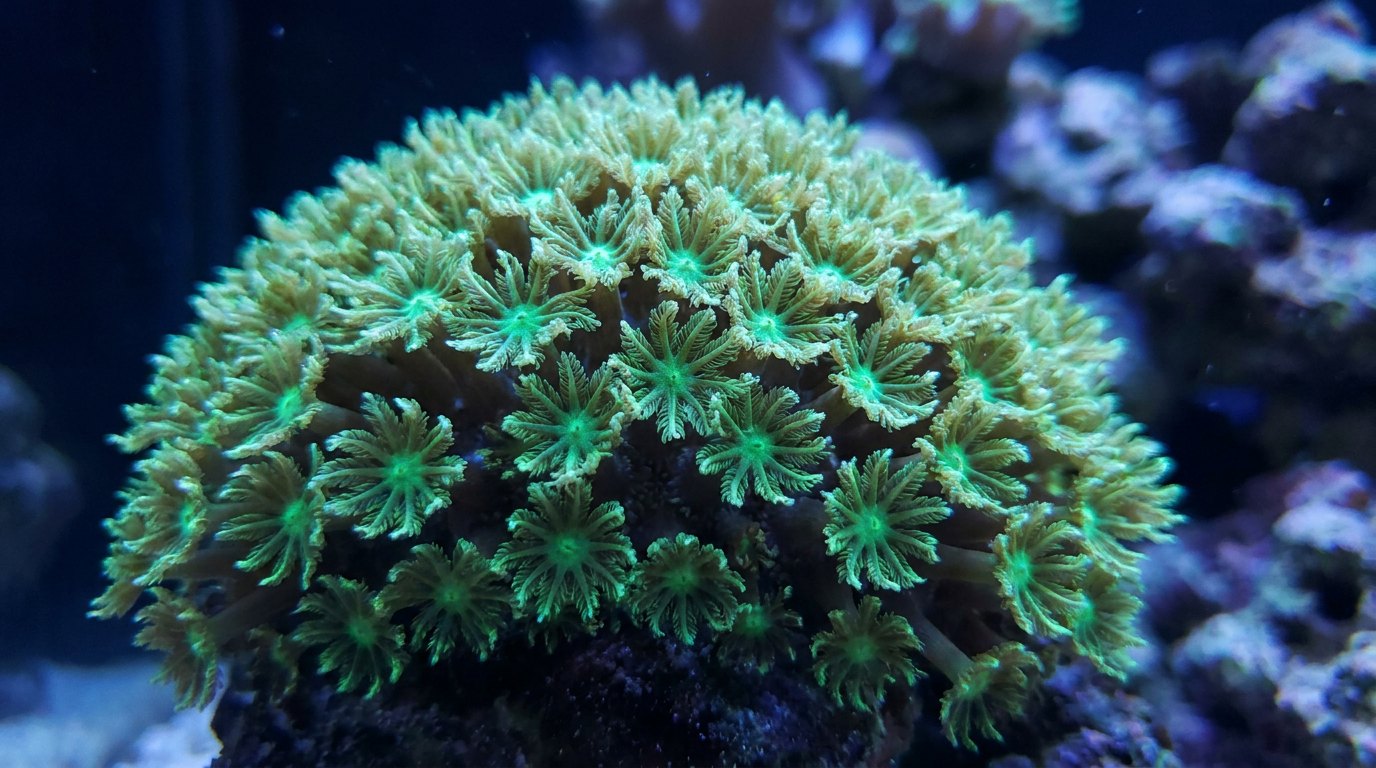
Green Goniopora is the most familiar color form of flowerpot coral, not a separate species. Its green comes mainly from green fluorescent proteins in the coral tissue, relatives of the jellyfish GFP that absorb blue light and re-emit green, so green Goniopora glow under actinic lighting. Because green colonies are widely aquacultured, they are often the easiest entry point into Goniopora keeping. Give moderate, stable light, moderate random flow, steady parameters and fine-particle feeding about twice a week.
For anyone trying Goniopora for the first time, a healthy aquacultured green colony in a stable tank is the usual recommendation.
Why is green Goniopora green?
Reef corals make green fluorescent proteins closely related to the GFP discovered in the jellyfish Aequorea victoria. These proteins absorb blue and violet light and re-emit it as green, which is why green Goniopora seem to glow under actinic lights. Scientists have long debated their function; proposed roles include managing light for the coral’s algae and acting as antioxidants. Research on colorful bleaching shows the host ramps up these pigments when internal light levels rise.
| Lighting | How green Goni looks |
|---|---|
| Strong blue/actinic | Bright neon green glow |
| Balanced reef spectrum | Rich green |
| Daylight-heavy white | Olive or khaki |
| Low light | Browner as algae increase |
What exactly is fluorescence?
Fluorescence is the absorption of light at one wavelength and its almost instant re-emission at a longer, lower-energy wavelength. A green fluorescent protein in coral tissue absorbs blue or violet light and gives back green light. The emitted light carries a little less energy than the light absorbed; the difference is lost as heat. Fluorescence stops the moment the exciting light is switched off, which separates it from bioluminescence, where an animal makes light through a chemical reaction, and from phosphorescence, where the glow lingers.
That distinction matters for understanding a green Goniopora. The coral is not producing light of its own. It is converting part of the light that reaches it. Under white light, the green you see is a mixture of reflected colour and fluorescence. Under blue actinic light, which contains very little green, almost all the green reaching your eye is fluorescence, which is why the colony seems to glow.
How common is green fluorescence in corals?
Very common. Reef scientists describe fluorescence as highly prevalent in reef-building corals, and green is the most familiar colour of it. Coral fluorescent proteins come in several classes, including cyan, green, yellow-orange and red forms as well as non-fluorescent chromoproteins, and a single coral often carries more than one. A 2009 survey of seven healthy Caribbean coral species by Palmer, Modi and Mydlarz found that the type and amount of fluorescent protein varied between species, but fluorescent proteins were present across the group.
Coral tissue can contain these proteins at unusually high local concentrations, often arranged in granules or patterned layers. A 2026 review by the coral fluorescence researcher Anya Salih pointed out that dense packing, overlapping colours, reabsorption and scattering from the skeleton make it unreliable to judge a coral’s pigments from the brightness of its glow alone. A colony that looks intensely green may simply hold its pigment near the surface, while a duller one may hold as much or more in deeper tissue.
What is green fluorescence for?
Scientists have debated this for decades, and the current answer is that fluorescent proteins probably do several jobs, with different ones mattering in different habitats.
The oldest idea is photoprotection. In bright, shallow water, fluorescent proteins and chromoproteins absorb strongly in particular parts of the spectrum and scatter light through the tissue, which can shield the coral’s algae from excess light. A 2026 review of the microscopy evidence described two complementary roles: protection from high light in bright conditions, and redistribution or transformation of light in dim tissues and habitats. It also noted that in several coral groups, high host fluorescence has been associated with lower susceptibility to bleaching.
A second idea is that fluorescent proteins help mop up harmful reactive oxygen molecules, which build up when photosynthesis runs hard and during heat stress. In 2006, Bou-Abdallah, Chasteen and Lesser showed in laboratory tests that jellyfish GFP can quench superoxide radicals and behaves somewhat like the antioxidant enzyme superoxide dismutase. The 2009 Caribbean study then found that coral tissue with more fluorescent protein scavenged hydrogen peroxide faster, and that purified coral cyan, green and red fluorescent proteins and a chromoprotein all scavenged hydrogen peroxide in the test tube. Curiously, versions of the proteins without their light-absorbing chromophores scavenged even better, which the authors took as a sign that the colours themselves serve additional functions.
A third idea, and the most surprising, is that fluorescence attracts food.
Can green fluorescence lure plankton?
A 2022 study by Or Ben-Zvi, Yoav Lindemann, Gal Eyal and Yossi Loya tested this directly. Corals living at mesophotic depths of 30–150 m receive dim, blue-shifted light and may not be able to rely on their symbiotic algae as their main source of energy. The team showed that plankton swam preferentially toward green fluorescent cues, and that a green-fluorescing colour form of the mesophotic coral Euphyllia paradivisa captured prey at higher rates than other colour forms. They concluded that plankton are actively attracted to fluorescent signals, which would make fluorescence a way of drawing food toward the coral.
The study concerned deep-water corals in their natural blue light field, not shallow Goniopora under reef aquarium lighting, and it has not been tested on Goniopora. It is still an intriguing link for aquarists. Goniopora is a strongly heterotrophic coral with long, prey-catching polyps, and green is its most common colour. Whether its glow helps it catch food in a lagoon, or under a blue-heavy tank light, is an open question.
Is green fluorescence a health signal?
It can be, but reading it takes care. In a 2013 study, Melissa Roth and Dimitri Deheyn exposed the branching coral Acropora yongei to cold and heat stress. In both treatments, the concentration of green fluorescent protein and the coral’s fluorescence fell as its health declined, before any visible bleaching. The cold-treated corals eventually acclimated, and their GFP and fluorescence recovered. The heat-treated corals bleached, yet still fluoresced strongly despite holding less GFP, because the loss of their brown algae removed the shading that normally dims the glow. Across the experiment, green fluorescence tracked coral growth more closely than any other measure, leading the authors to suggest that it could serve as a physiological indicator of health in some corals.
For a green Goniopora, the lesson is twofold. A gradual, unexplained dulling of green fluorescence under unchanged lighting can be an early warning, worth checking against your temperature and parameter records. But a colony that suddenly glows brighter is not necessarily healthier; it may be losing the algae that normally mask the glow, or ramping up host pigments as a stress response. Fluorescence is most useful when you compare the same colony with itself, photographed under the same light, over time.
Does fluorescence affect how a coral heats up?
Possibly. A 2026 study posted as a preprint, which has not yet completed peer review, combined light and temperature microsensors with computer modelling to examine how host pigments shape light and heat inside coral tissue. It suggested that chromoproteins concentrate heating in the outer tissue layer, while fluorescent proteins re-emit part of the absorbed light at longer wavelengths that travel deeper, shifting some energy deposition and heating further into the tissue. In bleached corals in the model, host pigments became the main source of heat generation. These results are preliminary, but they show how much remains to be learned about what a coral’s colour does inside the animal.
Is green the original coral colour?
In at least one well-studied coral, yes. When Ugalde, Chang and Matz used gene sequences to resurrect the shared ancestor of the fluorescent proteins found in the great star coral Montastraea cavernosa, a Caribbean species that carries both green and red forms, the protein they rebuilt glowed green. The red versions in that coral turned out to be later modifications, reached step by step through many small mutations.
That history helps explain why green is so widespread in corals, including Goniopora. A green fluorescent protein is the default product of this protein family, and other colours require additional evolutionary modifications that only some lineages have made.
Why do green Goniopora range from olive to neon?
The shade of a green colony depends on two things at once: how much fluorescent protein the coral makes, and how much brown pigment from its symbiotic algae sits in front of or among it. A colony with modest amounts of green protein and dense algae looks olive or khaki. The same colony with more green protein, or fewer algae, looks brighter. That is why lowering nutrients or raising light gradually often makes a green Goniopora look greener, and why higher nutrients or dimmer light dull it.
Production of many coral fluorescent proteins is switched on by light, particularly blue light, so the amount of pigment can rise or fall over weeks after a lighting change. Not every fluorescent protein behaves this way: a 2015 Red Sea study found that some corals kept producing their fluorescent pigments in darkness while others lost or changed them. Without testing, you cannot know which type your colony carries, which is another reason to change lighting slowly and judge the result over a month or more.
Does blue or violet light make green Goniopora glow more?
Green fluorescent proteins absorb in the blue and violet part of the spectrum and emit green, so lights rich in those wavelengths make the glow more obvious. Adding blue or violet does two separate things: it excites more fluorescence at any moment, which is an instant visual effect, and over time it may also encourage the coral to produce more pigment. Only the second is a change in the coral.
Research on Goniopora itself suggests that a blue-weighted spectrum is good for the coral as well as for the view: a 2022 lighting trial on Goniopora columna, described on the red Goniopora page, found that blue and purple light improved growth and survival while green and red light did not. A green Goniopora does not need green light; it needs the blue light it converts into green.
How do scientists measure coral fluorescence?
Researchers rarely rely on how bright a coral looks. The simplest method is spectral emission analysis: the coral, or an extract of its tissue, is lit with a known excitation wavelength and a spectrometer records the colours of light that come back, producing a curve with a peak for each fluorescent protein present. The 2009 Caribbean survey used this approach on tissue extracts, and the 2013 stress study combined it with direct measurements of how much green protein the tissue contained.
Microscopy goes further. Confocal microspectroscopy can map where each spectrally distinct protein sits inside intact tissue, and fluorescence lifetime imaging measures how long excited molecules take to release their energy. That timing reveals whether one pigment is passing energy directly to a neighbouring pigment, rather than simply emitting light that another pigment then reabsorbs. These techniques are how researchers established that coral tissues behave as organised optical systems rather than as bags of randomly mixed pigment.
Why does a green Goniopora look different in photos?
Cameras record fluorescence differently from the human eye. Under blue reef lighting, a camera often exaggerates the blue background and can either wash out or oversaturate the green. Aquarium photographers usually fit an orange or yellow filter over the lens, which blocks the reflected blue and lets the fluorescent green through, giving a truer picture of the glow. Night divers use the same trick, pairing a blue torch with a yellow mask filter to see coral fluorescence on the reef.
If you want to track a green Goniopora’s health by its fluorescence, use the same camera, settings, filter and lighting each time. Changes you see in casual phone photos taken under different light are more likely to come from the camera than from the coral. Note the filter, exposure and light settings with each photo so that later comparisons really are like for like.
Is green Goniopora easier to keep?
Color itself doesn’t change a coral’s biology, but availability does. Green Goniopora are common in aquaculture, and Reef Builders notes that aquacultured strains are the lower-risk choice. Wild-collected colonies of any color can still do well with good care, but they arrive more stressed.
Why is my green Goniopora turning brown?
Usually lower light, higher nutrients or both. When light falls or nitrate and phosphate rise, corals often carry more zooxanthellae, and their brown pigment masks the green. Gradual light increases and a steady nutrient level usually restore color over weeks.
Green Goniopora or green Alveopora?
Both are sold as green flowerpot coral. Count the tentacles: 24 means Goniopora, 12 means Alveopora. See Alveopora vs Goniopora.
Where should green Goniopora go?
Middle rockwork or a sand bed with moderate light and random flow, 3–4 inches from other corals. Guides: placement, care, feeding. Compare other colors in yellow and rainbow Goniopora.
What is GFP, and why does it matter beyond reef tanks?
Green fluorescent protein was first isolated from the jellyfish Aequorea victoria, and its discovery and development as a biological marker earned Osamu Shimomura, Martin Chalfie and Roger Tsien the 2008 Nobel Prize in Chemistry. Researchers now attach GFP and its color variants, including several first found in corals, to proteins they want to track inside living cells. The glow you see on a green Goniopora under actinic light is part of the same protein family that lit up modern cell biology.
| Pigment | First described in | Lab use |
|---|---|---|
| GFP (green) | Jellyfish Aequorea victoria | Cell tracking marker |
| Red fluorescent proteins | Reef anthozoans | Multicolor imaging |
| Chromoproteins | Reef corals | Color markers, research on photoprotection |
Why does green Goniopora glow?
Green fluorescent proteins absorb blue light and emit green.
Is green Goniopora good for beginners?
Aquacultured green colonies are among the easier Goniopora in a stable tank.
Why is my green Goniopora brown?
Lower light or higher nutrients let brown algae pigments dominate.
Is green Goniopora a species?
No, it is a color form.
How often should I feed green Goniopora?
About twice a week with fine foods.
What light is best for green Goniopora?
Moderate, stable reef lighting with blue for the glow.
Does green Goniopora sting?
Yes. Keep 3–4 inches from neighbors.
- Ben-Zvi, O., Lindemann, Y., Eyal, G. & Loya, Y. (2022). Coral fluorescence: a prey-lure in deep habitats. Communications Biology 5. doi:10.1038/s42003-022-03460-3
- Palmer, C.V., Modi, C.K. & Mydlarz, L.D. (2009). Coral fluorescent proteins as antioxidants. PLoS ONE 4: e7298. doi:10.1371/journal.pone.0007298
- Bou-Abdallah, F., Chasteen, N.D. & Lesser, M.P. (2006). Quenching of superoxide radicals by green fluorescent protein. Biochimica et Biophysica Acta. doi:10.1016/j.bbagen.2006.08.014
- Roth, M.S. & Deheyn, D.D. (2013). Effects of cold stress and heat stress on coral fluorescence in reef-building corals. Scientific Reports 3: 1421. doi:10.1038/srep01421
- Ugalde, J.A., Chang, B.S. & Matz, M.V. (2004). Evolution of coral pigments recreated. Science 305: 1433. doi:10.1126/science.1099597
- Eyal, G. et al. (2015). Spectral diversity and regulation of coral fluorescence in a mesophotic reef habitat in the Red Sea. PLoS ONE 10: e0128697.
- Salih, A. (2026). Microscopy insights into reef coral fluorescent proteins: diversity, light energy transfer and biological function. Journal of Microscopy. doi:10.1111/jmi.70186
- Murthy, S., Bollati, E., Salih, A. & Kühl, M. (2026). From coral color to tissue heating: how host pigments redirect light within the tissue. Preprint, not yet peer reviewed.
- Cheng, C.M. et al. (2022). Effects of LED light illumination on Goniopora columna in captivity. Animals 12: 306. doi:10.3390/ani12030306
- Bollati, E. et al. (2020). Optical feedback loop involving dinoflagellate symbiont and scleractinian host drives colorful coral bleaching. Current Biology 30: 2433–2445.
- Reef Builders (2025): Introduction to Goniopora care.
Blane Perun has been exploring Earth’s oceans and marine life for over 25 years. Founder of TheSea.Org in 1999, underwater photographer, coral aquaculture pioneer, and explorer of 80+ countries.
About Blane Perun →