Goniopora — The Flowerpot Coral Reefers Learned to Keep
Goniopora, the flowerpot coral, is a genus of stony corals in the family Poritidae with long, daisy-like polyps that extend from the skeleton by day, each crowned with 24 tentacles. It lives mainly in lagoons and turbid water across the Indian Ocean and tropical Pacific, and it was long infamous as a coral that slowly died in most aquariums. Better understanding of its needs, and aquacultured stock, have made it far more keepable.
Goniopora was once present in the Caribbean too: fossils show it there in the Miocene, but it has since gone locally extinct in the Atlantic. Today species range as far north as Hong Kong, where Goniopora is the dominant colonial coral on non-reef communities, and southern Japan.
How do you tell Goniopora from Alveopora?
Count the tentacles. Goniopora polyps have 24 tentacles; Alveopora polyps have 12, often with swollen knob-like tips. Goniopora is in Poritidae, Alveopora in Acroporidae, and their skeletons differ too. A full comparison is in Alveopora vs Goniopora.
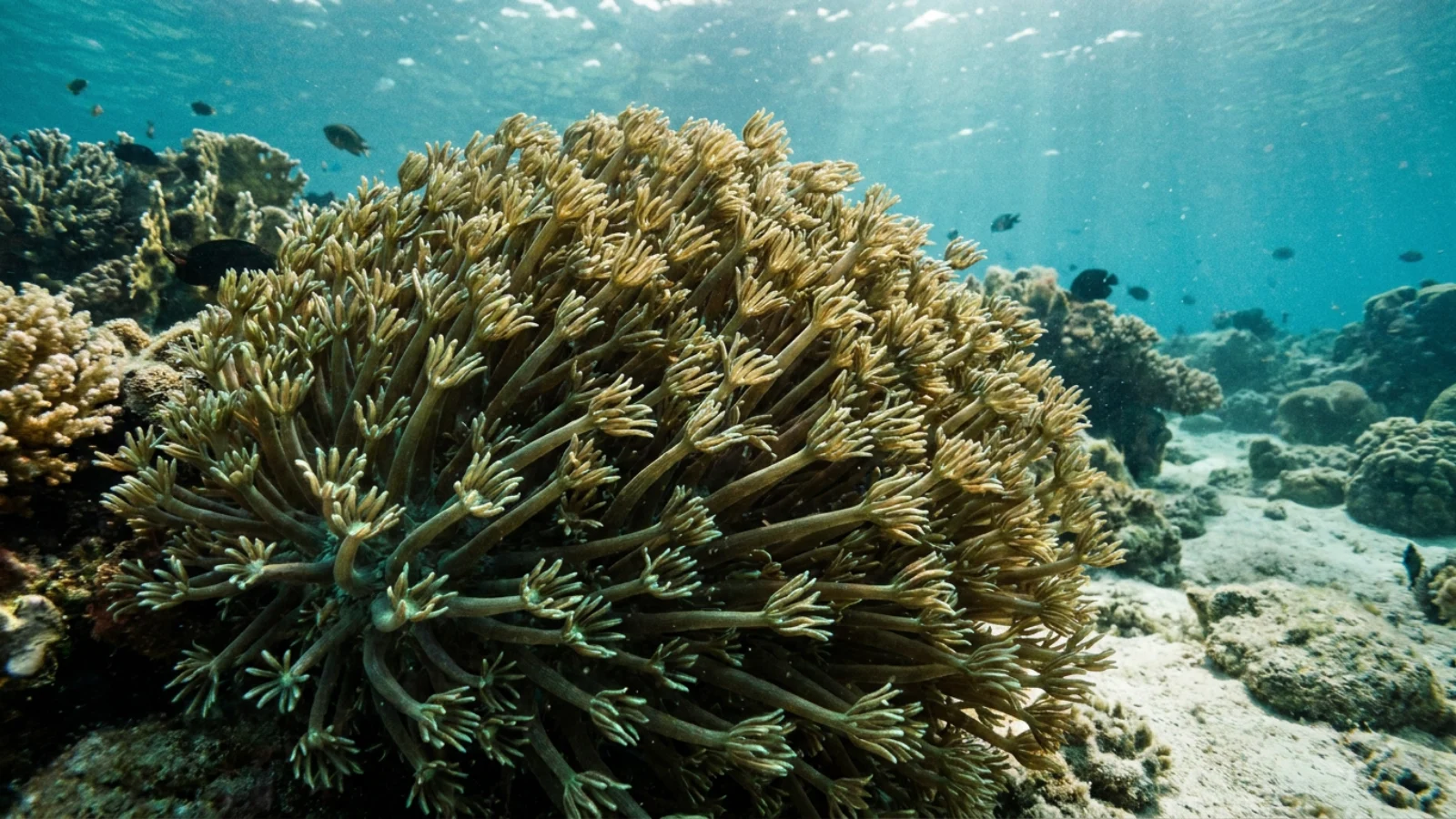
Where does Goniopora live?
Goniopora favours lagoons, sheltered bays and turbid water, often on soft or silty bottoms. Many species tolerate sediment well. Goniopora stokesi, a free-living species often sold in the trade, has been recorded from about 2 to 26 m and was assessed by the IUCN as Least Concern in 2023; so were G. lobata and G. columna.
Why was Goniopora so hard to keep?
For decades most wild-collected Goniopora declined over months in aquariums. The most likely reasons are that it depends heavily on capturing fine particulate food, as its turbid-water habitat suggests, and that many specimens were stressed by collection and shipping. Older advice also stressed adequate calcium and trace elements for skeletal growth. Today aquacultured colonies, regular fine-particle feeding and stable mature tanks give much better results.
How do you care for Goniopora?
More detail is in Goniopora care, Goniopora placement and feeding Goniopora.
What colours does Goniopora come in?
Green is the most common, followed by pink, purple, red and multi-coloured aquaculture lines. See our pages on green, red, purple and rainbow Goniopora. Older sources reported that the short greenish wild forms were less hardy than pink or purple ones.
Why does Goniopora thrive on marginal reefs?
Goniopora is one of the corals that does best where reef-building is hardest. Its long, extended polyps and tolerance of sediment let it hold on in murky, nutrient-rich water that many branching corals cannot handle, and in several places at the northern edge of the tropics it is one of the main corals present. The Xuwen coral reef, on the Leizhou Peninsula of mainland China facing the northern South China Sea, is a good example. A 2023 study in the journal Biology surveyed the reef in 2020 and compared it with a survey from 2004. Coral cover had fallen significantly over that period, yet the dominant genera were still Goniopora and its relative Porites, and the community was made up mainly of massive colonies.
The same study offers clues about why these two genera persist. A mass bleaching event in the northern South China Sea in August 2020 did not cause severe short-term coral death at Xuwen. Instead, the authors linked the slow decline to high levels of suspended solids and nutrients, which they tied to coastal currents, mariculture and erosion of the shoreline, along with fishing and coastal aquaculture more broadly. Corals that can clear sediment from their surface and feed on particles in the water column are better placed than most to survive such conditions, and Goniopora fits that description.
Laboratory work points the same way. In a 2022 study published in Biology, researchers grew Goniopora columna at different combinations of temperature and salinity. The coral survived across a wide salinity range, from 25 to 40 practical salinity units (psu), but it grew fastest at 25 °C and 30 to 35 psu, where polyp numbers and weight were greatest and nutrient uptake, polyp expansion and metabolic rate all peaked. A colony that can survive brackish pulses after heavy rain, as well as the saltier water of a shallow lagoon in the dry season, is well suited to the estuaries, bays and turbid coastal waters where Goniopora is often found.
Tolerance has limits, though. Surviving in marginal water is not the same as thriving in it, and the Xuwen survey showed that even a tough, sediment-tolerant coral community can lose ground year after year when local pressures stack up. Goniopora’s presence on a degraded reef is better read as a sign of what can still hang on than as proof that conditions are acceptable.
A similar story is playing out farther east along the same coast. Around the Dapeng Peninsula near Shenzhen, at the northern edge of the subtropics, surveys in 2023 and 2024 identified 51 coral species from 20 genera across conservation, tourist, fishery and relatively untouched areas. Compared with the first survey four decades earlier, coral cover had declined at a rate of roughly 0.54 percent a year between 1983 and 2023, and the dominant corals had shifted from branching forms, which build the most reef structure, to clumping forms that cope better with environmental pressure. The authors blamed rapid urbanization and warming. Shifts like this favor the compact, massive growth forms typical of Goniopora and Porites, which helps explain why these genera so often dominate the reefs that are left at the edges of the coral world.
How did the 2024 heatwave affect wild Goniopora?
Massive Goniopora colonies can live for a very long time and are usually regarded as hardy. The fourth global mass coral bleaching event, which began in 2023, tested that reputation on the Great Barrier Reef. At One Tree Reef, in the southern part of the reef, Byrne and colleagues tagged 112 Goniopora colonies at the onset of bleaching and followed them through seven surveys, from the summer of 2024 through the winter and into the following summer. Their results were published in Proceedings of the Royal Society B in 2025.
In February 2024, 75 percent of the tagged colonies were bleached, and 4 percent of those also showed black band disease, a dark mat of bacteria that moves across a colony and leaves bare white skeleton behind it. The disease is normally rare on the Great Barrier Reef, but here it appeared along the edges of bleached polyps. By April, 61 percent of the bleached colonies had an aggressive black band advancing into their tissue. Cooler winter water did not bring the expected recovery: by October, 75 percent of the tagged colonies were dead, and only 24 percent had recovered, all of them with some partial mortality. Wider population surveys at two sites showed the same pattern, with 46 and 66 percent mortality by October.
The authors described bleaching and disease as “evil twins”. Heat stress weakens a colony and its symbiotic algae, and the disease then finishes the job on colonies that might otherwise have regained their color. For a genus valued for its resilience, the loss of many large, old colonies at One Tree Reef is a warning that even slow-growing massive corals are not safe from repeated, severe heatwaves.
The study also has a practical lesson for anyone monitoring reefs. A colony that is pale but intact in late summer may still be lost months later, so survey programs that stop counting once the water cools can underestimate the true death toll. Tracking tagged colonies over a full year, as this team did, gives a much clearer picture of what a heatwave really costs.
Why is black band disease so damaging to Goniopora?
Black band disease is not unique to Australia. During a survey of 22 sites in the southern central Red Sea, published in PeerJ in 2018, researchers found the disease at roughly a third of the sites, infecting nine coral genera including Goniopora. Background prevalence was low, at 0.04 percent of colonies, but at one site hit by bleaching the prevalence was 40 times higher, at 1.7 percent. Analysis of the dark mats showed the classic mix of filamentous cyanobacteria, sulfate-reducing bacteria and sulfide-oxidizing bacteria known from outbreaks around the world. As at One Tree Reef, heat stress and disease went together.
Work on Goniopora columna explains part of the damage at the cellular level. In a 2017 study in Cell Stress and Chaperones, Seveso and colleagues measured stress proteins, including heat shock proteins Hsp70 and Hsp60 and the antioxidant enzymes heme oxygenase-1 and manganese superoxide dismutase, in tissue at different distances from an advancing band. Healthy colonies showed low, stable levels. In diseased colonies, all of these markers were strongly switched on, even in tissue that still looked normal. The authors linked this to oxidative stress caused by swings between oxygen supersaturation and near-zero oxygen at the front of the band, and to microcystin, a toxin produced by the band’s cyanobacteria. Because the stress response begins before the pathogens reach the tissue, measuring it could become an early warning test for coral disease.
What happens to Goniopora’s bacteria during bleaching?
Every coral colony carries a community of bacteria on and inside its tissue, and those microbes change as the coral comes under stress. A 2026 study in Microorganisms sampled healthy, partly bleached and fully bleached Goniopora colonies in the Sanya Coral Reef Conservation District on Hainan Island in the South China Sea and sequenced their bacterial DNA. The team obtained 599,003 usable sequences, grouped into 5,094 operational taxonomic units drawn from 45 bacterial phyla, which shows how diverse the coral’s microbiome is.
The most surprising result concerned diversity. Healthy colonies had the lowest bacterial diversity, with a Shannon index of 3.04, while partly bleached colonies had the highest at 6.25 and fully bleached colonies fell in between at 5.49. In other words, stress did not empty the coral of bacteria; it opened the door to many more kinds. As bleaching worsened, groups thought to be beneficial, including the phylum Pseudomonadota and the genus Cohaesibacter, declined, while opportunistic or stress-linked bacteria such as Blastopirellula and Mycobacterium increased. Several other groups, including Acidobacteriota, Woeseia and Ruegeria, rose or fell sharply only during the partly bleached stage.
The authors argue that the partly bleached condition is a distinct transitional phase rather than just a midpoint between healthy and bleached. That matches what reef scientists see in the field: a colony that is only partly pale may already be undergoing major internal changes. Taken together with the Great Barrier Reef disease results above, the microbiome data help explain how a bleached Goniopora can become vulnerable to infections that a healthy colony would resist.
What does DNA reveal about Goniopora species?
Goniopora species are notoriously hard to tell apart by eye, because the living polyps hide the skeleton that taxonomists traditionally use and the polyps themselves vary with light, flow and feeding. Genetic tools are slowly filling the gap. Researchers have now published the complete mitochondrial genomes of at least two species. The mitogenome of Goniopora lobata, reported in 2020, is 18,770 base pairs long and contains 13 protein-coding genes, three transfer RNA genes and two ribosomal RNA genes. The mitogenome of Goniopora planulata, reported in 2022, is very similar in size at 18,766 base pairs, with 13 protein-coding genes, two ribosomal RNA genes and five transfer RNA genes. Both are low in guanine and cytosine, at about 37 percent.
These sequences give scientists fixed reference points for building family trees of stony corals and for checking the identity of colonies collected in the wild or traded for aquariums. They matter for conservation too. Goniopora planulata is listed as Vulnerable on the IUCN Red List, while other species such as G. stokesi, G. lobata and G. columna were assessed as Least Concern in 2023, so being able to separate them reliably has real consequences for monitoring and trade.
Mitochondrial genes change slowly in corals compared with many other animals, so they are better at placing Goniopora within the Poritidae than at separating closely related species. Telling apart species within the genus will need nuclear markers and genome-wide data as well, but each new reference sequence makes that work easier. For reef keepers, the practical point is that names attached to colonies in the trade are often best guesses, which is one reason TheSea’s color and growth-form pages describe what you see rather than claiming a precise species for every colony.
Accurate identification also supports the move toward farmed colonies. Researchers working on captive culture of Goniopora columna have stated plainly that one goal of finding the best growing conditions is to make efficient cultivation possible and so reduce illegal collection from the wild. Farmed colonies with a known origin, matched to reference DNA, are easier to trace than wild-caught pieces, and they put less pressure on reefs already strained by heat, sediment and disease.
Is Goniopora hard to keep?
It is moderately hard; aquacultured colonies in mature tanks do much better than wild ones.
How many tentacles does Goniopora have?
24 per polyp.
What does Goniopora eat?
It uses light and also captures fine particulate food and plankton.
What temperature does Goniopora need?
About 25–29 °C, kept stable.
Where does Goniopora come from?
The Indian Ocean and tropical Pacific, mostly from lagoons and turbid water.
Is Goniopora aggressive?
Its long polyps can sting neighbours, but it is more often the victim.
Is Goniopora endangered?
Species checked, such as G. stokesi, G. lobata and G. columna, were assessed as Least Concern in 2023.
- Wikipedia: Goniopora; tentacle count, range, Miocene Caribbean record, Hong Kong and care notes.
- SeaLifeBase: Goniopora stokesi, G. lobata, G. columna; depth and IUCN status (2023).
- World Register of Marine Species: Goniopora, Poritidae.
- Byrne M, Clements M, Kingsford M, Foo SA, Ramjus N, Waller A (2025). Marine heatwave-driven mortality of bleached colonies of the massive coral Goniopora is exacerbated by a black band disease epizootic. Proceedings of the Royal Society B 292: 20251912.
- Mo L et al. (2026). Stage-dependent succession of bacterial communities in the South China Sea stony coral Goniopora sp. during bleaching. Microorganisms 14: 833.
- Yang Z et al. (2023). The ecological status and change in high-latitude coral assemblages at the Xuwen coral reef, northern South China Sea. Biology 12: 330.
- Ding DS, Patel AK, Singhania RR, Chen CW, Dong CD (2022). Effects of temperature and salinity on growth, metabolism and digestive enzymes synthesis of Goniopora columna. Biology 11: 436.
- Hadaidi G et al. (2018). Ecological and molecular characterization of a coral black band disease outbreak in the Red Sea during a bleaching event. PeerJ 6: e5169.
- Seveso D et al. (2017). The cellular stress response of the scleractinian coral Goniopora columna during the progression of the black band disease. Cell Stress and Chaperones 22: 225–236.
- Peng H, Zhang Y, Shen C, Liu L (2020). The complete mitochondrial genome of Goniopora lobata. Mitochondrial DNA Part B 5: 912–913.
- Huang W, Meng M, Zhang Y, Shen C, Liu L (2022). The complete mitochondrial genome of the coral Goniopora planulata. Mitochondrial DNA Part B 7: 946–947.
- Wu DH et al. (2025). The distribution, diversity, and indicator species of coral communities under the influence of environmental changes in the subtropical peninsula of southern China. Ecology and Evolution 15: e72212.
- Cheng CM et al. (2022). Effects of LED light illumination on the growth, digestive enzymes, and photoacclimation of Goniopora columna in captivity. Animals 12: 306.
Blane Perun has been exploring Earth’s oceans and marine life for over 25 years. Founder of TheSea.Org in 1999, underwater photographer, coral aquaculture pioneer, and explorer of 80+ countries.
About Blane Perun →