Feeding Goniopora Coral — Tiny Mouths, Fine Foods, Steady Schedule
Goniopora is photosynthetic, but it benefits from regular feeding with very fine foods because its polyp mouths are tiny. Good choices are phytoplankton, rotifers, copepods, oyster eggs and fine reef powders. Spot-feed with a pipette about twice a week while the polyps are open and flow is turned down. Skip chunky foods such as mysis or pellets, which the polyps can’t swallow and which pollute the water. Feeding is one of the main reasons Goniopora survival has improved.
Watch a Goniopora after a dose of rotifers and you can see the polyps close and pull food in. Watch it after a cube of mysis and you will see food bouncing off.
Why does Goniopora need to be fed?
Like most reef corals, Goniopora hosts zooxanthellae that make sugars from light. Sugars aren’t a complete diet; captured particles supply nitrogen, phosphorus and other nutrients. Its long polyps with 24 tentacles each are built for catching fine particles drifting in turbid water, and many wild Goniopora colonies live in sheltered, sediment-rich habitats. Hobbyists widely attribute the old “slow starvation” of Goniopora in clean reef tanks to too little food.
| Food | Particle size | Suitability |
|---|---|---|
| Live or bottled phytoplankton | Very fine | Useful supplement; less growth than protein-rich feed in trials |
| Rotifers | Fine | Excellent |
| Copepods (live or frozen) | Fine to small | Very good |
| Oyster eggs | Fine | Very good |
| Fine reef powders | Fine | Good |
| Mysis, brine shrimp | Too large | Poor |
| Pellets, flakes | Too large | Avoid |
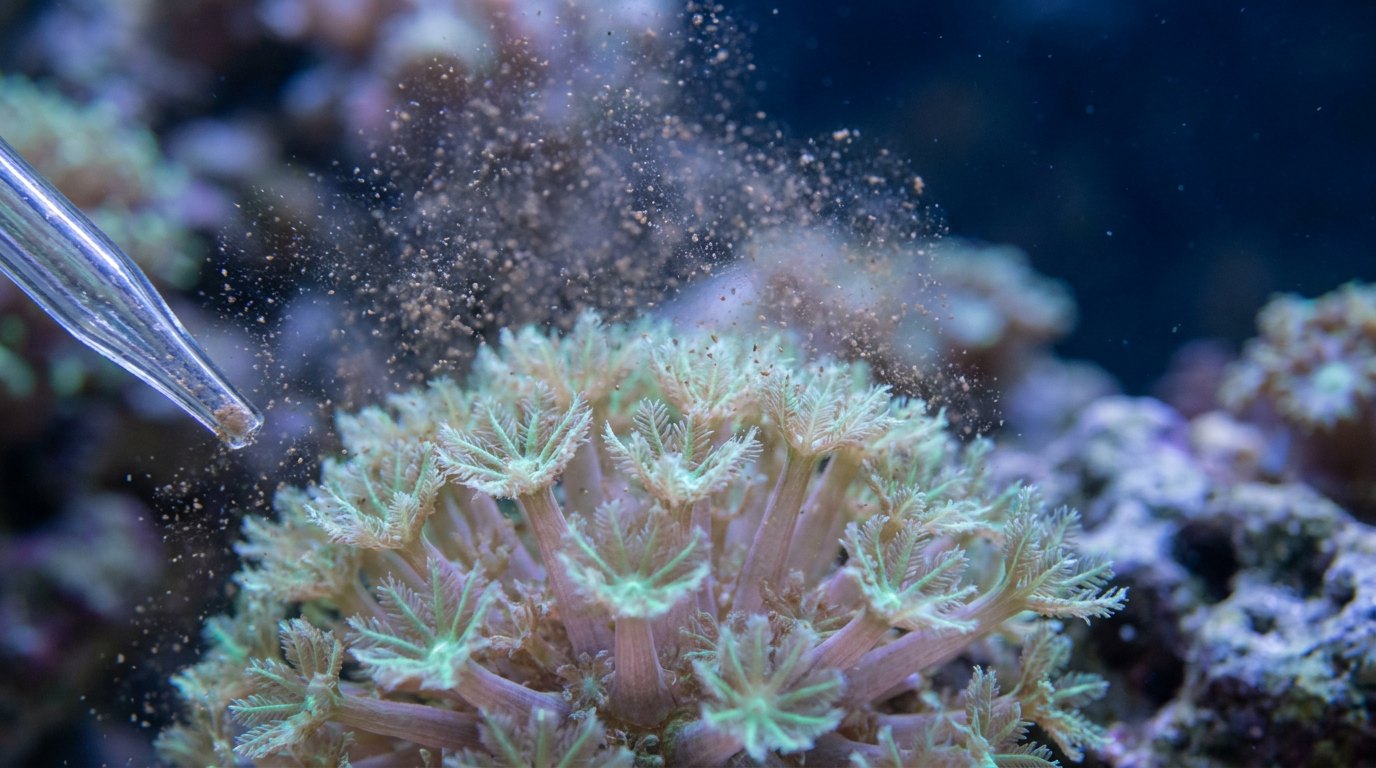
How do you target feed Goniopora?
How often should Goniopora be fed?
About twice a week is the common recommendation from Reef Builders. In heavily stocked tanks with high natural plankton, once a week may be enough; in very low-nutrient tanks, colonies sometimes do better with more frequent, smaller feedings. Let the colony and your nutrient tests guide you: rising nitrate and phosphate or algae growth mean you are overfeeding.
Does Goniopora eat at night?
Many Goniopora keep polyps extended into the evening, and some aquarists feed shortly after lights out. Either works if the polyps are open. Broadcast feeding of phytoplankton into the tank is less efficient than spot feeding but benefits the whole system.
Should I feed Alveopora the same way?
Yes. Alveopora, the 12-tentacle look-alike, has similar small mouths and benefits from the same fine foods. See Alveopora vs Goniopora.
What does the feeding research actually measure?
Coral feeding studies face a basic problem: a coral gets energy from two sources at once. Its symbiotic algae pass on sugars and other products of photosynthesis, while the coral animal captures plankton and particles and absorbs dissolved material from the water. Separating the two is difficult. Researchers use several approaches, including counting prey removed from the water, tracing chemical labels from food into coral tissue, and comparing growth between fed and unfed or differently fed colonies. Each method captures part of the picture, and results from one coral species do not always transfer to another.
For Goniopora, only a handful of controlled feeding studies exist, all on Goniopora columna grown in aquaculture. Broader research on other reef corals fills in why feeding matters and what food supplies. Together they give a reasonably clear picture, with some important gaps.
Which foods did Goniopora grow best on?
The most direct test is a 2021 study by Ding, Sun and Pan, who fed G. columna one of four diets at two ration sizes, 5% and 10% of the coral’s body weight. Two diets were microalgae, Isochrysis galbana and Nannochloropsis oculata. One was baker’s yeast, Saccharomyces cerevisiae. The fourth, labelled R, was a formulated feed rich in animal protein and polyunsaturated fatty acids. The team measured growth, survival, body composition and digestive enzymes.
The coral’s tissue held more protein than carbohydrate or fat, and its digestive enzymes were dominated by protease, the enzymes that break down protein. On that basis the authors argued that protein uptake is the right yardstick for Goniopora feeding. The protein-rich formulated feed came out clearly ahead: colonies on it had significantly higher protein content, protease activity and growth rate than those on any other diet. Over the trial, polyp numbers rose by about 40 at the 5% ration and about 47 at the 10% ration, both significantly more than in the microalgae and yeast groups.
That result matters for hobby practice because Isochrysis and Nannochloropsis are among the microalgae most often sold in bottled reef “phyto” products. In this trial they supported the coral less well than a protein-rich feed. Phytoplankton still has a role: it feeds rotifers, copepods and other filter feeders that Goniopora can catch, and it adds fine organic particles to the water. But the evidence does not support relying on phytoplankton alone as a Goniopora diet.
What do wild Goniopora eat?
No study has analysed the gut contents or prey of wild Goniopora, but its habitat gives strong clues. Many Goniopora live in lagoons, sheltered bays and turbid inshore water, where the water carries large amounts of fine suspended sediment mixed with detritus, bacteria and plankton. Research on other corals shows that this murky material is food as well as a stress.
In a 2000 study on the Great Barrier Reef, Kenneth Anthony compared colonies of Pocillopora damicornis and Acropora millepora from turbid inshore reefs with the same species from clearer midshelf reefs. Corals from the more turbid sites cleared suspended particles from the water at two to four times the rate of their clear-water counterparts, and their sediment intake rose roughly in step with sediment load across 1–30 mg per litre, without levelling off. They assimilated an estimated 50–80% of the organic carbon in those particles. Anthony concluded that inshore corals may be 10–20 times more heterotrophic on suspended sediment than midshelf corals of the same species.
Goniopora was not part of that study, but it often occupies exactly the kind of water those inshore corals came from. Its long, mobile polyps sweep a large volume of water, and a diet of fine organic particles fits its anatomy. That helps explain why clean, particle-poor display tanks were so hard on wild-collected colonies, and why fine foods work better for Goniopora than large meaty items.
How do research rations compare with hobby feeding?
The research rations were generous by hobby standards. In the 2022 lighting study, colonies received the formulated feed every day at 5% of their combined tissue and skeletal dry weight. Most hobby guidance, including the twice-a-week schedule on this page, uses far less food, far less often. The difference reflects the setting: aquaculture systems are built to remove waste quickly, while a home reef with fish, invertebrates and other corals has to absorb whatever the coral does not eat.
The research does not mean you should feed a Goniopora daily at 5% of its weight; in most display tanks that would raise nitrate and phosphate quickly and fuel algae. It does show that Goniopora can use far more food than it usually receives, and that growth responds to ration size. If your nutrients stay low and stable, small, more frequent feedings of protein-rich fine food are a reasonable way to move toward what the trials found, increasing gradually while you watch both the colony and your test results.
Does light change how well Goniopora digests food?
It appears to. In a 2022 study, Cheng and colleagues fed every group of G. columna the same formulated feed each day, at 5% of the coral’s tissue and skeletal dry weight, while varying only the colour and duration of the light. Colonies under blue or purple light for at least six hours a day had higher protein content and higher protease activity than those under red or green light, as well as better growth and survival.
Because the food was identical across treatments, the differences in digestive enzymes must have come from the light. The likely explanation is that a coral with well-lit, productive symbionts has more energy to invest in building tissue and digestive machinery, so it makes better use of the food it catches. Feeding and lighting are not separate levers. A colony that is short of suitable light may not respond to extra food the way a well-lit colony does.
What does captured food supply that light cannot?
Photosynthesis gives corals plenty of carbon in the form of sugars and lipids, but it is poor in nitrogen, phosphorus and some essential fatty acids. Food supplies those. A 2025 study by Love and colleagues grew the coral Stylophora pistillata along a controlled gradient from purely photosynthetic nutrition to purely heterotrophic feeding, then traced where the food went. Fatty acids and nitrogen from the food were efficiently built into both the coral and its symbiotic algae, but carbon from the food was not. The authors concluded that a key function of feeding is to retain essential elements such as nitrogen and molecules such as fatty acids, and that standard carbon-based methods probably underestimate how much corals rely on food.
That finding fits the Goniopora trials. A protein- and fatty-acid-rich feed gave the best growth, which is what you would expect if the main job of food is to supply the building blocks that photosynthesis cannot.
Can feeding help a stressed or bleached coral?
For some corals, yes, dramatically. In a widely cited 2006 study in Nature, Andréa Grottoli and colleagues found that bleached and recovering colonies of the Hawaiian coral Montipora capitata sharply increased their feeding and met more than 100% of their daily metabolic energy needs from food. Two Porites species, P. compressa and P. lobata, did not; they could not compensate for the loss of their algae by eating more. The authors suggested that species able to switch to feeding would be more resilient to future bleaching.
Porites belongs to the same family as Goniopora, but the two genera are built very differently. Porites has tiny polyps, while Goniopora extends long polyps with 24 tentacles each, a design that looks well suited to capturing particles. No one has yet measured whether bleached Goniopora can raise its feeding the way Montipora capitata can. Keepers often report that stressed colonies stop extending, which would limit feeding just when it might help most. Until there is data, the sensible approach is to keep feeding a recovering colony lightly whenever its polyps are open, rather than assuming food alone will rescue it.
Do corals absorb food through their tissue?
Corals do not rely only on their mouths. A 2020 study published in eLife by Ganot and colleagues traced fluorescent tracers and nanoparticles from seawater into living coral tissues. After entering the gut cavity, the particles spread through the tissues between cells, and cells throughout the coral then took them in through macropinocytosis, a process in which the cell membrane continuously forms large vesicles, 350–600 nanometres across, that engulf the surrounding fluid. The authors found this uptake route in all the tissues they examined.
For aquarists, this helps explain why dissolved and very fine organic material in the water can contribute to coral nutrition, and why Goniopora often does better in mature tanks with a background of fine particles than in very new or heavily stripped systems. It is not a reason to overdose liquid foods, which can just as easily feed nuisance algae and bacteria.
Do Goniopora polyps choose what they eat?
Coral polyps are more selective than they look. A 2022 experiment on Stylophora pistillata found that polyps retracted significantly more after microplastic particles settled on them than after a comparable amount of natural calcareous sediment, and that microplastics stayed on the coral longer because they stuck more firmly and the polyps spent longer examining them. Corals inspect what lands on them and reject what they cannot use.
Aquarists commonly see the same behaviour when Goniopora is fed. Particles that are too large, too hard or the wrong texture are often held briefly and then released, or trigger the polyps to close without the food being swallowed. Foods with a soft texture and a strong protein signal, such as rotifers, copepod nauplii and fine protein-based powders, are more likely to be accepted. Watching how the polyps handle a new food for a few minutes tells you more than the label on the packet.
Does fluorescence help corals catch food?
Some research suggests that coral fluorescence may attract plankton. Experiments on a deep-water coral found that plankton swam toward green fluorescent cues and that a green-fluorescing colour form captured more prey than other forms. Whether this applies to shallow-water Goniopora under reef lights is unknown. The evidence is discussed on the green Goniopora page.
What does the research not tell us?
The controlled studies leave clear gaps. They used a single species, G. columna, and compared foods or lights rather than testing fed against unfed colonies in a mixed reef tank. They measured growth over weeks, not survival over years. None tested the frozen and bottled foods most hobbyists actually buy, and none tested how often to feed, which is why recommended frequencies such as twice a week remain rules of thumb. They also did not test live foods such as rotifers or copepod nauplii, which many keepers consider the best Goniopora foods, so that preference rests on watching how the polyps respond rather than on measured growth. A direct comparison between live zooplankton and the protein-rich formulated feed would be an obvious next experiment. The broader research on other corals explains why food matters but cannot set exact rations for Goniopora. Treat feeding schedules as starting points, adjust to the colony’s response and your nutrient readings, and change one thing at a time.
What else affects Goniopora feeding response?
Flow that is too strong blows food away before polyps can catch it, and pests such as nudibranchs or flatworms stress colonies so they stop opening. If a colony won’t open to eat, review Goniopora care and placement before changing the diet.
What should I feed Goniopora?
Fine foods: phytoplankton, rotifers, copepods, oyster eggs and fine reef powders.
How often do you feed Goniopora?
About twice a week by spot feeding.
Can Goniopora eat mysis shrimp?
Mysis is generally too large for its tiny mouths.
Does Goniopora need phytoplankton?
It helps, directly and by feeding the rotifers and copepods Goniopora catches, but a 2021 trial found a protein-rich feed gave more growth than microalgae alone.
Should I turn off pumps when feeding Goniopora?
Yes, for about 10–15 minutes.
Can I overfeed Goniopora?
Yes. Excess food raises nutrients and feeds algae that irritate the polyps.
Do Goniopora need feeding if lighting is strong?
Yes. Light provides sugars but not all the nutrients they need.
- Ding, D.S., Sun, W.T. & Pan, C.H. (2021). Feeding of a scleractinian coral, Goniopora columna, on microalgae, yeast, and artificial feed in captivity. Animals 11: 3009. doi:10.3390/ani11113009
- Cheng, C.M. et al. (2022). Effects of LED light illumination on the growth, digestive enzymes, and photoacclimation of Goniopora columna in captivity. Animals 12: 306. doi:10.3390/ani12030306
- Love, C.R. et al. (2025). Selective nutrient incorporation may underestimate heterotrophy of a mixotrophic reef-building coral. Communications Biology. doi:10.1038/s42003-025-08621-8
- Grottoli, A.G., Rodrigues, L.J. & Palardy, J.E. (2006). Heterotrophic plasticity and resilience in bleached corals. Nature 440: 1186–1189. doi:10.1038/nature04565
- Anthony, K.R.N. (2000). Enhanced particle-feeding capacity of corals on turbid reefs (Great Barrier Reef, Australia). Coral Reefs 19: 59–67. doi:10.1007/s003380050227
- Ganot, P. et al. (2020). Ubiquitous macropinocytosis in anthozoans. eLife 9: e50022. doi:10.7554/eLife.50022
- Bejarano, S. et al. (2022). No short-term effect of sinking microplastics on heterotrophy or sediment clearing in the tropical coral Stylophora pistillata. Scientific Reports 12. doi:10.1038/s41598-022-05420-7
- Ben-Zvi, O. et al. (2022). Coral fluorescence: a prey-lure in deep habitats. Communications Biology 5. doi:10.1038/s42003-022-03460-3
- Reef Builders (2025): Introduction to Goniopora care, feeding guidance.
- Kitano Y.F. et al. (2014). Phylogeny of Poritidae; Goniopora 24-tentacle polyps. PLoS ONE 9: e98406.
- Reference entry: Goniopora stokesi, habitat in turbid, relatively still water.
Blane Perun has been exploring Earth’s oceans and marine life for over 25 years. Founder of TheSea.Org in 1999, underwater photographer, coral aquaculture pioneer, and explorer of 80+ countries.
About Blane Perun →