Burmeister’s Porpoise — South America’s Dark, Spiny-Finned Porpoise
Burmeister’s porpoise (Phocoena spinipinnis) is a small, dark grey to black porpoise found only in the coastal waters of South America, from northern Peru around Cape Horn to southern Brazil. It grows to about 1.5–2 m, has a low, backswept dorsal fin edged with tiny spines, and is the closest living relative of the vaquita.
Of the seven porpoise species alive today, Burmeister’s porpoise is one of the least familiar to most people. It lives only along the coasts of South America, it surfaces with barely a ripple, and its dark colour makes it hard to pick out against grey water. Yet it is not especially rare. Fishermen in Peru and Chile have known it for generations, and it has an important story to tell about the evolution of the porpoise family, including the vaquita of Mexico. This page covers what Burmeister’s porpoise looks like, where it lives, what it eats, how it behaves and the threats it faces. For an overview of all seven species, see our porpoise species guide.
Identification: the dark porpoise with a spiny fin
Two features set Burmeister’s porpoise apart: its dark body and an unusual dorsal fin set far back on the body.
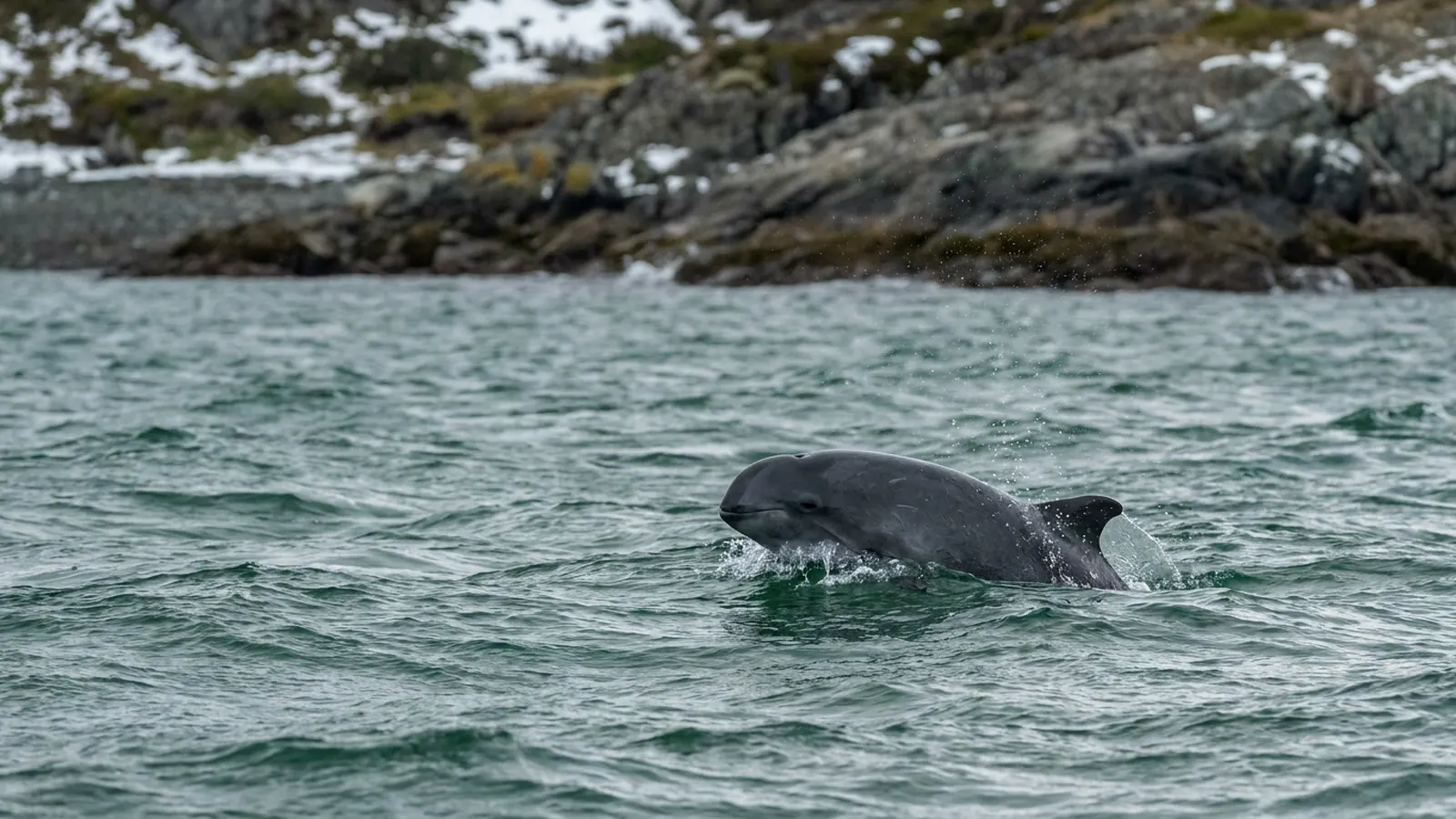
Adult Burmeister’s porpoises are typically 1.4 to 2 metres long, with males slightly larger than females on average. The body is robust, the head is small and rounded without a distinct beak, and the colour is a uniform dark grey that can look almost black at sea. There is often a paler grey zone on the belly and a dark stripe running from the corner of the mouth to the flipper. Interestingly, the skin darkens quickly after death, so stranded animals look jet black, which is why older books described the species as black.
The dorsal fin is the giveaway. It is low and triangular, angled backward, and positioned much further toward the tail than on other porpoises. Along its leading edge are rows of small, hard bumps called tubercles. Those little spines give the species its scientific name: spinipinnis means “spiny fin”. Other porpoises have tubercles too, but they are especially noticeable in this species.
The common name honours Hermann Burmeister, a German-born naturalist who directed the natural history museum in Buenos Aires and described the species in the 1860s from a specimen collected near the Río de la Plata.
Where Burmeister’s porpoise lives
Burmeister’s porpoise is a coastal animal of temperate and cold South American waters. On the Pacific side, its range runs from northern Peru south along the entire coast of Chile, including the maze of fjords and channels in Chilean Patagonia. It continues around Tierra del Fuego and Cape Horn and up the Atlantic coast of Argentina and Uruguay to southern Brazil.
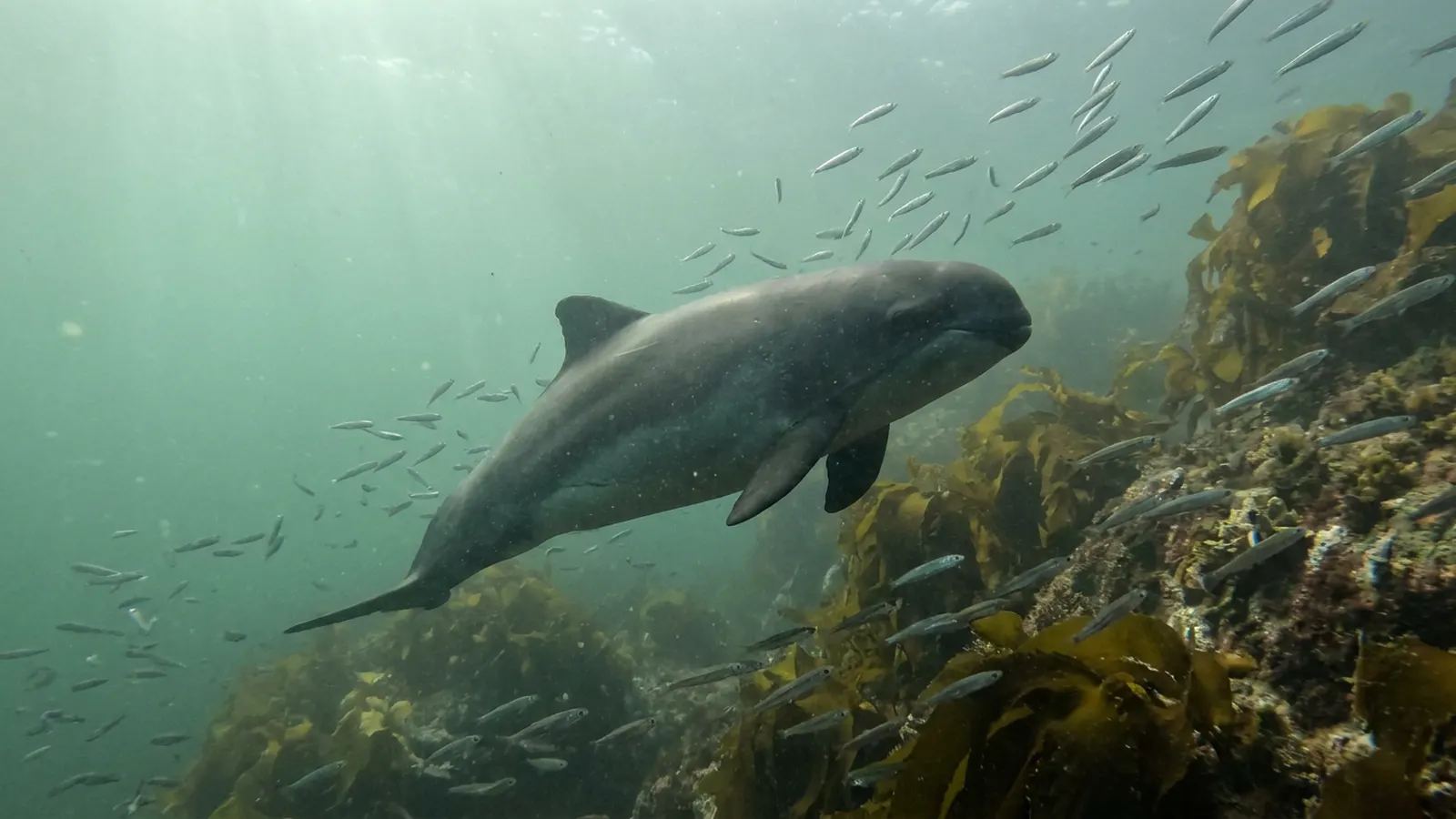
It is most often found in shallow water over the continental shelf, close to shore, in bays, river mouths and channels. On the Pacific coast, its distribution follows the cold, nutrient-rich Humboldt Current, which supports enormous schools of anchoveta and other small fish. It overlaps there with dusky dolphins, Chilean dolphins, and the South American sea lion, which feed on many of the same prey. For how its range compares with the rest of the family, see where do porpoises live.
| Feature | Burmeister’s porpoise | Spectacled porpoise | Harbor porpoise |
|---|---|---|---|
| Region | South American coasts | Subantarctic, open ocean | North Atlantic, North Pacific |
| Habitat | Shallow coastal, fjords | Offshore, around islands | Coastal shelf, bays |
| Colour | Uniform dark grey | Black above, white below | Dark grey back, pale belly |
| Dorsal fin | Low, backswept, set far back | Large, rounded (males) | Small, triangular |
| Adult length | About 1.4–2 m | About 1.3–2.2 m | About 1.4–1.9 m |
| IUCN status | Near Threatened | Least Concern | Least Concern |
What Burmeister’s porpoises eat
Like the rest of the family, Burmeister’s porpoise eats small fish and invertebrates. Stomach contents from animals caught in nets off Peru and Chile show a diet dominated by Peruvian anchoveta, along with hake, small sciaenid fish such as drums and croakers, squid and shrimp. On the Atlantic coast, stomach studies of bycaught animals have found anchovy, small hake and other bottom and mid-water fish, plus squid.
The heavy reliance on anchoveta matters. Anchoveta populations swing dramatically with El Niño events, when warm water pushes into the Humboldt Current and the fish scatter or crash. Porpoises, seabirds, sea lions and fishermen all feel the effect. For more on how porpoises hunt and how much they eat, see what do porpoises eat.
Behaviour and breeding
Burmeister’s porpoises are shy and inconspicuous. They are usually seen alone or in small groups of two to eight, although loose gatherings of a few dozen have been recorded. They surface quietly, show only a small part of the back and that low dorsal fin, and are easily missed in anything but calm seas. They do not ride bow waves the way Dall’s porpoise does, and they tend to move away from boats rather than approach them.
Much of what is known about their life history comes from animals taken in Peruvian fisheries. Calves are born after a pregnancy of around 11 to 12 months, mostly in late summer and autumn in the Southern Hemisphere, and measure roughly 85 centimetres at birth. Like other porpoises, they mature early and reproduce quickly compared with larger whales, but even so, a female can produce at most one calf a year. Lifespan in the wild is thought to be around a dozen years or more, though data are limited.
The vaquita connection
One of the most interesting things about Burmeister’s porpoise is its family tree. Genetic and anatomical studies indicate that it is the closest living relative of the vaquita, the critically endangered porpoise found only in the northern Gulf of California. The leading explanation is that during a cold period of the Pleistocene, an ancestor of Burmeister’s porpoise was able to cross the warm tropical waters of the eastern Pacific when they cooled. When the climate warmed again, a population was left isolated in the cool, productive northern Gulf of California, and it evolved into the vaquita.
That shared ancestry shows in their shape. Both are small, dark-backed porpoises with relatively large, backswept fins, and both live in shallow coastal water close to fishing communities. Sadly, both have also suffered heavily from gillnets. The vaquita is down to a handful of animals; Burmeister’s porpoise, with a much larger range, is in far better shape, but the parallel is a warning.
Why it is so hard to study
Burmeister’s porpoise is a difficult animal to survey. It is small, dark and quiet, it avoids boats, and much of its range is rough, cold water where wind chop hides a low dorsal fin within seconds. In the Chilean fjords, rain, mist and a maze of channels add to the challenge. As a result, there is no reliable estimate of how many Burmeister’s porpoises exist, either overall or in most regions.
Most of our knowledge comes from three sources. Dead animals landed in fishing ports or stranded on beaches provide measurements, stomach contents, reproductive data and tissue samples for genetics. Shore-based and small-boat surveys in a few sheltered areas, such as parts of southern Chile, record group sizes and behaviour. And acoustic monitoring, using underwater recorders that detect the porpoise’s very high-frequency clicks, is increasingly used to confirm where porpoises occur without needing to see them. Each method gives a partial picture, which is why the species’ status is still uncertain.
Threats and conservation
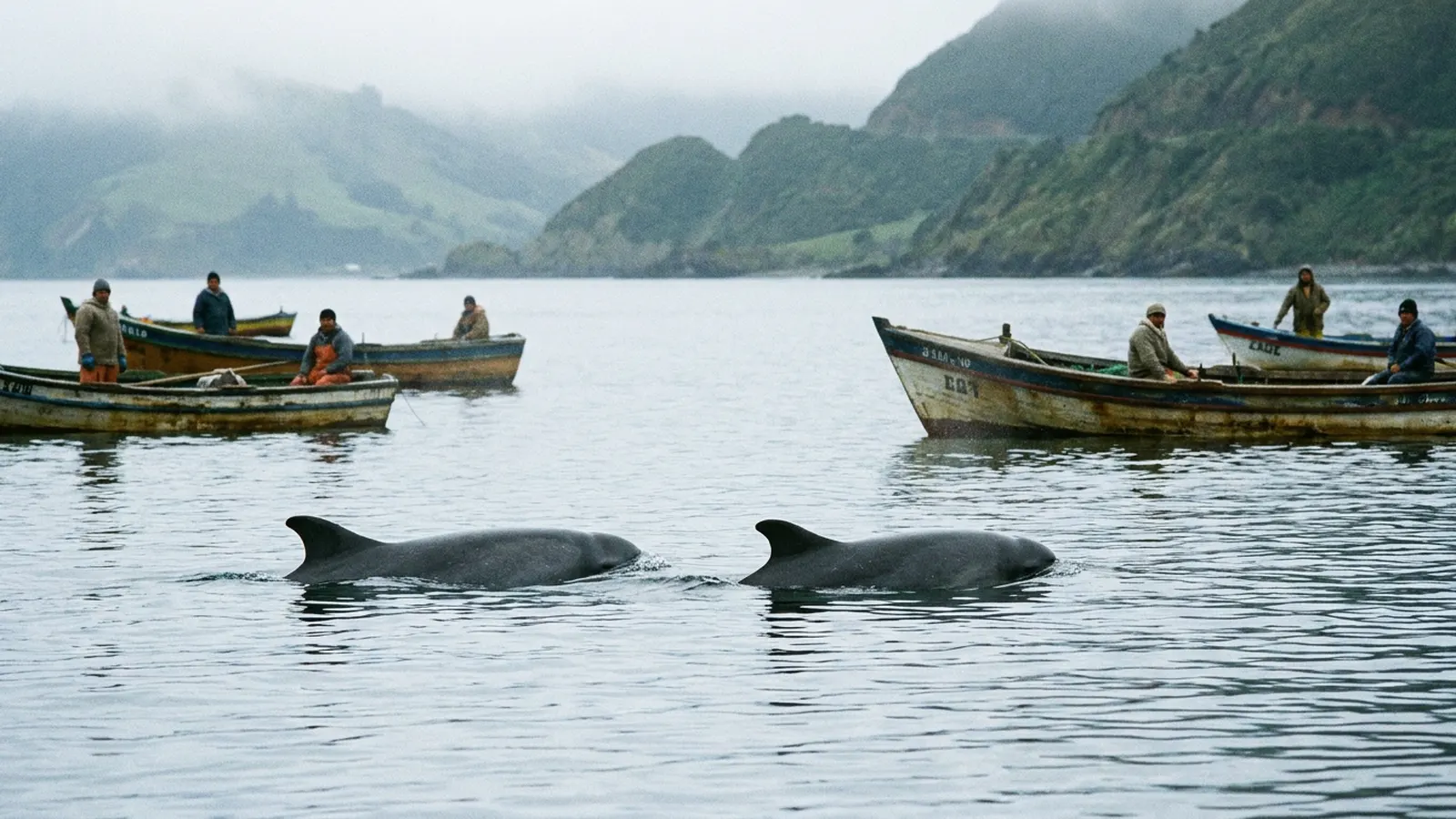
The main threat to Burmeister’s porpoise is entanglement in fishing nets. Small-scale gillnet fisheries operate all along its coastal range, and porpoises that hunt the same fish drown in the nets. Peru has historically had the highest documented catches. In past decades, porpoises and dolphins caught in Peruvian nets were sold for food and used as bait, and some were harpooned deliberately. Peru banned the capture and sale of small cetaceans in the 1990s, but enforcement has been difficult and bycatch continues.
In Chile, porpoises have been taken for crab bait, and bycatch occurs in gillnet fisheries in Argentina, Uruguay and southern Brazil as well. Other pressures include habitat loss in coastal areas, aquaculture expansion in the Chilean fjords, pollution and changes in prey linked to El Niño and climate change. Because there is no reliable estimate of total population size, and because bycatch rates in several areas look unsustainable, the IUCN lists the species as Near Threatened.
My take on a porpoise few people notice
I haven’t written up any dive trips along the Pacific or Patagonian coast of South America, so I’m not going to pretend I’ve watched these animals in the wild. What I can offer is perspective from nearly three decades around marine animals. Anyone who keeps a reef tank learns that the quiet, cryptic animals hiding in the rockwork are the hardest to keep an eye on, because you rarely see them. Burmeister’s porpoise strikes me the same way. It is dark, shy and low-profile, and that makes it easy for people to overlook how many are being lost in nets.
If I were advising someone who wanted to help, I’d point them toward supporting bycatch monitoring and alternative fishing gear in Peru and Chile, the same kind of work that came too late for the vaquita. And if you want to understand how this porpoise fits into the wider picture, the is a porpoise a whale? page explains where porpoises sit among whales and dolphins, and the harbor porpoise page covers its best-studied relative.
Where does Burmeister’s porpoise live?
Only in South American coastal waters, from northern Peru around Cape Horn to southern Brazil.
Why is it called Burmeister’s porpoise?
It is named after Hermann Burmeister, the naturalist who described it in the 1860s.
What does spinipinnis mean?
“Spiny fin”, after the small tubercles along the leading edge of the dorsal fin.
How big is a Burmeister’s porpoise?
About 1.4–2 m long and up to roughly 85 kg.
Is Burmeister’s porpoise endangered?
It is listed as Near Threatened, mainly because of bycatch in gillnets.
Is Burmeister’s porpoise related to the vaquita?
Yes. It is considered the vaquita’s closest living relative.
What does Burmeister’s porpoise eat?
Mainly anchoveta and other small fish, plus hake, squid and shrimp.
- IUCN Red List of Threatened Species: Phocoena spinipinnis assessment.
- Jefferson, T.A., Webber, M.A. & Pitman, R.L. (2015). Marine Mammals of the World, 2nd ed. Academic Press.
- Rosel, P.E., Haygood, M.G. & Perrin, W.F. (1995). Phylogenetic relationships among the true porpoises (Cetacea: Phocoenidae). Molecular Phylogenetics and Evolution 4: 463–474.
- Perrin, W.F., Würsig, B. & Thewissen, J.G.M. (eds.) Encyclopedia of Marine Mammals. Academic Press.
Blane Perun has been exploring Earth’s oceans and marine life for over 25 years. Founder of TheSea.Org in 1999, underwater photographer, coral aquaculture pioneer, and explorer of 80+ countries.
About Blane Perun → More on porpoises →