Bioluminescent Sharks — Lanternsharks, Kitefin Sharks and Cookiecutters
Yes. More than 50 shark species can glow, almost all of them small deep-sea sharks in the dogfish order. They belong mainly to three families: the lanternsharks (Etmopteridae), the kitefin sharks (Dalatiidae), which include the cookiecutter shark, and a few relatives. Thousands of tiny skin photophores give off blue light, mostly from the belly, to hide the shark’s silhouette from below.
Most people picture sharks as big, sleek predators cruising sunlit water. But a large share of the world’s shark species are small, dark animals living in the deep sea, hundreds of metres down where sunlight fades to a dim blue glow and then disappears. Many of those deep-sea sharks make their own light. Glowing sharks have been known to science for a long time, but only in the past few decades have researchers begun to understand how they do it, why, and how common it is. This page introduces the main bioluminescent sharks, explains how their light works, and covers what we still don’t know. For the bigger picture, see our deep-sea bioluminescence guide.
Which sharks glow?
All known bioluminescent sharks belong to the order Squaliformes, the dogfish sharks. Within it, glowing has been confirmed in two main families and suspected in a third.
The lanternsharks, family Etmopteridae, are the biggest group. There are dozens of species in the genus Etmopterus alone, and most are small, often less than 60 centimetres long. Nearly all are thought to be luminous. Lanternsharks live along continental slopes and around seamounts in all the world’s oceans, usually between about 200 and 1,500 metres deep. Our lantern shark page covers the group in more detail.
The kitefin sharks, family Dalatiidae, include several glowing species of very different sizes. The kitefin shark itself, Dalatias licha, can reach about 1.8 metres. The family also includes the cookiecutter shark and the pygmy shark, one of the smallest sharks in the world at little more than 20 centimetres. Some researchers have also suggested that members of a third family, the Somniosidae or sleeper sharks, might luminesce, but that has not been clearly shown.
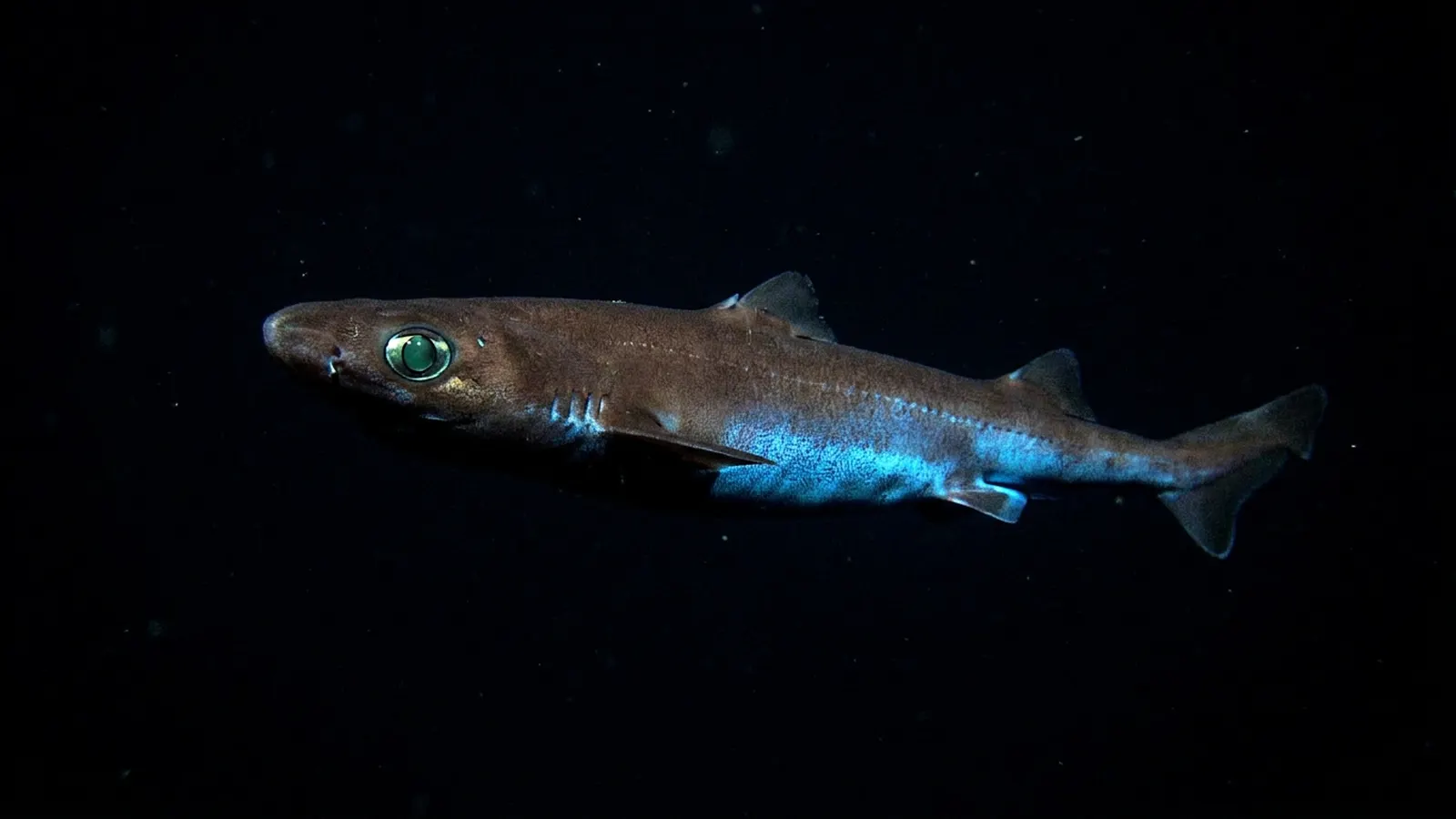
The kitefin shark: the largest glowing vertebrate
In 2021, a team led by Jérôme Mallefet of the Catholic University of Louvain in Belgium published a study confirming that three deep-sea sharks caught off the Chatham Rise near New Zealand were bioluminescent. They were the kitefin shark, the blackbelly lanternshark and the southern lanternshark. The headline result was the kitefin shark. At up to about 1.8 metres long, it became the largest known luminous vertebrate on Earth.
The kitefin shark lives on the outer continental shelf and upper slope, usually between a few hundred and roughly a thousand metres deep, in scattered locations around the world. It is a slow, solitary hunter that feeds on bony fish, other sharks, squid and crustaceans, and it is known for powerful jaws that can take bites out of larger animals. The researchers found that its glow is concentrated on the belly, which supports the idea that it uses light to hide its silhouette from animals below.
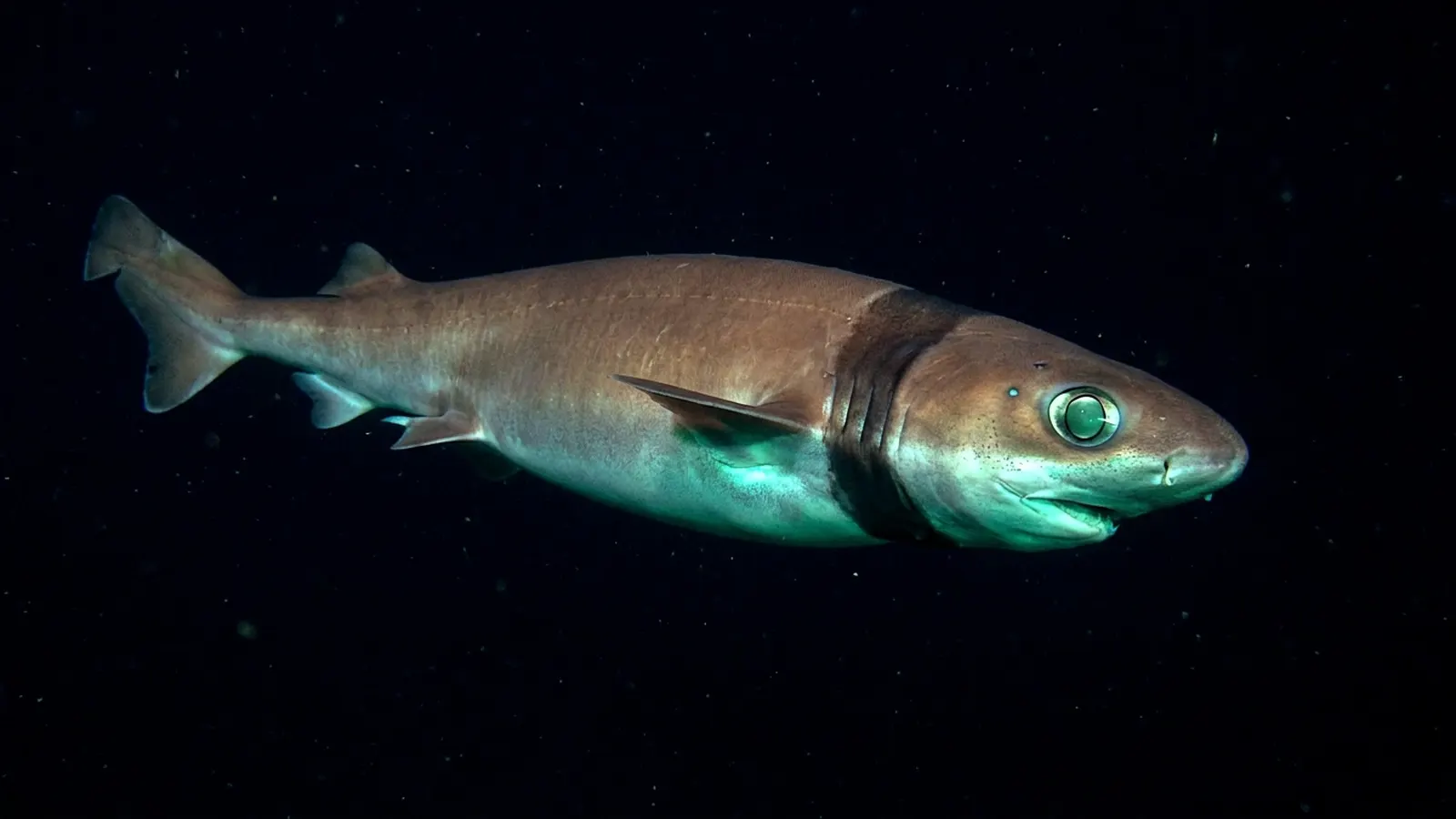
The cookiecutter shark’s dark collar
The cookiecutter shark, Isistius brasiliensis, is one of the strangest sharks in the sea. It is only about 40 to 50 centimetres long, but it feeds by attaching itself to much larger animals, from tuna and dolphins to whales, and twisting out a neat, round plug of flesh with its saw-like lower teeth. The wounds it leaves are so distinctive that they have been found on almost every large animal in warm open oceans, and even on the rubber domes of submarines.
Its glow plays a key part in this lifestyle. The cookiecutter’s belly is covered with photophores that produce a greenish-blue light, except for a dark band around its throat. One leading idea is that, seen from below against the faint light from the surface, the glowing belly disappears and only the dark collar remains visible, looking like the silhouette of a small fish. A predator that swims up to investigate the “fish” gets close enough for the cookiecutter to strike. Cookiecutters also migrate vertically each day, rising toward the surface at night and descending deep during the day. See cookiecutter shark for more.
How sharks make light
Glowing sharks have thousands of tiny light organs, called photophores, scattered through their skin. Each is a small cup of light-producing cells topped with a lens-like structure and backed by a layer of pigment that blocks light from leaking in the wrong direction. Under a microscope, the photophores sit between the shark’s tooth-like skin scales, the dermal denticles. Unlike anglerfish, which borrow light from bacteria, sharks make their own light chemically.
One of the most unusual features of shark bioluminescence is how it is controlled. In most glowing fish, nerves switch the light on and off quickly. In lanternsharks, experiments have shown that the light is regulated mainly by hormones. Melatonin, the same hormone that helps regulate sleep in humans, triggers the glow, while other hormones turn it down. This makes shark light slow to change, which suits a function like camouflage that needs a steady, long-lasting glow rather than quick flashes. The precise chemistry of the light reaction in sharks is still being studied, and researchers have suggested it may differ from the systems known in other fish.
| Shark | Family | Typical size | Where the glow is | Likely purpose |
|---|---|---|---|---|
| Kitefin shark | Dalatiidae | Up to ~1.8 m | Belly | Counterillumination |
| Cookiecutter shark | Dalatiidae | ~40–50 cm | Belly, except a dark collar | Lure and camouflage |
| Pygmy shark | Dalatiidae | ~20–27 cm | Belly | Counterillumination |
| Velvet belly lanternshark | Etmopteridae | ~45–60 cm | Belly and flank marks, near spines | Camouflage and warning |
| Blackbelly lanternshark | Etmopteridae | ~45 cm | Belly and flanks | Camouflage and signalling |
| Dwarf lanternshark | Etmopteridae | ~20 cm | Belly | Counterillumination |
Why sharks glow: three jobs for one light
The most widely accepted reason for shark bioluminescence is counterillumination. In the twilight zone, a little sunlight still filters down from above. Any animal that swims through that faint light casts a dark silhouette when seen from below, which makes it an easy target for predators looking up. By producing a glow on the belly that roughly matches the brightness and color of the light above, a shark erases its own shadow. Many deep-sea fish, squid and shrimp use the same trick.
The second job is communication. In lanternsharks, the photophores are not spread evenly. Many species have distinctive patterns of light on their flanks, tails and around the claspers of males. Because these patterns differ between species, scientists think they may help lanternsharks recognise their own kind, find mates or keep together in groups in the dark.
The third job is defence. The velvet belly lanternshark has glowing marks lined up along its two dorsal spines, as if to light up its weapons. Researchers have proposed that this works as a warning signal, telling a would-be predator that biting this shark comes with a painful spine. Not every pattern has an obvious explanation yet, and some species may use their light for more than one purpose.
Glowing versus fluorescent sharks
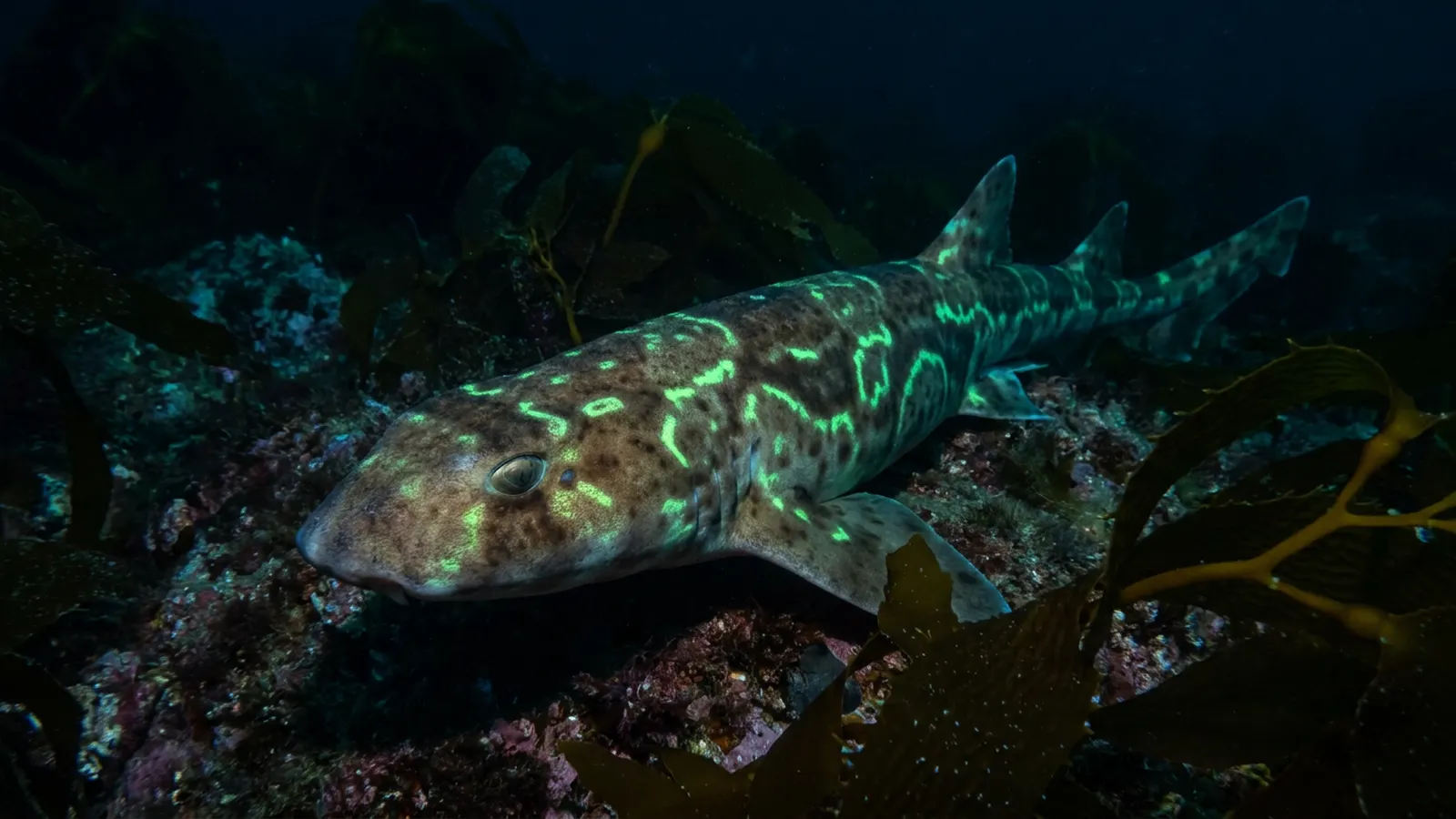
Glowing sharks are sometimes confused with fluorescent sharks, but the two are completely different. Bioluminescent sharks make their own light in total darkness. Fluorescent sharks, such as the swell shark and the chain catshark, absorb the blue light that reaches them and re-emit it as green. Their fluorescence only appears when light shines on them, and to human eyes it is invisible without special filters. Researchers think the sharks themselves, whose eyes are tuned to blue-green light, can see the patterns, which may help them recognise one another. Swell sharks and catsharks live in shallower coastal water and are not related to the deep-sea lanternsharks. For the broader topic, see bioluminescence.
What I find most interesting about them
I have logged a lot of dives, from the Florida Keys to Caribbean walls, but the bioluminescent sharks live far below anywhere a recreational diver can go. Almost everything we know about them comes from animals brought up in trawls or longlines, or from rare footage taken by submersibles and deep cameras. That is part of what makes them so fascinating to me: a tenth of all shark species glow, and most people have never heard of them.
It also tells you something about how much of the ocean remains unexplored. The kitefin shark has been known to science since the eighteenth century, yet confirmation that it glows only came in 2021. If an animal nearly two metres long could keep that secret for so long, there are surely other glowing species, and other glowing behaviours, waiting to be found. If you want to explore that world further, our deep-sea creatures page is a good place to start.
Threats to deep-sea sharks
Deep-sea sharks grow slowly, mature late and produce few young, which makes them vulnerable to overfishing. Many lanternsharks and kitefin sharks are caught as bycatch in deep-water trawl and longline fisheries targeting other species. The kitefin shark has been targeted in the past for its liver oil, which is rich in squalene, a compound used in cosmetics and other products. Because so little is known about the numbers of many deep-sea sharks, it is hard to tell how heavily some populations have been affected. Several are listed as threatened or data deficient on the IUCN Red List. Protecting deep-sea habitats such as seamounts and slopes from destructive trawling is one of the best ways to protect these glowing sharks.
Are there bioluminescent sharks?
Yes. More than 50 species, mostly lanternsharks and kitefin sharks, produce their own light.
What is the largest bioluminescent shark?
The kitefin shark, which reaches about 1.8 metres and is the largest known glowing vertebrate.
Why do sharks glow?
Mainly to hide their silhouette from predators below, and possibly to signal to one another or warn predators.
Does the cookiecutter shark glow?
Yes. Its belly glows except for a dark collar, which may act as a lure for larger predators.
What color is shark bioluminescence?
Blue to blue-green, the color that travels farthest in seawater.
Can you see glowing sharks while diving?
Almost never. They live hundreds of metres deep, far below recreational diving limits.
Is a fluorescent shark the same as a bioluminescent shark?
No. Fluorescent sharks re-emit light that hits them; bioluminescent sharks make their own light.
- Mallefet, J., Stevens, D.W. & Duchatelet, L. (2021). Bioluminescence of the largest luminous vertebrate, the kitefin shark, Dalatias licha. Frontiers in Marine Science 8: 633582.
- Claes, J.M. & Mallefet, J. (2009). Hormonal control of luminescence from lantern shark (Etmopterus spinax) photophores. Journal of Experimental Biology 212: 3684–3692.
- Widder, E.A. (1998). A predatory use of counterillumination by the squaloid shark, Isistius brasiliensis. Environmental Biology of Fishes 53: 267–273.
- IUCN Red List of Threatened Species: Dalatias licha.
Blane Perun has been exploring Earth’s oceans and marine life for over 25 years. Founder of TheSea.Org in 1999, underwater photographer, coral aquaculture pioneer, and explorer of 80+ countries.
About Blane Perun → More on bioluminescence →