Bioluminescent Bay St Croix — Salt River Bay, the Virgin Islands’ Glowing Bay
St. Croix’s bioluminescent bay is Salt River Bay, on the island’s north shore west of Christiansted. It lies inside Salt River Bay National Historical Park and Ecological Preserve. On dark nights, dinoflagellates in the shallow, mangrove-lined bay flash blue-green around kayak paddles and fish. Visitors see it on guided night kayak tours.
Ask people to name a bioluminescent bay in the Caribbean and most will say Puerto Rico. Yet just east of Puerto Rico, on the north shore of St. Croix, there is another glowing bay that sees a fraction of the visitors. Salt River Bay combines three things you rarely find in one place: a bay that lights up at night, a protected mangrove and seagrass ecosystem, and one of the most important historic sites in the Caribbean. This guide covers what makes the bay glow, how a visit works, what to expect from the light, and why the bay is protected. For the science of glowing water in general, start with our bioluminescence guide.
Where Salt River Bay is
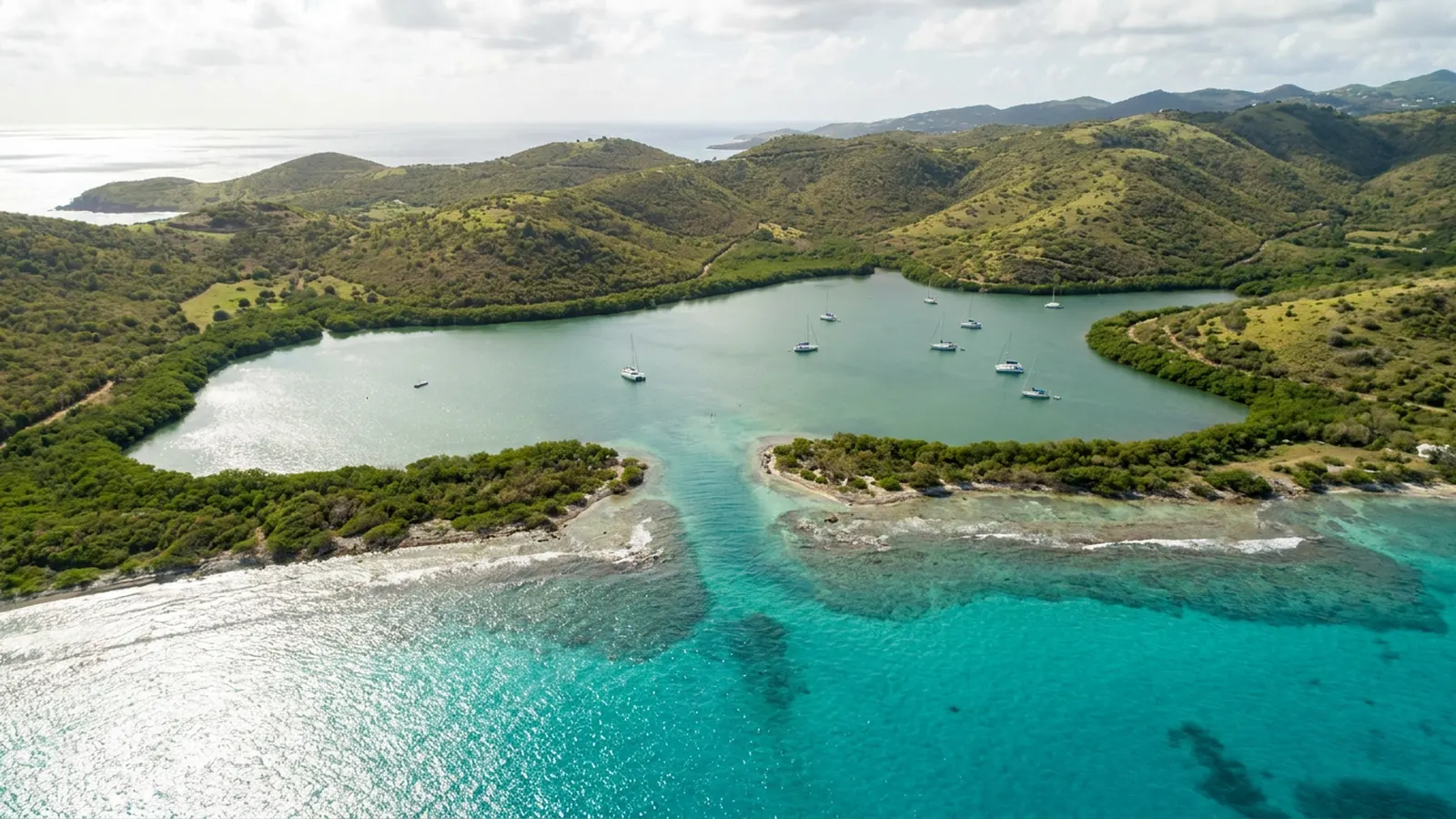
Salt River Bay sits on the north coast of St. Croix, the largest of the US Virgin Islands, a short drive west of Christiansted.
The bay is a long, irregular inlet that cuts into the island, with an inner lagoon and several fingers of water lined with red mangroves. A narrow mouth connects it to the open sea, and just outside that mouth the seafloor drops steeply into the Salt River submarine canyon. The whole area, land and water together, was protected in 1992 as Salt River Bay National Historical Park and Ecological Preserve. Unlike most national parks, it is jointly managed by the National Park Service and the government of the US Virgin Islands, and much of the land around the bay is still privately owned.
Night tours usually leave from the marina area on the bay’s western side. Christiansted is close enough that most visitors drive over in the early evening. If you want to see how the reefs around the island are laid out, our US Virgin Islands coral reef maps page shows them.
What makes the bay glow
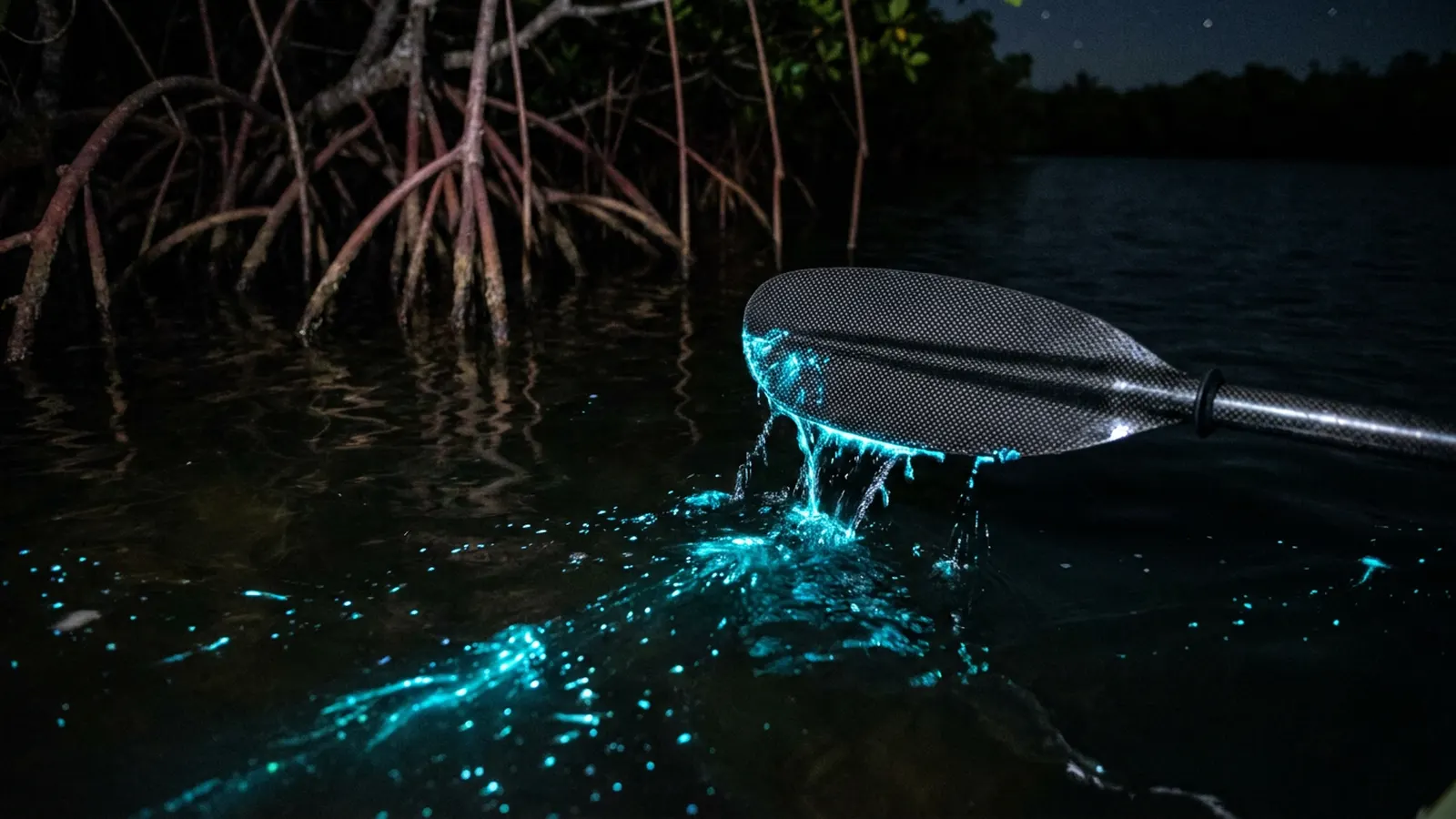
The glow comes from dinoflagellates, single-celled plankton that live in the bay’s warm, shallow water. Like the organisms in Puerto Rico’s bays and Jamaica’s lagoon, they produce light through a chemical reaction in which the enzyme luciferase acts on a molecule called luciferin. The reaction is triggered when the water around a cell is disturbed, so the light appears only where something moves: a paddle, a hand, a fish, the bow of a kayak. Each flash lasts a fraction of a second, but millions of cells flashing together produce a visible blue-green glow. For how that reaction works in detail, see bioluminescent plankton.
Bright bays need the right conditions, and Salt River has many of them. The bay is sheltered and has a restricted connection to the sea, which helps hold the plankton in place. Mangroves along the shore supply organic matter and nutrients, and calm, warm water lets the population build up. The glow is generally described as softer and more variable than in Puerto Rico’s brightest bay, Mosquito Bay on Vieques, but on a good night it is still striking.
What a night kayak tour is like
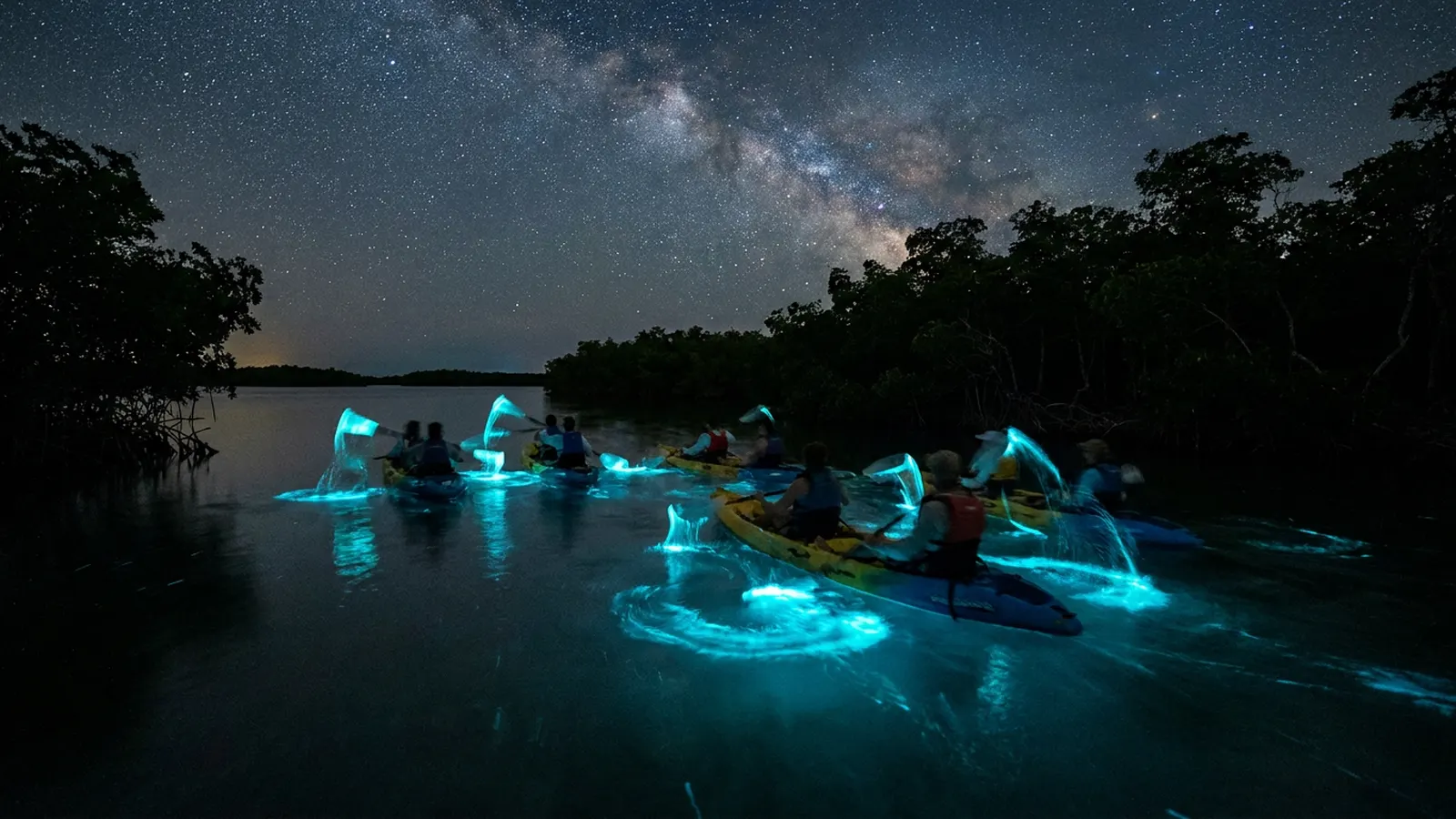
Most visits happen on guided kayak tours that start around dusk. Guides give a short safety talk, then lead the group across the bay as the last light fades. At first you see nothing special. As the sky darkens, every paddle stroke starts to leave swirls of light, and drips falling from the blade sparkle as they hit the surface. Fish shooting away from the kayaks leave bright streaks, and in the shallows you may see whole patches of water light up as something moves underneath.
Guides usually point out the stars and the mangroves, and many also talk about the bay’s history while the group drifts. Tours typically last around two hours. Swimming is not part of the standard tours, partly for safety in the dark and partly to protect the plankton from sunscreen, repellent and disturbance. If you want to swim in glowing water, Jamaica’s lagoon is the better choice; see Luminous Lagoon, Jamaica.
How it compares with other Caribbean bays
| Bay | Island | Usual brightness | How to visit | Swimming |
|---|---|---|---|---|
| Salt River Bay | St. Croix, USVI | Moderate, variable | Kayak tour | No |
| Mosquito Bay | Vieques, Puerto Rico | Very bright | Electric boat, clear kayak | No |
| Laguna Grande | Fajardo, Puerto Rico | Moderate | Kayak through mangrove channel | No |
| La Parguera | Southwest Puerto Rico | Moderate | Boat tour | Restricted |
| Luminous Lagoon | Jamaica | Bright | Boat, then swim | Yes |
The honest summary is that Salt River Bay is not usually the brightest of the Caribbean bays, but it is quieter, part of a national park, and paired with a remarkable history. For the others, see Mosquito Bay, bioluminescent bay Puerto Rico and our overview of every bioluminescent bay.
The history of Salt River Bay
Salt River Bay is one of the few places in US territory where members of Christopher Columbus’s expeditions are documented as having come ashore. On his second voyage in November 1493, Columbus’s fleet anchored off the bay and sent a party ashore for water. The landing led to a skirmish with the island’s Indigenous inhabitants, the first recorded armed clash between Europeans and Native people in what is now US territory. Columbus named the point at the bay’s entrance Cabo de la Flecha, the Cape of the Arrow.
Long before that, the area was home to Indigenous communities, and archaeologists have found the remains of a ceremonial ball court and village sites near the bay. Later, the bay saw successive European colonial powers come and go, including the Dutch, English, French, Knights of Malta and Danes, and the remains of an earthwork fort still stand on the western side. All of that is part of why the area was protected as a national historical park as well as an ecological preserve.
The ecology behind the glow
The bay’s value goes well beyond the light show. Its mangroves are among the largest remaining stands in the US Virgin Islands, and together with seagrass beds and the nearby reefs they form a nursery for young fish, lobsters and conch. Juvenile reef fish shelter among the mangrove roots before moving out onto the reef. Birds nest and roost in the trees, and sea turtles feed in the seagrass.
The glowing dinoflagellates are a sign that this system is working. Bioluminescent bays depend on a delicate balance of nutrients, salinity, water exchange and light, and when that balance shifts, the glow can fade. Hurricanes, runoff from land, dredging and too much traffic have all affected bioluminescent bays around the Caribbean. St. Croix was hit by two powerful hurricanes, Irma and Maria, in 2017, and tour operators reported periods when the glow was weaker afterward, a reminder of how sensitive these bays are.
How I would plan a visit
I haven’t paddled Salt River Bay myself, but I have spent decades around Caribbean water, both diving it and keeping reef systems at home since 1996, and the same rules apply to any small, enclosed body of water. If I were planning a night on Salt River Bay, the first thing I would check is the moon. Book as close to the new moon as you can; a bright moon washes out the glow far more than any other factor. Second, I would skip sunscreen and insect repellent before the tour, or wash them off, because they end up in the water. A long-sleeved shirt deals with the mosquitoes better anyway.
Third, I would pick a small-group operator that keeps the pace slow and explains the ecology, not just the light. Finally, I would build the trip around the park rather than treating the bay as a one-hour attraction: visit the overlook and the historic sites by day, then come back for the glow at night. If you are a diver, the Salt River canyon just outside the bay is also well known for its wall dives. For more ideas, our bioluminescent kayaking page lists other paddling spots.
What to bring
A night kayak tour needs very little, but a few things make it more comfortable. Wear clothes that can get wet, and bring a light long-sleeved layer for the paddle back, since the breeze off the water can feel cool after dark. Water shoes or sandals that strap on are better than flip-flops for launching from the shore. Leave bright flashlights in the car; guides use dim red lights so everyone’s eyes can adjust, and a white phone screen will ruin your night vision for several minutes. A dry bag for keys and a phone is useful, though, as with every glowing bay, your camera is unlikely to capture the light the way you see it.
When to go
The bay glows year-round, so there is no single best season. St. Croix’s drier months, roughly December through April, bring calmer weather and fewer rain-related dips in the glow, while the late-summer and autumn months fall in hurricane season. More important than the month is the moon. Most operators schedule fewer tours, or warn guests, around the full moon. Clouds can actually help by blocking moonlight, and calm, windless evenings make the glow easier to see because the surface is not broken up by small waves.
Is there a bioluminescent bay in St. Croix?
Yes. Salt River Bay on St. Croix’s north shore glows from dinoflagellates and is visited on night kayak tours.
Can you swim in Salt River Bay’s bioluminescent water?
Standard tours do not include swimming. The bay is viewed from kayaks.
Is Salt River Bay as bright as Mosquito Bay?
Usually not. Mosquito Bay on Vieques is generally brighter, but Salt River is quieter and part of a national park.
When is the best time to see the glow?
On dark nights close to the new moon, with calm weather.
Who manages Salt River Bay?
The National Park Service and the US Virgin Islands government jointly manage the national historical park and ecological preserve.
Did Columbus land at Salt River Bay?
Yes. Columbus’s fleet anchored there in November 1493 and sent a party ashore.
Are there other bioluminescent bays in the Virgin Islands?
Salt River Bay is the best known in the US Virgin Islands; nearby Puerto Rico has three famous bays.
- National Park Service: Salt River Bay National Historical Park and Ecological Preserve.
- NOAA Ocean Exploration: What is bioluminescence?
- Haddock, S.H.D., Moline, M.A. & Case, J.F. (2010). Bioluminescence in the sea. Annual Review of Marine Science 2: 443–493.
- Smithsonian Ocean: Mangroves.
Blane Perun has been exploring Earth’s oceans and marine life for over 25 years. Founder of TheSea.Org in 1999, underwater photographer, coral aquaculture pioneer, and explorer of 80+ countries.
About Blane Perun → More on bioluminescence →