Are Humans Bioluminescent? — The Faint Glow of the Human Body
Not in the way fireflies or deep-sea fish are. Humans have no light organs and no luciferin–luciferase system. But the body does give off an ultraweak photon emission, a by-product of metabolism, that Japanese researchers photographed in 2009. It is roughly 1,000 times too faint for the human eye to see, and it is brightest on the face in the late afternoon.
Spend enough time reading about glowing sea life and the question eventually turns around: if squid, jellyfish, fish, bacteria and plankton can make their own light, can we? The short answer is no, not usefully. The longer answer is more interesting. Every living human gives off a tiny amount of visible light, all the time. It is far too faint to see, it is not produced the way ocean animals make light, and it was only captured on camera in 2009. This page explains what that glow is, why it doesn’t count as true bioluminescence, and how humans have nevertheless borrowed glowing chemistry from the sea. For the ocean side of the story, see our bioluminescence guide.
What bioluminescence actually is
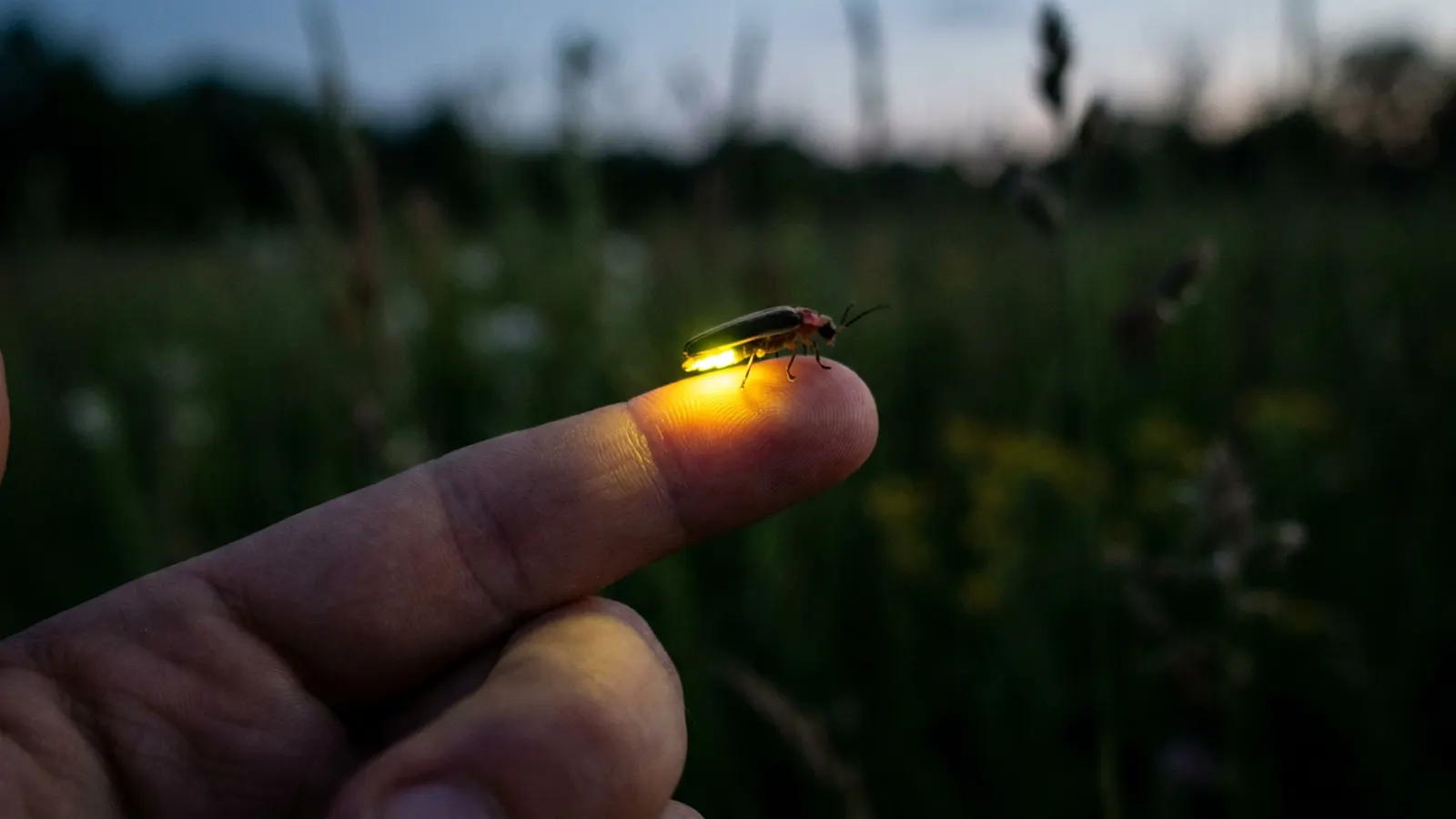
Bioluminescence is light made on purpose by a living organism through a dedicated chemical reaction. Most marine glowing animals use a light-emitting molecule called a luciferin and an enzyme called a luciferase.
When luciferase helps oxygen react with luciferin, the luciferin is left in an excited state and releases its extra energy as a photon of light. Animals that glow have evolved specialised cells, organs or symbiotic bacteria to run this reaction and control it: switching it on, dimming it, pointing it in a direction or pairing it with lenses and reflectors. Lanternfish have rows of photophores along their bellies. The anglerfish hangs a lure full of glowing bacteria in front of its mouth. Dinoflagellates flash when the water around them is disturbed. In every case, the light has a job: hunting, hiding, signalling or startling a predator. Our deep-sea bioluminescence page explains why so many animals in dark water rely on it.
Humans have none of this machinery. We have no luciferins, no luciferases, no photophores and no symbiotic light bacteria. That is why scientists don’t describe us as bioluminescent.
The 2009 study that photographed the human glow
In 2009, researchers in Japan led by Masaki Kobayashi published a study in the journal PLoS ONE showing that the human body emits visible light in a daily rhythm. They used ultra-sensitive cooled CCD cameras in a completely dark, light-tight room and photographed five healthy young men, stripped to the waist, every few hours across several days. The cameras recorded faint light coming from the body. The face glowed more than the torso, the cheeks and forehead were brightest, and the overall emission rose and fell over the day, with a low point in the late morning and a peak in the late afternoon.
The emission was extremely weak. The researchers estimated it was roughly a thousand times weaker than the lowest level the human eye can detect. You could sit in a pitch-black room with someone for hours and never see it. The study is often summarised in headlines as “humans glow in the dark,” which is true in a literal sense and very misleading in a practical one.
Where the human glow comes from
The light is a side effect of being alive. Cells burn fuel using oxygen, and that process produces reactive oxygen species, often called free radicals. These highly reactive molecules attack fats and proteins in a process called oxidation. Some of the products of these reactions are left in an excited state, and a small fraction of them release that energy as a photon of visible light, a phenomenon known as chemiluminescence. Fluorescent molecules in the skin can pick up some of that energy and re-emit it too.
Because the glow tracks metabolism, it changes with the body’s internal clock, which is probably why it follows a daily rhythm. Researchers have also noted that the face, which gets more sun exposure and contains particular pigments, glows more than the body. There is ongoing interest in whether measuring this ultraweak emission could reveal oxidative stress or disease, but that work is still at the research stage.
The key difference from real bioluminescence is purpose and control. A firefly squid or an anglerfish makes light with a dedicated enzyme for a reason. Human light is an accidental leak from chemistry the body is doing for other reasons entirely.
| Feature | True bioluminescence | Human ultraweak emission | Biofluorescence |
|---|---|---|---|
| Energy source | Chemical reaction (luciferin + luciferase) | Side reactions of metabolism | Absorbs outside light and re-emits it |
| Purpose | Hunting, defence, signalling | None; a by-product | Often signalling or none |
| Visible to the eye? | Yes, often clearly | No | Yes, under the right light |
| Works in total darkness? | Yes | Yes, but too faint to see | No |
| Examples | Dinoflagellates, lanternfish, fireflies | Humans and most living cells | Corals, some sharks, scorpions |
Glow versus fluorescence: an important distinction
People often mix up bioluminescence and fluorescence, and the human body is a good example of the difference. Fluorescence happens when a material absorbs light of one color, usually blue or ultraviolet, and re-emits it as another color. It needs an outside light source. Teeth, nails and some skin compounds fluoresce under a blacklight, which is why white teeth light up at a nightclub. That is not your body making light; it is your body changing the color of light that hits it.
Fluorescence is common in the sea too. Many corals fluoresce green, orange or red under blue light, and some sharks and eels fluoresce in ways that only show up through special filters. Anyone who has kept a reef tank under actinic lighting, as I have since the 1990s, has seen how strongly corals fluoresce under blue light. It is a beautiful effect, but it stops the moment the light is switched off. Bioluminescence keeps working in total darkness.

When human wounds really did glow
There is one well-known case where humans appeared to glow. After the Battle of Shiloh in the American Civil War in 1862, soldiers lying wounded on the field reported that some of their wounds gave off a faint blue-green light. The glow was nicknamed “Angel’s Glow,” and the soldiers with glowing wounds were said to survive more often and heal better.
Nearly 140 years later, two high school students investigating the story with a microbiologist proposed an explanation. They suggested that the light came from Photorhabdus luminescens, a bioluminescent bacterium that lives inside soil nematodes. The cold, wet conditions at Shiloh would have lowered the soldiers’ body temperatures enough for the bacteria to survive, and the bacteria produce compounds that kill competing microbes, which may have helped prevent infection. The light, in other words, was bacterial bioluminescence on a human, not from a human. See bioluminescent bacteria for more on these microbes.
How humans borrowed light from the sea
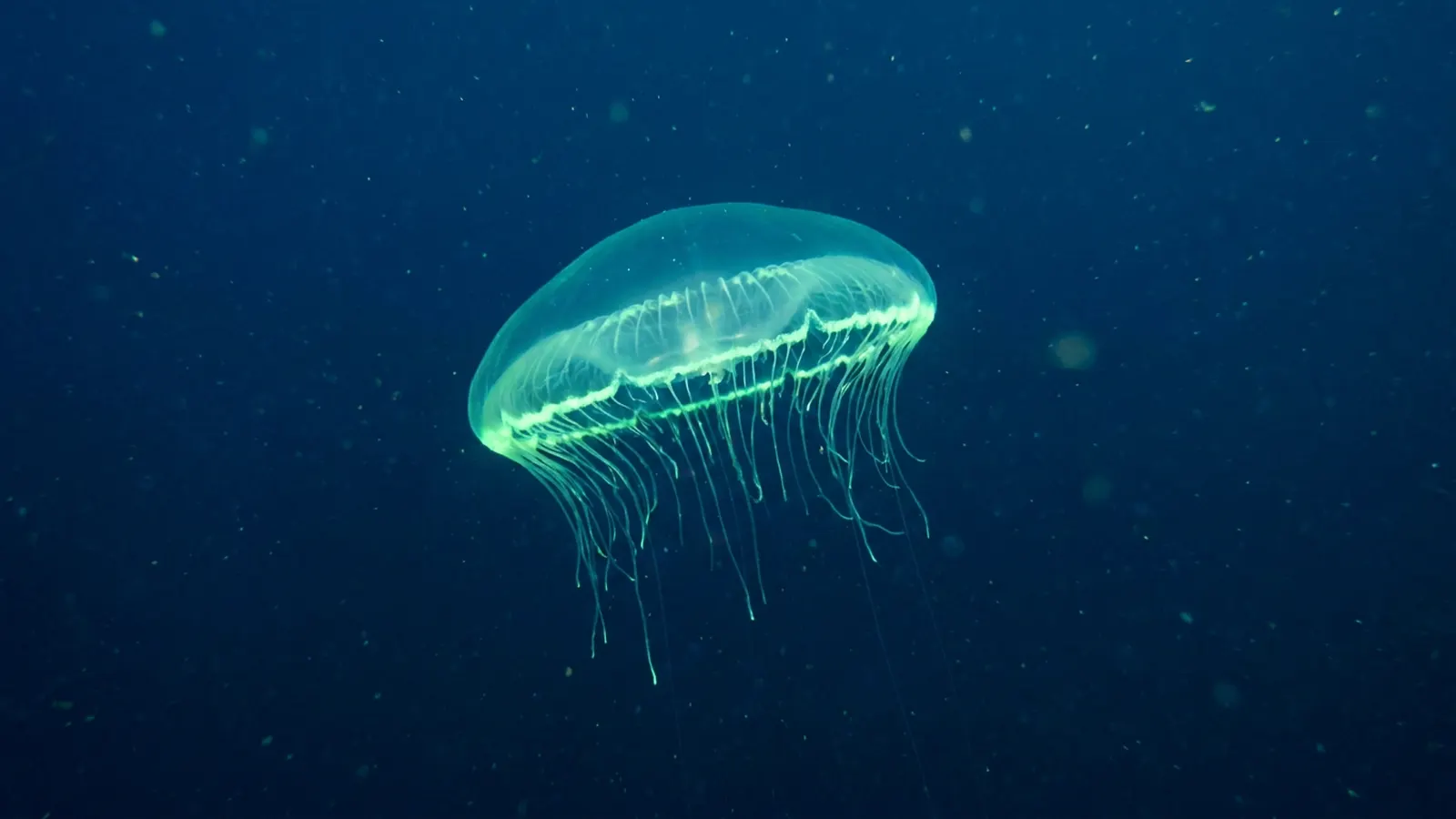
We cannot make light ourselves, but we have learned to use the glowing chemistry of marine animals. In the 1960s, Osamu Shimomura isolated a light-producing protein called aequorin and a green fluorescent protein, GFP, from the crystal jelly Aequorea victoria collected off the coast of Washington State. Decades later, GFP became one of the most important tools in biology. Scientists attach it to other proteins so they can watch genes switch on, track cancer cells and follow nerve cells as they grow. Shimomura shared the 2008 Nobel Prize in Chemistry for the discovery.
Luciferase enzymes from fireflies and marine organisms are also widely used in laboratories to measure cell activity, because light is easy to detect even in tiny amounts. So while humans are not bioluminescent, a great deal of modern medicine relies on light borrowed from glowing animals. Our page on bioluminescent jellyfish covers the crystal jelly and its relatives.
Why no mammal evolved to glow
It is worth asking why bioluminescence is so common in the sea and so rare on land, and why it is absent in mammals altogether. Most glowing species live in the ocean, and most of those live in the twilight and midnight zones, where sunlight fades out and light becomes a rare and valuable signal. In that setting, a glowing lure, a flash to startle a predator or a belly lit to match the faint light from above is worth the cost of producing it. Mammals evolved on land, mostly in daylight or in the familiar half-light of dawn and dusk, and they rely on sound, smell and vision of reflected light instead. Even the marine mammals, which returned to the sea relatively recently, hunt with echolocation, whiskers and keen eyesight rather than light of their own. Evolution tends to produce bioluminescence where darkness is the rule, not the exception.
My take
I like this question because it shows how special real bioluminescence is. Every cell in your body leaks a few photons, but turning chemistry into useful light took evolution a long time and a lot of specialised machinery. Ocean animals have done it again and again, in groups as different as bacteria, jellies, squid, shrimp, sharks and fish. If you want to see it for yourself, a dark beach during a plankton bloom or a night paddle in a bioluminescent bay is far more rewarding than staring at your hand in a dark room. Our guides to bioluminescent plankton and bioluminescent beaches are a good place to start.
Are humans bioluminescent?
No. Humans emit an ultraweak glow from metabolism, but we have no dedicated light-making chemistry, so we are not truly bioluminescent.
Do humans glow in the dark?
Technically yes, but the light is about 1,000 times too faint for the eye to see.
What part of the body glows the most?
In the 2009 study, the face, especially the cheeks, glowed most.
Why does the human body emit light?
Free radicals produced during metabolism react with fats and proteins, and some of these reactions release photons.
Are any mammals bioluminescent?
No mammal is known to be truly bioluminescent, though some, such as platypuses, fluoresce under ultraviolet light.
What was Angel’s Glow?
Glowing wounds reported after the Battle of Shiloh, probably caused by the bioluminescent bacterium Photorhabdus luminescens.
Can humans be made to glow?
Not as people, but scientists routinely add glowing proteins such as GFP to cells and lab animals for research.
- Kobayashi, M., Kikuchi, D. & Okamura, H. (2009). Imaging of ultraweak spontaneous photon emission from human body displaying diurnal rhythm. PLoS ONE 4(7): e6256.
- NobelPrize.org: The Nobel Prize in Chemistry 2008 (Shimomura, Chalfie, Tsien) for green fluorescent protein.
- Haddock, S.H.D., Moline, M.A. & Case, J.F. (2010). Bioluminescence in the sea. Annual Review of Marine Science 2: 443–493.
- Smithsonian Ocean: Bioluminescence.
Blane Perun has been exploring Earth’s oceans and marine life for over 25 years. Founder of TheSea.Org in 1999, underwater photographer, coral aquaculture pioneer, and explorer of 80+ countries.
About Blane Perun → More on bioluminescence →