Sea Otter Teeth — Crushing Molars Built for Shellfish
An adult sea otter has 32 teeth. Unlike most carnivores, its cheek teeth are broad, flat and rounded rather than blade-like, built to crush urchins, crabs, clams and snails instead of slicing meat. It has only two pairs of lower incisors, which work like spades to scoop flesh from shells, and its enamel is unusually resistant to chipping.
Most people picture a sea otter floating on its back, cracking a clam on a rock balanced on its chest. What they do not picture is the mouth that finishes the job. A sea otter is a member of the weasel family, the same group as ferrets, minks and badgers, and those relatives have teeth built for cutting meat. The sea otter went a different way. It spent a few million years eating hard-shelled invertebrates in the cold North Pacific, and its teeth changed to match. If you have ever looked at a sea otter skull next to a river otter skull, the difference jumps out: the sea otter’s cheek teeth look more like a bear’s or even a pig’s than a weasel’s. Here is what those teeth look like, how they work and why they matter for the animal’s survival.
How many teeth does a sea otter have?
An adult sea otter has 32 permanent teeth: on each side, three upper and two lower incisors, one canine top and bottom, three premolars top and bottom, one upper molar and two lower molars.
That lower incisor count is the unusual part. Almost every other carnivore, from dogs and cats to other otters, has three pairs of lower incisors. The sea otter has only two, and they jut forward slightly. Biologists who have watched otters eat describe them using those lower front teeth like a scoop or chisel to pry meat out of clam shells and scrape the soft insides out of an urchin test. Fewer, sturdier incisors make sense for that job: a spade works better than a comb.
The canines are still there, and they are reasonably large, because a sea otter still has to grab and hold slippery prey and occasionally fight. But it is the back of the mouth, the premolars and molars, that really sets this animal apart.
| Tooth type | Count (upper/lower, per side) | Shape | Job |
|---|---|---|---|
| Incisors | 3 / 2 | Small; lower pair spade-like | Scooping meat from shells, grooming |
| Canines | 1 / 1 | Conical, fairly stout | Gripping prey, defence, biting open crabs |
| Premolars | 3 / 3 | Low, rounded, increasingly molar-like | Cracking thinner shells |
| Molars | 1 / 2 | Broad, flat, rounded cusps | Crushing urchins, crabs, clams, snails |
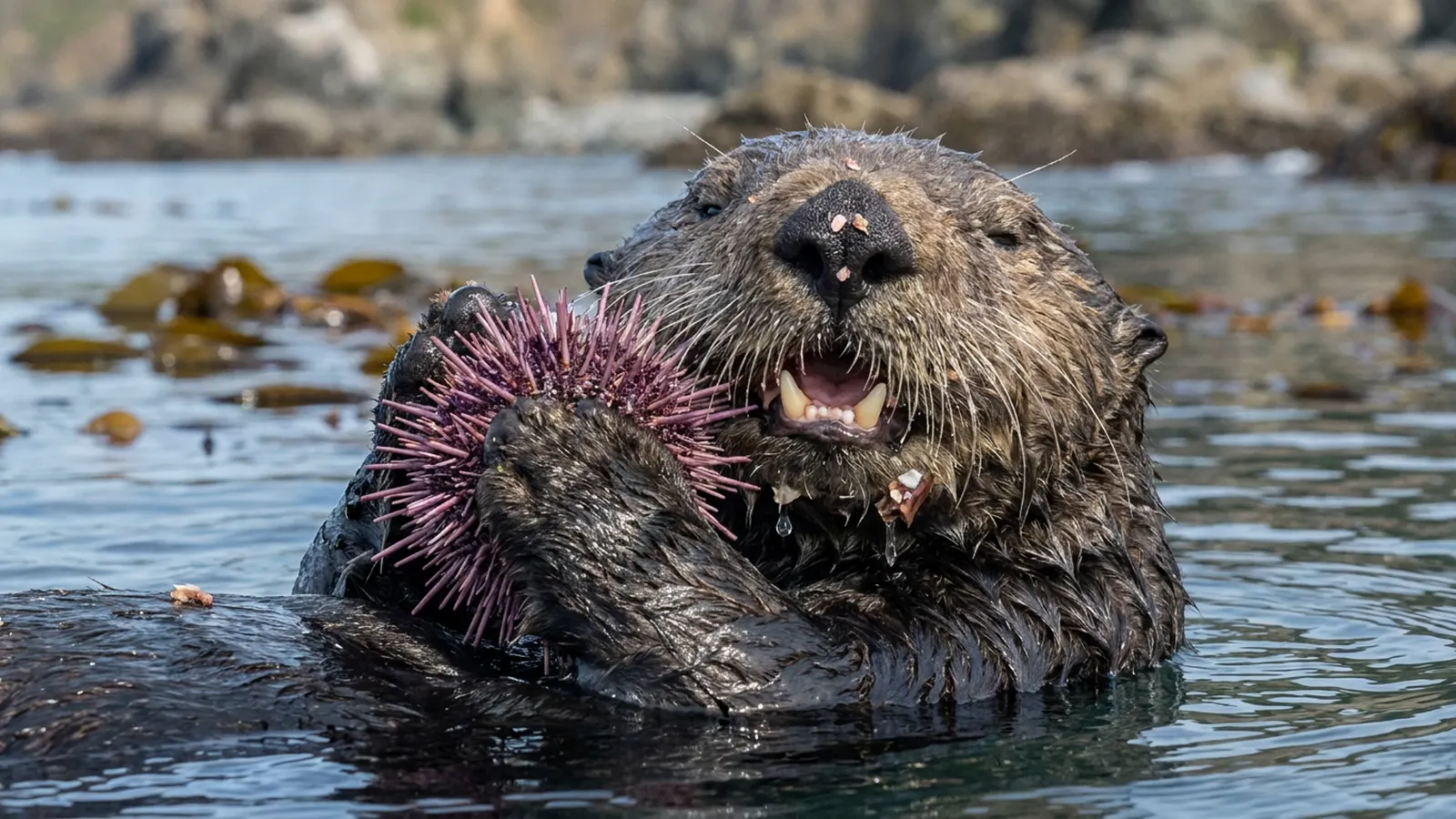
Crushers, not carnassials
In a typical carnivore, the most important cheek teeth are the carnassials, a pair of blade-shaped teeth (the last upper premolar and first lower molar) that slide past each other like scissors to shear meat. A cat or a wolf depends on them. In the sea otter, those same teeth are low, wide and rounded, with blunt cusps that meet each other rather than slicing past. Scientists call this kind of tooth bunodont, the same general design seen in animals that crush hard or tough food.
The result is a set of grinding plates at the back of the jaw. When a sea otter bites down on a crab leg or a small mussel, the shell is cracked between broad surfaces rather than cut. The jaw muscles are powerful and the skull is short and wide, which gives good leverage at the back of the mouth. You can see that in the sea otter skeleton: a rounded braincase, a heavy lower jaw and a skull that is wide across the cheeks for its length.
That design reflects the menu. Sea otters eat purple and red sea urchins, Dungeness and rock crabs, clams, mussels, abalone, turban snails, sea stars and fat innkeeper worms, plus occasional fish where invertebrates are scarce. Almost all of it comes wrapped in shell or spines. For the full list, see what sea otters eat.
Enamel that resists chipping
Crushing shells all day should wreck a set of teeth, and in many old otters it does. But sea otter enamel is surprisingly tough. A 2014 study in Biology Letters by Ziscovici and colleagues tested enamel from sea otter teeth and found it far more resistant to chipping than human enamel. The researchers traced that toughness to the microstructure of the enamel, where the bundles of crystals, called prisms, are woven and decussated so that cracks have a hard time running straight through.
That matters because chipping, not slow grinding, is the main danger when you bite hard objects. A single bad bite on a thick clam can knock a flake of enamel off a tooth. Tough enamel lets the otter take the risk thousands of times over a lifetime. It does not make the teeth indestructible, though, and that is where the famous rock comes in.
Why the rock saves their teeth
Sea otters are one of the few marine mammals that use tools. They pound hard prey against a rock held on the chest, or hit it with a rock, or smash it against a hard surface like a boulder or even a boat hull. For a long time people saw this as a clever trick for opening prey. Research now shows it is also a way to protect teeth.
A study published in Science in 2024, led by Chris Law with Tim Tinker and colleagues working on southern sea otters in California, followed tagged individual otters. They found that otters, especially females, that relied on tools could eat larger and harder prey, and that heavy tool users showed less tooth damage than otters that relied mainly on biting. In areas where the softer, preferred prey such as abalone and large urchins have been depleted, otters shift to harder items like snails and small crabs, and the ones that use tools handle that shift with less wear on their teeth. Females are smaller with weaker bites than males, which helps explain why they use tools more often.
In other words, the rock and the teeth are parts of the same toolkit. The teeth do the fine work; the rock does the heavy smashing. See do otters have a favorite rock? for more on the rocks themselves, and do otters have pockets? for where they keep them.

Baby teeth, wear and telling an otter’s age
Sea otter pups are born with a set of milk teeth that are replaced by permanent teeth during their first months of life, roughly the same period in which they learn to dive and forage with their mother. For the life history around that period, see the sea otter life cycle.
From then on, the teeth tell a story. Young adults have sharp, clean cusps. As the years pass, the cusps flatten, the enamel cracks and chips, and in old animals the cheek teeth can be ground down nearly to the gum, sometimes with broken crowns and abscesses. Wildlife biologists use that pattern. On a live otter captured for tagging, tooth wear gives a rough age class. On a dead otter, a premolar can be sectioned and the growth layers in the cementum counted like tree rings for a more precise age.
Heavy tooth wear is not just a sign of age; it can shorten an otter’s life. A sea otter has almost no blubber and burns energy so fast that it must eat around a quarter of its body weight every day. An animal with broken or worn-out teeth that cannot process food quickly enough can starve, especially in winter. Tooth condition is one of the things researchers record when they examine stranded otters.
Sea otter teeth vs other otters and marine mammals
Compare the sea otter with its closest relatives and the pattern is clear. The North American river otter eats mainly fish, and its cheek teeth keep more of the sharp, shearing carnassial shape. The Asian small-clawed otter and the African clawless otters, which also eat a lot of crabs and molluscs, have broader cheek teeth more like the sea otter’s. Diet, not family tree, shaped the teeth. See all 13 otter species for how they differ.
Across marine mammals as a whole, the range is huge. Dolphins have dozens of simple peg-shaped teeth for gripping fish. Manatees have no front teeth at all and replace their molars from the back like a conveyor belt; see manatee teeth. Walruses have massive tusks and flat cheek teeth for sucking clams out of their shells, which makes them the closest match to the sea otter’s shell-crushing lifestyle, though they do it by suction rather than crushing. Baleen whales have no teeth at all as adults. The sea otter sits in its own niche: a small carnivore that crushes hard prey with its mouth and a tool.
Do sea otters bite people?
They can, and with those teeth a bite is serious. Wild sea otters are generally not aggressive to people, but a cornered, injured or habituated otter can bite, and a few individual otters in California have made news for approaching surfers and kayakers and biting boards. Staff who handle sea otters in rehabilitation centres and aquariums treat them with the same caution as any strong carnivore. The jaw that can crack a crab is more than capable of crushing a finger. That is one more reason, alongside the law, to give them space; see can you keep a sea otter as a pet?
What I take from sea otter teeth
I have kept reef systems since 1996, and a big part of that hobby is matching animals to their food and their environment. You learn quickly that an animal’s body tells you what it eats. That is exactly what the sea otter’s mouth does. Look at the flat molars and you know it eats things with shells. Look at the worn teeth of an old otter and you see the cost of that diet. Look at the rock on its chest and you see the workaround.
If I were watching sea otters in Monterey Bay or Alaska, I would bring binoculars and watch them eat rather than just float. You can often hear the tapping of a rock on a shell across the water, and with a good view you can see an otter use its front teeth to work meat out of a clam after the rock has done the heavy lifting. Our guides to sea otters in Monterey Bay and sea otters in Alaska list the best places to watch. For the bigger picture of how fur, lungs, paws and teeth fit together, see sea otter adaptations and the main sea otter guide.
How many teeth does a sea otter have?
Adults have 32 teeth: 6 upper and 4 lower incisors, 4 canines, 12 premolars and 6 molars.
Do sea otters have sharp teeth?
Their canines are pointed, but their cheek teeth are broad and flat for crushing shells rather than sharp for slicing.
What do sea otters use their teeth for?
Gripping prey, crushing crabs, urchins and molluscs, scooping meat out of shells, and grooming their fur.
Why do sea otters use rocks if they have strong teeth?
Rocks let them open bigger, harder prey and reduce tooth damage. Otters that use tools heavily show less dental wear.
Do sea otters lose their teeth?
Pups replace milk teeth with permanent ones. Old otters often have badly worn or broken teeth, which can make feeding hard.
Can a sea otter bite hurt you?
Yes. Their jaws are built to crush shells, and a bite can cause serious injury. Keep your distance.
- Ziscovici, C., Lucas, P.W., Constantino, P.J., Bromage, T.G. & van Casteren, A. (2014). Sea otter dental enamel is highly resistant to chipping due to its microstructure. Biology Letters 10(10).
- Law, C.J., Tinker, M.T., Fujii, J.A. et al. (2024). Tool use increases mechanical foraging success and tooth health in southern sea otters. Science.
- Kenyon, K.W. (1969). The Sea Otter in the Eastern Pacific Ocean. North American Fauna 68, US Fish and Wildlife Service.
- Jefferson, T.A., Webber, M.A. & Pitman, R.L. (2015). Marine Mammals of the World, 2nd ed. Academic Press.
Blane Perun has been exploring Earth’s oceans and marine life for over 25 years. Founder of TheSea.Org in 1999, underwater photographer, coral aquaculture pioneer, and explorer of 80+ countries.
About Blane Perun → More on sea otters →