Frilled Shark — Chlamydoselachus anguineus, Chlamydoselachus anguineus, the Living-Fossil Eel-Shark
The frilled shark (Chlamydoselachus anguineus) is one of the most ancient lineages of shark still alive: a living-fossil deep-sea predator whose body plan has barely changed in 80 million years. With a long, eel-like body, a terminal mouth lined with rows of trident-shaped teeth, and frilled gill slits that give the species its name, the frilled shark resembles nothing else in the modern ocean. It lives at 500–1,500 m on continental slopes worldwide, reaches roughly 2 metres in length, and is rarely seen alive — most records come from deep-sea trawl bycatch.
Frilled Shark
Identification — the eel that is actually a shark
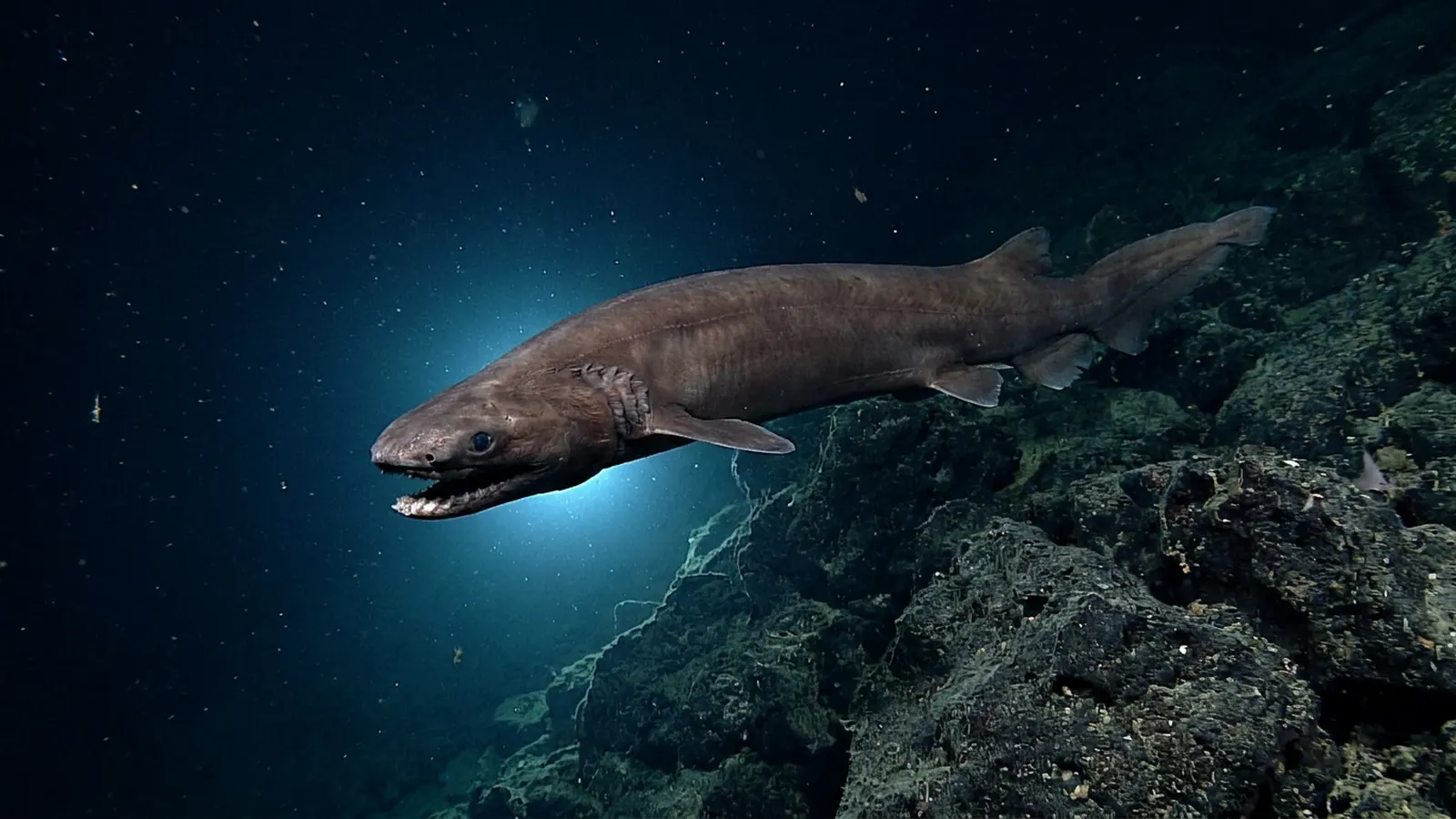
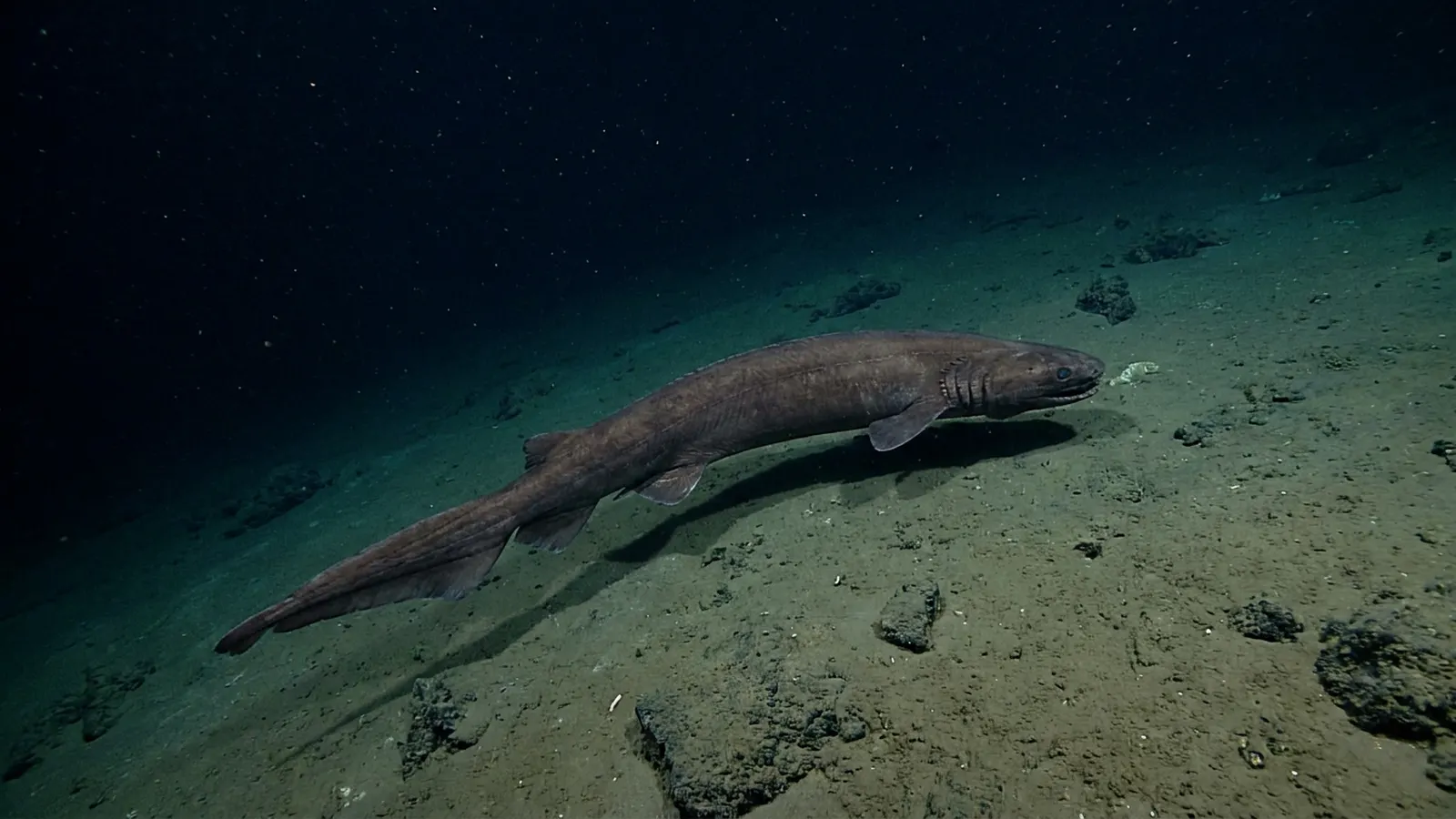
Frilled sharks look like a cross between an eel and a shark, with the slim cylindrical body of an eel and the cartilage skeleton, gill slits, and tooth rows of a shark.
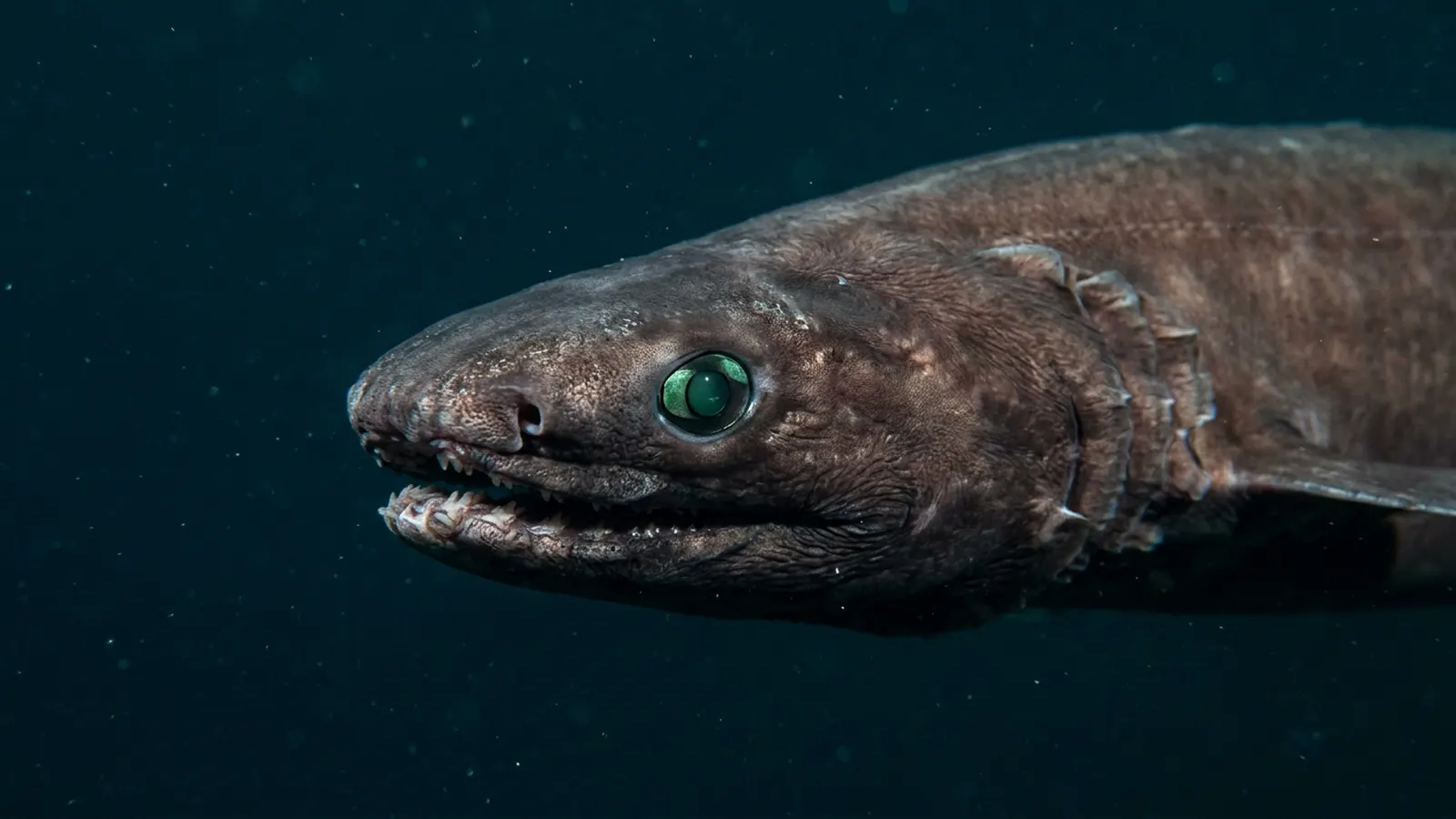
The frilled shark's most distinctive feature is its mouth: rather than the underslung mouth of most sharks, the mouth is at the very front of the head — terminal — lined with about 300 trident-shaped teeth arranged in 25 rows. The body is long and cylindrical, more like an eel than a shark, with six pairs of gill slits (most sharks have five), the first pair of which connects across the throat in a "frill" that gives the species its name. The dorsal coloration is uniform dark grey-brown, suited to the dim light of the species' continental-slope habitat.
Adult frilled sharks reach 1.5–2 m in length, with the largest reliably measured individuals at 2 m and 12 kg. The species is small for a shark but ancient in body plan: fossil chlamydoselachids are known from rocks more than 80 million years old, and the modern species has barely changed from its Cretaceous ancestors.
Range — deep continental slopes worldwide
Frilled sharks have a patchy global distribution along continental slopes between 500 and 1,500 m, with major records from a small number of well-studied deep-sea fishery regions.
The most extensively documented population is in Suruga Bay, Japan, where local fishing operations regularly bring up specimens from 500–1,500 m depths. Other significant records come from Norwegian deep waters, the New England continental slope, the Bay of Biscay, the Azores, New Zealand, and parts of the South African shelf edge. The species' patchy global distribution likely reflects the difficulty of detecting and recording a deep-water animal that rarely strands or reaches surface waters in living condition.
Diet — squid and the trident teeth
Frilled shark stomach analyses are dominated by squid — both small species and (occasionally) much larger ones — with the trident-shaped teeth uniquely suited to gripping the muscular, slippery bodies of cephalopods.
Stomach contents are heavily skewed toward squid (often making up over 60% of identifiable items by mass), with smaller amounts of bony fish and other sharks. The trident-shaped teeth function like the barbed jaw of a hagfish or the radula of a snail: small soft prey gets caught between the cusps and pulled into the throat. Frilled sharks are estimated to feed only every few weeks — the metabolic rate is extremely low — and the slow, eel-like body undulation is suited to ambush rather than pursuit hunting.
Reproduction — possibly the longest gestation of any vertebrate
Frilled shark gestation is estimated at 3.5 years, longer than the spiny dogfish and possibly the longest of any vertebrate — though the data are based on indirect inference rather than direct observation.
Detailed work by Sho Tanaka and colleagues on Suruga Bay specimens estimated gestation at 3.5 years based on embryo growth rates and the proportion of pregnant females in samples. If correct, this would exceed the spiny dogfish's 18–24 month gestation and make the frilled shark the longest-gestating vertebrate on Earth. Litter sizes range from 2–15 pups at 40–60 cm. The reproductive biology is poorly understood beyond these basic parameters.
Where the frilled shark sits among the major shark species
Comparing frilled sharks against the major species at a glance.
The frilled shark is the smallest species in the comparison after the spiny dogfish and is the only one with a body plan that has barely changed since the Cretaceous. It poses no threat to humans, has zero documented attacks, and is one of the rarest large sharks for divers to encounter alive.
| Species | Max length | Max weight | Bite force | Attacks (unprov.) | Lifespan |
|---|---|---|---|---|---|
| Great white shark | 6.0 m | 2,300 kg | ~4,000 PSI | 354 | 70 yrs |
| Tiger shark | 5.5 m | 900 kg | ~6,000 PSI | 142 | 27–50 yrs |
| Bull shark | 3.5 m | 320 kg | 1,250 PSI | 121 | 16 yrs |
| Oceanic whitetip | 4.0 m | 170 kg | n/a | 15 | 22 yrs |
| Shortfin mako | 4.0 m | 570 kg | n/a | 10 | 30 yrs |
| Great hammerhead | 6.1 m | 580 kg | n/a | 17 | 44 yrs |
| Whale shark | 12.0 m | 19,000 kg | n/a (filter) | 0 | 80–130 yrs |
Related on TheSea
What makes the frilled shark a living fossil?
The body plan has barely changed in 80 million years. Fossil chlamydoselachids from the Late Cretaceous look strikingly similar to the modern species, which is unusual among vertebrates — most lineages diversify and evolve substantially over that timescale.
How big does a frilled shark get?
Adults reach 1.5–2 m, with the largest reliably documented individuals at 2 m and 12 kg. They are small for a shark but typical-sized for deep-sea continental-slope predators.
Where do frilled sharks live?
Frilled sharks live on continental slopes worldwide at depths of 500–1,570 m, with the most documented population in Suruga Bay, Japan. They occasionally venture into shallower water (~50 m has been recorded), but typical encounters require deep-sea trawls or submersible work.
Are frilled sharks dangerous?
No. The species lives at depths well below typical human activity, has small jaws and small teeth designed for soft prey, and has zero documented attacks on humans on record.
What does a frilled shark eat?
Squid (often making up over 60% of stomach contents), smaller sharks, and deep-sea bony fish. The trident-shaped teeth are uniquely suited to gripping muscular, slippery cephalopod bodies, which are the species' primary prey.
Blane Perun has been exploring Earth’s oceans and marine life for over 25 years. Founder of TheSea.Org in 1999, underwater photographer, coral aquaculture pioneer, and explorer of 80+ countries.
About Blane Perun → More on Sharks →