Great White Shark — Carcharodon carcharias — Species Overview
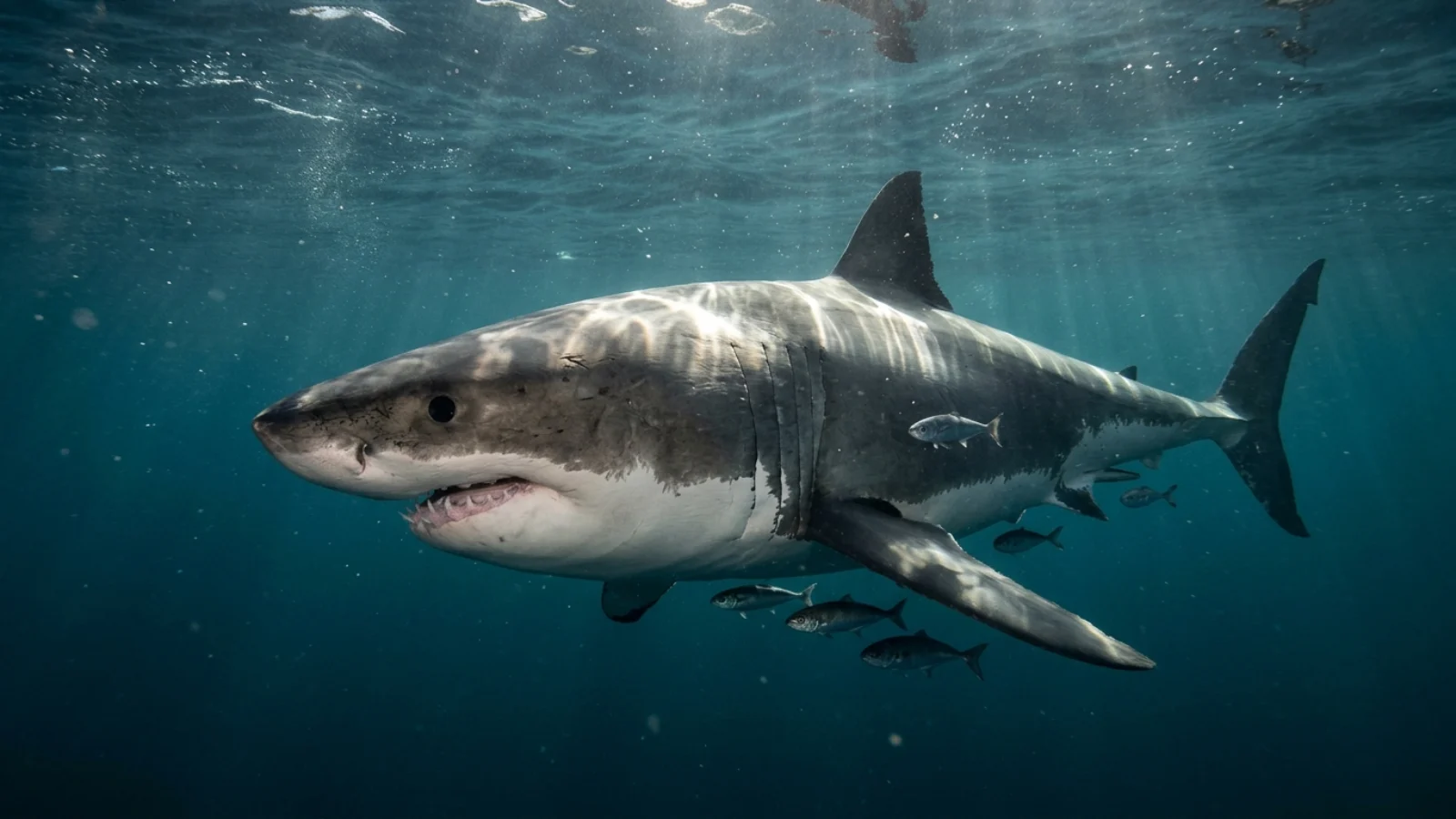
The great white shark (Carcharodon carcharias) is the world’s largest predatory fish — reaching 6.4 metres and 2,300 kg. The species is part of the Lamnidae family alongside the mako, salmon shark, and porbeagle, distinguished by warm-bodied regional endothermy that lets them warm muscles and brain above ambient water temperature. They live in temperate and subtropical seas worldwide, eat marine mammals as adults and fish as juveniles, reproduce extraordinarily slowly, and are listed as Vulnerable on the IUCN Red List. Despite their reputation, great whites kill humans rarely — about 6 fatal attacks worldwide per year across all shark species combined.
The great white is the most famous shark species on Earth, partly through pop culture (Jaws) and partly through genuine scientific significance. This page is a structured species overview — the headline biology, the scientific classification, the size and behaviour, the conservation status — designed to anchor the rest of our great white Q&A cluster. For deep dives into specific aspects, see the linked sibling pages.
Scientific classification — one species, no close relatives
Great white sharks belong to the genus Carcharodon, which contains only this one living species. The closest living relatives are the makos and salmon sharks, all members of the family Lamnidae.
The full classification: Class Chondrichthyes (cartilaginous fishes) → Subclass Elasmobranchii (sharks, rays, skates) → Order Lamniformes (mackerel sharks) → Family Lamnidae (mackerel sharks proper) → Genus Carcharodon → Species C. carcharias.
The famous extinct megalodon (Otodus megalodon) is sometimes incorrectly classified as a close great white relative. Recent work has assigned megalodon to the family Otodontidae rather than Lamnidae, with the great white likely a more distant cousin than older taxonomies suggested. Genetic and morphological evidence places the modern great white as the descendant of a separate lineage that converged on similar predatory adaptations.
Size summary
For deep size details by length, weight, and growth rate, see our weight page. Key points: females grow significantly larger than males, the cube relationship between length and weight makes size jumps dramatic, and “Deep Blue” at Guadalupe is the most-photographed example of a 6+ metre individual.
Anatomy — built for ambush predation
Great white anatomy is highly specialised for vertical-strike predation on large agile prey, primarily seals.
The body that kills seals
- Torpedo body with conical snout, optimised for high-speed vertical strikes through the water column.
- Approximately 300 teeth in 5 rows, with broad triangular serrated upper teeth and narrow piercing lower teeth in adults.
- Regional endothermy via the rete mirabile — muscle, brain, and eyes warmed 10–14°C above ambient water.
- Large liver at up to 25% of body weight, providing buoyancy and energy storage. Disproportionately large vs other sharks.
- Black eyes with no nictitating membrane, instead protected by rolling backward during attacks — the famous “black-eye” appearance during a strike.
- Counter-shading: dark grey-brown back, white belly. The colouration that gives the species its English name.
Behaviour — what great whites actually do
Great whites are not the constantly-aggressive predators of pop culture. The reality is more interesting and more variable.
Adult great whites spend most of their time cruising at moderate speed, conserving energy. They make occasional bursts to high speed during prey strikes — but the strikes are brief, often unsuccessful, and followed by long periods of recovery. Hunting tends to be solitary, though aggregations occur at seal colonies during peak season and at whale carcasses.
Social behaviour exists but is poorly understood. Tagged great whites at established aggregation sites (Guadalupe, Farallons) appear to maintain individual identities and recognise each other; certain pairs are observed together repeatedly across seasons. The “feeding hierarchy” sometimes claimed in popular accounts — with dominant individuals chasing smaller ones away from prey — has limited empirical support. What’s documented is that aggressive interactions between conspecifics happen but are not as ritualised as the popular accounts suggest.
Diet, habitat, predators — the rest of the species
For deep coverage of diet, habitat, predators, and reproduction, see the dedicated sibling pages. Brief summaries here.
Diet: juveniles eat fish; adults eat marine mammals (primarily seals) supplemented by whale carrion, dolphins, and large fish. The dietary shift around 3 m total length is one of the most dramatic ontogenetic transitions in any vertebrate. Full diet page.
Habitat: temperate and subtropical waters worldwide, with population centres at California, Mexico, South Africa, Australia, and the U.S. East Coast. The species ranges from surface to 1,250 m depth and undertakes long-distance migrations between coastal aggregation sites. Full habitat page.
Predators: orcas (killer whales) are the only known natural predators that kill great whites systematically, taking the lipid-rich liver. Other great whites occasionally cannibalise smaller individuals. Humans, through fishing and beach-protection programmes, account for the majority of great white mortality. Full predators page.
Reproduction: extraordinarily slow. Female maturity at 33 years, 18-month gestation, 2–14 pups every 2–3 years. Mating has never been directly observed in the wild. Full reproduction page.
Attack risk — real but rare
Great whites cause more fatal shark attacks than any other species — about 32% of total shark fatalities globally — but the absolute numbers remain small. Unprovoked great white attacks on humans average ~2 fatalities per year worldwide, against an estimated 1+ billion ocean recreation events annually. The statistical risk per swim is essentially negligible, even at the most-affected beaches in California, Australia, and South Africa.
Conservation status
Great whites are listed as Vulnerable on the IUCN Red List, with declining trends in most populations outside the recovering U.S. East Coast.
The combination of slow reproduction (33 years to first pup), long maturity, and continuing fishing pressure has driven population declines across most of the species’ range. South African populations are particularly affected; Mediterranean populations are critically reduced. International protections under CMS Appendices I and II and CITES Appendix II provide regulatory framework, and most major fishing nations now prohibit targeted great white fishing.
Cape Cod represents the clearest documented population recovery, where great whites returned to the area as grey seal populations rebounded under U.S. Marine Mammal Protection Act protections. The species’ presence on Cape Cod beaches has driven public-facing safety considerations and significantly increased local research opportunities.
Related on TheSea
What is a great white shark?
The great white shark (Carcharodon carcharias) is the world’s largest predatory fish, reaching up to 6.4 metres and 2,300 kg. The species belongs to the family Lamnidae alongside makos and salmon sharks, all distinguished by regional endothermy — warm-bodied muscles, brain, and eyes despite a fully cold-blooded ancestral background.
Are great white sharks endangered?
Listed as Vulnerable on the IUCN Red List globally. Most regional populations are declining, with South African and Mediterranean populations particularly affected. The U.S. East Coast (Cape Cod) is a documented recovery area. International protections (CMS, CITES) prohibit targeted fishing in most jurisdictions.
What’s the largest great white ever recorded?
The largest reliably measured great white was approximately 6.4 metres and 2,300 kg. The famous “Deep Blue” individual at Guadalupe is estimated at ~6 metres but has not been directly weighed. Larger reports exist in older literature but lack reliable measurement.
Are great whites related to megalodon?
Distantly. Recent work suggests megalodon belongs to the family Otodontidae rather than Lamnidae (where great whites belong), making them more distant cousins than older taxonomies indicated. Both species converged on similar large-predator morphology, but they descend from separate lamniform lineages.
Where can I see great white sharks safely?
The three established cage diving destinations are Guadalupe Island (Mexico), Gansbaai (South Africa), and the Neptune Islands (South Australia). All have multi-decade safety records, professional operators, and good shark encounter rates in season. More on diving with great whites.
- IUCN Red List. Carcharodon carcharias assessment, including population trends.
- Compagno, L. J. V. (2001). FAO Species Catalogue: Sharks of the World, Vol. 2. Standard taxonomic and biological reference.
- Hamady, L. L., et al. (2014). Bomb radiocarbon dating and revised lifespan estimates.
- Florida Museum International Shark Attack File. Historical attack data and species attribution.
- Skomal, G. B., et al. (2017). Cape Cod population recovery documentation.
Blane Perun has been exploring Earth’s oceans and marine life for over 25 years. Founder of TheSea.Org in 1999, underwater photographer, coral aquaculture pioneer, and explorer of 80+ countries.
About Blane Perun → Back to Great White Shark →