Octopus — The Eight-Armed Cephalopods, From the 1-Gram Pygmy to the 71-Kg Pacific Giant
An octopus is a soft-bodied, eight-armed cephalopod mollusc in the order Octopoda — the most behaviourally complex group of invertebrates on Earth. Octopuses have three hearts, nine brains (one central plus one in each arm), blue copper-based blood, no bones, and chromatophore-driven skin capable of changing colour and texture in milliseconds. They occupy every marine habitat from the intertidal zone to the abyssal trenches, and range in size from Octopus wolfi — under one gram — to Enteroctopus dofleini, the giant Pacific octopus, verified to 71 kg. Around 300 species are recognised worldwide, with new species described every year. This section catalogues the major species, the most common questions about octopus biology, and species-specific deep dives where the available science is rich enough to fill its own pages.
Octopus on TheSea.Org
This is the top-level hub for everything octopus on TheSea.Org. The section is built in two layers: species pages covering each individual octopus we have enough material on, and question-and-answer pages covering the topics that come up most often — hearts, eyes, beaks, tentacles, life cycle, diet, predators, and so on.
Some species have an additional layer of species-specific Q&A — the blue ringed octopus, the dumbo octopus, and the giant Pacific octopus all have dedicated question categories because they are the species people most often ask about. The full structure is laid out below.
This page does not duplicate the species pages; it routes you to them. Start with the species you came looking for, or with one of the general questions at the bottom of the page if you arrived without a specific octopus in mind.
Octopus biology in one paragraph

Octopuses are molluscs that have abandoned almost everything that defines a mollusc — no shell, no rigid body plan, no slow nervous system — in favour of intelligence, soft-body flexibility, and the most sophisticated sensory skin in the animal kingdom.
The body consists of a soft bulbous mantle (the “head” most people see) and eight muscular arms lined with hundreds of suckers each. There are no bones; the only hard structure is the chitinous beak at the centre of the arms. The nervous system includes a central brain plus a large ganglion in each arm, giving the colloquial figure of “nine brains” — about two-thirds of the animal’s neurons are in the arms, not the central brain. The circulatory system uses three hearts pumping copper-based haemocyanin blood, which is blue rather than red and carries oxygen efficiently in cold water. Reproduction is, for almost all species, a single event followed by death — semelparity — with only a few exceptions like the larger Pacific striped octopus and its small relative, the lesser Pacific striped octopus. The skin contains millions of chromatophores, iridophores, and leucophores that allow real-time colour and pattern control, even though octopuses are believed to be largely colour-blind — the colour-sense may be in the skin itself.

How intelligent are octopuses?
Octopuses are the clearest example of complex intelligence evolving in an animal far removed from vertebrates. A common octopus has roughly 500 million neurons, a number in the range of some mammals, and most of them are in the arms rather than the brain. Each arm can taste and touch with its suckers and carry out movements with a degree of independence, while the central brain sets goals and coordinates. In laboratory tests octopuses learn to open jars, navigate simple mazes and recognise individual human keepers, and in the wild they choose and remember dens and hunting routes.
Some of the best evidence comes from the field. In 2009, Julian Finn, Tom Tregenza and Mark Norman reported in Current Biology that veined octopuses in Indonesia dig up discarded coconut shell halves, carry them across the seabed stacked under their bodies and later assemble them into a shelter, the first documented case of an invertebrate carrying objects for later use as a tool. The publication of the California two-spot octopus genome in 2015 by Caroline Albertin and colleagues showed large expansions in gene families linked to nervous-system wiring, offering clues to how such a capable brain evolved on a separate branch of the tree of life.
That evidence has shaped law as well as science. After an independent review of the evidence for sentience in cephalopods and decapod crustaceans, the United Kingdom included octopuses, squid and cuttlefish in its Animal Welfare (Sentience) Act of 2022, and proposals to farm octopuses commercially have met strong opposition from scientists and animal-welfare groups.
Where do octopuses live and how do they hunt?
Octopuses are found in every ocean, from rock pools and coral reefs to the deepest trenches, though none live in fresh water. Most are bottom dwellers that shelter in dens among rocks, in empty shells or in burrows dug into sand, and many forage at dusk, at night or at dawn, though some, such as the day octopus of Indo-Pacific reefs and the mimic octopus, hunt in daylight. A few, including the blanket octopuses and the argonauts, live in open water, and the finned dumbo octopuses hover above the deep-sea floor.
Almost all octopuses are predators. They eat crabs, shrimp, clams, snails, fish and other octopuses, finding prey by touch and taste as much as by sight. Many pounce from above, enveloping prey in the web between the arms; others probe crevices with an arm tip. Venom from the salivary glands subdues prey, and some species drill through shells with a toothed radula and salivary secretions before injecting it. The blue-ringed octopuses carry tetrodotoxin, which makes them among the few octopuses dangerous to people.
In turn, octopuses are eaten by moray eels, sharks, groupers, seals, sea otters, whales and seabirds. Their defences, rapid camouflage, ink clouds, jet-propelled escape and the ability to squeeze through any gap larger than the beak, are the reason a soft-bodied animal with no shell can survive among so many predators.
All octopus species covered on TheSea.Org
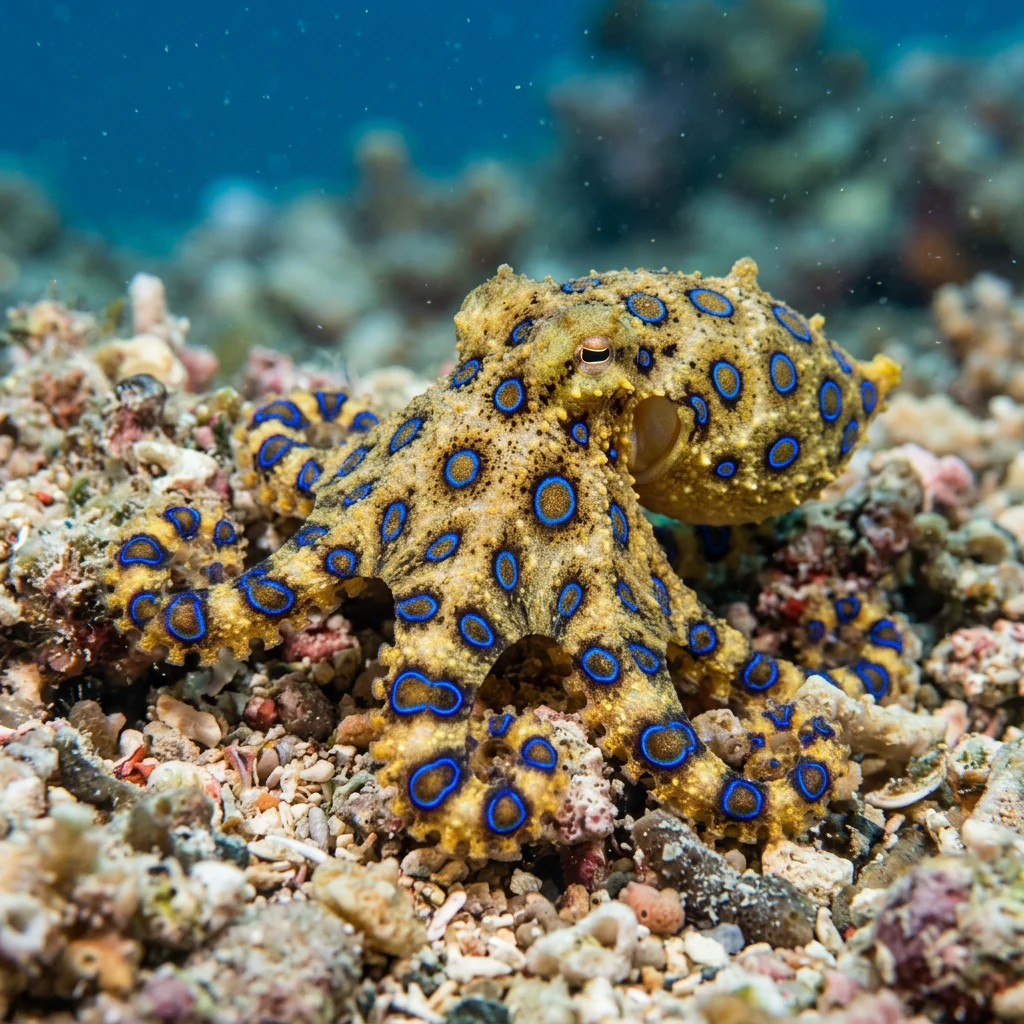
Twenty-six octopus species have dedicated pages on the site, spanning every major group: the giant cold-water rim species, the tropical Indo-Pacific behaviourists, the deep-sea oddities, and the pygmy specialists. Tap any species below for the full dossier.
The most common octopus questions

A general Q&A library answering the questions readers most often arrive with. These cover octopus anatomy, biology, life cycle, and ecology without being tied to a specific species.
Species-specific question libraries
Seven species generate enough specific questions to warrant their own dedicated Q&A category. These are the most-asked-about octopuses on the site — the venomous ones, the famous ones, and the giants.
How many species of octopus are there?
Around 300 are recognised, and new species are described regularly, especially from the deep sea.
What is the largest octopus?
The giant Pacific octopus. Adults usually weigh around 15 kg, and the largest scientifically verified individual weighed 71 kg.
How many hearts does an octopus have?
Three: two pump blood through the gills and one through the rest of the body.
How long do octopuses live?
Most live one to two years; the giant Pacific octopus typically lives three to five. Nearly all die after breeding once.
Are octopuses intelligent?
Yes. They solve problems, remember dens and routes, use tools such as coconut shells and are legally recognised as sentient in the UK.
Are octopuses dangerous to humans?
Almost all are harmless. Blue-ringed octopuses carry tetrodotoxin and have caused deaths, so they should never be handled.
- Finn, J.K., Tregenza, T. & Norman, M.D. (2009). Defensive tool use in a coconut-carrying octopus. Current Biology 19(23).
- Albertin, C.B. et al. (2015). The octopus genome and the evolution of cephalopod neural and morphological novelties. Nature 524.
- Jamieson, A.J. & Vecchione, M. (2020). First in situ observation of Cephalopoda at hadal depths. Marine Biology 167 (dumbo octopus at 6,957 m).
- UK Government (2022). Animal Welfare (Sentience) Act, following the LSE review of sentience in cephalopod molluscs and decapod crustaceans (Birch et al. 2021).
- Wikipedia: Giant Pacific octopus (verified 71 kg; typical weight and lifespan).
The ten-limbed cousins — two tentacles, eight arms, and a different evolutionary path through the open ocean.
The reef-dwelling cuttlebone-bearing third major cephalopod group — pattern-rich, communicative.
The ancient shelled cephalopod — living fossils, with up to 90 small tentacles and no chromatophores.
Octopuses, Octopi or Octopodes?
The Internet’s Most Famous Fake Animal.
Puzzles, Escapes and Tool Use.
The Cambrian Panspermia Paper Explained.
Allergy and Biology Answer.
What the Film Got Right About the Common Octopus.
Blane Perun has been exploring Earth’s oceans and marine life for over 25 years. Founder of TheSea.Org in 1999, underwater photographer, coral aquaculture pioneer, and explorer of 80+ countries.
About Blane Perun → Browse all Octopus content →