Pacific Brown Octopus — The Informal Name That Refers to Several Brown-Colored North Pacific Species
“Pacific brown octopus” is an informal common name that doesn’t refer to one specific scientific species. It’s most often used to describe brown-colored octopuses encountered in the North Pacific, which in practice means one of two species: the giant Pacific octopus (Enteroctopus dofleini, especially juveniles and sub-adults that display brown coloration) or the East Pacific red octopus (Octopus rubescens, whose color often falls in the reddish-brown to brown range). The lack of standardization in the name reflects that octopus colors change — a single individual can appear brown, red, white, or mottled depending on mood, substrate, and behavior. Why the name is used: divers, tide-poolers, and casual observers often describe what they see by color rather than species. A medium-sized brown octopus encountered in a Pacific Northwest tidepool gets called “Pacific brown octopus” without species-level identification. Why it’s imprecise: both giant Pacific and East Pacific red can be brown at any given moment. Without seeing the diagnostic features (size scale, eyespots below eyes, body proportions), the species cannot be reliably distinguished by color alone. The two real species behind the name: E. dofleini grows to 4–5 m arm span at full adult size; O. rubescens reaches 40–50 cm. The East Pacific red has three small white-rimmed false eyespots below each real eye — a reliable identification mark absent in giant Pacific. The wider use: the informal name appears in casual writing, dive reports, and aquarium signage. Scientific literature uses the proper species names instead. The implication for divers: if you encounter a brown octopus in the Pacific Northwest, knowing whether it’s a giant Pacific or East Pacific red matters for the species’ biology, but identification requires more than color.
The name “Pacific brown octopus” is informal — it’s a description rather than a taxonomy. Understanding which species the name actually refers to in any given case requires more than color identification.
Why color alone doesn’t identify an octopus
Octopuses change colors rapidly. The color a person sees at any given moment doesn’t reliably indicate species.
Color-based identification has fundamental limits for octopuses. Chromatophore biology: octopus skin contains thousands of chromatophores — pigment cells that can be expanded or contracted by muscles. The chromatophores in different cells contain different pigments. By controlling which cells are expanded and contracted, the octopus produces patterns and colors. The speed of change: octopuses can change colors in well under a second. A brown octopus can become red, pale, or mottled in a fraction of the time it takes to identify the species visually. The drivers of color change: substrate matching (camouflage), mood (stress, curiosity, aggression), social signaling (during mating or territorial encounters), and display behaviors. Each driver can produce different color states. The species variation: giant Pacific octopuses and East Pacific reds can both produce similar color states. A brown-colored individual could be either species. The lighting effect: water-borne illumination affects what color appears in observation. Different depths, water clarity, and time of day affect the apparent color. The substrate matching: in brown rocky areas, both species often display brown coloration. The substrate match makes color even less species-specific. The conclusion: color is one feature in a complex visual identification. Body size, eye marks, body proportions, behavior, and habitat all contribute to species identification. Color alone cannot do it.
The two main species the name covers
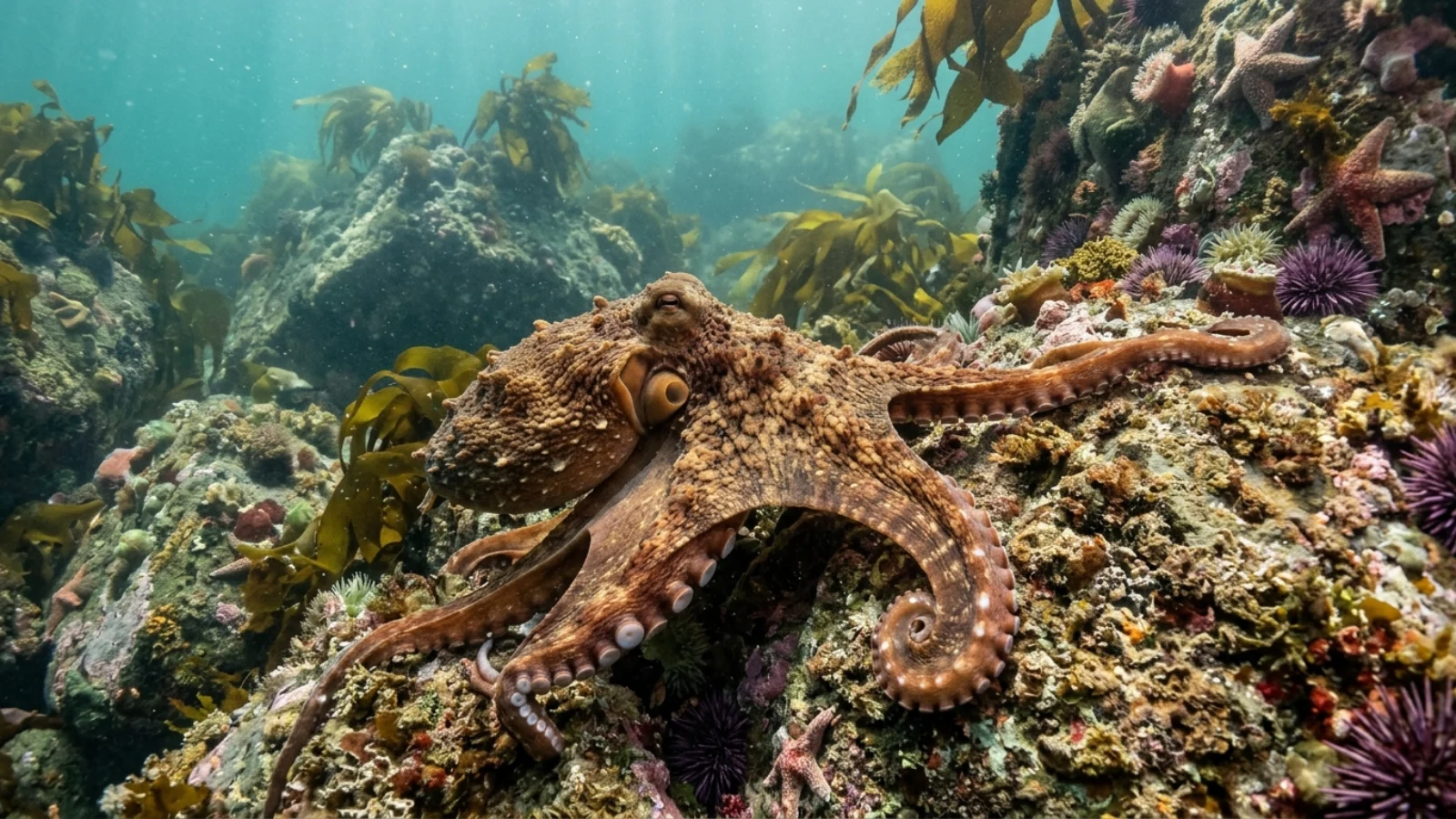
The two species most often called “Pacific brown octopus” are giant Pacific octopus and East Pacific red octopus. They share habitat but differ in many other ways.
Understanding both species is essential for the name’s meaning. Giant Pacific octopus (Enteroctopus dofleini): 4–5 m arm span at adult, 10–50 kg, 3–5 year lifespan, range from southern California to Korea/Japan. Color varies from reddish-brown to brown to pale to mottled. Juveniles and sub-adults often display brown coloration. East Pacific red octopus (Octopus rubescens): 40–50 cm total length at adult, 150–400 g, 1–2 year lifespan, range from southern Alaska to Baja California. Color usually reddish-brown to brown. Has three small white-rimmed false eyespots below each real eye — a key identification feature. The habitat overlap: both species occupy rocky reefs, kelp forests, tidepools, and similar habitat. Recreational divers in the Pacific Northwest encounter both. The size difference: dramatic in adults. A 50 cm octopus is definitely not a giant Pacific. A 4 m octopus is definitely a giant Pacific. Intermediate sizes (1–2 m) are clearly a giant Pacific juvenile. The eyespots: the most reliable distinguishing feature. East Pacific red has three small white-rimmed false eyespots arranged below each real eye. Giant Pacific lacks these. The behavior: East Pacific red is generally more skittish; giant Pacific is more deliberate. Both species can show various behaviors depending on context. The lifespan: very different. East Pacific red: 1–2 years. Giant Pacific: 3–5 years. This affects life-history aspects like size growth and reproductive timing. The cultural importance: giant Pacific is more iconic; East Pacific red is more commonly encountered. Both are part of the Pacific Northwest’s natural heritage.
When the name applies to a giant Pacific juvenile
Juvenile and sub-adult giant Pacific octopuses are often called “Pacific brown octopus” based on their size and color.
Juvenile giant Pacifics are commonly confused with adult East Pacific reds. The size context: a 10–50 cm octopus could be either a young giant Pacific or an adult East Pacific red. Color alone won’t distinguish them. The growth rate: giant Pacific octopuses grow extremely fast. A juvenile that’s 30 cm today might be 1 m in a few months. The species is rarely “small” for long. The identification: eyespots are the reliable mark. If the small octopus has three small white-rimmed false eyespots below each real eye, it’s an East Pacific red. If it doesn’t, it’s likely a young giant Pacific. The habitat preference: young giant Pacifics often use smaller crevices than adults will. They share habitat with East Pacific reds. The behavior: similar between species at small size. Both species hunt similar small prey and use similar refuges. The recovery rate: when divers see a brown octopus in the 30–50 cm range, they often describe it as “Pacific brown octopus” without specifying species. Correct identification matters for understanding what the animal is and what to expect. The conservation implications: if observers don’t distinguish between species, population estimates may be unreliable. Researchers conducting density surveys need to identify each species correctly.
The proper scientific names — and why they matter
For biological accuracy, the scientific names matter. Using informal “Pacific brown octopus” introduces ambiguity that affects communication.
Scientific names provide clarity. Enteroctopus dofleini: the giant Pacific octopus. The species is the largest octopus in the world. Range across the entire North Pacific. The scientific name unambiguously identifies the species, regardless of color or size at observation. Octopus rubescens: the East Pacific red octopus. The species is small-to-medium, found from southern Alaska to Baja California. The scientific name removes ambiguity that “brown” would create. The communication issue: when sources say “Pacific brown octopus” without species clarification, they introduce uncertainty. A scientific paper using the term would be considered ambiguous. Casual writing accommodates the term but can mislead. The taxonomic distinction: the two species are in different families and have very different biology. Calling them by the same informal name obscures these differences. The conservation distinction: the species are managed differently for fisheries and conservation. Misidentification could affect management efforts. The scientific reporting: serious natural history sources use the proper species names. Informal descriptions are appropriate for casual writing but not for biological documentation. The takeaway: when a publication or website says “Pacific brown octopus,” check whether they mean giant Pacific (E. dofleini), East Pacific red (O. rubescens), or are using the term loosely. The two species require different conservation, management, and scientific approaches.
Field identification — what to look for
Divers, tide-poolers, and other observers can identify the actual species by combining several features rather than relying on color alone.
Field identification follows a checklist. 1. Size: estimate the arm span of the octopus. A few centimeters: small juvenile. 30–50 cm: could be either species. 1–2 m: probably giant Pacific juvenile/sub-adult. Over 2 m: definitely giant Pacific. 2. Body proportions: East Pacific red has compact body with arms ~2–3 times mantle length. Giant Pacific has longer arms relative to mantle. 3. Eyespots: most reliable feature. Look for three small white-rimmed false eyespots arranged in a triangle below each real eye. Present = East Pacific red. Absent = giant Pacific. 4. Skin texture: East Pacific red usually smoother. Giant Pacific often has pronounced papillae and rougher texture when stressed. 5. Behavior: East Pacific red more skittish and quick to flee. Giant Pacific more deliberate. 6. Habitat: East Pacific red often in tidepools, shallow rocky areas, and kelp. Giant Pacific in similar but often larger dens, with preference for substantial refuges. 7. Color: useful only in combination with other features. Both species can show brown coloration. The combination: no single feature is definitive in isolation. Combining several (size + eyespots + behavior) gives reliable identification. The photography helps: a clear photo of the octopus’s head region (showing whether eyespots are present) makes later identification easier. The expert verification: marine biologists and experienced divers can identify the species reliably. Identifications by casual observers may be less reliable.
What is a Pacific brown octopus?
An informal common name, not a scientific species. The term refers to brown-colored octopuses encountered in the North Pacific, which in practice usually means either the giant Pacific octopus (Enteroctopus dofleini, especially juveniles) or the East Pacific red octopus (Octopus rubescens). Color is not a reliable species identifier because both species change colors rapidly. Other features (size, eyespots, body proportions) are needed for accurate identification.
Is “Pacific brown octopus” a real species?
No. It’s an informal description, not a scientifically recognized species. The two real species most often called by this name are the giant Pacific octopus (E. dofleini) and the East Pacific red octopus (O. rubescens). They have different scientific names because they are different species in different families with different biology. The informal name introduces ambiguity that proper scientific names avoid.
How do I tell which species I’m looking at?
Check several features. Size: 30–50 cm could be either species; 1+ m is giant Pacific. Eyespots: East Pacific red has three small white-rimmed false eyespots below each real eye; giant Pacific lacks these. Body proportions: East Pacific red has compact body; giant Pacific has longer arms relative to mantle. Skin texture: East Pacific red usually smoother; giant Pacific often more papillose. Combining these features gives reliable identification.
Can a giant Pacific octopus be brown?
Yes, frequently. Brown is one of the colors giant Pacific octopuses can display. They change colors using chromatophores in their skin, producing brown, reddish-brown, pale, mottled, and many other coloration states. Juveniles and sub-adults often appear brown. Adults can also appear brown when matching brown substrate or in certain behavioral states. Color alone doesn’t identify the species.
Can an East Pacific red octopus be brown?
Yes. Despite its “red” common name, the species often appears reddish-brown or brown. The name “red” refers to one common coloration but doesn’t capture the full range. Brown coloration is common in this species, particularly in certain substrate matches and behavioral states. The presence of the three white-rimmed false eyespots is the reliable identifier.
Why doesn’t the scientific literature use “Pacific brown octopus”?
Because it’s ambiguous. Scientific naming requires precision — one name per species. “Pacific brown octopus” could refer to either of two distinct species, which is unacceptable for scientific communication. Researchers use the proper species names (E. dofleini, O. rubescens) to ensure clear identification. Informal names are appropriate for casual contexts but not for biological documentation.
Blane Perun has been exploring Earth’s oceans and marine life for over 25 years. Founder of TheSea.Org in 1999, underwater photographer, coral aquaculture pioneer, and explorer of 80+ countries.
About Blane Perun → More Giant Pacific Q&A →