East Asia Coral Reef Maps — The Coral Triangle, South Asia and the Kuroshio Reefs
Asia holds more coral reef and more reef species than any other region on Earth. Its heart is the Coral Triangle, where Indonesia and the Philippines together hold roughly three-quarters of the reef mapped in this section. Beyond it, atolls and island reefs stretch west through the Maldives, India and Sri Lanka; subtropical reefs reach north to Japan, Taiwan and southern China on the warm Kuroshio Current; and mainland reefs fringe Vietnam and Cambodia. This hub maps 12 Asian reef nations and links to a detailed coral reef map for each.
No region on Earth comes close to Asia for coral reefs. Its seas hold the greatest reef area and by far the greatest marine biodiversity of any part of the world, from the equatorial reefs of Raja Ampat to the subtropical lagoons of Okinawa. They are also among the most pressured: hundreds of millions of people live along these coasts, and many depend on reefs for food. This page maps where Asia’s reefs lie, compares the 12 countries covered on TheSea.Org and explains what makes the region so important for the future of coral.
Asia’s reefs and the Coral Triangle
A single biodiversity core, with reefs radiating west, north and onto the mainland.
At the centre is the Coral Triangle, a region of roughly six million square kilometres of sea spanning Indonesia, the Philippines, Malaysia, Timor-Leste, Papua New Guinea and the Solomon Islands, where reef life reaches its global peak. It holds around three-quarters of the world’s known reef-building coral species and the greatest variety of reef fish anywhere. (Papua New Guinea and the Solomon Islands are mapped in the Oceania coral reef maps.)
Asia’s reefs stretch well beyond that core. To the west lie the atolls of the Maldives and the scattered reefs of India and Sri Lanka. To the north, warmed by the Kuroshio Current, subtropical reefs fringe the islands of southern Japan and Taiwan and the coast of southern China. Between them, the long coasts of Vietnam and Cambodia carry their own reefs. The chart below shows how mapped reef area is shared between the 12 countries in this section.
Asian coral reefs by country
Twelve country maps, from the world’s largest reef nation to Cambodia’s island reefs.
| Country | Region | Relative reef extent | Known for |
|---|---|---|---|
| Indonesia | Coral Triangle | Largest in the world | Raja Ampat, Komodo, Bunaken |
| Philippines | Coral Triangle | Very large | Verde Island Passage, Tubbataha |
| Maldives | South Asia | Large | A nation built of coral atolls |
| Malaysia | Coral Triangle | Large | Sipadan; Sabah and peninsula islands |
| India | South Asia | Large | Four scattered reef regions |
| Japan | East Asia | Moderate | Ryukyu reefs; Sekisei Lagoon |
| China | East Asia | Moderate | Hainan; contested offshore reefs |
| Vietnam | Southeast Asia | Moderate | Nha Trang, Con Dao, Phu Quoc |
| Taiwan | East Asia | Small | Kenting; Green Island, Orchid Island |
| Sri Lanka | South Asia | Small | Bar Reef; Hikkaduwa; Pigeon Island |
| Brunei | Coral Triangle (edge) | Small | Offshore patch reefs |
| Cambodia | Southeast Asia | Small | Koh Rong archipelago |
The Coral Triangle: the centre of it all
The Coral Triangle is to coral reefs what the Amazon is to rainforest.
Indonesia has the largest reef area of any country on Earth, its reefs scattered across more than 17,000 islands from Sumatra to Papua. Raja Ampat in the far east is often cited as the richest reef area ever surveyed, while Komodo, Bunaken, Wakatobi and the Banda Sea are famous among divers. The Philippines, with over 7,000 islands, has extensive reefs and exceptional diversity; the Verde Island Passage between Luzon and Mindoro has been described as the “centre of the centre” of marine shore-fish diversity. Tubbataha Reefs Natural Park in the Sulu Sea is a UNESCO World Heritage Site.
Malaysia, straddling the South China Sea, adds the oceanic island of Sipadan off Sabah and many island reefs off the peninsula, and tiny Brunei completes the cluster on Borneo. Together these reefs hold more coral and reef-fish species than anywhere else, and they feed millions of people. The Coral Triangle Initiative, launched by six governments in 2009, aims to coordinate protection across the region. For background, see world coral reef maps.
South Asia: atolls and island reefs
West of the Coral Triangle, the Indian Ocean holds a very different set of reefs.
The Maldives is the most striking: an entire nation built of coral, a double chain of 26 natural atolls with most land only a metre or two above sea level. Its reefs form the country itself, supply the sand for its islands and support its fishing and tourism economies. The Maldives suffered severe bleaching in 1998 and 2016, but many reefs have shown recovery between events.
India’s reefs are gathered into four widely separated regions: the Lakshadweep atolls in the Arabian Sea, the Gulf of Mannar between India and Sri Lanka, the Andaman and Nicobar Islands in the Bay of Bengal, and the Gulf of Kutch in the north-west, where corals survive in turbid, highly tidal water. Just to the south, Sri Lanka carries smaller but important reefs around its coast, from the Bar Reef off the north-west to Hikkaduwa in the south and Pigeon Island in the east. These South Asian reefs sit on the front line of climate change, with the Maldives among the places on Earth most exposed to warming seas and rising water.
East Asia: reefs at the Kuroshio’s edge
A warm current carries tropical reefs to unusually high latitudes.
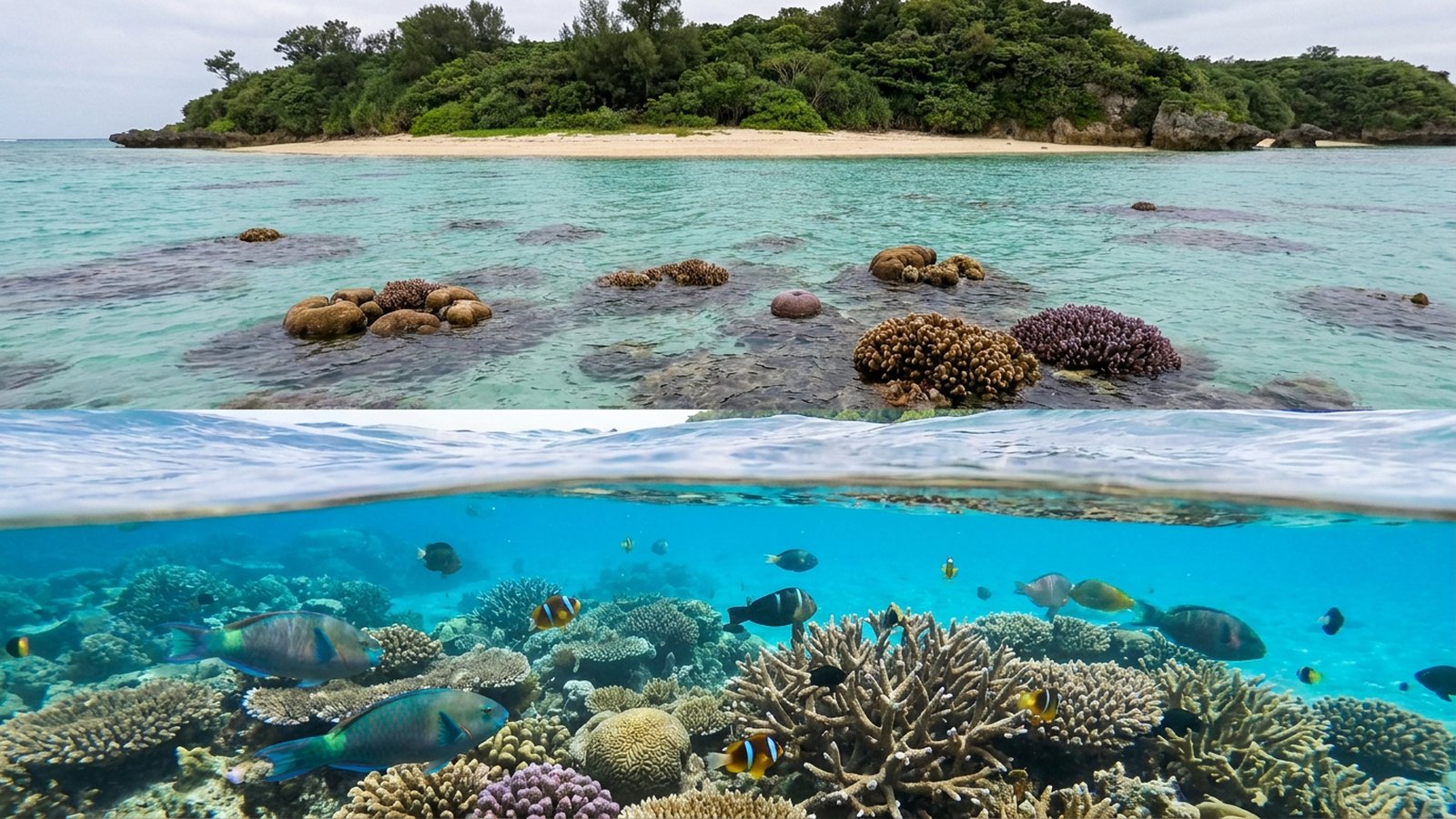
The Kuroshio Current carries warm tropical water northward along the western Pacific, allowing reefs to grow far beyond the tropics. Japan’s reefs cluster in the Ryukyu Islands of the south-west, including Okinawa and the Yaeyama Islands, where Sekisei Lagoon between Ishigaki and Iriomote is the country’s largest coral reef. Corals have been recorded spreading northward along mainland Japan’s Pacific coast as the sea warms. Taiwan has reefs around its southern tip at Kenting and on Kuroshio-washed islands such as Green Island and Orchid Island.
China’s reefs lie mainly around tropical Hainan Island and its southern coast, with extensive offshore reefs in the South China Sea whose ownership is contested. Many of those offshore reefs have been heavily damaged by dredging and island-building. Because East Asian reefs sit near the cool limit for coral growth, they are sensitive barometers of how reefs respond to a warming ocean.
Mainland Southeast Asia
Smaller reefs at the Coral Triangle’s western edge.
Vietnam’s reefs fringe its central and southern coast and offshore islands — Nha Trang’s Hon Mun marine protected area, the Con Dao islands and Phu Quoc — sharing much of the Coral Triangle’s biodiversity. Further west, Cambodia’s small but surprisingly diverse reefs ring the islands off its short coast, centred on the Koh Rong archipelago, now a growing focus of community-based conservation as the coast develops. Thailand’s reefs in the Andaman Sea and Gulf of Thailand are another important part of the mainland picture; see snorkelling Koh Tao.
Reading the reef data
One shared dataset, and one important caveat about the South China Sea.
The chart and country maps are based on the global coral reef dataset compiled by UNEP-WCMC, the standard reference used by scientists and conservation bodies, which combines satellite mapping and survey data. Using one source keeps reef shapes and areas comparable from country to country, although exact figures vary between datasets. The offshore Paracel and Spratly reefs of the South China Sea are claimed in whole or part by several governments. Because the dataset records reef extent without assigning nationality, those reefs are attributed here to the nearest coastline — a geographic convenience, not a statement about sovereignty.
Shared threats across Asia’s reefs
The world’s richest reefs are also among its most pressured.
Asia’s reefs face a common set of pressures. Overfishing and destructive fishing — including blast and cyanide fishing for the live reef-fish trade — have damaged reefs across the region, while coastal development, land reclamation, sedimentation and pollution stress reefs near some of the most crowded coastlines on Earth. Analyses such as the World Resources Institute’s Reefs at Risk have rated Southeast Asia’s reefs among the most threatened in the world.
Above it all sits warming. Mass bleaching has struck reefs from the equatorial Coral Triangle to high-latitude Japan, and low-lying atoll nations face rising seas as well. Yet Asia also holds the world’s greatest reef biodiversity and a fast-growing movement of marine parks and community protection, from Philippine village sanctuaries to Raja Ampat’s protected-area network. Safeguarding these reefs is the work traced across our coral reef conservation pages.
For travellers, the region offers reef experiences for every level, from shore snorkelling in Bali, Okinawa and the Gili Islands to liveaboard expeditions in Raja Ampat, Komodo, Tubbataha and the remote Maldivian atolls. Seasons depend on the monsoons, which shift wind and visibility from one coast to another, so the best time to visit varies by destination. Choosing operators that respect marine-park rules and support local communities helps keep these reefs healthy.
Related on TheSea
Which country has the most coral reefs in Asia?
Indonesia has the largest reef area of any country in the world, followed in Asia by the Philippines. Together they hold roughly three-quarters of the reef mapped in this section.
What is the Coral Triangle?
The Coral Triangle is a marine region spanning Indonesia, the Philippines, Malaysia, Timor-Leste, Papua New Guinea and the Solomon Islands. It has the highest diversity of reef corals and reef fish on Earth, with around three-quarters of known reef-building coral species.
Does Japan have coral reefs?
Yes. Japan’s reefs are mainly in the Ryukyu Islands, including Okinawa and the Yaeyama Islands, where Sekisei Lagoon is the country’s largest reef. The warm Kuroshio Current allows corals to grow farther north than usual.
Where are India’s coral reefs?
In four regions: the Lakshadweep atolls, the Gulf of Mannar, the Andaman and Nicobar Islands, and the Gulf of Kutch.
Why are Asian coral reefs threatened?
Overfishing, blast and cyanide fishing, coastal development, sediment and pollution combine with repeated bleaching from marine heatwaves. Dense coastal populations put especially heavy pressure on Southeast Asian reefs.
Where does the Asia reef map data come from?
From the UNEP-WCMC global coral reef dataset, which combines satellite mapping and survey data. Contested offshore reefs are attributed to the nearest coastline for mapping convenience only.
Blane Perun has been exploring Earth’s oceans and marine life for over 25 years. Founder of TheSea.Org in 1999, underwater photographer, coral aquaculture pioneer, and explorer of 80+ countries.
About Blane Perun → More Coral Reef Maps →