Blastomussa — The Pineapple Coral That Thrives in the Shade
Blastomussa is a genus of small large-polyp stony corals, sold as pineapple coral or simply “blasto.” Its fleshy, round polyps sit on separate tube-like corallites and, in the commonest aquarium species, swell to hide the skeleton completely. Blastos tolerate low light, need little flow and rarely sting their neighbours, which makes them one of the easiest LPS to keep.
The World Register of Marine Species lists six living species and places the genus in the family Plerogyridae with bubble corals, though some references still treat its family as uncertain.
What are the species of Blastomussa?
| Species | Hobby name | Notes |
|---|---|---|
| B. merleti | Pineapple coral, “merleti” | Small corallites under 7 mm; polyps open mainly at night |
| B. wellsi | “Wellsi,” blasto | Larger, puffy polyps that hide the skeleton; the common aquarium blasto |
| B. loyae | — | Head, 1978; shares range with merleti and wellsi |
| B. omanensis | — | Sheppard & Sheppard, 1991 |
| B. vivida | — | Benzoni, Arrigoni & Hoeksema, 2014 |
| B. angularis | — | Accepted by WoRMS |
Most aquarium “color morphs” are B. wellsi: see our pages on Blastomussa wellsi, Blastomussa merleti and Blastomussa vivida, plus named strains like red, green and rainbow.
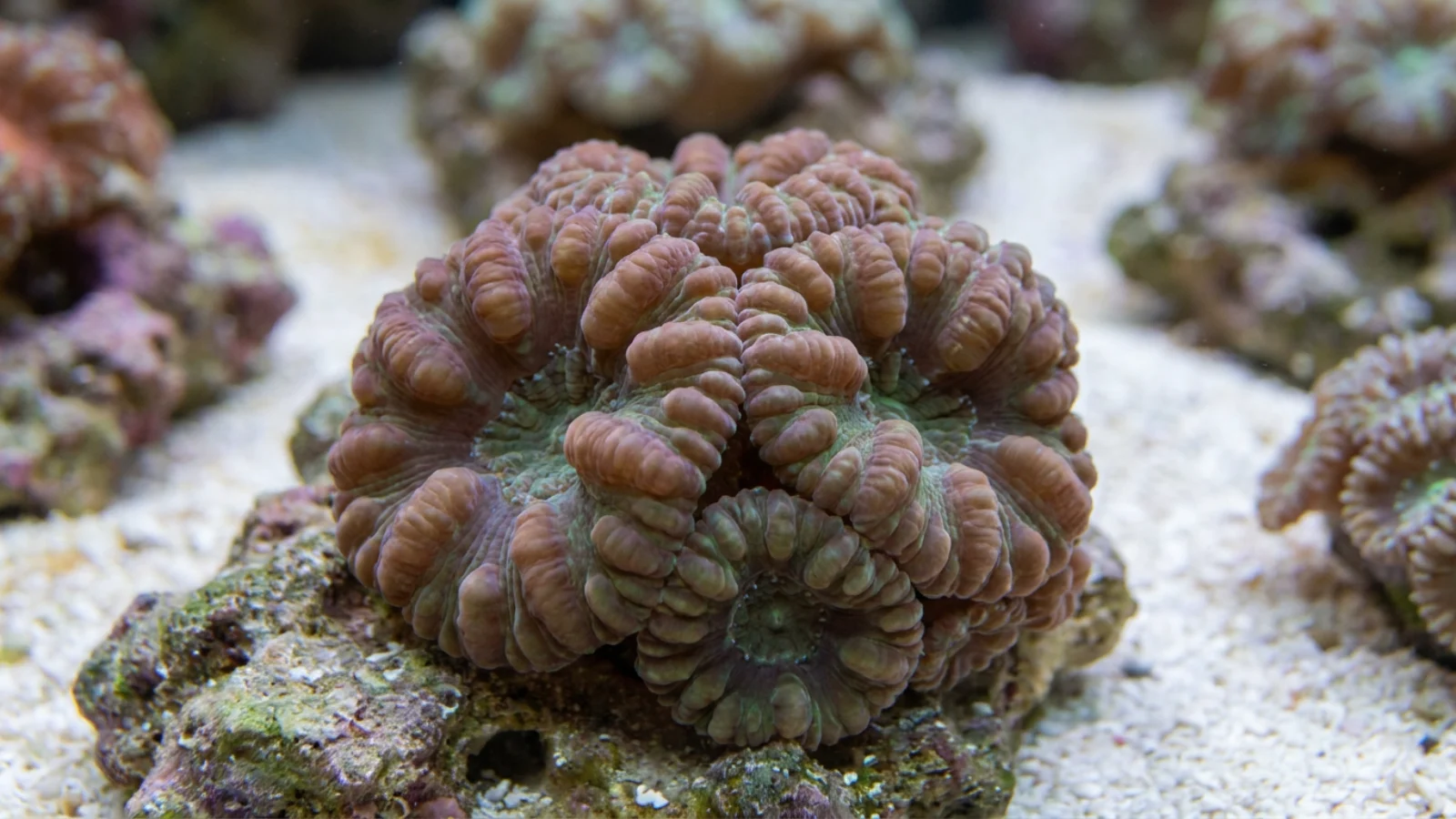
What does Blastomussa merleti look like?
Young B. merleti colonies start with corallites radiating from a common dome-shaped centre. As the colony grows, the corallites separate, so an older colony looks like a cluster of cloned individuals. Each corallite is under 7 mm across, with toothed septa in two cycles. Colours include dark red, pink, orange, brown and dark grey, often with a contrasting green oral disc. In the wild its polyps are usually extended only at night.
Where does Blastomussa live?
B. merleti ranges from the Red Sea and East Africa through the Indian Ocean to northern and western Australia, Japan, the East China Sea and the islands of the western Pacific, sharing that range with B. wellsi and B. loyae. It lives in many reef habitats, including steep slopes and crevices, down to about 50 m. It is moderately common, and the IUCN lists it as Least Concern, though numbers are probably falling with reef destruction.
A short history of the name
Blastomussa has been reclassified almost as often as it has been described. In 1961 the coral specialist Wells first placed its type species, B. merleti, in the genus Bantamia, which was then thought to be close to Galaxea because of its smooth septa and tufted, branching growth. When he examined new specimens with strongly lobed septa, he erected the genus Blastomussa and placed it in the family Mussidae, writing that its mussid affinity was scarcely to be doubted. He also noted that new corallites in Blastomussa form by budding outside the ring of tentacles, a trait that set it apart from other mussids.
In 1973 Wijsman-Best realized that some of the material Wells had studied belonged to a different species, which she named B. wellsi in his honor. Both B. merleti and B. wellsi were first described from New Caledonia. In 1978 Head described a third species, B. loyae, from the Red Sea; it was later merged with B. merleti, then formally reinstated as a separate species in 2011.
Molecular studies in the 2000s then showed that many traditional coral families did not reflect real evolutionary relationships. Blastomussa ended up among a handful of genera with no settled family, listed as incertae sedis, or of uncertain position. That is why older books and some current references still say its family is unclear.
The 2014 revision and the newest species
The most thorough study of the genus is a 2014 revision by F. Benzoni, R. Arrigoni, Z. Waheed, F. Stefani and B. W. Hoeksema, published in the Raffles Bulletin of Zoology. They re-examined type specimens and museum material and sampled new corals in New Caledonia, northern Papua New Guinea, Sabah, Brunei and the east coast of Peninsular Malaysia. DNA from both the nucleus and the mitochondria confirmed that Blastomussa is a natural group.
The study also produced a new species, B. vivida, named from the Latin for lively after its flashy, bright polyps. It had been confused with B. wellsi, but it grows as an encrusting coral with corallites packed tightly together in a honeycomb-like pattern, rather than as separate tubes, and its corallites are much larger, with more septa than any other species in the genus. The largest corallite among the type specimens was 2.8 cm across. In the field B. vivida can be solitary or form small colonies up to about 10 cm long, with fleshy polyps that are usually bright orange to red, sometimes green to brown with a contrasting mouth, or nearly black. Museum collections and published photographs extended its known range to Japan, Vietnam, Indonesia, the Philippines and Australia, so it appears to be widespread despite being described so recently. Genetically, it is the closest relative of B. wellsi.
The same study found that the only living species of another genus, Parasimplastrea, actually sits inside the Blastomussa family tree. It was therefore moved into the genus as Blastomussa omanensis, a species originally named from Oman.
How to tell the species apart
Separating blastos usually means looking at the skeleton, which is hidden in life by the fleshy mantle. The 2014 revision gave the key features:
B. merleti forms colonies of separate, tube-like corallites that are round to oval and about 5 to 7 mm across, with three cycles of septa. B. wellsi has the same separate-tube growth form, but its corallites are larger, about 8 to 13 mm across in the revision and 9 to 14 mm in other descriptions, with four cycles of septa and lobed septal margins. B. loyae forms encrusting colonies with corallites of about 5 to 8 mm that are fused into a honeycomb or partly honeycomb pattern, and its septa have smooth margins and stand well above the surface. B. omanensis is also encrusting, with irregularly polygonal corallites about 4 to 7 mm across. B. vivida is the giant of the genus, encrusting, with honeycomb-packed corallites that can reach a few centimeters.
In aquarium shops, these skeletal details are rarely visible. The practical rule is that a coral with small, separate, tube-like heads and night-opening polyps is probably B. merleti, while one with large, puffy polyps that hide the skeleton completely is usually sold as B. wellsi. Some brightly colored corals sold as wellsi may in fact be B. vivida.
Relatives: bubble corals and the family Plerogyridae
The 2014 study also looked beyond the genus. It found that Blastomussa forms a strongly supported group with Plerogyra, the bubble coral, Physogyra, the pearl or grape coral, and Nemenzophyllia, a genus with a single species. All have fleshy polyps with well-developed, expandable mantles. The authors suggested that these genera might form a new family, but said the skeletons needed closer study first.
That family now exists. Plerogyridae, formally named in 2020, includes Blastomussa, Nemenzophyllia, Physogyra and Plerogyra, and the World Register of Marine Species places Blastomussa in it. Complete mitochondrial genomes of Physogyra and Plerogyra published in 2022 placed them in the robust clade of stony corals, one of the two main branches of the reef-building corals. For aquarists, the link makes intuitive sense: blastos, bubble corals and grape corals are all grown for their fleshy, expandable tissue rather than their skeletons.
Two more species: omanensis and angularis
B. omanensis has a narrow, mostly Arabian range. It has been recorded from the northern Gulf of Aden, the Arabian Sea and Mauritius, and its holotype was collected in the Dhofar region of Oman at about 7 m. It lives in the same protected habitats as B. merleti and can grow alongside it. Unusually for the genus, the 2014 authors noted that its colors are remarkably consistent from colony to colony.
The newest name in the genus is B. angularis, described by T. Mondal and C. Raghunathan from Lakshadweep, the coral atolls off southwest India. A version first circulated as a preprint in 2021 and the formal description appeared in 2026 in the Journal of the Marine Biological Association of the United Kingdom. The authors separate it by its angular corallites, corallite diameter, the number and arrangement of its septa, its strongly projecting septa, the structure of the central columella and an extra septum-like projection from the base. They compare it most closely with B. loyae, B. omanensis and the fossil species B. simplicitexta. As a recent description based on skeletal features alone, it has not yet been tested with genetic data.
Habitat and the wild life of a blasto
In the wild, blastos are corals of quiet water. B. merleti lives in a range of reef habitats, including steep slopes and crevices, down to about 50 m. B. omanensis shares its protected habitats, and B. vivida was found in semi-protected to protected settings, often on hard surfaces covered with a film of sediment. Their fleshy tissue and modest size suit them to shaded and sheltered spots where faster-growing branching corals do poorly.
Like most reef corals, blastos host symbiotic algae, zooxanthellae, in their tissues. The algae provide most of the coral’s food through photosynthesis, while the polyps capture zooplankton with their tentacles and absorb dissolved organic matter from the water. That mixed diet helps explain why blastos do well in lower light than many stony corals.
B. wellsi is a hermaphrodite that releases eggs and sperm into the water, where fertilization takes place. The resulting larvae, called planulae, drift in the plankton before settling and changing into the first polyp, which then builds a skeleton and buds to form a colony. In Blastomussa, new polyps bud off outside the tentacle ring of the parent, which is why colonies look like clusters of separate heads.
Day and night: reading a blasto’s tissue
Much of what makes a blasto recognizable is soft tissue rather than skeleton. In the genus, the polyp’s mantle, the fleshy sheet of tissue that can spread over and beyond the corallite wall, is well developed and expandable. In the field descriptions of the 2014 revision, the tentacles are typically pulled in toward the mouth during the day while the mantle is expanded, so a colony by daylight looks like a cluster of smooth, colored cushions. The surface of the mantle can be smooth or covered in rugged vesicles, small blister-like swellings, depending on the species.
B. merleti behaves differently from the aquarium favorite. Its polyps are extended mainly at night, and colonies come in dark red, pink, orange, brown or dark gray, often with a contrasting green oral disc. In B. wellsi, the mantle reaches over the corallite wall and hides the skeleton, and colors include dark red, green, gray or blue, again often with a contrasting mouth. This difference in how much skeleton shows is the quickest clue in a shop tank, where the coral cannot be removed and examined.
When Wells first studied the genus he compared the toothed septa of B. merleti with those of Cynarina, the button or doughnut coral, which is one reason he put Blastomussa among the mussids. The DNA results now place the two in different parts of the coral tree, a reminder that similar-looking skeletons do not always mean close relationship.
Where the specimens came from
The specimens behind the 2014 revision give a sense of where blastos live. B. merleti material came from several sites in New Caledonia, collected at about 12 to 25 m during French research expeditions, and from Australia, including the Murray Islands in Torres Strait at 2 to 27 m, the Palm Islands off Queensland at 15 to 20 m and Newcastle in New South Wales, far to the south. B. omanensis came from Oman and from Balhaf in the Gulf of Aden off Yemen, where one colony was collected at 14 m. B. vivida was sampled in New Caledonia, Papua New Guinea, Malaysia and Brunei, with additional records from museum collections in Japan, Indonesia and elsewhere.
The genus also has a fossil member, B. simplicitexta, described by Umbgrove in 1942, which the authors of B. angularis used as one of their points of comparison. Its presence in the fossil record shows that the lineage is not a recent arrival, even if most of its living species were only sorted out in the last two decades.
The aquarium trade and conservation
The bright, fleshy mantles that make blastos popular in reef tanks have also made them targets for commercial collection. The 2014 revision noted that the genus is increasingly harvested for the aquarium trade. Indonesia alone exported 3,800 live pieces of B. wellsi in 2005.
Conservation assessments differ by species. The IUCN lists B. merleti as Least Concern, describing it as moderately common and widespread, with a population trend that is unknown but probably declining as reefs are degraded. B. wellsi is uncommon and listed as Near Threatened, with collection for the trade added to habitat loss. B. vivida has also now been assessed for the IUCN Red List. Because several species were confused with one another until recently, older trade and survey records under the name wellsi may include more than one species, which makes it harder to judge how heavily each one is collected.
Choosing captive-grown frags where they are available, rather than wild-collected colonies, reduces pressure on wild reefs. The revision also has a practical side for reef keepers: a label such as “wellsi” on a shop tank is a trade name as much as a scientific one, and a coral with unusually large, honeycomb-packed heads and very bright tissue may be B. vivida. Recording where a colony came from, and photographing it with the mantle both expanded and retracted, makes it far easier for anyone to identify it later.
How do you care for Blastomussa?
How fast does Blastomussa grow?
Slowly to moderately. A well-fed colony adds new heads by budding, and growth accelerates under regular feeding. Our Blastomussa growth rate page covers what to expect, and Blastomussa placement covers light and flow positions in detail. Full care notes are in Blastomussa care.
Is Blastomussa aggressive?
Hardly. Blastomussa is one of the most peaceful LPS corals. It has short tentacles and is more likely to be stung than to sting. Keep it away from torch, Galaxea and other corals with long sweepers.
Is Blastomussa easy to keep?
Yes. It is one of the easiest LPS corals, tolerating low light and low flow.
What is the difference between Blastomussa merleti and wellsi?
Merleti has small corallites under 7 mm; wellsi has larger, puffier polyps that hide the skeleton.
Does Blastomussa need to be fed?
It does not strictly need feeding but grows faster when fed.
Is Blastomussa aggressive?
No, it is one of the most peaceful LPS.
How much light does Blastomussa need?
Low to moderate light.
Why is my Blastomussa shrinking?
Common causes are too much light or flow, or a neighbouring coral stinging it.
Can Blastomussa be fragged?
Yes; individual heads can be cut apart at the skeleton.
Is Blastomussa endangered?
B. merleti is listed as Least Concern by the IUCN.
- World Register of Marine Species: Blastomussa; accepted species, family Plerogyridae.
- Wikipedia: Blastomussa merleti; corallite size, depth, range and IUCN status.
- Benzoni, F., Arrigoni, R., Waheed, Z., Stefani, F. & Hoeksema, B. W. (2014). Phylogenetic relationships and revision of the genus Blastomussa with description of a new species. Raffles Bulletin of Zoology 62: 358–378.
- Mondal, T. & Raghunathan, C. (2026). Description of Blastomussa angularis sp. nov. from Lakshadweep, India. Journal of the Marine Biological Association of the UK (preprint 2021).
- Tian, P. et al. (2022). Complete mitochondrial genomes of Physogyra lichtensteini and Plerogyra sinuosa (Plerogyridae). ZooKeys 1114.
- Wikipedia: Blastomussa wellsi (corallite size, reproduction, IUCN Near Threatened, Indonesian exports); Plerogyridae.
- IUCN Red List: Blastomussa vivida assessment.
Blane Perun has been exploring Earth’s oceans and marine life for over 25 years. Founder of TheSea.Org in 1999, underwater photographer, coral aquaculture pioneer, and explorer of 80+ countries.
About Blane Perun →