Large-Polyp Stony Corals — Big Polyps, Hard Skeletons, Endless Variety
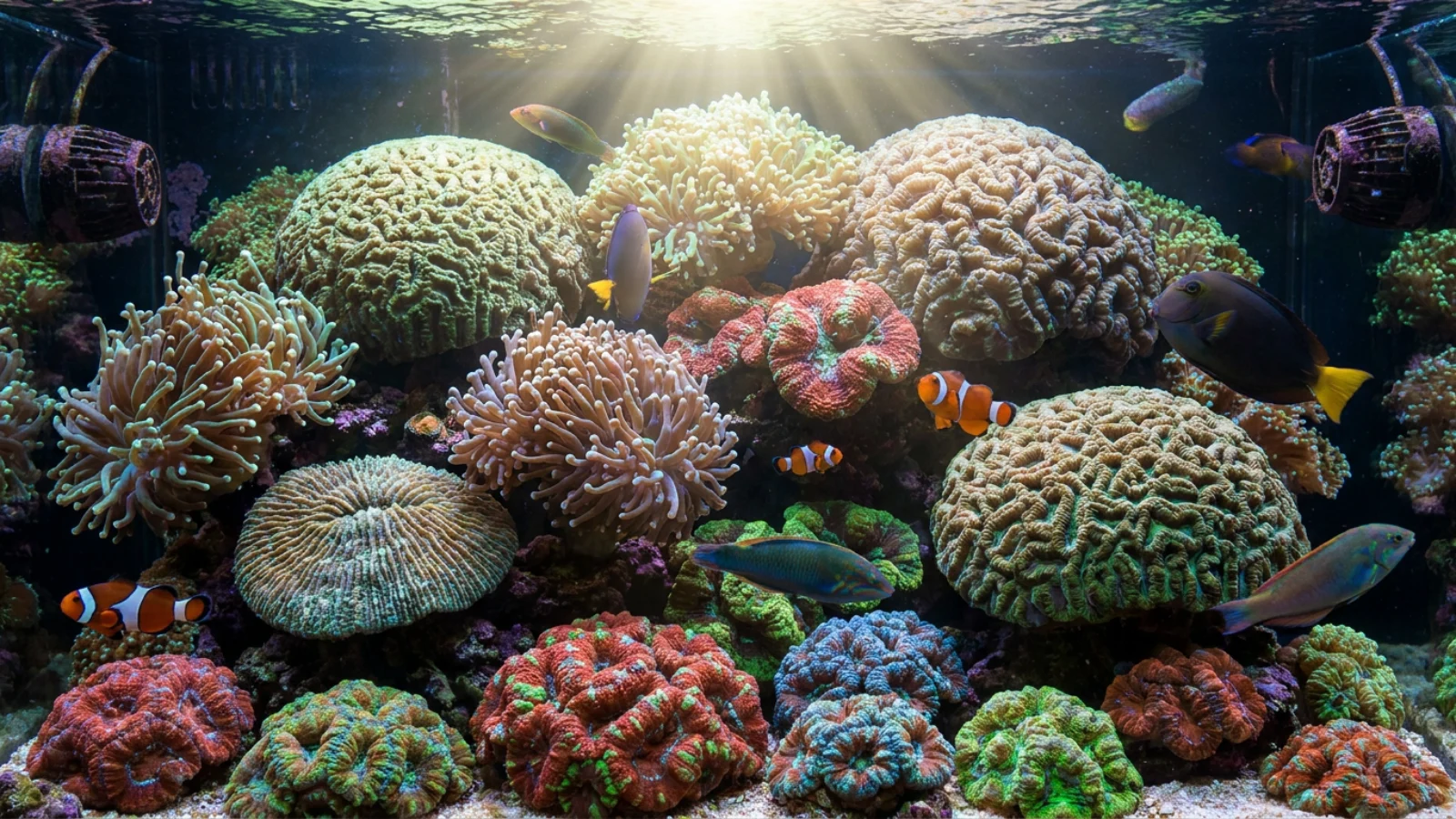
Large-polyp stony corals, or LPS, are hard corals whose individual polyps are big and fleshy, from a few millimetres up to the dinner-plate-sized single polyp of a free-living Fungia-type coral. They build a limestone skeleton like every reef-building coral, but you see the animal far more than the skeleton.
“LPS” is an aquarium-trade label, not a scientific one. Taxonomists sort stony corals by skeleton detail and DNA, and the LPS group cuts across several families: Euphylliidae (torch, hammer, frogspawn, Galaxea), Merulinidae (most brain corals, Favites, Platygyra, Echinopora, Mycedium), Lobophylliidae (Lobophyllia, Acanthastrea-type “acans”), Fungiidae (plate and disc corals), Dendrophylliidae (Duncanopsammia, sun corals) and others. The opposite hobby label, small-polyp stony (SPS) corals, covers fine-polyped genera like Acropora and Montipora.
What are LPS corals?
Every stony coral is a colony (or occasionally a single giant polyp) of cnidarian animals related to sea anemones. Each polyp sits in a cup in the skeleton called a corallite, has a ring of stinging tentacles around a central mouth, and houses single-celled algae, zooxanthellae, in its tissue. LPS corals simply have large corallites and thick tissue, so they look soft and fleshy even though there is solid stone underneath. Touch one roughly and you will tear the tissue on its own skeleton, which is why handling and placement matter so much.
What are the main types of LPS corals?
| Group | Example genera | Look | Typical aquarium demand |
|---|---|---|---|
| Euphylliids | torch, hammer, frogspawn, Galaxea | Long flowing tentacles | Moderate; strong sweepers |
| Brain corals | Platygyra, Favia, Favites, Goniastrea | Massive domes, valleys or honeycomb | Easy to moderate |
| Bubble corals | Plerogyra | Grape-like vesicles by day | Easy to moderate |
| Lobophylliids | Lobophyllia, Acanthastrea, Blastomussa | Fleshy, colourful heads | Easy |
| Plate and disc | Fungia, plate corals | Free-living single polyp | Easy; keep on sand |
| Foliose | Mycedium, Echinopora | Plates and scrolls | Moderate |
| Branching LPS | Caulastrea, Duncan | Polyps on stalks | Easy |
| Flowerpot types | Goniopora, Alveopora | Long daisy-like polyps | Moderate to hard |
| Non-photosynthetic | Tubastraea (sun coral) | Orange cups, no algae | Hard; daily feeding |
How do LPS corals feed?
Most LPS corals run on two engines. By day their zooxanthellae photosynthesise and pass sugars to the coral; this is the bulk of the energy budget for most species. At night, and in many species also by day, the polyps extend tentacles or feeding tentacles to catch zooplankton, and the mouth can take surprisingly large prey. That is why LPS respond so well to target feeding with mysis or small pellet foods. A few genera, notably Tubastraea sun corals, have no zooxanthellae at all and must be fed. Background on the symbiosis is in why zooxanthellae matter to corals.
Why do LPS family names keep changing?
For most of the twentieth century corals were classified by the shape of their skeletons. In the scheme summarised by Charlie Veron in 2000, stony corals were divided into 18 families, and many familiar LPS sat comfortably in groups such as Euphylliidae, Faviidae, Mussidae and Caryophylliidae. DNA studies then showed that many of those families were artificial: stony corals fall into two deep lineages, informally the “complex” and “robust” clades, and genera that look alike are sometimes only distantly related. A 2017 molecular study of Euphyllia noted that most traditional coral families and many genera had turned out to be paraphyletic, which is why the old frogspawn species are now split between Euphyllia and Fimbriaphyllia.
Bubble corals are a good example. Plerogyra was long filed under Euphylliidae with the torch and hammer corals, but molecular work showed it belonged elsewhere. In 2020 it was placed with the pearl bubble coral Physogyra, the aquarium favourite Blastomussa and the little-known Nemenzophyllia in a new family, Plerogyridae; a 2022 study of complete mitochondrial genomes placed that family in the robust clade. Many brain corals once in Faviidae and Mussidae have likewise been moved to Merulinidae and Lobophylliidae. For hobbyists the practical point is that “LPS” is a description of what a coral looks like and how it is kept, not a statement about its relatives. Our Plerogyra article follows one genus through these changes.
How do LPS corals adjust to light?
Big, fleshy tissue lets many LPS change shape with conditions. The bubble coral is the clearest case. A 1982 study in Marine Ecology Progress Series found that its daytime bubbles held about 2,300 symbiotic algae per square millimetre of cross-section but only about 140 stinging cells, while its night-time tentacles held about 760 algae and 1,600 stinging cells. The bubbles inflated to as much as 45 millimetres across in dim light and contracted in bright light, and measurements on the reef showed high photosynthetic activity in them. The authors described them as photosynthetic organs that let the coral compete across a wide range of light levels. Many other LPS similarly expand their tissue by day and switch to feeding tentacles at night, which is why the same coral can look completely different at noon and at midnight. It also explains a common aquarium mistake: a coral moved suddenly from dim to bright light may retract and look unhealthy for days, not because it is dying but because it is adjusting the amount of tissue, and algae, it exposes. Acclimating new LPS by starting them low and moving them up gradually lets them make that adjustment without bleaching.
Which LPS corals live alone and can move?
Not every LPS is a colony fixed to the reef. The mushroom or plate corals of the family Fungiidae, which has thirteen living genera, include solitary species that start life attached to rock and break free as they grow. Fungia fungites can reach about 30 centimetres across, and the long-tentacled Heliofungia actiniformis up to about 20 centimetres, each essentially one giant polyp. Most species stay detached as adults and are capable of slow movement over the bottom. The genus Fungia itself is a good example of how coral taxonomy has shifted: until 2015 it held more than 30 species, but after recent studies it was reduced to a single species. In aquariums, free-living fungiids should be kept on sand rather than wedged into rockwork.
How do LPS corals fight?
Big polyps mean big weapons. Many LPS grow sweeper tentacles, extra-long tentacles packed with stinging cells, that can reach several centimetres (in torch and Galaxea often 10 cm or more) to sting anything nearby. Others, such as brain and Lobophyllia heads, extrude mesenterial filaments from the mouth to digest a neighbour’s tissue directly. In a tank the practical rule is simple: give LPS more space than looks necessary, and check at night, when the sweepers come out.
How do you keep LPS corals in a reef tank?
Are LPS corals endangered?
Some are. Reef-building corals as a group are among the most threatened animals assessed by the IUCN, mainly because of heat-driven bleaching, disease and reef loss. A 2012 analysis covering all 837 living reef coral species estimated that about one-third of reef-building corals are threatened with extinction. Individual assessments shift as data improve: the branching frogspawn Fimbriaphyllia paradivisa was improved from Vulnerable to Least Concern on the IUCN Red List in 2024, yet the US National Oceanic and Atmospheric Administration has stated there is “a risk of extinction within the foreseeable future” for the species, which is listed under the US Endangered Species Act. Choosing aquacultured frags over wild colonies reduces pressure on reefs; see coral aquaculture.
What does LPS coral stand for?
Large-polyp stony coral: a hobby term for hard corals with large, fleshy polyps.
Are LPS corals good for beginners?
Many are. Duncans, candy cane, Blastomussa and most brain corals are forgiving once a tank is stable.
What is the difference between LPS and SPS corals?
LPS have large fleshy polyps and usually want moderate light and gentle flow; SPS have tiny polyps and usually want strong light, strong flow and very stable water.
Do LPS corals need to be fed?
Most benefit from feeding but get much of their energy from light. Sun corals have no algae and must be fed.
How much light do LPS corals need?
Moderate reef lighting suits most; acclimate gradually.
Can different LPS corals touch?
Avoid it. Sweeper tentacles and digestive filaments will damage neighbours.
Why is my LPS coral not opening?
Common causes are changes in light, flow, alkalinity or temperature, pests, or recent handling.
Are LPS corals endangered?
Some species are listed as threatened; coral reefs as a whole face serious decline.
- Veron, J.E.N. (2000). Corals of the World. Australian Institute of Marine Science.
- World Register of Marine Species (WoRMS): Scleractinia family classifications.
- Wikipedia: Fimbriaphyllia and Fimbriaphyllia paradivisa (ESA and IUCN status).
- Borneman, E. (2001). Aquarium Corals. TFH Publications.
- A scleractinian coral (Plerogyra sinuosa) with “photosynthetic organs” (1982). Marine Ecology Progress Series 7: 273–278.
- Luzon, K.S. et al. (2017). Molecular phylogeny of Euphyllia and Fimbriaphyllia. PeerJ 5: e4074; Tian, P. et al. (2022). Mitogenomes of Physogyra and Plerogyra. ZooKeys 1114.
- Huang, D. (2012). Threatened reef corals of the world. PLOS ONE 7: e34459.
- Wikipedia: Fungiidae, Fungia and Heliofungia actiniformis (accessed November 2026).
Blane Perun has been exploring Earth’s oceans and marine life for over 25 years. Founder of TheSea.Org in 1999, underwater photographer, coral aquaculture pioneer, and explorer of 80+ countries.
About Blane Perun →