Euphyllia — The Torch, Hammer and Frogspawn Family Tree
Euphyllia is a genus of large-polyp stony corals in the family Euphylliidae, best known in the reef hobby for the torch coral (Euphyllia glabrescens). Until recently the name also covered the hammer and frogspawn corals, but genetic work moved those into their own genus, Fimbriaphyllia, so most shop labels that say “Euphyllia” now span two genera.
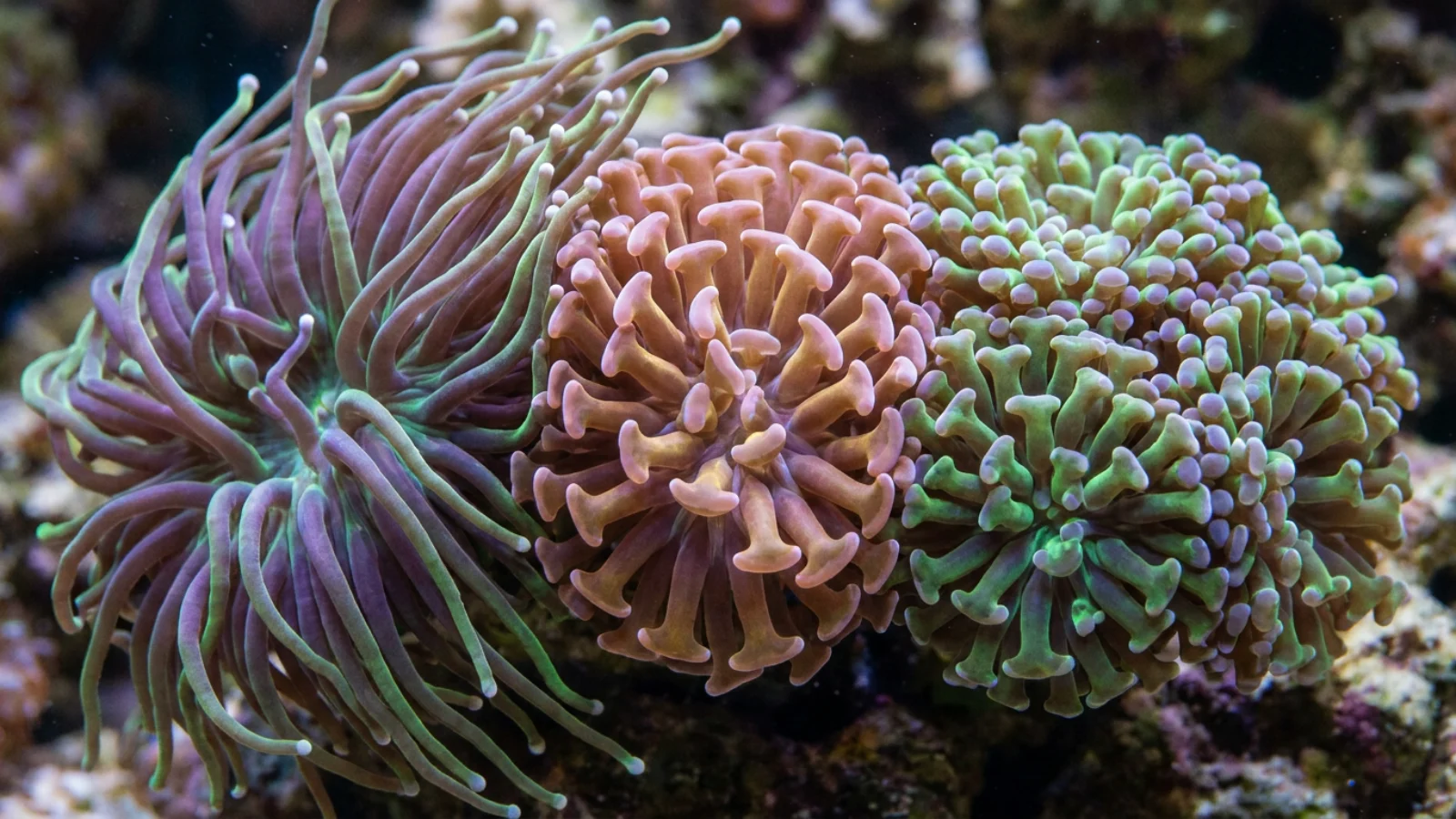
All of them share the same basic plan: a stony skeleton of tall, thin-walled corallites hidden under big, fleshy, tubular tentacles that stay extended day and night. The shape of the tentacle tips, together with the way the skeleton grows, is what tells them apart. This page covers the genus as a whole, how its species are classified and identified, what is known of their biology in the wild, and how they fare in aquariums; the commonest species have their own pages on torch coral and hammer coral.
What corals are in the Euphyllia genus?
The World Register of Marine Species currently accepts five species in Euphyllia proper: the torch coral E. glabrescens (Chamisso & Eysenhardt, 1821), the grape coral E. cristata Chevalier, 1971, E. paraglabrescens Veron, 1990, E. baliensis Turak, DeVantier & Erdmann, 2012, and E. grandiseptata Latypov, 2014. It accepts five more in Fimbriaphyllia: F. ancora (hammer or anchor coral), F. divisa (frogspawn), F. paradivisa (branching frogspawn), F. paraancora (branching hammer) and F. yaeyamaensis. The genus Euphyllia itself dates to the American naturalist James Dwight Dana in 1846, and the register lists dozens of older names that are now treated as synonyms, doubtful names or species needing further study, a sign of how variable these corals look.
| Coral | Current name | Tentacle tips | Skeleton |
|---|---|---|---|
| Torch | Euphyllia glabrescens | Round knob, often contrasting colour | Branching (phaceloid) |
| Grape | Euphyllia cristata | Small rounded tips | Branching |
| Bali species | Euphyllia baliensis | Anchor-, kidney- or hammer-shaped | Branching, very small corallites |
| Hammer, wall | Fimbriaphyllia ancora | T- or boomerang-shaped | Wall (flabello-meandroid) |
| Hammer, branching | Fimbriaphyllia paraancora | T-shaped | Branching |
| Frogspawn, wall | Fimbriaphyllia divisa | Branched, many small knobs | Wall |
| Frogspawn, branching | Fimbriaphyllia paradivisa | Branched, many small knobs | Branching |
Why were hammer and frogspawn moved to Fimbriaphyllia?
Because their DNA showed they are not each other’s closest relatives. Coral classification was built on the skeleton, and Euphyllia had long been split into two subgenera, Euphyllia and Fimbriaphyllia, on the basis of colony structure. In 2017 Luzon and colleagues published a study in PeerJ that sequenced three genes, cytochrome oxidase 1, cytochrome b and β-tubulin, from 36 colonies representing six Euphyllia species and a related coral, Galaxea fascicularis. The torch coral formed a group on its own. The hammer, frogspawn, branching hammer, branching frogspawn and yaeyamaensis clustered together and shared an ancestor with Galaxea rather than with the torch coral. Because the old subgenera matched those two groups, the authors raised Fimbriaphyllia to a full genus.
The study made two other useful points. It found that one end of the cytochrome oxidase 1 gene could tell the morphological species apart, which matters for corals whose tentacles and skeletons vary so much that misidentification is common. And it argued that features other than the skeleton, such as polyp shape and reproductive traits, had been underused in coral classification. You will still see “Euphyllia ancora” and “Euphyllia divisa” on frag labels and in older books; they refer to the same animals as Fimbriaphyllia ancora and F. divisa.
Which other corals are related to Euphyllia?
The family Euphylliidae was named by Henri Milne Edwards and Jules Haime in 1857, and its corals were originally grouped with the Caryophylliidae. It is a family of zooxanthellate stony corals, and the World Register of Marine Species has listed seven genera in it: Ctenella, Euphyllia, Fimbriaphyllia, Galaxea, Gyrosmilia, Montigyra and Simplastrea. Most are little known outside specialist literature, but Galaxea, the galaxy or star coral, is a familiar reef coral, and the 2017 genetic study found that hammer and frogspawn corals share a common ancestor with it rather than with the torch coral. Despite their very different appearance, then, a frogspawn colony may be closer kin to Galaxea than to the torch coral sold beside it.
The reef hobby often lumps another large-polyp coral, the elegance coral Catalaphyllia jardinei, in with Euphyllia. It was first described by William Saville-Kent in 1893 and is a single-species genus from the western Pacific, with very large polyps, long tendrils and a fleshy oral disc, often fluorescent green. Some of its synonyms, such as Euphyllia picteti, show how easily these big-polyped corals have been confused. It has been listed as Vulnerable by the IUCN and described as overexploited by wild collection for the aquarium trade, a useful warning of what can happen to a showy coral when collection outpaces aquaculture.
The torch coral itself has a long naming history. It was first described in 1821 by Chamisso and Eysenhardt as Caryophyllia glabrescens, and over the following two centuries it acquired a string of synonyms, including Caryophyllia angulosa, Euphyllia costulata and even Catalaphyllia okinawaensis, as different authors described variants of the same animal under new names. The hammer and frogspawn corals are much younger names, described by Veron and Pichon in 1980, with the branching forms paraancora and paradivisa added by Veron in 1990.
What does a Euphyllia skeleton look like?
Euphylliid corals have unusually tall corallites, the cup-like skeletal tubes that each polyp sits in, reaching up to about 150 mm, with diameters anywhere from about 1 to 40 mm. They grow either singly or in rows, rising separately from an encrusting base. Colonies are phaceloid, meaning separate branches each topped by a polyp, or meandroid and flabello-meandroid, meaning continuous curving walls with many mouths along them. The radiating plates inside each corallite, called septa, are numerous and large, and the bigger ones project as much as 10 mm above the wall. Their edges are smooth and unornamented, and the walls are thin and sharp. Because the skeleton is buried under thick tissue in life, most divers never see it, but a dead or bleached colony shows the structure clearly.
The torch coral is a good example of the branching form. Its corallites are about 20 to 30 mm across and spaced 15 to 30 mm apart, each at the tip of a separate branch. The hammer coral is the classic wall form: its colonies can be flabelloid, phaceloid or flabello-meandroid, usually no more than a metre across, though some reach several metres.
Colour varies widely within each species, which is one reason the hobby trades so many named colour morphs. Some hammer corals show partial or full green fluorescence from fluorescent proteins in their tissue, a trait aquarists prize. Colour alone, however, says nothing reliable about species; tentacle tips and skeleton do.
How do you identify a Euphyllia coral?
Look at the tentacle tips first. Torch tentacles end in a single rounded knob, often in a contrasting colour, so that green tentacles may have yellow tips or beige ones white. Hammer tentacles end in a T, crescent or boomerang shape, and the colonies range from blue-grey to orange, sometimes with green on the tentacles. Frogspawn tentacles split into clusters of small round tips that look like a mass of eggs. Then look at the skeleton: wall forms grow as continuous ridges, while branching forms carry one polyp head per branch. The branching frogspawn, F. paradivisa, is often mistaken for the wall frogspawn, F. divisa; the tentacles look alike, and only the tree-like branching skeleton separates them.
Tentacle shape is not foolproof. Euphyllia baliensis, described in 2012 from 10 specimens collected at 27 to 37 m off the central eastern coast of Bali, has tentacles that are anchor-, kidney- or hammer-shaped at their tips, sometimes with small extra bulbs that look like mittens. It nonetheless sits in Euphyllia, set apart by its very small corallites, averaging just 3 mm across, its short, thin, lightly calcified branches and an unusual arrangement of four or eight primary and secondary septa. Its tentacles are dull to dark reddish-brown with lime-green bases and cream tips. As of its description it had not been reported anywhere else, a reminder that even well-studied coral groups can still yield new species.
Where do Euphyllia corals live?
Across the tropical Indo-Pacific. The torch coral is widespread but patchy: it is rare in the Red Sea and Gulf of Aden and uncommon through the northern Indian Ocean, the Persian Gulf, Southeast Asia, Australia, southern Japan, the East China Sea, Micronesia and American Samoa, at depths of about 1 to 35 m in a wide range of reef settings. The hammer coral ranges from the Maldives to the Solomon Islands, with a large presence in Indonesia. The frogspawn is found from Australia and Southeast Asia to the Ryukyu Islands, the Solomon Islands, Fiji and Palau. The branching frogspawn prefers places protected from surface waves, such as fringing reef crests, mid-slope terraces and lagoons, at depths of 2 to 25 m.
The common thread is shelter. Big, soft, inflated tentacles are vulnerable to being torn in heavy surge, and Euphyllia-type corals are generally found in calmer water on reef slopes and in lagoons, often where the water is somewhat turbid. Like most reef-building corals they host symbiotic algae, zooxanthellae, which supply much of their energy through photosynthesis, and they also catch zooplankton and other small prey with their tentacles.
Are Euphyllia corals aggressive?
Yes. The torch coral takes its common name from its long sweeper tentacles, tipped with powerful stinging cells, which it extends to attack neighbouring corals that grow too close. All Euphyllia-type corals carry potent stinging cells and will damage corals of other genera that they touch. Reef aquarists generally find that hammer, frogspawn and torch colonies tolerate each other better than they tolerate unrelated corals, but that is a tendency rather than a rule, and torch corals are the least tolerant. The 2017 genetic split adds a twist: torch corals are not as closely related to hammer and frogspawn as their shared name once implied.
How do Euphyllia corals reproduce?
The best-studied species is the hammer coral. In Taiwan, Fimbriaphyllia ancora is gonochoristic, meaning each colony is either male or female, and it spawns in late spring by releasing eggs and sperm into the water for external fertilisation. It takes part in mass spawning, the synchronised release of gametes by many coral species on the same evening, and its main spawning nights fall on the third and sixth nights after the full moon, during neap tides. Before spawning, the gametes gather beneath the oral disc of the polyp.
Development after fertilisation is fast. Cleavage begins within one or two hours. Ciliated larvae form 14 to 24 hours after fertilisation, and a mouth and pharynx develop at about 24 hours. Between 24 and 36 hours a gut cavity forms, and the larvae become elongated and increasingly active swimmers. They begin searching the seabed for a place to settle three to seven days after fertilisation. In aquariums, branching Euphyllia are propagated by fragmentation: each head can be cut or snapped off at its base and grown on as a new colony, which is how most captive-bred frags are produced.
How do you care for Euphyllia in a reef tank?
Euphyllia are popular because they are showy and, once settled, fairly forgiving. Hobbyists generally give them moderate light and moderate, indirect water flow: enough to make the tentacles sway, not enough to whip them flat. Very strong light or flow can make the tentacles retract. Stable alkalinity, calcium and magnesium matter more than any particular target number, because sudden swings are a common trigger for tissue loss. They do not strictly need feeding, since their zooxanthellae supply much of their energy, but they catch zooplankton in the wild, and occasional small meaty foods are widely used to support growth.
Two problems deserve special attention. The first is the Euphyllia-eating flatworm, a small pest that feeds on the tissue of these corals; new colonies should be inspected and dipped before they go into a display. See Euphyllia-eating flatworm. The second is brown jelly disease, a brown, slimy mass that can spread rapidly across stressed colonies. Aquarists usually remove an affected head from a branching colony and look for the underlying stress, such as poor water quality, injury or temperature swings. Give every Euphyllia room to extend its sweepers without reaching other corals.
Are Euphyllia corals endangered?
Not at present, on the IUCN’s most recent assessments. The torch coral is now listed as Least Concern, with a 2024 Red List entry replacing an older assessment that had placed it as Near Threatened. The branching frogspawn, F. paradivisa, was previously listed as Vulnerable and had its status improved to Least Concern in 2024. In the United States, however, F. paradivisa was one of 15 Indo-Pacific reef corals listed under the Endangered Species Act in 2014, and a NOAA Fisheries five-year review posted in April 2024 concluded that no change to the listing status of those 15 species was warranted.
The pressures are real even where the label is reassuring. Zooxanthellate corals live close to the upper limit of their thermal tolerance and become stressed when water is 1 to 2 °C above normal, and tropical seas have warmed by almost 1 °C over the past century, so bleaching is a growing threat. Reef habitat is also degraded in many areas. Collection is a further pressure: in 2005, Indonesia and Fiji had annual export quotas for wild torch coral of 28,000 and 6,000 pieces respectively. Aquacultured frags of torch, hammer and frogspawn are now widely available, and buying them rather than wild colonies is the lower-impact choice.
Is Euphyllia a hard or soft coral?
Hard. It is a large-polyp stony coral with a calcium carbonate skeleton under its fleshy tentacles.
Is hammer coral still a Euphyllia?
Scientifically it is now Fimbriaphyllia ancora, after a 2017 genetic study; the old name is still widely used in the hobby.
How many Euphyllia species are there?
WoRMS accepts five species in Euphyllia (including torch and grape coral) and five in Fimbriaphyllia (hammer, frogspawn and relatives).
Can torch, hammer and frogspawn touch?
They often tolerate each other better than unrelated corals, but torch corals can still sting; give them space.
Do Euphyllia corals need to be fed?
Not strictly, since their zooxanthellae supply much of their energy, but they catch zooplankton and occasional small meaty feeds are widely used.
Where do Euphyllia come from?
The tropical Indo-Pacific, including the Red Sea, mostly from sheltered reef slopes and lagoons; torch coral occurs at about 1 to 35 m.
Is torch coral endangered?
No. The IUCN now lists it as Least Concern, though bleaching, reef damage and collection are pressures.
- Luzon K.S., Lin M.-F., Ablan Lagman M.C. et al. (2017). Resurrecting a subgenus to genus: molecular phylogeny of Euphyllia and Fimbriaphyllia. PeerJ 5:e4074. doi:10.7717/peerj.4074
- Turak E., DeVantier L. & Erdmann M. (2012). Euphyllia baliensis sp. nov., a new species of reef coral from Indonesia. Zootaxa 3422. doi:10.11646/zootaxa.3422.1.3
- World Register of Marine Species. Euphyllia Dana, 1846 and Fimbriaphyllia: accepted species (accessed November 2026).
- NOAA Fisheries (2024). 5-year review: 15 Indo-Pacific reef-building coral species.
- IUCN Red List. Euphyllia glabrescens; Fimbriaphyllia paradivisa.
- Wikipedia. Euphylliidae; Euphyllia glabrescens; Fimbriaphyllia ancora; F. divisa; F. paradivisa.
Blane Perun has been exploring Earth’s oceans and marine life for over 25 years. Founder of TheSea.Org in 1999, underwater photographer, coral aquaculture pioneer, and explorer of 80+ countries.
About Blane Perun →