Why Do Coral Reefs Have Such High Productivity? — An Oasis in a Watery Desert
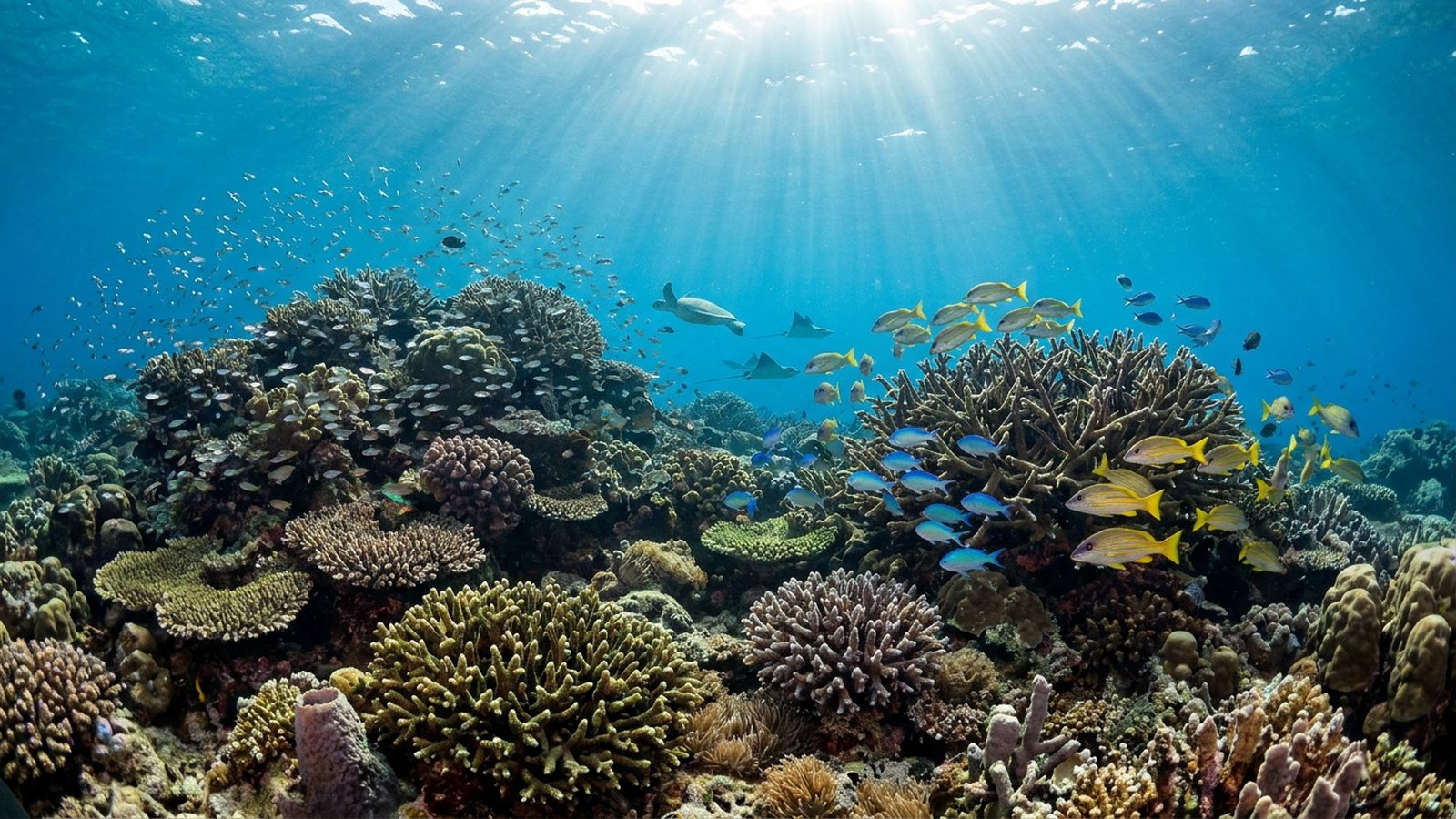
Coral reefs are highly productive because they make food on-site and waste almost none of it. Reef-building corals host symbiotic algae (zooxanthellae) that turn abundant tropical sunlight into sugars inside the coral’s own tissue, while turf algae, seaweeds, coralline algae and cyanobacteria add more production. Nutrients are scarce in tropical water, so reefs survive by recycling them tightly — between corals and their algae, through sponges and microbes, and via fish waste — instead of losing them to the open sea. Nitrogen-fixing microbes add new nutrients, constant water flow delivers plankton, and a complex structure packs many organisms into a small space. The result is an oasis of life in otherwise nutrient-poor, “desert-like” tropical ocean.
When Charles Darwin sailed among the coral atolls of the Indian and Pacific Oceans, he was struck by a puzzle. The water around the reefs was crystal clear — a sign that it held very little plankton or nutrients — yet the reefs themselves teemed with life. How could such a rich ecosystem thrive in such poor water? The puzzle became known as Darwin’s paradox, and the answer reveals how cleverly reefs work. This guide explains what “productivity” means, why reefs have so much of it and why that productivity is so easily disrupted.
What productivity means on a reef
In ecology, productivity is the rate at which an ecosystem captures energy and turns it into living matter. Reefs rank among the most productive ecosystems in the ocean.
Primary productivity is the amount of organic matter made by photosynthesis — by algae, seagrasses and the zooxanthellae inside corals. Gross productivity is the total made; net productivity is what is left after the producers’ own respiration. On coral reefs, gross primary productivity is very high, comparable to some of the most productive ecosystems on land. Much of that production is used up within the reef itself, feeding a dense web of animals, which is why the reef supports so much life per square metre.
The open tropical ocean, by contrast, has low productivity. Warm surface water sits on top of colder, nutrient-rich deep water and does not mix with it easily, so nutrients near the surface are quickly used up and stay scarce. That is why tropical seas are so clear and blue — and why a productive reef in the middle of them is so remarkable.
Symbiosis: food made on-site
The heart of reef productivity is the partnership between corals and microscopic algae that live inside them.
Each reef-building coral polyp hosts large numbers of single-celled algae called zooxanthellae. These algae photosynthesise using the strong tropical sunlight and pass most of the sugars and other organic compounds they produce to the coral — in shallow, sunlit corals, enough to supply the large majority of the coral’s energy needs. In return, the coral provides the algae with shelter, carbon dioxide and nutrient-rich waste products.
The genius of this arrangement is that nutrients are passed directly between partners rather than being released into the water. The coral’s nitrogen and phosphorus waste is immediately taken up by the algae and turned back into food. This closed loop lets corals grow in water that would otherwise be far too poor to support them. It is also why reef-building corals are restricted to clear, shallow, sunny water. Read more in how corals eat.
Corals also top up this home-grown food supply by hunting. At night many reef corals extend their tentacles to catch zooplankton that rises from the reef and drifts in from open water. That prey supplies nitrogen, phosphorus and other nutrients that photosynthesis alone cannot provide, and some of it is passed on to the algae. In effect, corals capture nutrients from the passing water and lock them into the reef, where they can be recycled many times. This combination of farming and hunting — known as mixotrophy — lets corals switch between food sources as light and plankton levels change, keeping the reef’s engine running through day and night, calm and stormy weather.
Tight nutrient recycling
Reefs are masters of recycling. Instead of letting precious nutrients wash away, they pass them from organism to organism again and again.
Beyond the coral-algae loop, many other recyclers keep nutrients in the system. Sponges pump huge volumes of water and absorb dissolved organic matter that most animals cannot use; research has shown they shed cells that become food for detritus-eating animals, a pathway sometimes called the “sponge loop”. Bacteria break down waste and dead material and are themselves eaten by filter feeders. Sea cucumbers, worms and crabs process sediment and detritus. Fish feed on the reef and in nearby habitats, and their excretion fertilises corals and algae; schools of fish sheltering on a coral head can measurably enrich it.
Coral mucus is another recycled resource. Corals release mucus that traps particles; the mucus is then eaten by fish and invertebrates or broken down by microbes, returning its energy to the food web. Together these pathways make the reef a nearly closed system for nutrients, which is the main solution to Darwin’s paradox.
Many producers and new nutrients
Zooxanthellae are not the only producers on a reef. A wide range of photosynthesisers and nutrient-fixing microbes add to the reef’s output.
Fine turf algae grow on almost every exposed surface and are highly productive, constantly grazed by fish and urchins, so their production moves quickly up the food web. Seaweeds, crustose coralline algae, seagrasses in nearby lagoons and phytoplankton in the water add more. Cyanobacteria living on reef surfaces and in coral tissue can fix nitrogen gas from the water, adding new nitrogen to a system where it is usually in short supply. Giant clams, some sponges and other animals also host photosynthetic symbionts.
Water movement matters as well. Waves, tides and currents constantly carry fresh seawater over the reef, bringing in plankton, dissolved nutrients and oxygen. The reef acts like a filter, capturing food from a much larger volume of water than sits above it at any moment. In some places, internal waves and upwelling bring pulses of cooler, nutrient-richer water from below, boosting productivity further.
Structure and biodiversity multiply production
A reef is three-dimensional. Its complex shape creates far more living space than a flat seafloor of the same size.
Branches, plates, caves and crevices multiply the surface area available for algae, sponges and other organisms, and provide shelter for animals at every level of the food web. High biodiversity means many species fill different niches — feeding at different times, on different foods, in different parts of the reef — so less energy goes unused. Day-active grazers and night-active plankton feeders, for example, exploit the same reef at different times. This efficient use of every resource allows reefs to support dense populations of fish and invertebrates. Explore the food web in coral reef food web and meet the residents in what animals live in the coral reef.
Why high productivity is fragile
A system tuned to recycle scarce nutrients is easily thrown off balance, both by too little and by too much.
When ocean heat causes corals to expel their algae during bleaching, the reef’s main engine of production switches off. If corals die, the recycling loops they supported break down. Paradoxically, adding nutrients can also harm reefs: sewage and fertiliser runoff tend to feed fast-growing seaweeds and plankton rather than corals, clouding the water and helping algae overgrow the reef. Overfishing of grazers removes a key link that moves energy from algae to the rest of the food web and keeps algae in check. In other words, reef productivity depends on the right balance of light, nutrients, grazers and corals. See why coral reefs are so fragile and why coral reefs are dying.
Related on TheSea
- How Have Coral Reefs Changed Over Time?
- Why Are Coral Reefs Overexploited?
- What Kills Coral Reefs?
- How Many Coral Reefs Are There?
- What Are Coral Reefs Made Of?
- Why Are Coral Reefs In Tropical Waters?
- In What Environment Do Coral Reefs Form?
- What Happens When Coral Reefs Die?
- What Animals And Plants Live In Coral Reefs?
- Coral Reef Reproduction
Why are coral reefs so productive?
Because corals and their symbiotic algae make food on-site from sunlight, nutrients are recycled tightly between organisms instead of being lost, nitrogen-fixing microbes add new nutrients, water flow brings in plankton, and the reef’s complex structure supports many species using every resource.
What is Darwin’s paradox?
The puzzle of how coral reefs support so much life in clear, nutrient-poor tropical water. The answer lies mainly in coral-algae symbiosis and efficient nutrient recycling by sponges, microbes and other reef organisms.
Are coral reefs the most productive ecosystems?
Coral reefs have some of the highest gross primary productivity of any marine ecosystem and are often compared with tropical rainforests. Other habitats such as kelp forests, seagrass beds and estuaries can also be extremely productive.
Why is the water around coral reefs so clear?
Tropical surface waters contain few nutrients and therefore little plankton to cloud the water. Reefs thrive in this clear water because their algae need light and because they recycle the scarce nutrients efficiently.
Who are the primary producers on a coral reef?
Zooxanthellae inside corals, turf algae, seaweeds, coralline algae, cyanobacteria, phytoplankton and seagrasses in nearby lagoons.
Do more nutrients make coral reefs more productive?
Not usually in a healthy way. Extra nutrients from sewage or farm runoff tend to fuel seaweeds and plankton that compete with corals and cloud the water, often harming the reef rather than helping it.
Blane Perun has been exploring Earth’s oceans and marine life for over 25 years. Founder of TheSea.Org in 1999, underwater photographer, coral aquaculture pioneer, and explorer of 80+ countries.
About Blane Perun → More Coral Reef Q&A →