Why Are Coral Reefs So Fragile? — Strong-Looking, Easily Broken
Coral reefs are fragile because the corals that build them live close to the limits of what they can tolerate. Reef-building corals need warm but not too warm, clear, shallow, salty, low-nutrient water, and they depend on a delicate partnership with symbiotic algae that breaks down when the water overheats. Their limestone framework grows only millimetres per year, so damage takes years to decades to repair. A coral colony is covered by a thin layer of living tissue that is easily injured by heat, sediment, pollution, disease or physical contact. And because reefs are interconnected ecosystems, losing a key group — corals, grazing fish or coralline algae — can tip the whole system into decline.
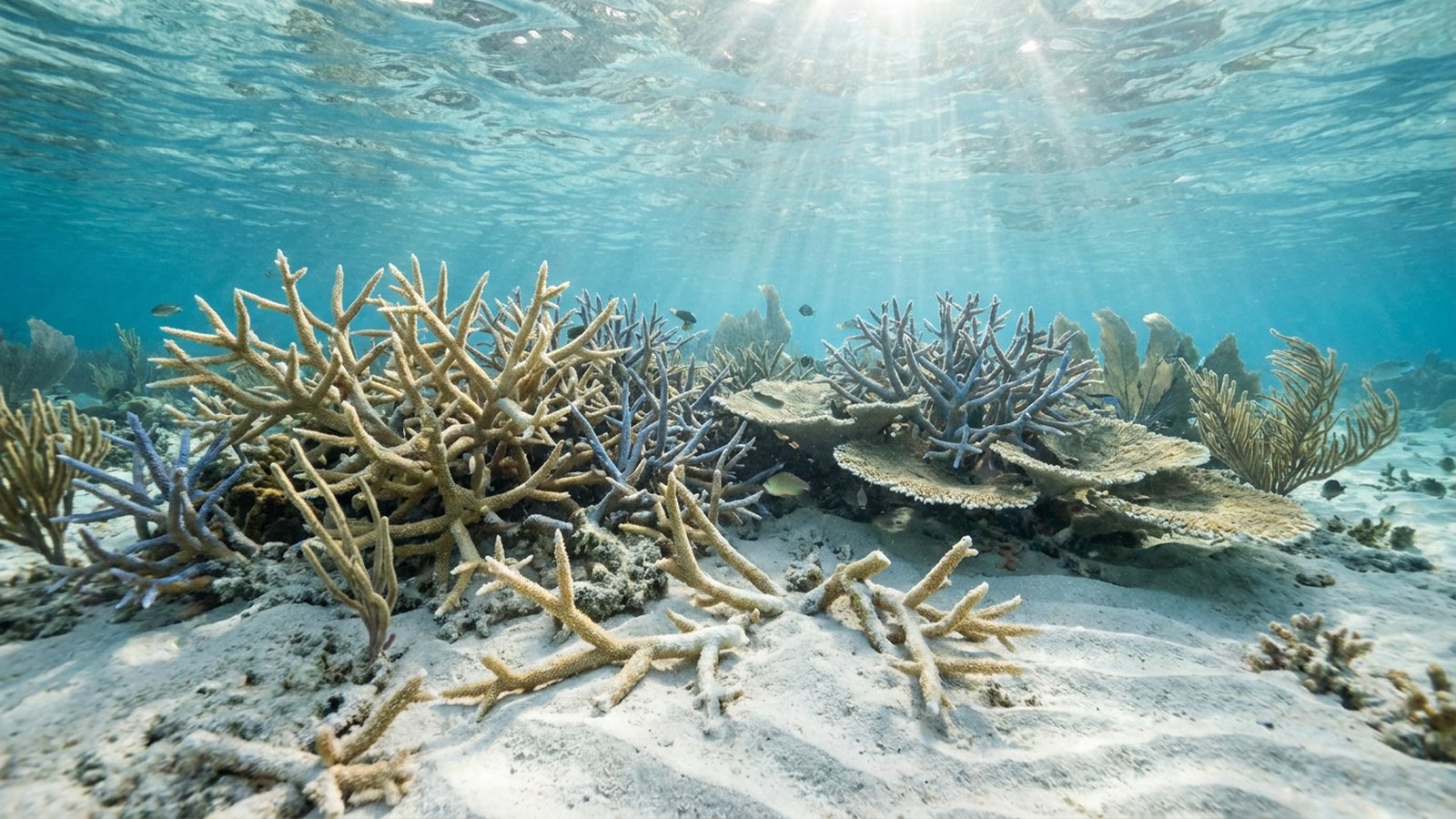
A coral reef looks like the most solid thing in the sea — a wall of rock that can withstand ocean swells for thousands of years. Yet reefs can lose most of their living coral in a single summer heatwave, and a careless kick from a diver can break a colony that took decades to grow. That contrast is the key to understanding reefs. The rock is durable; the living animals that build it are not. Reefs are fragile because their builders are specialists, finely tuned to a narrow set of conditions that are now changing quickly.
Corals live at the edge of their limits
Reef-building corals have narrow environmental needs. They thrive only where several conditions are met at once, and many already live near the top of their temperature range.
Most shallow-water reef corals do best in water that stays roughly between the low 20s and high 20s in degrees Celsius. They also need plenty of light for their algae, so the water must be clear and shallow; normal ocean salinity, since fresh water from heavy rain or river floods can kill them; low levels of nutrients and sediment; and a hard surface to grow on. That is why reefs are found mainly in tropical seas and are scarce near large river mouths. See the environment coral reefs form in.
Crucially, local coral populations are adapted to the normal conditions where they live, including their usual summer peak. Even a small rise above that peak, sustained for a few weeks, can push corals past their limit. There is very little margin between “comfortable” and “lethal”, which is why ocean warming is such a severe threat.
A partnership that breaks under stress
The source of a reef coral’s success is also its weak point: its dependence on microscopic algae living in its tissue.
Reef-building corals host single-celled algae called zooxanthellae that photosynthesise and pass most of the food they make to the coral. In good conditions this partnership is extraordinarily efficient. But when the water overheats — or when corals are stressed by intense light, cold snaps, low salinity or pollution — the algae become damaged and the coral expels them. This is coral bleaching. A bleached coral has lost its main food supply and can starve if conditions do not improve quickly.
The partnership is so central that a stress affecting the algae effectively affects the whole reef. That makes reefs far more sensitive to temperature than most marine ecosystems.
A thin living skin over stone
Only the surface of a reef is alive. The coral animals form a layer of tissue just millimetres thick over a skeleton of limestone.
That tissue is easily damaged. Sediment settling on corals can smother them and force them to spend energy producing mucus to clear it. Touching coral can strip the tissue and its protective mucus, opening the way for infection. Broken branches expose bare skeleton that algae and boring organisms quickly colonise. Pollutants such as oil, pesticides and some chemicals can damage tissue or interfere with reproduction.
Corals also cannot move away from danger. A fish can swim from warm or polluted water; a coral must endure whatever reaches it. Combined with their slow growth, that makes them especially vulnerable to anything that injures their living surface.
Slow growth means slow recovery
Reefs are built over thousands of years. When damage happens faster than growth, reefs lose ground.
The net upward growth of a reef is usually on the order of millimetres per year, and large massive corals may be centuries old. Faster-growing branching corals can rebound within a decade or so after a disturbance — if conditions are good and larvae are available to resettle. But many coral species reproduce only once a year, often during brief spawning events, and only a tiny fraction of larvae survive to become adult colonies. If adult corals are killed over a large area, there may be few left to supply new larvae.
At the same time, eroders such as parrotfish, boring sponges and worms keep removing limestone. On a healthy reef, construction outpaces erosion. On a damaged reef, erosion can win, and the reef framework slowly breaks down into rubble. Ocean acidification adds to the problem by making it harder for corals and coralline algae to build skeletons. Read more in what forms the structure called a coral reef.
An interconnected system with tipping points
Reefs depend on many species doing different jobs. Remove one group, and the balance can shift dramatically.
Grazing fish and sea urchins keep algae in check, giving corals space to grow and young corals places to settle. Coralline algae cement the reef and help attract coral larvae. Predators keep populations of coral-eating animals in check. Sponges and microbes recycle nutrients. When any of these links weakens, problems cascade. For example, if grazing fish are overfished and corals then die from bleaching, seaweed can take over and prevent coral recovery. Caribbean reefs suffered such a shift in the 1980s, when a disease killed huge numbers of the long-spined sea urchin Diadema antillarum, an important grazer, and seaweed spread across many reefs.
Ecologists describe these shifts as tipping points: once a reef moves from coral-dominated to algae-dominated, it can be hard to reverse. That sensitivity to the loss of key species is another reason reefs are considered fragile. See the coral reef food web and why coral reefs are overexploited.
Disease and predators take advantage
Weakened corals are easier targets. Diseases and coral-eating animals that a healthy reef can absorb become far more damaging on a stressed one.
Coral diseases such as white band, black band and stony coral tissue loss disease can spread across a reef and kill colonies within weeks. Outbreaks are often more severe after heat stress or in polluted water, when corals have fewer resources to defend themselves. Predators add to the pressure. The crown-of-thorns starfish feeds on coral tissue, and during population outbreaks it can strip large areas of reef; outbreaks on the Great Barrier Reef have been a major cause of coral loss alongside bleaching and cyclones. Coral-eating snails and some fish also feed on living coral. On a healthy reef, coral growth keeps pace with these losses. On a reef already weakened by heat, sediment or overfishing, they can push coral cover down further and delay recovery.
Many stresses at once
Individually, many reef stresses are survivable. Together, they overwhelm the reef’s ability to cope.
Today’s reefs face warming seas and more frequent marine heatwaves, ocean acidification, pollution and sediment from land, overfishing, disease outbreaks, coastal development and physical damage from storms, anchors and tourism. Each stress reduces a reef’s resilience to the next. A reef already struggling with murky, nutrient-rich water bleaches more readily and recovers more slowly; a reef weakened by bleaching is more vulnerable to disease. Reducing the local stresses that people can control is one of the best ways to help reefs survive the global ones. See what kills coral reefs and why coral reefs are dying.
Related on TheSea
- What Do Coral Reefs Do?
- How Many Coral Reefs Are There?
- What Are Coral Reefs Made Of?
- Why Are Coral Reefs In Tropical Waters?
- Why Do Coral Reefs Have Such High Productivity?
- What Do Coral Reefs Eat?
- How Have Coral Reefs Changed Over Time?
- What Animals And Plants Live In Coral Reefs?
- A Coral Reef Is a Community
- Coral Reef Plants
Why are coral reefs so fragile?
Because reef-building corals live near their temperature limits, depend on symbiotic algae that are expelled under stress, have only a thin layer of living tissue, grow very slowly and are part of an interconnected ecosystem where losing key species can trigger collapse.
Why are coral reefs sensitive to temperature?
Corals are adapted to a narrow temperature range, and the partnership with their algae breaks down when water stays about a degree or more above the normal summer maximum for weeks, causing bleaching.
Can touching coral kill it?
Touching can damage the thin living tissue and protective mucus, leaving the coral open to infection, and standing on or kicking corals can break them. Repeated contact from many visitors can kill colonies.
How long does it take a coral reef to recover?
Fast-growing corals can recover within about a decade after a disturbance if conditions are good. Slow-growing corals and heavily damaged reefs can take many decades, and some may not recover if stresses continue.
What makes some reefs more resilient than others?
Clean water, healthy populations of grazing fish, a diversity of coral species, cooler or well-mixed water and connections to other reefs that supply larvae all help reefs resist and recover from damage.
Are coral reefs strong or weak?
Both. The limestone structure is strong enough to withstand waves for millennia, but the living corals that build and maintain it are delicate and highly sensitive to environmental change.
Blane Perun has been exploring Earth’s oceans and marine life for over 25 years. Founder of TheSea.Org in 1999, underwater photographer, coral aquaculture pioneer, and explorer of 80+ countries.
About Blane Perun → More Coral Reef Q&A →