What Were Some Notable Conquests of The Ranger
The specific prizes taken by The Ranger under Vane’s command during 1718 are not individually named in surviving historical sources with the precision that later romanticised accounts suggest. What the historical record does document are the operational patterns: raiding along the Carolina coast after the escape from Nassau in July 1718, prizes taken during the Caribbean campaign through mid-to-late 1718, and the declining to attack a French man-of-war in November 1718 that directly triggered the crew mutiny. The fireship escape from Nassau itself — where a captured French prize was burned to cover the breakout — is the most documented specific action associated with The Ranger during Vane’s command.
The historical record of The Ranger’s specific conquests under Vane’s command is less precise than many popular accounts suggest. Captain Charles Johnson’s General History of the Pyrates, published in 1724, is the primary source for Vane’s career, and while it documents the pattern of his raiding operations, it does not provide a comprehensive list of specific named prizes with dates, cargo values, and circumstances of capture. Colonial correspondence from Carolina and Caribbean governors supplements Johnson’s account but also tends toward general descriptions of piracy rather than vessel-by-vessel records. What follows is an honest account of what the historical evidence actually supports.
The fireship escape: The Ranger’s first documented action
The most specifically documented action associated with The Ranger under Vane’s command is not a prize capture but an escape. In July 1718, when Woodes Rogers arrived in Nassau with a naval blockade, Vane used a captured French prize as a fireship to create chaos while The Ranger broke through the blockade under cover of darkness.
This action is documented in Johnson’s General History and corroborated by colonial correspondence from the period. The captured French prize — a vessel Vane had taken before Rogers’ arrival — was set alight and sent toward the blockading ships while The Ranger slipped through the gap created by the confusion. The action required timing, seamanship, and a willingness to sacrifice a valuable prize for operational freedom.
The burning of the French prize is the most precisely documented specific action of The Ranger’s career under Vane precisely because it was the most dramatic and most directly witnessed event. It happened in Nassau harbour in the presence of Rogers’ entire force, and it was reported in colonial correspondence that has survived. Subsequent prize captures happened at sea, away from witnesses who left records, and are correspondingly less precisely documented.
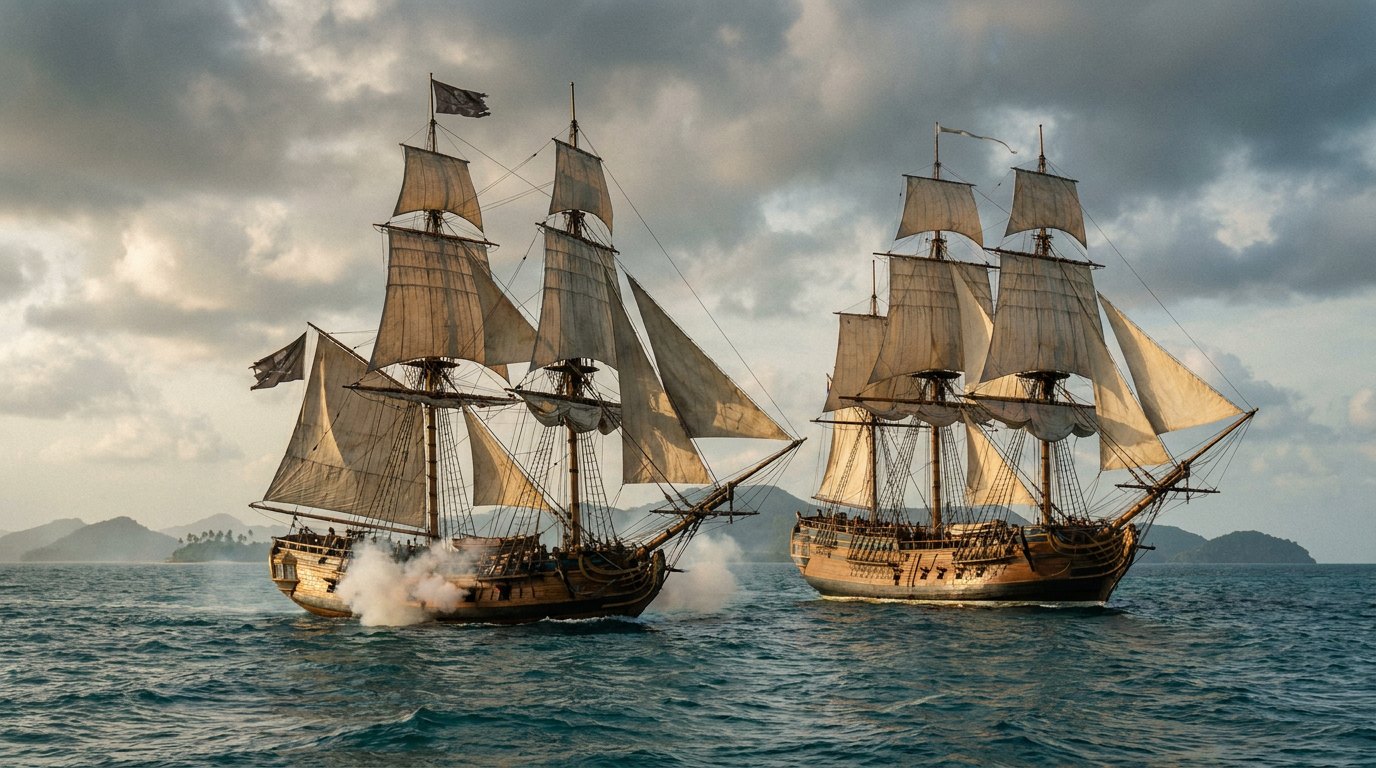
The Carolina coast campaign and its documented prizes
After escaping Nassau, Vane moved The Ranger north along the American colonial coast, raiding in the waters off the Carolinas and Virginia. This campaign is documented in colonial correspondence from Carolina governors who reported pirate activity consistent with Vane’s movements.
The Carolina colonial records reference pirate attacks on merchant vessels in the coastal waters during the summer and autumn of 1718, some of which are attributed to Vane based on his known movements and the descriptions of the attacking vessels. These records describe multiple prizes taken from merchant ships carrying colonial export goods — primarily tobacco, naval stores such as tar and pitch, and other commodities moving between the colonies and Britain.
The specific vessels named in these records as Vane’s prizes vary by source, and some claimed attributions are uncertain because multiple pirate vessels were operating in the same waters during the same period. What is clear from the aggregate of colonial correspondence is that Vane conducted a sustained raiding campaign along the Carolina coast during mid-1718, that multiple prizes were taken, and that the campaign caused sufficient disruption to Atlantic colonial trade to generate official correspondence at the gubernatorial level.
Caribbean operations and the pattern of prize-taking
After the Carolina coast campaign, Vane moved The Ranger into Caribbean waters. Johnson’s account describes a sustained pattern of prize-taking during this period, though again with less precision about individual vessels than later popular histories often imply.
The Caribbean offered different targets than the Carolina coast. Merchant traffic included vessels moving between the Caribbean islands and their European metropoles, Spanish colonial trade, and intercolonial Caribbean commerce. Vane’s pattern of operation during this period appears to have involved taking smaller prizes rather than engaging heavily armed vessels — a pattern consistent with the resources available to a sloop operating without a permanent base after Nassau’s fall.
Johnson describes Vane as operating with his characteristic violence toward captured crews during this period, which generated the kind of testimony from survivors that would later form the basis of the charges at his trial. The treatment of prize crew members — which ranged from release after taking the vessel’s cargo to retention as forced crew additions to violence against those who resisted — is described in general terms by Johnson without the specific vessel-by-vessel detail that would make a precise conquest list possible.
The French man-of-war encounter and its significance
The most consequential specific encounter of The Ranger’s career under Vane was not a successful conquest but a deliberate non-engagement. In November 1718, Vane encountered a heavily armed French man-of-war and declined to attack. This decision cost him his command.
Johnson’s account describes Vane judging the French warship too powerful to attack profitably — the risk outweighed any potential prize value. His crew disagreed, interpreting the decision as cowardice under the articles they had signed. A vote was held and Vane lost. Calico Jack Rackham was elected captain, Vane was given a small sloop, and The Ranger passed to new command.
The irony is that this non-conquest is more precisely documented and more historically significant than any of the actual prizes The Ranger took. The encounter illustrates the tension in pirate command between the captain’s tactical judgment and the crew’s democratic rights under the articles — a tension that the articles resolved definitively in favour of the crew. It also raises a question that historians have noted: was Vane’s judgment actually correct? A sloop attacking a heavily armed man-of-war risked catastrophic loss. The crew who voted him out may have been exercising democratic rights to make a strategically dubious decision.
Conquests under Calico Jack’s command
After the crew mutiny transferred The Ranger to Calico Jack Rackham, the vessel continued taking prizes in the Caribbean through 1719 and 1720. This period is documented primarily through Rackham’s trial records and the trials of Anne Bonny and Mary Read.
Under Rackham, The Ranger’s conquests were smaller in scale than under Vane. Rackham targeted fishing vessels, small coastal traders, and other minor prizes along the Jamaican and Cuban coasts rather than the merchant vessels on major Atlantic trade routes that Vane had primarily targeted. The trial records list specific vessels taken by Rackham’s crew, including a number of small fishing canoes and coastal trading vessels, which were straightforward captures presenting little risk but also modest reward.
The contrast between The Ranger’s prize-taking under Vane and under Rackham reflects both the different characters of the two commanders and the changing operational environment. By 1719 and 1720, the anti-piracy campaign had significantly degraded the conditions for major prize-taking in the Caribbean. Rackham’s more modest conquests were the practical result of operating in a more constrained environment with a crew that was itself operating under increasingly difficult conditions.
What was The Ranger’s most documented specific action under Vane?
The fireship escape from Nassau in July 1718, where Vane burned a captured French prize to create cover for breaking through Woodes Rogers’ blockade. This is documented in Johnson’s General History and colonial correspondence, making it the most precisely evidenced specific action of The Ranger’s career under Vane.
Are specific named prizes attributed to The Ranger historically verified?
Popular history accounts often provide specific named prizes with precise dates, but these should be treated with caution. Johnson’s General History and colonial correspondence document the pattern of Vane’s raiding without providing a precise vessel-by-vessel conquest list. Some attributions in secondary sources conflate Vane with other pirates operating in the same waters.
What happened when The Ranger encountered a French man-of-war?
In November 1718, Vane declined to attack a heavily armed French man-of-war, judging it too powerful. His crew voted him out for cowardice under the articles they had signed, elected Calico Jack captain, and transferred The Ranger to new command. This non-engagement was the most consequential event of The Ranger’s career under Vane.
What prizes did The Ranger take under Calico Jack Rackham?
Under Rackham, The Ranger took smaller prizes than under Vane — fishing vessels, small coastal traders, and minor cargo ships along the Jamaican and Cuban coasts. These are documented in Rackham’s trial records and the trials of Anne Bonny and Mary Read.
What trade goods did Vane typically target in his raids?
Along the Carolina coast, Vane targeted vessels carrying colonial export goods: primarily tobacco, naval stores such as tar and pitch, and other commodities in Atlantic colonial trade. In the Caribbean, targets included intercolonial traders and vessels in Spanish colonial commerce.
Blane Perun has been exploring Earth’s oceans and marine life for over 25 years. Founder of TheSea.Org in 1999, underwater photographer, coral aquaculture pioneer, and explorer of 80+ countries.
About Blane Perun →