Charles Vane — The Pirate Who Refused a Royal Pardon
Charles Vane was one of the most defiant pirates of the Golden Age — a man who refused the King’s pardon when every other pirate in Nassau took it, fired on a Royal Navy warship to escape, and continued raiding for two more years while the pirate republic collapsed around him. He was eventually captured after a storm left him stranded on a deserted island, and was hanged in Jamaica in 1721. He never surrendered.
The Golden Age of Piracy ended not with a battle but with a piece of paper — the King’s Act of Grace offered by Governor Woodes Rogers when he arrived in Nassau in 1718. Almost every pirate in the Caribbean took it. Charles Vane did not. That single act of defiance defines him historically, but it only makes sense when you understand the man behind it — his origins, his methods, his crew dynamics, and the specific events that brought him from an unknown sailor to the last major pirate still raiding after the Nassau republic fell.
Charles Vane’s early life and rise to piracy
Almost nothing is known about Vane’s life before piracy. No birth record survives, no family history, no early career documentation. He appears in the historical record around 1715, already operating as a pirate out of Nassau.
What little context exists suggests Vane came from the English working poor, likely with some maritime background that gave him the seamanship skills he later deployed with genuine expertise. Nassau in 1715 was a near-lawless port on the island of New Providence in the Bahamas — a natural gathering point for pirates after the end of the War of the Spanish Succession left thousands of privateers unemployed and their letters of marque worthless. Vane arrived into this environment and rose quickly. By 1716 he was an established figure in the Nassau pirate community, operating with enough authority and crew loyalty to take prizes independently. He had no patron, no aristocratic connections, and no political cover. Everything he built, he built through his own competence and ruthlessness on the water.
His early targets were primarily merchant vessels in the Caribbean and along the American colonial coast. He was not, at this stage, particularly more notorious than dozens of other pirates operating out of Nassau. What set him apart would only become apparent in 1718, when the British crown decided to end the pirate republic once and for all.

The refusal of the King’s pardon
When Woodes Rogers arrived in Nassau in July 1718 with a Royal Navy escort and the King’s offer of full pardon, nearly every pirate in the port took the deal. Vane was the sole major holdout.
Vane had been one of the most powerful figures in Nassau. He commanded the harbour and had real options. He chose defiance. He sent back a message refusing the pardon, set a captured French vessel ablaze as a fireship, and used the chaos and darkness to break through Rogers’ blockade. Rogers posted a reward for his capture immediately. Vane headed for open water and kept raiding.
The significance of this refusal is easy to underestimate from a modern perspective. The Act of Grace was a genuinely generous offer — full immunity from prosecution for all past acts of piracy, with no conditions attached beyond stopping. Benjamin Hornigold took it, and went on to become a pirate hunter working for Rogers. Henry Jennings took it and retired. Blackbeard, despite his fearsome reputation, had already accepted a pardon earlier and only returned to piracy afterward. Vane refused from the start, on principle, without negotiation. No other prominent pirate of the era made that choice at that moment. It is the defining fact of his career.
Leadership style, The Ranger, and operations at sea
Vane commanded The Ranger, a fast sloop that became his primary vessel after escaping Nassau. His operational style was aggressive, his treatment of captives severe, and his command structure built on fear rather than the democratic pirate articles that governed most Golden Age ships.
Most pirate captains of the period operated under written crew articles that gave sailors genuine voting rights — they could elect and depose captains, vote on targets, and divide plunder according to fixed shares. Vane used a harsher model. His authority came from intimidation, and the treatment of prisoners his crew encountered was deliberately brutal, designed to build a reputation that would precede him into ports and make merchant captains think twice before resisting. This strategy was effective up to a point. Ships that had heard of Vane were more likely to strike their colours without a fight.
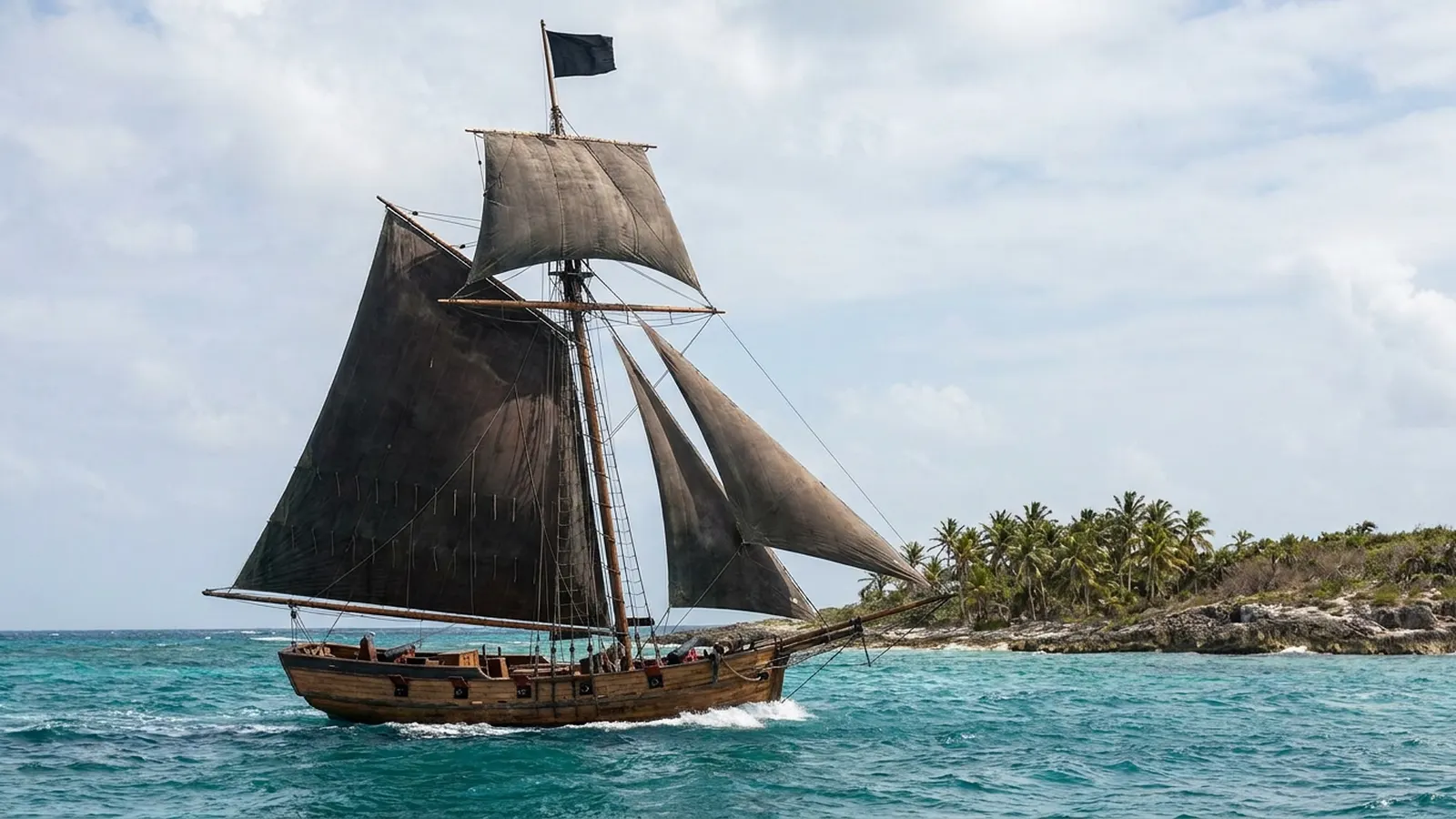
The Ranger was ideally suited to his methods — quick enough to run down merchant vessels, manoeuvrable enough to escape naval pursuit, and small enough to operate in shallow coastal waters where larger warships could not follow. Between mid-1718 and late 1718, Vane raided along the Carolina coast and throughout the Caribbean, taking numerous prizes and building his notoriety even as the broader pirate republic collapsed around him.
In October 1718, Vane met Blackbeard off Ocracoke Island for a gathering that colonial authorities found alarming enough to accelerate their response. It was one of the last moments of the old Nassau pirate world. Within weeks, Blackbeard was dead — killed by Lieutenant Robert Maynard’s forces on November 22, 1718. Stede Bonnet was hanged in December. The Golden Age was ending fast.
The mutiny, capture, trial, and execution
Vane’s command ended not from external defeat but from within. In November 1718, he declined to attack a heavily armed French man-of-war, judging the risk too great. His crew disagreed, held a vote under the articles, and found him guilty of cowardice. They elected Calico Jack Rackham captain in his place, gave Vane a small sloop, and sent him away with a handful of loyal crew members.
This deposition illustrates the structural weakness of fear-based command. Vane had no reservoir of goodwill to draw on. The moment he made a decision his crew could frame as cowardice, there was no loyalty to protect him. He lost his ship, his crew, and his operational capacity in a single vote.
What followed was a period of small-scale raiding with limited resources. In late 1719, a hurricane wrecked Vane’s vessel near the Bay of Honduras, stranding him on an uninhabited island. He survived for weeks before being rescued by a passing ship — only to be recognised by a former victim among the crew. He was arrested, transported to Jamaica, and held for trial.
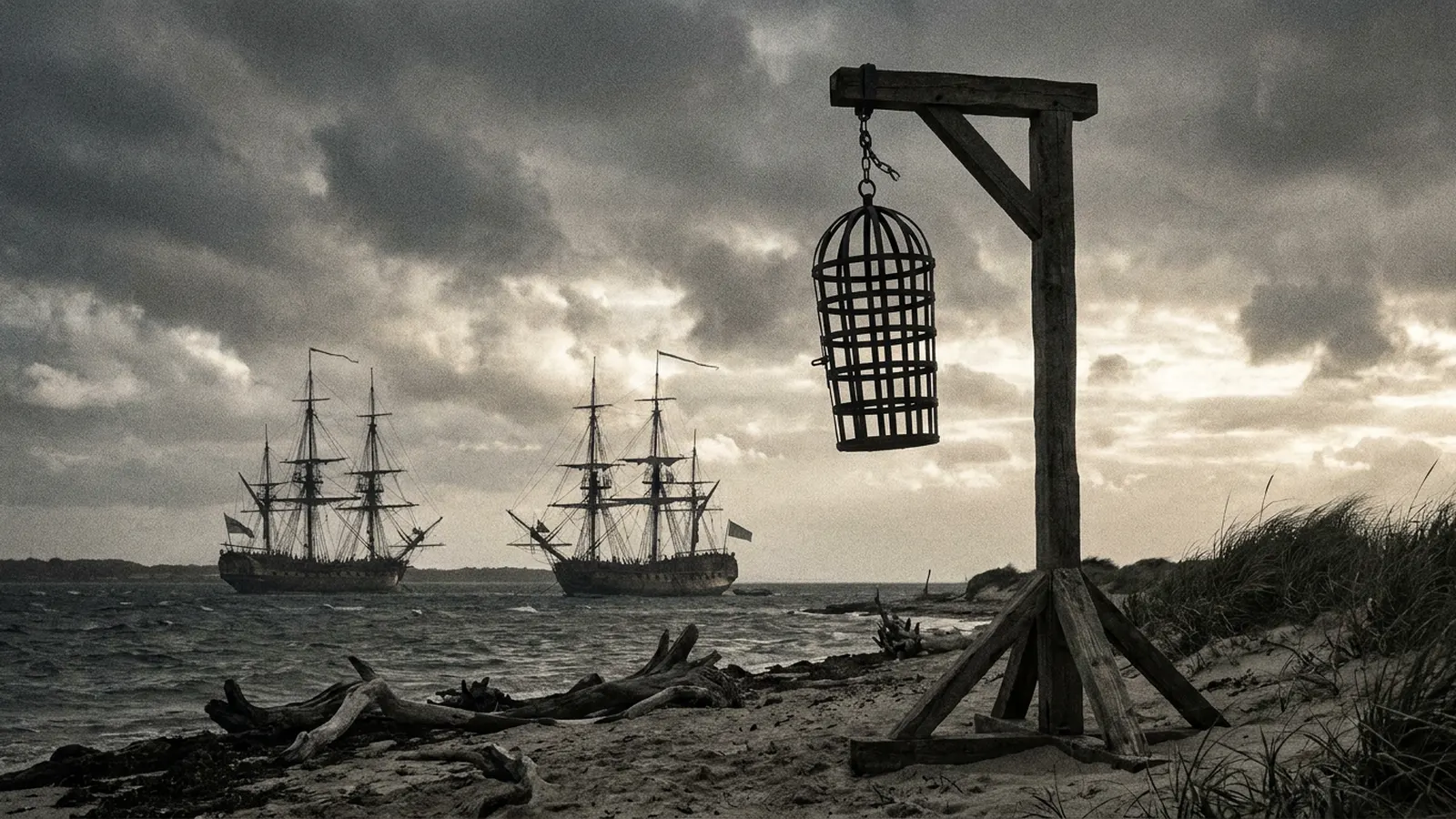
The trial of Charles Vane in Kingston, Jamaica in 1720 was a formal Admiralty proceeding. The charges against him included multiple counts of piracy covering specific acts of plunder and violence against named vessels and their crews. The evidence was substantial and largely uncontested. Vane was found guilty on all counts and sentenced to death. He was hanged at Port Royal on March 29, 1721, and his body was subsequently gibbeted — displayed in an iron cage at the harbour entrance as a warning to other sailors. He was one of the last major figures of the Golden Age to be executed. He never recanted, never sought clemency, and never expressed regret for his choices.
Charles Vane’s legacy
Vane’s legacy is narrower than Blackbeard’s but arguably more historically honest. He was not theatrical — no burning fuses in his beard, no carefully constructed mythology. He was simply a man who chose a path and followed it without compromise to the end.
In modern popular culture, Vane is perhaps best known from the television series Black Sails, where he is portrayed as a central character. The show takes significant creative liberties with the historical record but captures something true about his essential character — the absolute refusal to bend, the contempt for authority, and the self-destructive quality of a man who cannot stop fighting even when the war is clearly lost. His story has also been treated in historical accounts of the Golden Age, most notably in Captain Charles Johnson’s A General History of the Pyrates, published in 1724, which remains the primary historical source for much of what we know about Vane and his contemporaries.
What makes Vane genuinely interesting to historians is not the scale of his crimes, which were unremarkable by Golden Age standards, but the clarity of his choices. He was never ambiguous. He refused the pardon when others did not. He kept raiding when others stopped. He was deposed by his own crew rather than captured by his enemies. And he went to the gallows without the kind of public theatrics or last-minute bargaining that characterised some of his contemporaries. That consistency — whether you call it principle, stubbornness, or self-destruction — is what has kept him in the historical record three hundred years later.
Related on TheSea
Who was Charles Vane?
Charles Vane was a Golden Age pirate active from about 1716 to 1719, best known for refusing the King’s pardon and firing on a Royal Navy warship to escape Nassau. He was hanged at Port Royal, Jamaica in 1721.
Why did Charles Vane refuse the King’s pardon?
Vane refused on principle, sent a defiant message to Rogers, set a fire ship to create chaos, and broke through the blockade to continue piracy. He was the only major pirate of his era to refuse the Act of Grace outright.
How did Charles Vane die?
Vane was wrecked in a hurricane in late 1719, stranded on an uninhabited island, captured after being recognised by a former victim, transported to Jamaica, and hanged at Port Royal in March 1721.
What ship did Charles Vane sail?
Vane’s most famous vessel was The Ranger, a fast sloop he commanded from mid-1718. He was later deposed by his crew and given a smaller vessel, which was wrecked in a hurricane in 1719.
What happened to Calico Jack after the mutiny against Vane?
Calico Jack Rackham, who led the mutiny against Vane and became captain in his place, was himself captured in 1720 and hanged in Jamaica shortly after Vane’s own execution.
Blane Perun has been exploring Earth’s oceans and marine life for over 25 years. Founder of TheSea.Org in 1999, underwater photographer, coral aquaculture pioneer, and explorer of 80+ countries.
About Blane Perun →