Nuestra Señora de las Maravillas — The 1656 Treasure Galleon Still Scattered Across the Bahamas
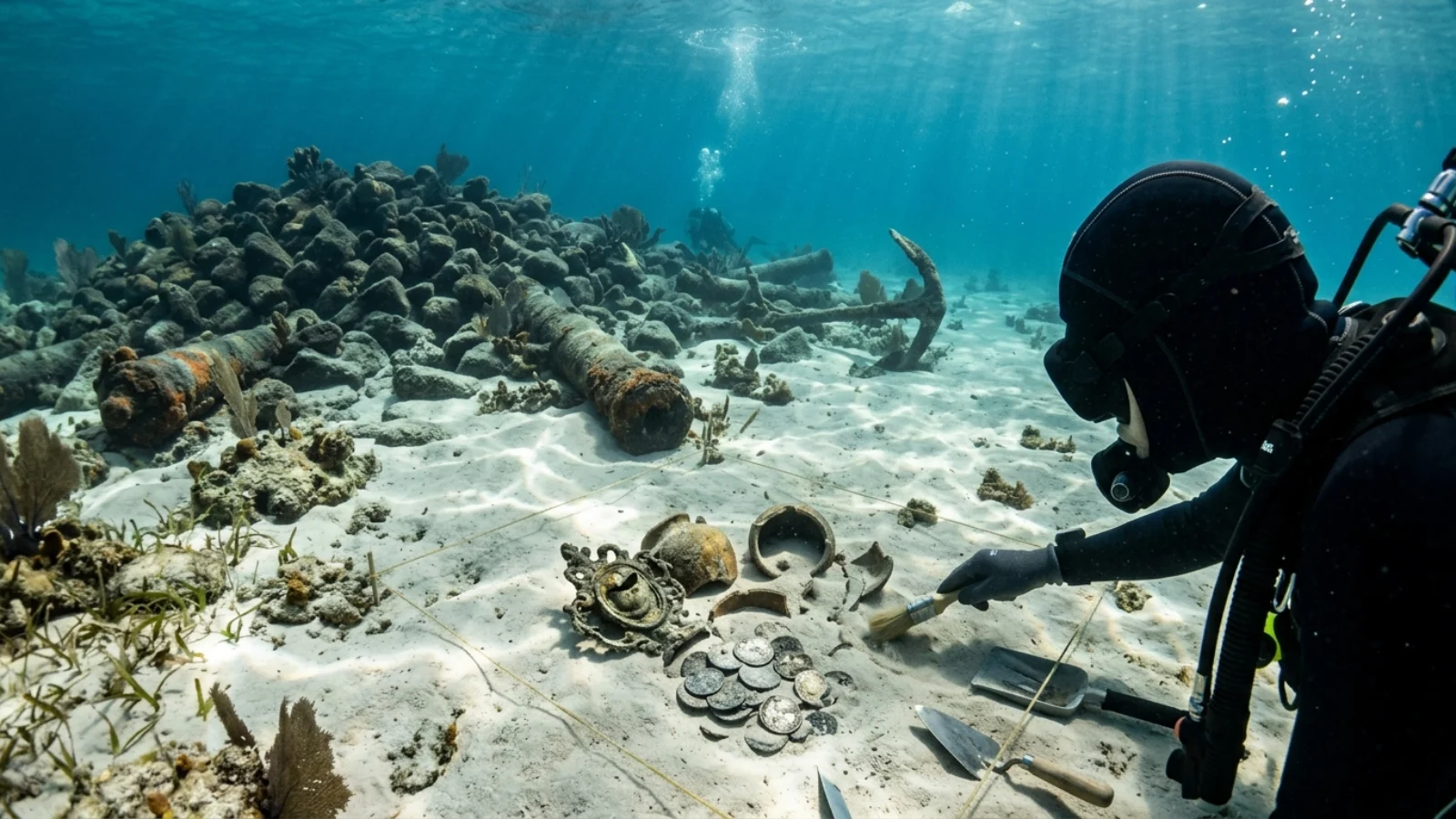
The Nuestra Señora de las Maravillas was a Spanish treasure galleon that sank on the Little Bahama Bank, north of Grand Bahama, on 4 January 1656, after her own fleet’s flagship rammed her at night and she struck a reef. Only about 45 of some 600–650 people aboard survived. She was carrying silver, gold and gems, and although Spanish salvors and modern divers have recovered millions of items, storms have spread her wreckage across kilometres of seabed. Some of her treasure, including contraband never listed on any manifest, is still out there.
Her name means “Our Lady of Wonders”. Unlike most ships in this series, she is not entirely unfound: her main site has been known since 1972. What is missing is a full accounting of her cargo. See the shipwreck treasure hub for other wrecks.
What happened to the Maravillas?
She left Havana for Spain on 1 January 1656 with the fleet. She was heavily laden: besides her own cargo, she carried silver salvaged from the Jesús María de la Limpia Concepción, a treasure ship that had sunk off Ecuador two years earlier. Three nights out, on the Little Bahama Bank, a navigational error brought the fleet’s flagship into collision with her, gashing her hull. Sinking, she struck a coral reef and went down in shallow water.
| Date | Event |
|---|---|
| 1 Jan 1656 | Fleet leaves Havana |
| 4 Jan 1656 | Rammed by the flagship; strikes a reef and sinks on the Little Bahama Bank |
| 1656–1670s | Ten Spanish salvage operations recover all 36 bronze guns and about 2.9 million silver pieces |
| 1972 | Robert Marx relocates the wreck in about 5–7 m of water; coins auctioned in New York in 1974 |
| 1988–early 1990s | Herbert Humfreys works the site; finds sold in London in 1992–1993 |
| 1990 | The Bahamas stops granting new salvage concessions |
| 2020s | Allen Exploration surveys and excavates under Bahamian government permit |
| Aug 2022 | Finds go on display at the new Bahamas Maritime Museum |
How much of the Maravillas treasure has been recovered?
A great deal, in three waves. In the two decades after the sinking, Spain ran ten salvage operations with divers and recovered all 36 bronze cannon and about 2.9 million silver pieces. After Robert Marx relocated the wreck in 1972 and later salvors worked it, some 3.9 million artefacts had been recovered by the 1990s, often with rough methods that destroyed archaeological context. Then, in a two-year project announced in 2022, Carl Allen’s Allen Exploration, working with Bahamian and American archaeologists, recovered spectacular jewellery that earlier salvors had missed.
What did Allen Exploration find?
The team believes it located material from the ship’s lost sterncastle, where wealthy passengers and officers kept their valuables. Finds included a 1.76 m gold filigree chain with pendants of the Order of Santiago; a scallop-shaped gold pendant bearing the Cross of Santiago set on a bezoar stone; an oval pendant with a large Colombian emerald surrounded by smaller ones; a necklace of 12 emeralds, said to represent the apostles; a silver sword hilt; gold chains; coins and ingots; and rough-cut Colombian emeralds and amethysts. None of those loose gems appear on the ship’s manifest, which suggests they were smuggled.
What treasure is still missing?
- Contraband. Smuggling was routine on Spanish treasure ships, and undeclared gold, gems and jewellery were never recorded, so no one knows how much more there was.
- Scattered cargo. Hurricanes over three and a half centuries have dragged wreckage across the bank; divers mapped a debris trail of about two miles (3 km).
- Buried material. Shifting sand on the shallow bank covers and uncovers deposits from year to year.
- Lost parts of the hull. Large sections of the ship, including parts of the stern, have only recently been located, and others may lie farther away.
Why has it taken so long to find?
Because shallow wrecks in hurricane country do not stay put. The Maravillas lies in only a few metres of water, where storm waves break up hulls and roll heavy objects across the seabed. Earlier, rougher salvage methods also scattered and mixed material. Allen Exploration used systematic magnetometer and sonar surveys, metal detection and careful recording to track the trail of debris.
Can you see the Maravillas treasure?
Yes. Finds from the Allen Exploration project went on display at the Bahamas Maritime Museum in Freeport, Grand Bahama, which opened in August 2022 with galleries on the Lucayan free-divers, the Atlantic slave trade and the Maravillas. Under Bahamian law, historic wrecks belong to the nation, and salvage now requires government permits with archaeological supervision.
Where did the Maravillas sink?
On the Little Bahama Bank, north of Grand Bahama, in the Bahamas.
When did the Maravillas sink?
On 4 January 1656, after being rammed by her fleet’s flagship.
How many people died on the Maravillas?
About 600 of the 600–650 aboard; only about 45 survived.
Has the Maravillas been found?
Yes, the main site was relocated in 1972, but her wreckage is scattered and parts of her treasure remain missing.
What treasure was found on the Maravillas?
Silver coins and bars, gold chains, emerald jewellery, a Cross of Santiago pendant and loose emeralds and amethysts.
Who found the Maravillas?
Robert Marx relocated it in 1972; Allen Exploration made major new finds in the 2020s.
Where can I see the Maravillas treasure?
At the Bahamas Maritime Museum in Freeport, Grand Bahama.
Why was the Maravillas carrying extra silver?
She carried silver salvaged from the Jesús María de la Limpia Concepción, which sank in 1654.
- Global News / Associated Press (2022). Treasure recovered from 350-year-old Maravillas galleon wreck in Bahamas.
- Shipwrecks.es. Nuestra Señora de las Maravillas.
- CBS News (2022–2023). Maravillas treasure mapped on legendary Bahamas shipwreck.
- Allen Exploration and Bahamas Maritime Museum. Project announcements.
- Marx, R.F. (1987). Shipwrecks in the Americas. Dover.
Blane Perun has been exploring Earth’s oceans and marine life for over 25 years. Founder of TheSea.Org in 1999, underwater photographer, coral aquaculture pioneer, and explorer of 80+ countries.
About Blane Perun →