USAT Liberty — Bali’s WWII Wreck off Tulamben Beach
The USAT Liberty is a 1918 American cargo ship that a Japanese submarine torpedoed near the Lombok Strait on January 11, 1942. It was towed toward Bali and beached at Tulamben, and in 1963 the earthquakes that accompanied the eruption of Mount Agung slid it into the sea. Today it lies on a sand slope roughly 25–40 m from the beach, in about 5 to 30 m of water.
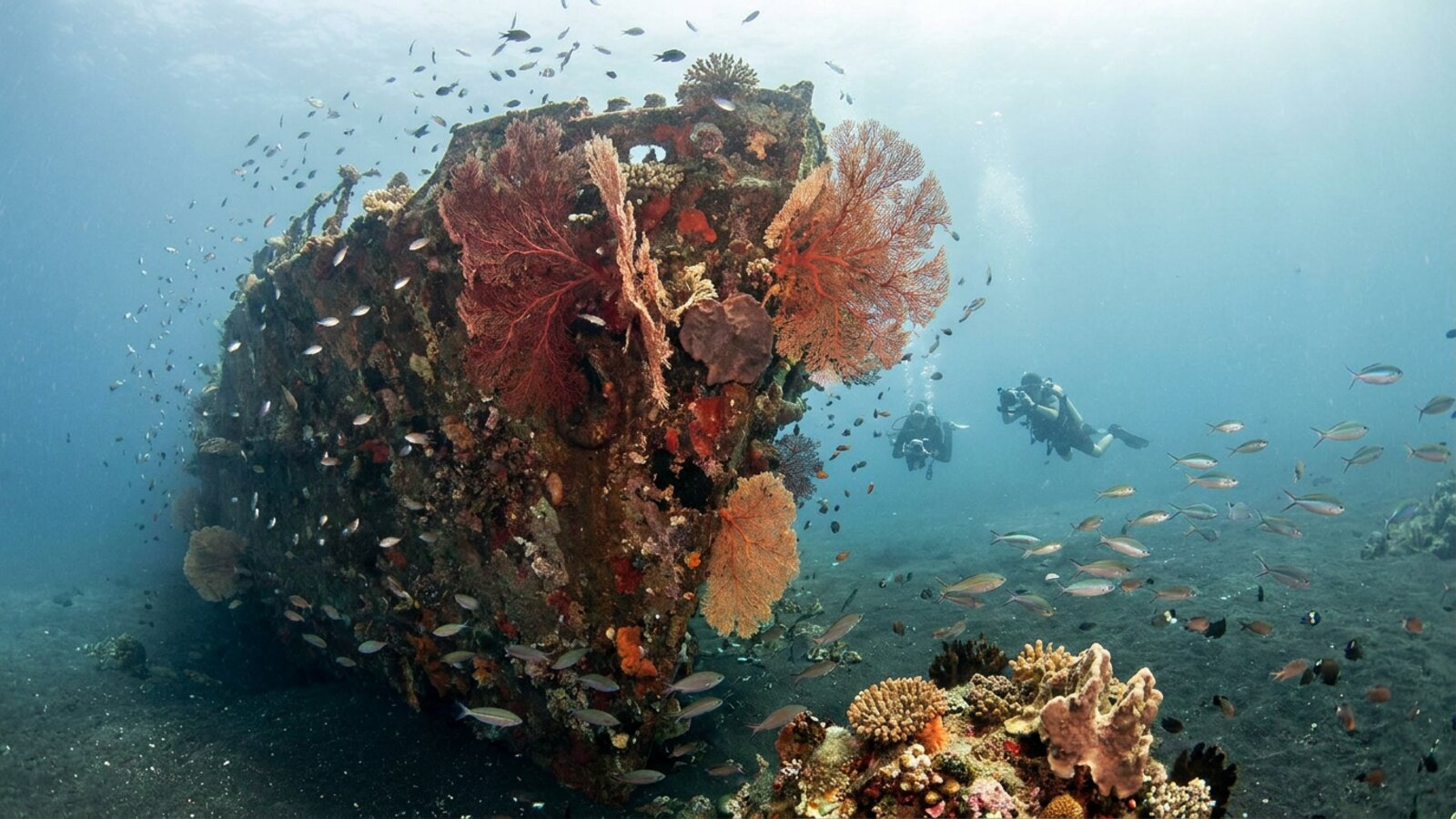
Coral, sponges and a crowd of reef fish have colonised the hull, and the Liberty is one of the most accessible large wreck dives anywhere. It lies close enough to swim to from the beach, its shallowest parts can be seen by snorkelers in good conditions, and during the high season up to about 100 divers a day visit it. This page tells the ship’s story from New Jersey to Bali, explains how a volcano moved it, and describes what divers can see and how to plan a visit.
What was the USAT Liberty?
A First World War cargo ship that served as a Navy horse transport, a merchant ship and finally a US Army transport.
The Liberty was built as a Design 1037 cargo ship for the United States Shipping Board, the agency that ordered hundreds of merchant ships to replace tonnage lost to German submarines in the First World War. She was launched on June 19, 1918, at Kearny, New Jersey, as yard number 1, the very first ship built by the Federal Shipbuilding Company. She was 411 feet 6 inches (125.43 m) long, with a beam of 55 feet (17 m), a draught of about 8 m and a displacement of 13,130 tons, and her engines gave her a speed of about 11 knots.
The US Navy acquired her on October 7, 1918, and commissioned her the same day as USS Liberty (ID-3461). Assigned to the Naval Overseas Transportation Service, she left the New York Navy Yard on October 24 with a cargo of horses and reached Brest, France, on November 8, three days before the Armistice. Over the next six months she made two more crossings from New York to France, carrying animals and general cargo. Her final voyage brought her back to Newport News, Virginia, on April 30, 1919, loaded with 436 tons of Army cargo and 2,072 tons of steel rails. She was decommissioned on May 7, 1919, and returned to the Shipping Board.
Between the wars the Liberty worked as a merchant ship. Her career was not entirely uneventful. On October 20, 1929, she collided with the French tug Dogue at Le Havre, and the tug sank with the loss of two crew. On November 23, 1933, she collided with the American cargo ship Ohioan in New York’s Ambrose Channel, and the Ohioan had to be beached. By 1939 the Liberty, though still government-owned through the United States Maritime Commission, was being operated by the Southgate-Nelson Corporation of Norfolk, Virginia. In November 1940 she was one of ten ships taken up by the United States Army for defence service, and she became the USAT (United States Army Transport) Liberty.
How did the Liberty end up at Tulamben?
A Japanese torpedo crippled her near Lombok, and she was run aground on Bali’s east coast so her cargo could be saved.
When the United States entered the Second World War in December 1941, the Liberty was in the Pacific. In January 1942 she was carrying railway parts and rubber from Australia to the Philippines, through waters that Japanese forces were rapidly closing off. On January 11, about 10 nautical miles (19 km) southwest of the Lombok Strait, which separates Bali from the island of Lombok, she was torpedoed by the Japanese submarine I-66.
The ship did not sink at once. The US destroyer Paul Jones and the Dutch destroyer Van Ghent took her in tow, aiming for the harbour at Singaraja, then the Dutch port and administrative centre for the Lesser Sunda Islands, on Bali’s north coast. The Liberty was taking on too much water to make it. Instead she was run onto the beach at Tulamben, on Bali’s northeast coast, so that her cargo and fittings could be salvaged. The war moved on quickly, and the beached hulk was left where it lay.
| Date | Event |
|---|---|
| June 19, 1918 | Launched at Kearny, New Jersey, the first ship built by Federal Shipbuilding |
| Oct 7, 1918 | Commissioned as USS Liberty, animal and cargo transport |
| May 7, 1919 | Decommissioned at Newport News and returned to the Shipping Board |
| 1929 and 1933 | Collisions at Le Havre and in New York’s Ambrose Channel |
| Nov 1940 | Taken up by the US Army; becomes USAT Liberty |
| Jan 11, 1942 | Torpedoed by Japanese submarine I-66 near the Lombok Strait |
| Jan 1942 | Towed toward Singaraja, then beached at Tulamben for salvage |
| 1963 | Mount Agung eruption and earthquakes slide the hulk into the sea |
| Today | One of Bali’s most dived sites |
How did a volcano move the wreck?
The 1963 eruption of Mount Agung, one of the most devastating in Indonesia’s history, shook the hulk off the beach and down the slope.
The Liberty sat on the stony beach at Tulamben for about two decades. Then, in 1963, Mount Agung, the highest point on Bali and an active stratovolcano that dominates the east of the island, came to life. On February 18 local people heard loud explosions and saw clouds rising from the crater. Lava began flowing down the northern slope on February 24 and travelled about 7 km over the next 20 days. On March 17 the volcano erupted violently, a VEI 5 eruption that hurled debris 8 to 10 km into the air and sent pyroclastic flows down its flanks.
The human cost was enormous. The flows destroyed numerous villages and killed an estimated 1,100 to 1,500 people. Cold lahars, mudflows triggered by heavy rain on fresh ash, killed about 200 more, and a second eruption on May 16 killed another 200. Minor eruptions continued for almost a year, and the eruption affected temperatures worldwide.
Amid the eruptions and earthquakes, the wreck of the Liberty slipped off the beach and settled completely underwater. It came to rest on a sand slope, lying roughly parallel to the shore. Its highest point, the stern, is now about 5 m below the surface and its lowest parts are at about 30 m. The hull broke up as it slid, but large sections, including guns, holds and parts of the superstructure, remain recognisable.
The volcano also gave Tulamben its name and its beach. The village name comes from batulambih, roughly “many stones”, a reference to the destructive eruptions of Mount Agung that have affected this part of Bali. The beach is not sand but fairly large, smooth stones.
Is the Liberty a “Liberty ship”?
No. The name causes a lot of confusion, but the USAT Liberty is older and of a different design.
“Liberty ships” were the mass-produced standard cargo ships built in American yards during the Second World War. The USAT Liberty was built a generation earlier, in 1918, and simply happened to be named Liberty. Her wreck is also sometimes misidentified as the Liberty Glo, a different First World War cargo ship that survived the Second World War and was scrapped in Baltimore in 1950, or referred to by her Navy name, USS Liberty. The correct name for the Tulamben wreck is USAT Liberty.
What can you see on the Liberty?
A wreck turned reef: corals, sponges and sea fans on the hull, schools of fish around it, and small critters in every crevice.
After more than six decades underwater, the Liberty is thickly encrusted with hard and soft corals, sponges, sea fans and hydroids, and coral formations can be seen on the wreck’s guns. The broken structure creates a maze of overhangs, holds and swim-throughs that shelter a wide range of reef life. Dive operators and divers commonly report schools of bumphead parrotfish, which often rest around the wreck at night, along with giant barracuda, groupers, batfish, jacks, snappers, moray eels, lionfish, frogfish, octopus and many species of nudibranch. On the surrounding sand slope, colonies of garden eels rise from their burrows.
Bigger visitors appear in some seasons. Tulamben divers have reported ocean sunfish (Mola mola), whale sharks and blacktip reef sharks, although none of these is guaranteed. Beside the wreck lies a species-rich reef zone known as the Coral Garden, from about 4 to 25 m deep, and nearby there is even a small Balinese Hindu temple, or pura, placed underwater at about 15 m. Night dives on the wreck are especially popular, when feeding invertebrates emerge and sleeping fish shelter in the hull. Local divers have also been praised for minimising fishing around the site, which has helped the marine life to thrive.
How do you dive the USAT Liberty?
Usually as a shore dive from Tulamben beach, with an easy entry and a short swim to the wreck.
The Liberty is considered suitable for divers of all certification levels, which is a large part of its appeal. Most dives start from the stony beach at Tulamben; divers walk in, descend and follow the sand slope a short distance out to the wreck. Some operators also use boats. The shallowest sections, around the stern at about 5 m, are accessible to new divers and visible to snorkelers when the water is clear, while the deeper parts of the hull and the swim-throughs reward experienced divers with good buoyancy. Penetrating enclosed spaces in any wreck requires proper training and equipment.
Conditions are generally best in October and November, when the weather is usually calm, and at the start of the southeast monsoon, which typically runs from May to July. The water is tropical year-round. Because the site is so popular, the wreck can be crowded from mid-morning onward, especially in the high season, so early-morning and late-afternoon dives are often quieter. Many divers stay in Tulamben or nearby Amed for several days, combining the Liberty with other dive sites along the northeast coast.
The usual rules of wreck and reef diving apply. Do not touch the wreck or the corals, which are fragile and can be damaged by a single fin-kick. Do not take anything, however small. Stay off the sand near garden-eel colonies, which retreat into their burrows if approached. And remember that the Liberty is a wartime casualty, a ship lost to enemy action, and treat it with respect.
How did a cargo ship become a reef?
By offering hard, complex surfaces in a place where the seafloor is mostly sand, and then being left alone for decades.
Much of the seabed off Tulamben is a sloping plain of sand and stones. Most corals, sponges and sea fans need a hard surface on which their larvae can settle, so a large steel hull lying on that slope is a valuable piece of real estate. Once the Liberty came to rest underwater in 1963, drifting larvae began to settle on it, and over the following decades layer upon layer of encrusting life built up on the plating, guns, masts and holds. Each new layer created more surfaces and more hiding places for the next arrivals.
The broken shape of the wreck matters as much as its hardness. Collapsed decks, open holds, frames and overhangs create a three-dimensional maze of light and shade, open water and shelter, which suits animals with very different needs: plankton-feeding fish that hover above the hull, predators that patrol its edges, shy species that hide in its crevices and small invertebrates that live on the encrusting growth. That variety is why one wreck can hold so many species in a small area.
The same process happens wherever ships sink in warm, clear water, and it is the reason some decommissioned ships are deliberately scuttled as artificial reefs. The Liberty’s advantage is time. It has been underwater for more than sixty years, close to healthy natural reefs that supply larvae, in a place where fishing pressure has been kept low. Protecting it from damage by divers is what will keep it that way.
How does the Liberty compare with other wreck dives?
It is warmer, shallower and closer to shore than most famous wrecks.
Many celebrated wreck dives require a boat ride, open-water conditions and advanced certification. The Liberty can be reached by a short swim from the beach, lies largely within recreational depths and sits in warm tropical water. Australia’s SS Yongala is a boat dive in open water with big pelagic fish; Grand Cayman’s Kittiwake was sunk on purpose as an artificial reef; and Aruba’s Antilla is another Second World War casualty that has become a reef. For more diving in Bali, read scuba diving in Bali.
What makes the Liberty unusual is its double history: a ship disabled by war, then moved into the sea by a natural disaster that killed well over a thousand people. Few dive sites carry so much of a region’s history in one place.
Where is the USAT Liberty wreck?
At Tulamben on Bali’s northeast coast, roughly 25–40 m from the beach.
How deep is the Liberty wreck?
From about 5 m at the stern to about 30 m at its deepest.
Can you snorkel the USAT Liberty?
Yes. The shallowest parts are visible from the surface in good conditions.
When was the USAT Liberty sunk?
It was torpedoed on January 11, 1942, beached at Tulamben, and slid into the sea during the 1963 Mount Agung eruption.
Who torpedoed the USAT Liberty?
The Japanese submarine I-66, about 10 nautical miles southwest of the Lombok Strait.
Is the USAT Liberty a Liberty ship?
No. It was built in 1918 as a Design 1037 cargo ship, decades before the WWII Liberty ships.
What fish can you see on the Liberty?
Bumphead parrotfish, barracuda, groupers, batfish, morays, garden eels and many small reef species; occasionally sunfish or whale sharks.
When is the best time to dive Tulamben?
Conditions are generally best in October and November and at the start of the southeast monsoon, about May to July.
- Wikipedia: USAT Liberty (construction, Navy service, collisions, torpedoing, beaching, dive site).
- Wikipedia: Mount Agung (1963–64 eruption chronology, casualties and the Liberty).
- Wikipedia: Tulamben (name, beach, diving conditions, visiting marine life, underwater temple).
- Dive operators’ site briefings for Tulamben and the Coral Garden.
Blane Perun has been exploring Earth’s oceans and marine life for over 25 years. Founder of TheSea.Org in 1999, underwater photographer, coral aquaculture pioneer, and explorer of 80+ countries.
About Blane Perun →