SS Yongala — Lost With All Hands in 1911, Now a Living Reef
The SS Yongala was a 350 ft passenger steamer that disappeared in a cyclone off the coast of Queensland, Australia, on March 23, 1911, with all 122 people aboard. The wreck lies in about 16 to 30 meters of water inside the Great Barrier Reef Marine Park, about 48 nautical miles from Townsville, and is widely rated one of the best wreck dives in the world.
Its location makes it remarkable: a lone, intact hull on an open sand bottom, far from other reef, that acts as a magnet for marine life in an otherwise empty stretch of sea.
What was the SS Yongala?
The Yongala was built in England in 1903 for the Adelaide Steamship Company and carried passengers and cargo along the Australian coast, first on southern routes and later on the run up the Queensland coast. It was a comfortable coastal liner of its time, about 350 ft long.
How did the Yongala sink?
In March 1911 the Yongala was on a voyage from Melbourne to Cairns, steaming up the Queensland coast toward Townsville, when a cyclone swept the area on March 23. It never arrived. Searchers found wreckage and cargo washed up around Cape Bowling Green, but not the ship. All aboard, at least 122 people, were lost, along with a racehorse named Moonshine listed on the manifest. Exactly how it was overwhelmed has never been established, and the loss remained a mystery for decades.
| Date | Event |
|---|---|
| 1903 | Built in England for the Adelaide Steamship Co. |
| Mar 23, 1911 | Lost in a cyclone with all 122 aboard |
| 1911 | Debris washes up near Cape Bowling Green |
| 1943 & 1947 | Navy ships detect an obstruction but do not identify it |
| 1958 | Bill Kirkpatrick and George Konrat find the wreck; purser’s safe raised |
| 1961 | Chubb confirms the safe’s serial number, 9825W, matches the Yongala |
| Today | Protected historic shipwreck in the Marine Park |
How was the Yongala found?
It took 47 years. Wartime naval soundings had marked a suspicious obstruction off Cape Bowling Green, but no one dived on it until a fisherman and a diver went looking in 1958, and the ship was only formally identified three years later from the serial number on a safe. The full sequence is set out below.
Why is the Yongala such a famous dive?
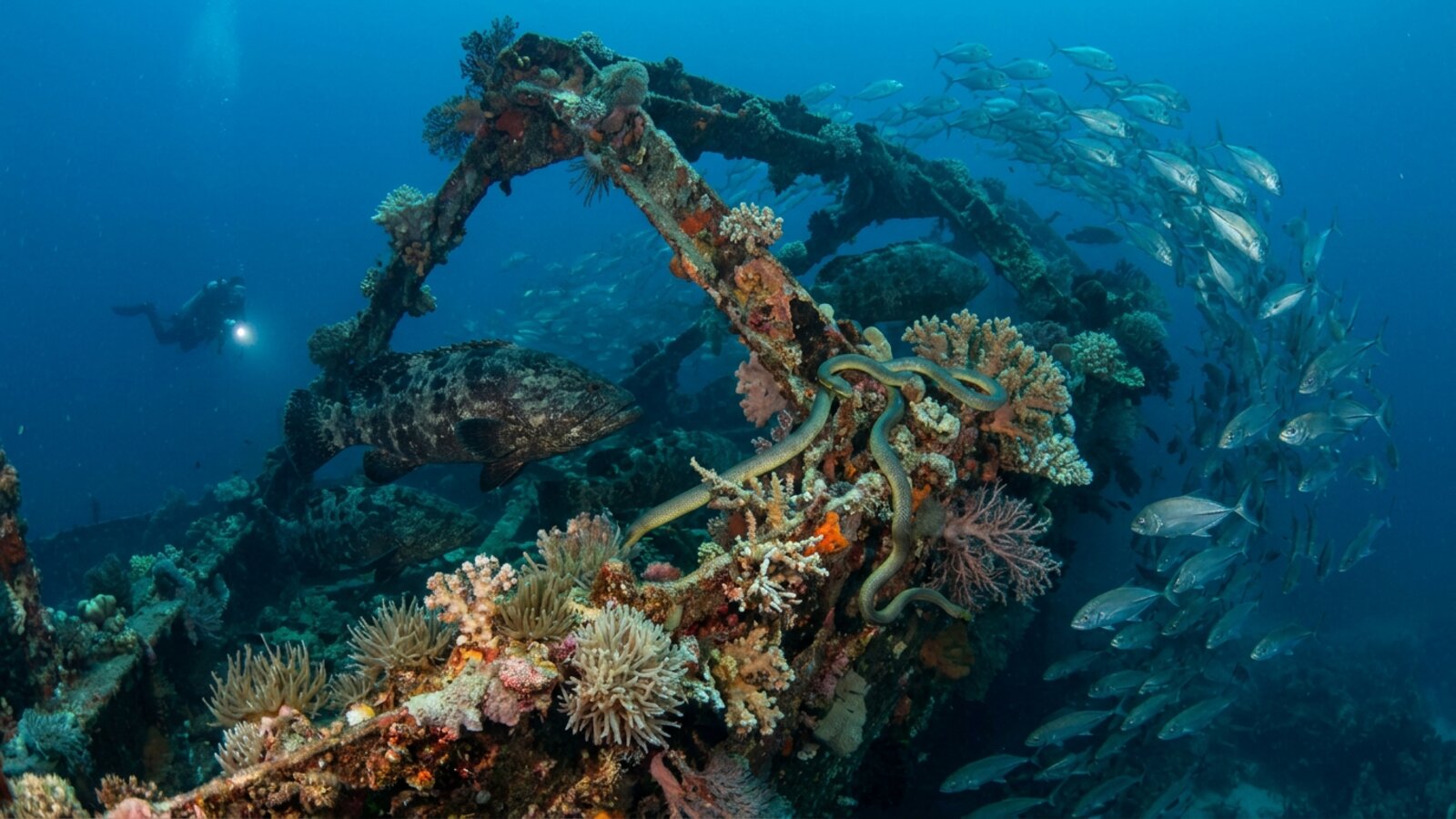
Because it is the only big structure for miles. Currents bring plankton across the hull, and fish concentrate around it. Divers regularly report manta rays, eagle rays, sea snakes, sea turtles, sharks, giant trevally and barracuda, together with schools of reef fish and dense coral and sponge growth on the hull. Many divers describe more life on a single Yongala dive than on whole days elsewhere.
Built on the Tyne for the Australian coast
The Yongala came from Sir W. G. Armstrong, Whitworth and Co’s Low Walker yard at Newcastle upon Tyne, which built her and a sister ship for the Adelaide Steamship Company in 1903. She was yard number 736, launched on 29 April 1903 and completed that October at a cost of about £102,000. Her sister, the Grantala, followed a month behind her on the slipway and in 1914 became Australia’s only hospital ship of the First World War.
On paper she was a substantial coastal liner: 350 ft (106.7 m) long on the register, 45.2 ft (13.8 m) in the beam, and 3,664 gross register tons. A single screw was turned by a three-cylinder triple-expansion engine built by the Wallsend Slipway Company and fed by five boilers that burned about 67 tonnes of coal a day. The engine was rated at 690 nominal horsepower and gave her a service speed of about 16 knots.
She was fitted out for comfort as well as freight. There were berths for 110 first-class and 130 second-class passengers, electric lighting throughout, and holds for about 3,000 tons of cargo, including 10,000 cubic feet of refrigerated space split between chilled stores and frozen meat. Two steam cranes and seven winches worked the cargo, and a steam steering gear in a house on the stern was controlled from the bridge.
Her name came from the small town of Yongala in South Australia. The word is from the Ngadjuri language and is usually translated as “broad water” or “broad, wide watering place”.
Eight years on the coastal run
The Yongala left Southampton on her delivery voyage on 9 October 1903. She took some damage from heavy weather in the Bay of Biscay, called at Las Palmas and Cape Town, and reached Fremantle on 24 November. On the next leg to Adelaide she was said to have raced the Orient Line mail ship Orizaba and won, a story the Adelaide Steamship Company publicly denied.
By 1905 she was working the route from Fremantle to Sydney by way of Adelaide and Melbourne. In 1906 the summer service was extended to Brisbane, a run of about 2,700 nautical miles (5,000 km) that was then the longest interstate shipping route in Australia, and the Yongala was the first ship to work it. Each winter from 1907 to 1911 she switched to the Melbourne to Cairns route, carrying passengers north from the southern winter to the Queensland coast.
The final voyage, hour by hour
On 14 March 1911 the Yongala left Melbourne on her 99th voyage in Australian waters under Captain William Knight, with 72 passengers aboard. At Brisbane on 20 March most of them went ashore and others joined for the trip up the Queensland coast. Two animals were also loaded there: the racehorse Moonshine and a Lincoln Red bull. A harbour inspection described the ship as “in excellent trim”.
She reached Mackay on the morning of 23 March and sailed again at 1:40 pm for Townsville. Shortly after she left, the signal station on Flat Top Island received a telegram warning of a tropical cyclone between Mackay and Townsville. It hoisted warning flags and sent wireless signals, and several ships turned back to shelter at Mackay. The Yongala did not see the flags, and she had no wireless: the Marconi Company had shipped a set from England for her, but it had not yet reached Australia.
At about 6:30 that evening the keeper of the Dent Island light saw her enter the Whitsunday Passage. It was the last confirmed sighting. She was due in Townsville on 24 March, at 6 am according to the Queensland Museum and 6 pm according to Queensland State Archives, and never arrived. The cyclone is believed to have overwhelmed her during the night of 23–24 March.
The number of people lost has never been settled to a single figure. Leaving Mackay, the ship’s records list 29 first-class and 19 second-class passengers, 72 crew and 677 tons of cargo. Newspapers in 1911 counted 120 or 121 people aboard; the figure now accepted is at least 122, because young children, servants and members of ethnic minorities were often left off official lists.
The search and the inquiry
At first Townsville assumed the Yongala had sheltered from the storm like other ships. Concern grew when the northbound steamer Cooma came in on Saturday 25 March without having sighted her, and two vessels went out to check the coastline the day after she failed to arrive. By 26 March she was officially listed as missing, and Queensland’s Premier, Digby Denham, ordered a sea search in which seven vessels combed the coast. Wreckage, mail and fittings washed up between Hinchinbrook Island and Bowen, and the body of Moonshine was found at Gordon Creek. No trace of any passenger or crew member was ever found.
The Queensland Government offered a reward of £1,000 for information leading to the ship, a sum Queensland State Archives puts at roughly A$140,000 in today’s money. Nobody claimed it, and it was eventually withdrawn. Theories ranged from the cyclone simply overwhelming her at sea to a grounding on a reef between Flinders Passage and Keeper Reef, on Nares Rock or on Cape Upstart. A Yongala distress fund was set up within days to support the families; when it closed on 30 September 1914, the remaining £900 went to the Queensland Shipwreck Society.
The Marine Board of Queensland held an inquiry between 8 and 20 June 1911. It examined the ship’s stability, equipment and seaworthiness, and the record of her master. It found no fault with the vessel, which had seven years of uneventful service behind it, or with Captain Knight, one of the company’s most capable officers with 14 years’ service without incident. Declining “to indulge in idle speculation”, the Board concluded that the fate of the Yongala had passed “into the realms of conjecture”.
Forty-seven years missing
The first clue came during the Second World War. In 1943 a minesweeper fouled what its commander took to be a shoal about 11 miles east of Cape Bowling Green and marked an obstruction at roughly 13 fathoms (24 m) on the route used by ships bound for Townsville. In June 1947 the survey vessel HMAS Lachlan examined the spot with echo-sounding and anti-submarine equipment. She found an object about 300 ft (91 m) long rising to about 6 fathoms (11 m) from a seabed 12 to 14 fathoms deep, and concluded it could be a steamship.
Nobody dived on it until 1958, when the local fisherman Bill Kirkpatrick and the Cairns-based German diver George Konrat went looking. On their third visit Konrat found and explored the wreck. Kirkpatrick later returned with divers from the Queensland Underwater Research Group, who raised a safe from one of the cabins. Its contents had decayed to black sludge, but part of the serial number, 9825W, was still legible. The number was sent to the manufacturer, Chubb, and three years later, in 1961, the company confirmed it was the safe supplied in 1903 for the Yongala’s purser’s cabin.
The wreck today: structure and change
The Yongala lies about 48 nautical miles (89 km) southeast of Townsville and 12 nautical miles (22 km) east of Cape Bowling Green, a long, low headland that ends in a sandspit about 30 km from the town of Ayr. A lighthouse first went up on the cape in 1874; it had to be moved more than once because of coastal erosion, and the original tower is now displayed at the Australian National Maritime Museum in Sydney. The cape was the nearest landmark to the cyclone’s path, and debris from the ship came ashore along this stretch of coast. The hull, about 109 m long, sits with its bow pointing north on a bearing of 347 degrees and lies over on its starboard side at an angle of 60 to 70 degrees. It still retains its structural integrity. The seabed around it is about 30 m deep, and the highest parts of the wreck come to within about 16 m of the surface.
Because the surrounding seafloor is flat sand, the hull works as an isolated artificial reef, and that is the reason for its famous abundance of life. Records of the wreck’s condition go back to a sketch made by the marine biologist Leon Zann in the early 1980s; Wikipedia dates it to 1981 and Queensland State Archives to 1982. The superstructure still looks much as he drew it, but sand that once banked against the starboard side has been scoured away, and the ventilators and railings have collapsed. The Queensland Museum photographed the wreck before and after Cyclone Yasi in 2011 to document storm damage.
How the site is protected
The Yongala is protected under the Commonwealth’s Underwater Cultural Heritage Act 2018 and managed through the Museum of Tropical Queensland in Townsville. The protected zone covers the wreck, all the seabed within 797 m (2,615 ft) of it and the water above. Entry needs a permit from the museum’s Maritime Archaeology Section, and dive trips run through licensed operators. Penetration diving and any interference with artefacts are banned.
Anchors once did real damage. In 2002 several public moorings were laid and anchoring inside the protected zone was forbidden. The site was also listed on the Register of the National Estate before that register was closed. More than 10,000 divers visit each year, and a citizen-science project on iNaturalist has logged over 213 observations of 79 species, with the humphead wrasse the most often recorded.
Remembering the Yongala
Townsville has kept the memory of the ship close. The Maritime Museum of Townsville displays many Yongala artefacts, including her bell, and the Museum of Tropical Queensland holds smaller finds such as an earthenware ink bottle stamped by the French maker N. Antoine et Fils. It held encre japonaise, a violet-black logwood writing ink first sold in 1853, and Antoine switched from earthenware to glass bottles in 1910, so the bottle was already old stock or a personal possession when the ship sank. It is the only one of its kind recovered from the wreck and most likely belonged to a passenger or crew member. In the suburb of North Ward, the heritage-listed Yongala Lodge carries the ship’s name; it was built for Matthew Rooney, who died in the wreck with his wife and youngest daughter.
The Yongala belongs to a run of large passenger steamers that vanished in the years just before wireless became standard. The Waratah disappeared off South Africa in 1909 and no trace of her has ever been found; the Koombana was lost in a cyclone off Western Australia in 1912. The Yongala, by contrast, was found and named, and her intact hull lets divers see a ship of that era almost as she sank.
How does the Yongala compare with other wreck dives?
Its marine life sets it apart from Bali’s shallow shore-dive USAT Liberty and the purpose-sunk Kittiwake. Like the Titanic, lost the following year, it is a reminder of how little warning ships had before radio was common.
When did the SS Yongala sink?
On March 23, 1911, during a cyclone off Queensland.
How many people died on the SS Yongala?
Everyone aboard, now accepted as at least 122 people; 1911 newspapers counted 120 or 121.
Where is the Yongala wreck?
In the Great Barrier Reef Marine Park, about 48 nautical miles from Townsville.
How deep is the Yongala?
About 16 to 30 m (52 to 98 ft).
When was the Yongala found?
In 1958, by fisherman Bill Kirkpatrick and diver George Konrat; its identity was confirmed in 1961.
Can you go inside the Yongala?
No. Penetration is forbidden; the wreck is a grave and a protected historic site.
Do you need a permit to dive the Yongala?
Yes. Dives are by permit through licensed operators.
What marine life is on the Yongala?
Manta and eagle rays, sea snakes, turtles, sharks, giant trevally, barracuda and many reef fish.
- Scuba Diving magazine: History of Australia’s Yongala shipwreck.
- Australian Geographic: One of Australia’s worst maritime disasters.
- Great Barrier Reef Marine Park Authority / Australian historic shipwreck rules.
- Wikipedia: SS Yongala (build, service, loss, inquiry, discovery, wreck site); SS Waratah; Cape Bowling Green Light.
- Queensland State Archives blog (May 2025): Secrets of the sea, the fate of the SS Yongala.
- Queensland Museum blog (November 2017): An earthenware bottle from Yongala.
Blane Perun has been exploring Earth’s oceans and marine life for over 25 years. Founder of TheSea.Org in 1999, underwater photographer, coral aquaculture pioneer, and explorer of 80+ countries.
About Blane Perun →