Squid — Every Species, Every Question, Organised in One Place
A squid is a marine cephalopod mollusc with eight arms, two longer tentacles, a chitinous beak, three hearts, blue copper-based blood, an ink sac, and the most complex eyes of any invertebrate. Squid belong to the class Cephalopoda alongside octopus, cuttlefish, and the nautilus, with around 300 named species distributed across every ocean on Earth, from shallow reefs to the abyssal zones below 6,000 m. The smallest squid (the southern pygmy squid) matures at 2 cm and weighs less than a paperclip; the largest (the colossal squid) reaches 10 m and 495 kg. Between them lie species that glow with their own chemistry, glue themselves to seagrass, fly out of the ocean to escape predators, hover in schools while running 35 different colour signals across their skin, and carry coiled internal shells whose closest relatives died out with the dinosaurs. This page is the gateway to TheSea.Org’s full squid library: 18 in-depth species pages and 60+ common questions, all organised by the same design system.
Squid
The 18 squid species, at a glance
TheSea.Org’s squid library covers 18 species in depth — the deep-sea giants, the reef hoverers, the bioluminescent specialists, the deep-water mysteries, and the small commercial species that feed much of the world. Each card below opens a full dossier with anatomy, range, diet, reproduction, conservation, and comparison context.

What unites every squid — the shared body plan
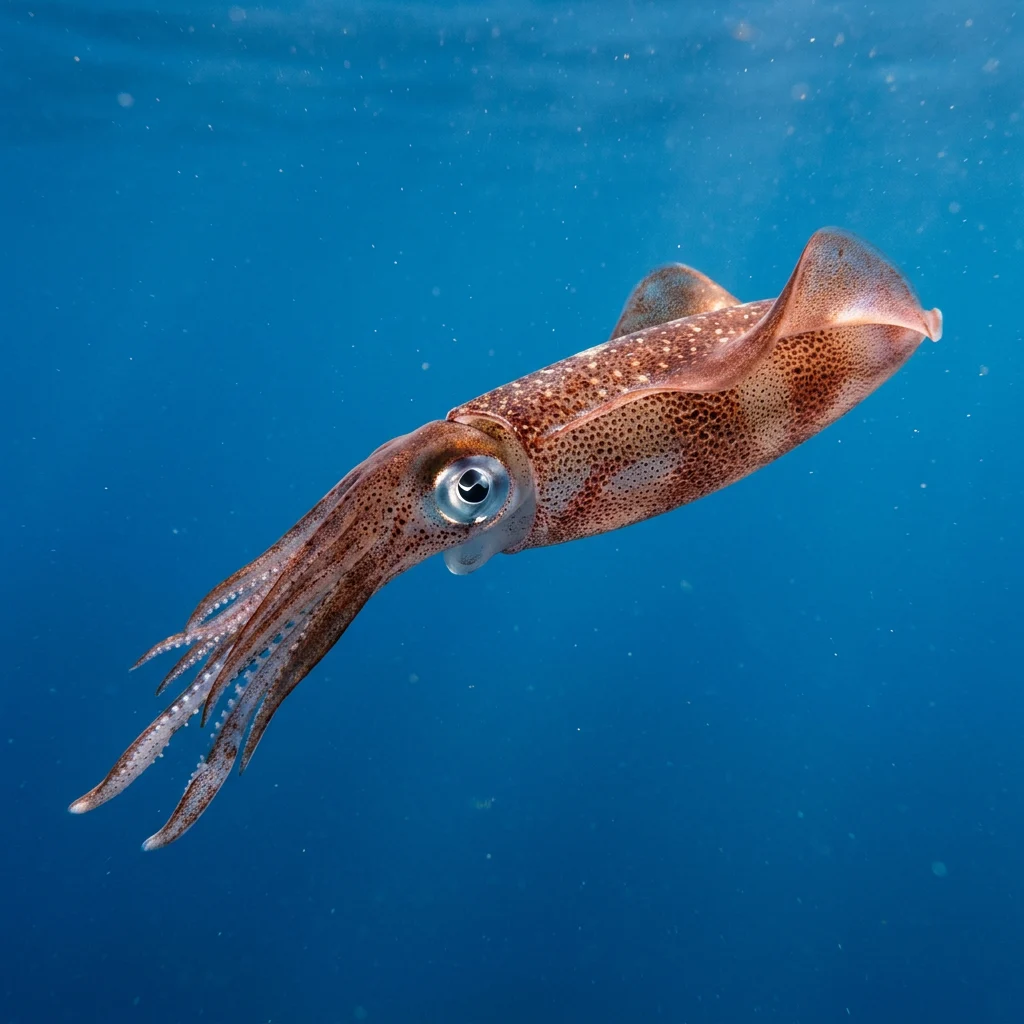
Squid range across nearly every size, depth, and habitat the ocean offers, but they all share a body plan that is recognisably the same animal. Understanding what a squid is — structurally and biologically — is the foundation for understanding what each species does.
A squid has a streamlined mantle — the muscular cylindrical body that contains the internal organs — ending in fins for steering and slow cruising. The mantle wraps a central body cavity that contains the digestive tract, the three hearts, the ink sac, and the reproductive organs. At one end of the mantle sits the head, with two large eyes, a central beak, and ten appendages: eight arms arranged around the mouth, and two longer tentacles that emerge from between the third and fourth arm pairs, ending in club-shaped suckered tips. The arms and tentacles handle prey capture; the beak processes it; the mantle and fins handle movement; the ink sac handles emergency defence.
The defining anatomical features that set squid apart from other cephalopods — and from other animals generally — include:
· Three hearts. One central systemic heart drives oxygenated blood to the body; two smaller branchial hearts (gill hearts) drive deoxygenated blood through the gills. Squid have one of the most actively pumped circulatory systems of any invertebrate.
· Blue blood. The respiratory pigment is haemocyanin, a copper-based molecule that turns blue when oxygenated — chemically very different from the iron-based haemoglobin of vertebrates. Haemocyanin works well in cold, low-oxygen water and is one of the reasons squid can thrive in deep mesopelagic environments.
· Chromatophore-controlled skin. Squid skin is full of tiny pigment-filled sacs (chromatophores) controlled by muscles. The squid can expand and contract individual chromatophores at high speed, producing complex colour patterns across its body in fractions of a second. This is the basis of squid camouflage, communication, and (in the Caribbean reef squid and others) elaborate social signalling.
· Ink sac. Squid eject a cloud of melanin-based ink as an emergency defensive response. The ink confuses predators visually, dulls their sense of smell (in vertebrate predators), and gives the squid time to jet away.
· Jet propulsion. Squid swim by drawing water into the mantle and forcing it out through a directional siphon. This produces both slow precision movement and explosive escape bursts (some squid achieve 25 mph in short sprints). The fins handle steering at speed and slow cruising.
· Camera-style eyes. Squid eyes are the most complex of any invertebrate and are remarkably similar to vertebrate eyes — an example of convergent evolution. They have lenses, retinas, and irises, and in some species (the colossal squid) the eyes reach 27 cm in diameter, the largest in the animal kingdom.
Where squid live — from tidepools to abyss
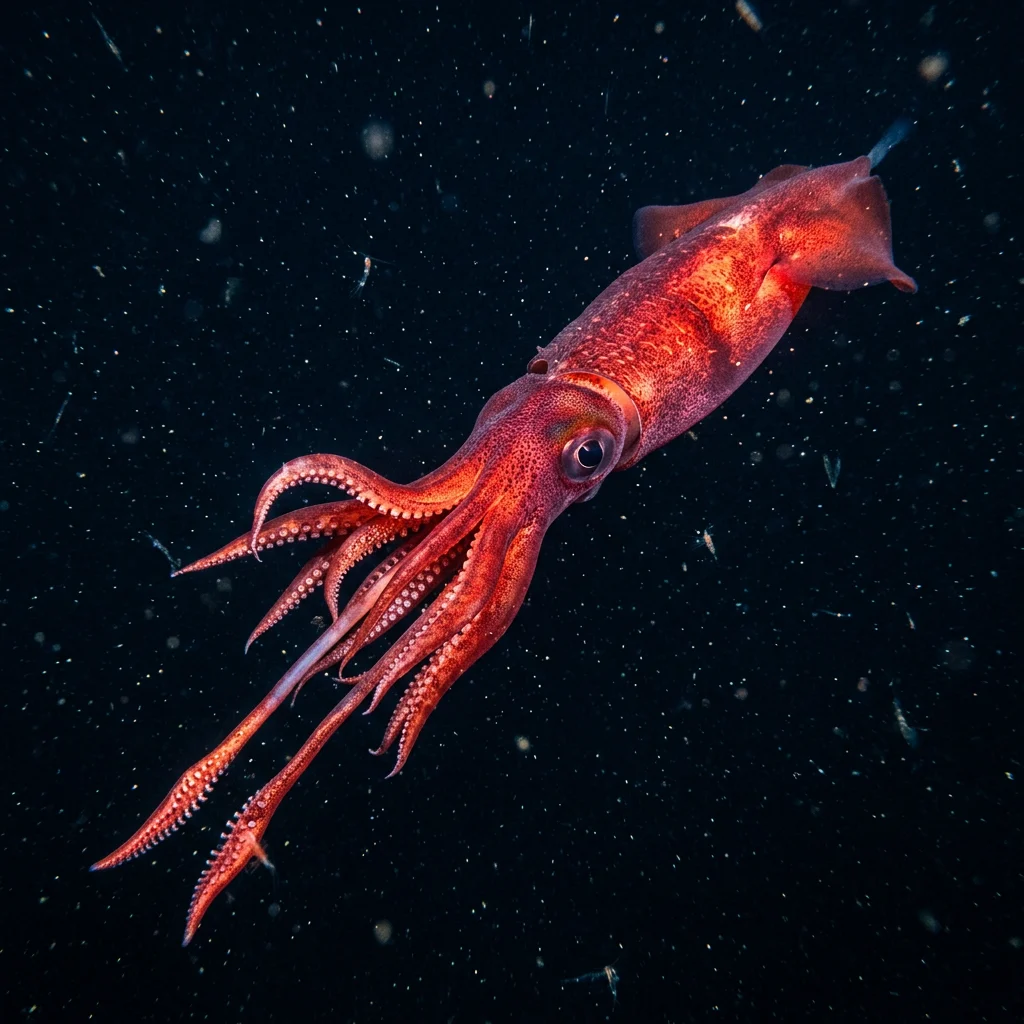
Squid occupy nearly every marine habitat. Some species sit in tropical reef shallows; others live in deep Antarctic abyssal water; still others spend their lives in the mid-water column of the open ocean. The depth and habitat divisions broadly track the major taxonomic orders.
The major squid habitats are:
· Shallow coastal and reef waters (0–200 m). Home to bigfin reef squid, Caribbean reef squid, market squid, bobtail squid, and southern pygmy squid. These are the squid most often encountered by divers, snorkelers, and commercial fisheries. Body sizes are small to medium; lifespans are short (3 months to ~1 year); reproduction is direct (eggs hatch as miniature adults).
· Mesopelagic and bathypelagic deep waters (200–4,000 m). The largest squid habitat by volume and by species count. Home to the giant squid, colossal squid, Dana octopus squid, vampire squid, firefly squid, glass squid, robust clubhook squid, ram’s horn squid, and Grimaldi-scaled squid. Most have bioluminescent photophores, transparent or dark-pigmented bodies, large eyes, and reduced active swimming compared to coastal species. Many migrate vertically through the water column on daily cycles.
· Abyssal waters (below 4,000 m). The frontier. Home to Magnapinna squid and a few other deep-water specialists. Known largely from ROV video and rare deep trawl catches. Most of the world’s least-understood squid live here.
· Open-ocean pelagic and migratory. Home to the Humboldt squid and Japanese flying squid, which span large vertical and horizontal ranges, swim in fast schools, and form the basis of major commercial squid fisheries worldwide.
Comparing the squid — size and habitat
All 18 species on this site, ordered from largest to smallest. Click any species name for the full dossier.
| Species | Max length | Max weight | Depth range | Habitat | Lifespan |
|---|---|---|---|---|---|
| Giant squid | 13 m | 275 kg | 300–1,000 m | Deep ocean | ~5 yrs |
| Colossal squid | 10 m | 495 kg | 1,000–2,000 m | Antarctic deep | ~5 yrs |
| Magnapinna squid | ~7 m | unknown | 1,500–6,000 m | Abyssal worldwide | unknown |
| Robust clubhook squid | 4 m | 50 kg | 200–1,500 m | N Pacific mesopelagic | ~2–3 yrs |
| Dana octopus squid | 2.3 m | 161 kg | 500–1,500 m | Worldwide deep | ~3 yrs |
| Humboldt squid | 2 m | 50 kg | 0–700 m | E. Pacific | 1–2 yrs |
| Grimaldi-scaled squid | 1.5 m | ~9 kg | 500–1,000 m | Tropical/subtropical deep | ~2–3 yrs |
| Bigfin reef squid | 50 cm | 1.8 kg | 0–100 m | Indo-Pacific reefs | 6–9 mo |
| Japanese flying squid | 50 cm | 0.5 kg | 0–500 m | NW Pacific | 1 yr |
| Vampire squid | 30 cm | n/a | 600–900 m | OMZ deep | ~8 yrs |
| Market squid | 30 cm | 0.15 kg | 0–200 m | E. Pacific shelf | 6–9 mo |
| Caribbean reef squid | 20 cm | 0.15 kg | 0–100 m | W Atlantic reefs | ~1 yr |
| Glass squid (most) | 10–30 cm | <1 kg | 200–1,500 m | Worldwide twilight | 1–3 yrs |
| Firefly squid | 10 cm | 0.01 kg | 0–400 m | W Pacific / Japan | ~1 yr |
| Bobtail squid (most) | ~10 cm | few g | 0–100 m | Coastal worldwide | 3–10 mo |
| Ram’s horn squid | 7 cm | few g | 500–1,000 m | Tropical/subtropical deep | 12–18 mo |
| Southern pygmy squid | 3 cm | 0.2 g | 0–20 m | S Australian seagrass | ~80 days |
| Deep sea squid | varies | varies | 200–6,000 m | Worldwide below 200 m | varies |
How squid reproduce — the once-and-die story

Almost every squid species in the world breeds once and dies. This pattern — semelparous reproduction — is one of the most consistent features of squid biology, and it shapes everything from population dynamics to commercial fishery management.
In a typical squid life cycle, hatchlings emerge from eggs (either as planktonic paralarvae for open-water species, or as fully-formed miniature squid for direct-developing species like the bobtail squid, bigfin reef squid, and southern pygmy squid). The hatchlings grow rapidly, reach sexual maturity at some species-specific age (50 days for southern pygmy squid; ~6 months for market squid; 2–3 years for robust clubhook squid; ~5 years for giant squid), mate, spawn, and die within days or weeks of completing reproduction. The total lifespan ranges from 80 days in the southern pygmy squid to about 5 years in the giant and colossal squid.
The only major exception in this collection is the vampire squid, which spawns repeatedly over an extended ~8-year adult life — the only known iteroparous squid (or squid-relative). The vampire squid’s exceptional pattern reflects its position outside true squid (it sits in its own order, Vampyromorphida) and its slow-metabolism lifestyle in the deep oxygen-minimum zone.
Mating itself follows a recognisable cephalopod pattern: the male produces packets of sperm called spermatophores and transfers them to the female using a specialised arm called the hectocotylus. The female stores the spermatophores until eggs are ready to be fertilised and laid. Egg-laying varies dramatically: bobtail squid attach individual eggs to substrate; market squid lay floor-of-the-bay carpets of finger-shaped egg capsules; firefly squid release fertilised eggs into the spawning surf at Toyama Bay; deep-water oegopsid squid release eggs into the open water column as drifting masses; most species hatch their young as miniature adults or planktonic paralarvae.
Squid in the food web — both predator and major prey
Squid sit at a critical intermediate trophic level in the ocean. They are voracious predators of small fish and crustaceans, and they are themselves the principal food source for some of the largest and most charismatic marine animals on Earth.
As predators, squid eat fish, crustaceans, and smaller cephalopods — including each other. The smallest squid hunt copepods and amphipods one at a time; the largest take fish, smaller squid, and (in the case of the colossal squid) potentially the toothfish that share its Antarctic deep habitat. The hunting strategies vary enormously across the family: tentacle-strike ambushes (most species), passive arm trailing (Magnapinna squid), bioluminescent strobe attacks (Dana octopus squid), schooling pursuit (Humboldt squid), and adhesive-anchored ambush (southern pygmy squid).
As prey, squid feed almost the entire sperm whale population worldwide, a significant fraction of elephant seal and beaked whale diets, and major portions of large pelagic fish populations (tuna, swordfish, mahi-mahi, lancetfish). They are also prey for seabirds, large sharks, smaller toothed whales, and (in coastal waters) reef fish and rays. Global sperm whales alone eat an estimated 100 million tonnes of squid per year, comparable to the entire human fishery harvest. The world’s squid fauna is one of the largest biomasses of any predator group on Earth.
How many squid species are there?
Around 300 named species worldwide, with many more suspected. Squid are classified across several orders within the class Cephalopoda: Oegopsida (open-ocean squid, the largest order, including most deep-water species), Myopsida (coastal and reef squid with covered eyes, including market and Caribbean reef squid), Sepiolida (bobtail squid and southern pygmy squid), Spirulida (ram’s horn squid, sole species), and Vampyromorphida (vampire squid, also sole species, technically not a true squid). This site covers 18 of the most-asked-about species in depth.
How big can squid get?
From 3 cm to 13 m. The smallest is the southern pygmy squid, which matures at about 2 cm of mantle length and weighs around 0.2 g. The longest is the giant squid (Architeuthis dux), reaching 13 m total length. The heaviest is the colossal squid (Mesonychoteuthis hamiltoni) at 495 kg — the heaviest invertebrate ever measured. Between these extremes sit dozens of medium and large squid species across every ocean.
Where do squid live?
Every ocean on Earth, from tide pools to abyssal water deeper than 6,000 m. The biggest squid habitat is the mesopelagic zone (200–1,000 m), home to the giant squid, glass squid, firefly squid, vampire squid, and most other deep-water species. Coastal and reef squid (bigfin reef squid, Caribbean reef squid, market squid, bobtail squid) occupy the upper 100 m. Open-ocean species (Humboldt squid, Japanese flying squid) span large vertical and horizontal ranges in shelf and slope waters worldwide.
What do squid eat?
Mostly fish, crustaceans, and smaller squid. Small species (southern pygmy squid, bobtail squid, firefly squid) eat copepods, mysid shrimp, and other small zooplankton. Medium species (market squid, bigfin reef squid, Caribbean reef squid) eat small fish, larger crustaceans, and other squid. Large species (Humboldt squid, giant squid, colossal squid, robust clubhook squid, Dana octopus squid) eat large fish (lanternfish, mackerel, hake, sometimes other squid), with the largest occasionally taking deep-water fish like toothfish. Hunting strategies span ambush, schooling pursuit, bioluminescent attack, and (in the Magnapinna squid) passive thread-arm capture.
Are squid intelligent?
Yes, by any reasonable measure for an invertebrate. Squid have the most complex nervous systems of any invertebrates after octopus, with large brains containing several hundred million neurons (compared to about 100 billion in humans). They learn, solve simple puzzles, navigate complex three-dimensional environments, communicate visually (the Caribbean reef squid produces ~35 distinct chromatophore signal patterns), school cooperatively, and display rapid adaptive behaviour. The Hawaiian bobtail squid is a model organism for studying animal-microbe symbiosis, and Caribbean reef squid are a model for studying invertebrate visual communication. Squid intelligence has been less studied than octopus intelligence but is in roughly the same league.
The Norse legend and the real giant squid behind it.
Fish, crustaceans, plankton and other squid.
The cock-eyed squid with one big yellow eye.
Jigs, lights and the world’s squid fleets.
15 species from firefly to colossal.
The closest living relatives of squid — same class, very different body plan.
The third major cephalopod group — with a calcified internal cuttlebone.
Major squid predators — and the next big species library on TheSea.Org.
Blane Perun has been exploring Earth’s oceans and marine life for over 25 years. Founder of TheSea.Org in 1999, underwater photographer, coral aquaculture pioneer, and explorer of 80+ countries.
About Blane Perun → All squid content →